4 Stroke Petrol Engine
and 4 Stroke Diesel Engine
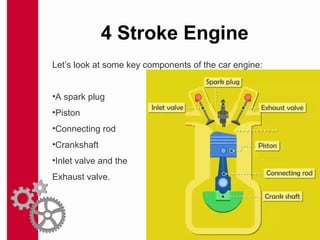
4 Stroke Engine
Let’s look at some key components of the car engine:
•A spark plug
•Piston
•Connecting rod
•Crankshaft
•Inlet valve and the
Exhaust valve.
4 Stroke Petrol Engine
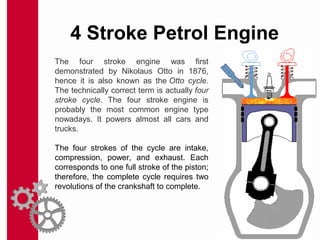
The four stroke engine was first
demonstrated by Nikolaus Otto in 1876,
hence it is also known as the Otto cycle.
The technically correct term is actually four
stroke cycle. The four stroke engine is
probably the most common engine type
nowadays. It powers almost all cars and
trucks.
The four strokes of the cycle are intake,
compression, power, and exhaust. Each
corresponds to one full stroke of the piston;
therefore, the complete cycle requires two
revolutions of the crankshaft to complete.
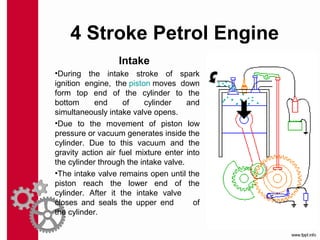
Intake
•During the intake stroke of spark
ignition engine, the piston moves down
form top end of the cylinder to the
bottom end of cylinder and
simultaneously intake valve opens.
•Due to the movement of piston low
pressure or vacuum generates inside the
cylinder. Due to this vacuum and the
gravity action air fuel mixture enter into
the cylinder through the intake valve.
•The intake valve remains open until the
piston reach the lower end of the
cylinder. After it the intake valve
closes and seals the upper end of
the cylinder.
4 Stroke Petrol Engine
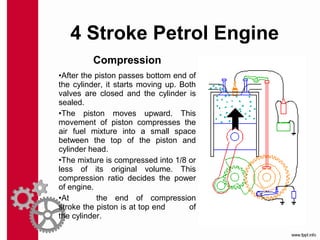
Compression
•After the piston passes bottom end of
the cylinder, it starts moving up. Both
valves are closed and the cylinder is
sealed.
•The piston moves upward. This
movement of piston compresses the
air fuel mixture into a small space
between the top of the piston and
cylinder head.
•The mixture is compressed into 1/8 or
less of its original volume. This
compression ratio decides the power
of engine.
•At the end of compression
stroke the piston is at top end of
the cylinder.
4 Stroke Petrol Engine
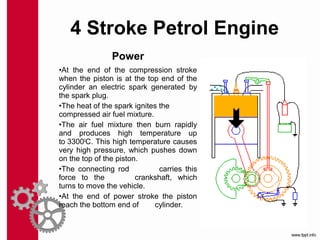
Power
•At the end of the compression stroke
when the piston is at the top end of the
cylinder an electric spark generated by
the spark plug.
•The heat of the spark ignites the
compressed air fuel mixture.
•The air fuel mixture then burn rapidly
and produces high temperature up
to 33000
C. This high temperature causes
very high pressure, which pushes down
on the top of the piston.
•The connecting rod carries this
force to the crankshaft, which
turns to move the vehicle.
•At the end of power stroke the piston
reach the bottom end of cylinder.
4 Stroke Petrol Engine
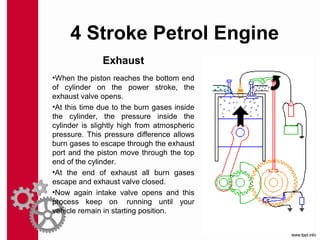
Exhaust
•When the piston reaches the bottom end
of cylinder on the power stroke, the
exhaust valve opens.
•At this time due to the burn gases inside
the cylinder, the pressure inside the
cylinder is slightly high from atmospheric
pressure. This pressure difference allows
burn gases to escape through the exhaust
port and the piston move through the top
end of the cylinder.
•At the end of exhaust all burn gases
escape and exhaust valve closed.
•Now again intake valve opens and this
process keep on running until your
vehicle remain in starting position.
4 Stroke Petrol Engine
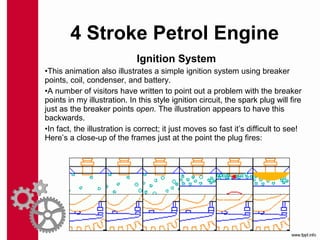
Ignition System
•This animation also illustrates a simple ignition system using breaker
points, coil, condenser, and battery.
•A number of visitors have written to point out a problem with the breaker
points in my illustration. In this style ignition circuit, the spark plug will fire
just as the breaker points open. The illustration appears to have this
backwards.
•In fact, the illustration is correct; it just moves so fast it’s difficult to see!
Here’s a close-up of the frames just at the point the plug fires:
4 Stroke Petrol Engine
4 Stroke Diesel Engine
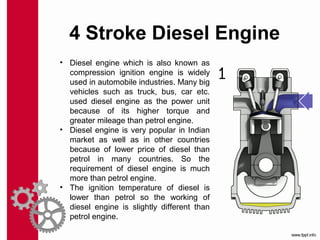
• Diesel engine which is also known as
compression ignition engine is widely
used in automobile industries. Many big
vehicles such as truck, bus, car etc.
used diesel engine as the power unit
because of its higher torque and
greater mileage than petrol engine.
• Diesel engine is very popular in Indian
market as well as in other countries
because of lower price of diesel than
petrol in many countries. So the
requirement of diesel engine is much
more than petrol engine.
• The ignition temperature of diesel is
lower than petrol so the working of
diesel engine is slightly different than
petrol engine.
4 Stroke Diesel Engine
Intake
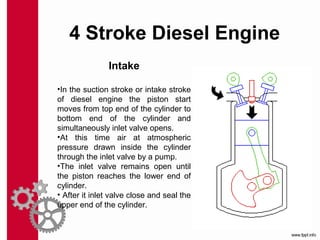
•In the suction stroke or intake stroke
of diesel engine the piston start
moves from top end of the cylinder to
bottom end of the cylinder and
simultaneously inlet valve opens.
•At this time air at atmospheric
pressure drawn inside the cylinder
through the inlet valve by a pump.
•The inlet valve remains open until
the piston reaches the lower end of
cylinder.
• After it inlet valve close and seal the
upper end of the cylinder.
4 Stroke Diesel Engine
Compression
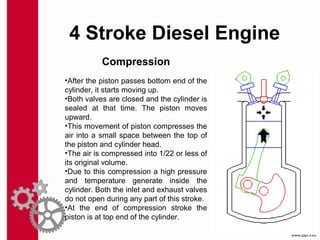
•After the piston passes bottom end of the
cylinder, it starts moving up.
•Both valves are closed and the cylinder is
sealed at that time. The piston moves
upward.
•This movement of piston compresses the
air into a small space between the top of
the piston and cylinder head.
•The air is compressed into 1/22 or less of
its original volume.
•Due to this compression a high pressure
and temperature generate inside the
cylinder. Both the inlet and exhaust valves
do not open during any part of this stroke.
•At the end of compression stroke the
piston is at top end of the cylinder.
4 Stroke Diesel Engine
Power
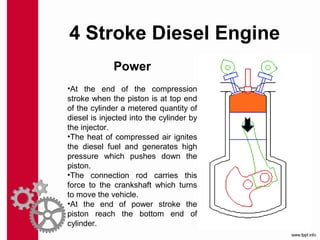
•At the end of the compression
stroke when the piston is at top end
of the cylinder a metered quantity of
diesel is injected into the cylinder by
the injector.
•The heat of compressed air ignites
the diesel fuel and generates high
pressure which pushes down the
piston.
•The connection rod carries this
force to the crankshaft which turns
to move the vehicle.
•At the end of power stroke the
piston reach the bottom end of
cylinder.
4 Stroke Diesel Engine
Exhaust
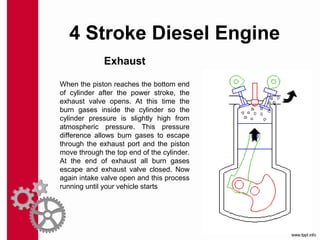
When the piston reaches the bottom end
of cylinder after the power stroke, the
exhaust valve opens. At this time the
burn gases inside the cylinder so the
cylinder pressure is slightly high from
atmospheric pressure. This pressure
difference allows burn gases to escape
through the exhaust port and the piston
move through the top end of the cylinder.
At the end of exhaust all burn gases
escape and exhaust valve closed. Now
again intake valve open and this process
running until your vehicle starts
4 Stroke Diesel Engine
Valve detail
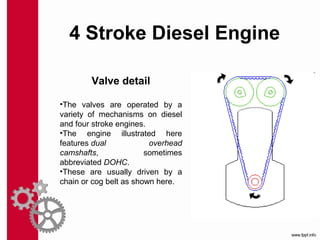
•The valves are operated by a
variety of mechanisms on diesel
and four stroke engines.
•The engine illustrated here
features dual overhead
camshafts, sometimes
abbreviated DOHC.
•These are usually driven by a
chain or cog belt as shown here.
Difference between Diesel and Petrol
Engine
Sr
No.
Petrol Engine Diesel Engine
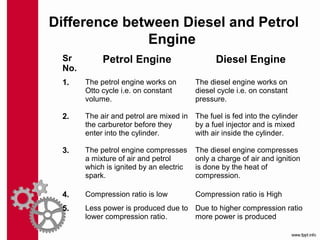
1. The petrol engine works on
Otto cycle i.e. on constant
volume.
The diesel engine works on
diesel cycle i.e. on constant
pressure.
2. The air and petrol are mixed in
the carburetor before they
enter into the cylinder.
The fuel is fed into the cylinder
by a fuel injector and is mixed
with air inside the cylinder.
3. The petrol engine compresses
a mixture of air and petrol
which is ignited by an electric
spark.
The diesel engine compresses
only a charge of air and ignition
is done by the heat of
compression.
4. Compression ratio is low Compression ratio is High
5. Less power is produced due to
lower compression ratio.
Due to higher compression ratio
more power is produced
Difference between Diesel and Petrol
Engine
Sr
No.
Petrol Engine Diesel Engine
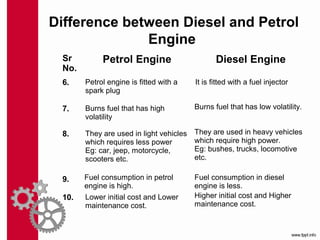
6. Petrol engine is fitted with a
spark plug
It is fitted with a fuel injector
7. Burns fuel that has high
volatility
Burns fuel that has low volatility.
8. They are used in light vehicles
which requires less power
Eg: car, jeep, motorcycle,
scooters etc.
They are used in heavy vehicles
which require high power.
Eg: bushes, trucks, locomotive
etc.
9. Fuel consumption in petrol
engine is high.
Fuel consumption in diesel
engine is less.
10. Lower initial cost and Lower
maintenance cost.
Higher initial cost and Higher
maintenance cost.
Diesel engines are more powerful
than petrol engines. They also have a
higher torque and hence they give a
smoother drive. On the other hand, the
harshness, noise, and vibrations
in diesel driven cars are way higher
than that of a petrol-driven car. The
maintenance cost of diesel cars is
higher than petrol cars.
4 stroke petrol engine and 4 stroke diesel engine

4 stroke petrol engine and 4 stroke diesel engine

  • 1.
    4 Stroke PetrolEngine and 4 Stroke Diesel Engine
  • 2.
    4 Stroke Engine Let’slook at some key components of the car engine: •A spark plug •Piston •Connecting rod •Crankshaft •Inlet valve and the Exhaust valve.
  • 3.
    4 Stroke PetrolEngine The four stroke engine was first demonstrated by Nikolaus Otto in 1876, hence it is also known as the Otto cycle. The technically correct term is actually four stroke cycle. The four stroke engine is probably the most common engine type nowadays. It powers almost all cars and trucks. The four strokes of the cycle are intake, compression, power, and exhaust. Each corresponds to one full stroke of the piston; therefore, the complete cycle requires two revolutions of the crankshaft to complete.
  • 4.
    Intake •During the intakestroke of spark ignition engine, the piston moves down form top end of the cylinder to the bottom end of cylinder and simultaneously intake valve opens. •Due to the movement of piston low pressure or vacuum generates inside the cylinder. Due to this vacuum and the gravity action air fuel mixture enter into the cylinder through the intake valve. •The intake valve remains open until the piston reach the lower end of the cylinder. After it the intake valve closes and seals the upper end of the cylinder. 4 Stroke Petrol Engine
  • 5.
    Compression •After the pistonpasses bottom end of the cylinder, it starts moving up. Both valves are closed and the cylinder is sealed. •The piston moves upward. This movement of piston compresses the air fuel mixture into a small space between the top of the piston and cylinder head. •The mixture is compressed into 1/8 or less of its original volume. This compression ratio decides the power of engine. •At the end of compression stroke the piston is at top end of the cylinder. 4 Stroke Petrol Engine
  • 6.
    Power •At the endof the compression stroke when the piston is at the top end of the cylinder an electric spark generated by the spark plug. •The heat of the spark ignites the compressed air fuel mixture. •The air fuel mixture then burn rapidly and produces high temperature up to 33000 C. This high temperature causes very high pressure, which pushes down on the top of the piston. •The connecting rod carries this force to the crankshaft, which turns to move the vehicle. •At the end of power stroke the piston reach the bottom end of cylinder. 4 Stroke Petrol Engine
  • 7.
    Exhaust •When the pistonreaches the bottom end of cylinder on the power stroke, the exhaust valve opens. •At this time due to the burn gases inside the cylinder, the pressure inside the cylinder is slightly high from atmospheric pressure. This pressure difference allows burn gases to escape through the exhaust port and the piston move through the top end of the cylinder. •At the end of exhaust all burn gases escape and exhaust valve closed. •Now again intake valve opens and this process keep on running until your vehicle remain in starting position. 4 Stroke Petrol Engine
  • 8.
    Ignition System •This animationalso illustrates a simple ignition system using breaker points, coil, condenser, and battery. •A number of visitors have written to point out a problem with the breaker points in my illustration. In this style ignition circuit, the spark plug will fire just as the breaker points open. The illustration appears to have this backwards. •In fact, the illustration is correct; it just moves so fast it’s difficult to see! Here’s a close-up of the frames just at the point the plug fires: 4 Stroke Petrol Engine
  • 9.
    4 Stroke DieselEngine • Diesel engine which is also known as compression ignition engine is widely used in automobile industries. Many big vehicles such as truck, bus, car etc. used diesel engine as the power unit because of its higher torque and greater mileage than petrol engine. • Diesel engine is very popular in Indian market as well as in other countries because of lower price of diesel than petrol in many countries. So the requirement of diesel engine is much more than petrol engine. • The ignition temperature of diesel is lower than petrol so the working of diesel engine is slightly different than petrol engine.
  • 10.
    4 Stroke DieselEngine Intake •In the suction stroke or intake stroke of diesel engine the piston start moves from top end of the cylinder to bottom end of the cylinder and simultaneously inlet valve opens. •At this time air at atmospheric pressure drawn inside the cylinder through the inlet valve by a pump. •The inlet valve remains open until the piston reaches the lower end of cylinder. • After it inlet valve close and seal the upper end of the cylinder.
  • 11.
    4 Stroke DieselEngine Compression •After the piston passes bottom end of the cylinder, it starts moving up. •Both valves are closed and the cylinder is sealed at that time. The piston moves upward. •This movement of piston compresses the air into a small space between the top of the piston and cylinder head. •The air is compressed into 1/22 or less of its original volume. •Due to this compression a high pressure and temperature generate inside the cylinder. Both the inlet and exhaust valves do not open during any part of this stroke. •At the end of compression stroke the piston is at top end of the cylinder.
  • 12.
    4 Stroke DieselEngine Power •At the end of the compression stroke when the piston is at top end of the cylinder a metered quantity of diesel is injected into the cylinder by the injector. •The heat of compressed air ignites the diesel fuel and generates high pressure which pushes down the piston. •The connection rod carries this force to the crankshaft which turns to move the vehicle. •At the end of power stroke the piston reach the bottom end of cylinder.
  • 13.
    4 Stroke DieselEngine Exhaust When the piston reaches the bottom end of cylinder after the power stroke, the exhaust valve opens. At this time the burn gases inside the cylinder so the cylinder pressure is slightly high from atmospheric pressure. This pressure difference allows burn gases to escape through the exhaust port and the piston move through the top end of the cylinder. At the end of exhaust all burn gases escape and exhaust valve closed. Now again intake valve open and this process running until your vehicle starts
  • 14.
    4 Stroke DieselEngine Valve detail •The valves are operated by a variety of mechanisms on diesel and four stroke engines. •The engine illustrated here features dual overhead camshafts, sometimes abbreviated DOHC. •These are usually driven by a chain or cog belt as shown here.
  • 15.
    Difference between Dieseland Petrol Engine Sr No. Petrol Engine Diesel Engine 1. The petrol engine works on Otto cycle i.e. on constant volume. The diesel engine works on diesel cycle i.e. on constant pressure. 2. The air and petrol are mixed in the carburetor before they enter into the cylinder. The fuel is fed into the cylinder by a fuel injector and is mixed with air inside the cylinder. 3. The petrol engine compresses a mixture of air and petrol which is ignited by an electric spark. The diesel engine compresses only a charge of air and ignition is done by the heat of compression. 4. Compression ratio is low Compression ratio is High 5. Less power is produced due to lower compression ratio. Due to higher compression ratio more power is produced
  • 16.
    Difference between Dieseland Petrol Engine Sr No. Petrol Engine Diesel Engine 6. Petrol engine is fitted with a spark plug It is fitted with a fuel injector 7. Burns fuel that has high volatility Burns fuel that has low volatility. 8. They are used in light vehicles which requires less power Eg: car, jeep, motorcycle, scooters etc. They are used in heavy vehicles which require high power. Eg: bushes, trucks, locomotive etc. 9. Fuel consumption in petrol engine is high. Fuel consumption in diesel engine is less. 10. Lower initial cost and Lower maintenance cost. Higher initial cost and Higher maintenance cost.
  • 17.
    Diesel engines aremore powerful than petrol engines. They also have a higher torque and hence they give a smoother drive. On the other hand, the harshness, noise, and vibrations in diesel driven cars are way higher than that of a petrol-driven car. The maintenance cost of diesel cars is higher than petrol cars.