Dynamic Equilibrium 
Chemical Reaction 
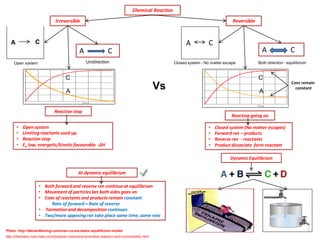
Reversible 
Irreversible 
A C 
•Open system 
•Limiting reactants used up. 
•Reaction stop 
•Ea low, energetic/kinetic favourable -ΔH 
C 
A C 
•Closed system (No matter escapes) 
•Forward rxn – products 
•Reverse rxn - reactants 
•Product dissociate form reactant 
C 
Reaction going on 
Reaction stop 
Open system 
Unidirection 
A 
C 
Closed system - No matter escape 
Both direction - equilibrium 
A 
C 
•Both forward and reverse rxn continue at equilibrium 
•Movement of particles bet both sides goes on 
•Conc of reactants and products remain constant Rate of forward = Rate of reverse 
• Formation and decomposition continues 
•Two/more opposing rxn take place same time, same rate 
At dynamic equilibrium 
Conc remain constant 
Vs 
A 
A 
Photo: http://declanfleming.com/man-vs-escalator-equilibrium-model/ 
http://chemistry.tutorvista.com/physical-chemistry/reversible-reaction-and-irreversibility.html
Dynamic Equilibrium 
Closed system 
Reversible 
Forward Rate, Kf 
Reverse Rate, Kr 
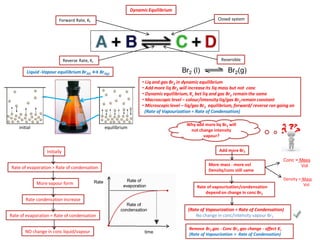
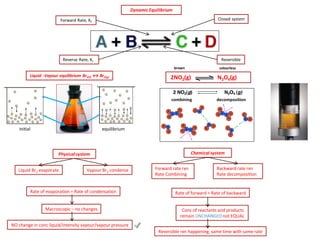
Liquid -Vapour equilibrium Br2(l) ↔ Br2(g) 
initial 
equilibrium 
• Liq and gas Br2 in dynamic equilibrium 
• Add more liq Br2 will increase its liq mass but not conc 
• Dynamic equilibrium, Kc bet liq and gas Br2 remain the same 
• Macroscopic level – colour/intensity liq/gas Br2 remain constant 
• Microscopic level – liq/gas Br2 equilibrium, forward/ reverse rxn going on (Rate of Vapourization = Rate of Condensation) 
NO change in conc liquid/vapour 
Rate of evaporation = Rate of condensation 
Rate of evaporation > Rate of condensation 
More vapour form 
Rate condensation increase 
Initially 
Br2 (l) Br2(g) 
time 
Rate 
Rate of condensation 
Rate of evaporation 
Why add more liq Br2 will not change intensity vapour? 
Remove Br2 gas - Conc Br2 gas change - affect Kc (Rate of Vapourization > Rate of Condensation) 
Density = Mass Vol 
Conc = Mass Vol 
More mass - more vol Density/conc still same 
Rate of vapourization/condensation depend on change in conc Br2 
(Rate of Vapourization = Rate of Condensation) No change in conc/intensity vapour Br2 
Add more Br2
Dynamic Equilibrium 
Closed system 
Reversible 
Forward Rate, Kf 
Reverse Rate, Kr 
initial 
equilibrium 
NO change in conc sugar sol 
Rate of dissolving = Rate of crystallization 
Rate of dissolving > Rate of crystallization 
More sugar dissolve - saturated sol form 
Rate crystallization increase 
Initially 
time 
Rate 
Rate of crystallization 
Rate of dissolving 
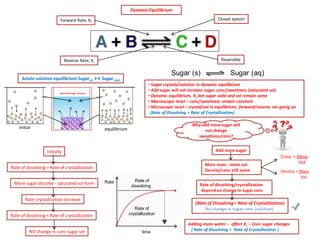
Why add more sugar will not change sweetness/conc? 
Solute-solution equilibrium Sugar(s) ↔ Sugar (aq) 
• Sugar crystals/solution in dynamic equilibrium 
• Add sugar will not increase sugar conc/sweetness (saturated sol) 
• Dynamic equilibrium, Kc bet sugar solid and sol remain same 
• Macroscopic level – conc/sweetness remain constant 
• Microscopic level – crystal/sol in equilibrium, forward/reverse rxn going on (Rate of Dissolving = Rate of Crystallization) 
Adding more water – affect Kc – Conc sugar changes ( Rate of Dissolving > Rate of Crystallization ) 
Sugar (s) Sugar (aq) 
Add more sugar 
More mass - more vol Density/conc still same 
Conc = Mass Vol 
Density = Mass Vol 
Rate of dissolving/crystallization depend on change in sugar conc 
(Rate of Dissolving = Rate of Crystallization) No change in sugar conc (solution)
Dynamic Equilibrium 
Closed system 
Reversible 
Forward Rate, Kf 
Reverse Rate, Kr 
initial 
equilibrium 
NO change in conc vapour 
Rate of vapourization = Rate of crystallization 
Rate of vapourization > Rate of crystallization 
More iodine sublime 
Rate crystallization increase 
Initially 
time 
Rate 
Rate of crystallization 
Rate of vapourization 
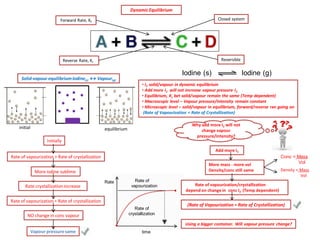
Why add more I2 will not change vapour pressure/intensity? 
Solid-vapour equilibrium Iodine(s) ↔ Vapour(g) 
• I2 solid/vapour in dynamic equilibrium 
• Add more I2 will not increase vapour pressure I2 
• Equilibrium, Kc bet solid/vapour remain the same (Temp dependent) 
• Macroscopic level – Vapour pressure/intensity remain constant 
• Microscopic level – solid/vapour in equilibrium, forward/reverse rxn going on (Rate of Vapourization = Rate of Crystallization) 
Using a bigger container. Will vapour pressure change? 
Iodine (s) Iodine (g) 
Add more I2 
More mass - more vol Density/conc still same 
Conc = Mass Vol 
Density = Mass Vol 
Rate of vapourization/crystallization depend on change in conc I2 (Temp dependent) 
(Rate of Vapourization = Rate of Crystallization) 
Vapour pressure same
Dynamic Equilibrium 
Closed system 
Reversible 
Forward Rate, Kf 
Reverse Rate, Kr 
Liquid -Vapour equilibrium Br2(l) ↔ Br2(g) 
initial 
equilibrium 
NO change in conc liquid/intensity vapour/vapour pressure 
Rate of evaporation = Rate of condensation 
Liquid Br2 evaporate 
Macroscopic – no changes 
2NO2(g) N2O4(g) 
Physical system 
Chemical system 
Vapour Br2 condense 
Forward rate rxn Rate Combining 
Backward rate rxn Rate decomposition 
Reversible rxn happening, same time with same rate 
Rate of forward = Rate of backward 
Conc of reactants and products remain UNCHANGED not EQUAL 
combining 
decomposition 
brown 
colourless
Dynamic Equilibrium 
Closed system 
Reversible 
Forward Rate, Kf 
Reverse Rate, Kr 
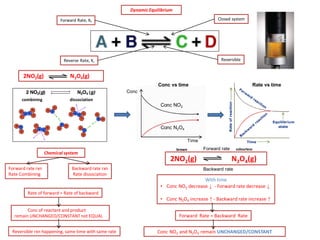
2NO2(g) N2O4(g) 
Chemical system 
Forward rate rxn Rate Combining 
Backward rate rxn Rate dissociation 
Reversible rxn happening, same time with same rate 
Rate of forward = Rate of backward 
Conc of reactant and product remain UNCHANGED/CONSTANT not EQUAL 
combining 
dissociation 
Conc vs time 
Rate vs time 
Conc 
Time 
Conc NO2 
Conc N2O4 
With time 
•Conc NO2 decrease ↓ - Forward rate decrease ↓ 
•Conc N2O4 increase ↑ - Backward rate increase ↑ 
2NO2(g) N2O4(g) 
Forward rate 
Backward rate 
Forward Rate = Backward Rate 
Conc NO2 and N2O4 remain UNCHANGED/CONSTANT 
brown 
colourless
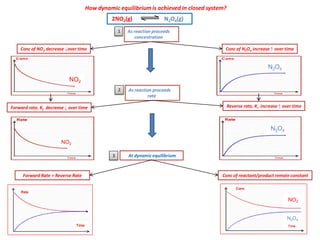
How dynamic equilibrium is achieved in closed system? 
Conc of NO2 decrease ↓over time 
Forward rate, Kf decrease ↓ over time 
Forward Rate = Reverse Rate 
NO2 
2NO2(g) N2O4(g) 
Conc of N2O4 increase ↑ over time 
N2O4 
Reverse rate, Kr increase ↑ over time 
NO2 
N2O4 
1 
2 
Conc of reactant/product remain constant 
Rate 
3 
Time 
Conc 
NO2 
N2O4 
At dynamic equilibrium 
As reaction proceeds concentration 
As reaction proceeds rate 
Time
Dynamic Equilibrium 
Reversible (closed system) 
Forward Rate, K1 Reverse Rate, K-1 
Kc = ratio of molar conc of product (raised to power of their respective stoichiometry coefficient) 
to molar conc of reactant (raised to power of their respective stoichiometry coefficient) 
Conc of product and reactant 
at equilibrium 
At Equilibrium 
Forward rate = Backward rate 
Conc reactants and products remain 
CONSTANT/UNCHANGE 
Equilibrium Constant Kc 
aA(aq) + bB(aq) cC(aq) + dD(aq) 
coefficient 
Solid/liq not included in Kc 
Conc represented by [ ] 
K1 
K-1 
    
   a b 
c d 
c 
A B 
C D 
K  
1 
1 
 
 
K 
K 
Kc 
Equilibrium Constant Kc 
express in 
Conc vs time Rate vs time 
A + B 
C + D 
Conc 
Time 
Click here notes on dynamic equilibrium 
Excellent Notes 
K1 = forward rate constant 
K-1 = reverse rate constant
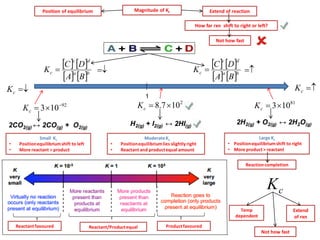
Large Kc 
• Position equilibrium shift to right 
• More product > reactant 
Magnitude of Kc 
    
   a b 
c d 
c 
A B 
C D 
K  
Extend of reaction 
How far rxn shift to right or left? 
Not how fast 
    
   a b 
c d 
c 
A B 
C D 
K  
Small Kc 
• Position equilibrium shift to left 
• More reactant > product 
  
 c  K c K 
Position of equilibrium 
2CO2(g) ↔ 2CO(g) + O2(g) 
92 3 10   c K 
2H2(g) + O2(g) ↔ 2H2O(g) 
81  310 c K 
H2(g) + I2(g) ↔ 2HI(g) 
2  8.710 c K 
1 
Moderate Kc 
• Position equilibrium lies slightly right 
• Reactant and product equal amount 
Reaction completion 
Reactant favoured Reactant/Product equal Product favoured 
c K 
Temp 
dependent 
Extend 
of rxn 
Not how fast
Equilibrium Constant Kc 
    
   a b 
c d 
c 
A B 
C D 
K  
aA(aq) + bB(aq) cC(aq) + dD(aq) 
Conc of product and reactant at equilibrium 
Equilibrium expression HOMOGENEOUS gaseous rxn 
4NH3(g) + 5O2(g) ↔ 4NO(g) + 6H2O(g) N2(g) + 3H2(g) ↔ 2NH3(g) 
NH4CI(s) ↔ NH3(g) + HCI(g) 
2SO2(g) + O2(g) ↔ 2SO3(g) 
    
   5 
2 
4 
3 
6 
2 
4 
NH O 
NO H O 
Kc  
  
   3 
2 
1 
2 
2 
3 
N H 
NH 
Kc  
   1 1 
3 K NH HCI c  
    
 0 
4 
1 1 
3 
NH CI 
NH HCI 
Kc  
  
   1 
2 
2 
2 
2 
3 
SO O 
SO 
Kc  
Equilibrium expression HETEROGENOUS rxn 
CaCO3(s) ↔ CaO(g) + CO2(g) 
    
 0 
3 
1 
2 
1 
CaCO 
CaO CO 
Kc  
   1 
2 
1 K CaO CO c  
CH3COOH(l) + C2H5OH(l) ↔ CH3COOC2H5(l) + H2O(l) 
    
   1 
2 5 
1 
3 
1 
2 
1 
3 2 5 
CH COOH C H OH 
CH COOC H H O 
Kc  
Equilibrium expression HOMOGENEOUS liquid rxn 
Cu2+ 
(aq) + 4NH3(aq) ↔ [Cu(NH3)4]2+ 
    
   4 
3 
2 1 
2 
3 4 ( ) 
Cu NH 
Cu NH 
Kc 
 
 
 
Reactant/product same phase 
Reactant/product diff phase 
Solid and liq - conc no change 
(not included)
Conc vs Time 
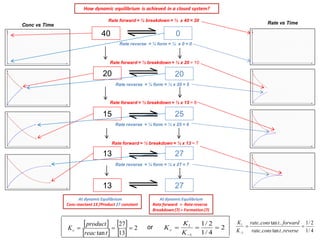
How dynamic equilibrium is achieved in a closed system? 
40 0 
Rate forward = ½ breakdown = ½ x 40 = 20 
Rate reverse = ¼ form = ¼ x 0 = 0 
20 20 
Rate forward = ½ breakdown = ½ x 20 = 10 
Rate reverse = ¼ form = ¼ x 20 = 5 
15 25 
Rate forward = ½ breakdown = ½ x 15 = 8 
Rate reverse = ¼ form = ¼ x 25 = 6 
13 27 
Rate forward = ½ breakdown = ½ x 13 = 7 
Rate reverse = ¼ form = ¼ x 27 = 7 
13 27 
At dynamic Equilibrium 
Rate forward = Rate reverse 
Breakdown (7) = Formation (7) 
At dynamic Equilibrium 
Conc reactant 13 /Product 27 constant 
Rate vs Time 
1/ 4 
1/ 2 
.. tan .. 
.. tan .. 
1 
1   
 rate cons t reverse 
rate cons t forward 
K 
  K 
  
  
  
2 
13 
27 
tan 
   
reac t 
product 
Kc 2 
1/ 4 
1/ 2 
1 
1    
 K 
K 
Kc or
Click here to view simulation 
Click here simulation using paper clips 
Click here simulation on reversible rxn 
Click here on reversible rxn 
Simulation on Dynamic equilibrium 
Click here on equilibrium constant

IB Chemistry on Dynamic Equilibrium and Equilibrium Constant

  • 1.
    Dynamic Equilibrium ChemicalReaction Reversible Irreversible A C •Open system •Limiting reactants used up. •Reaction stop •Ea low, energetic/kinetic favourable -ΔH C A C •Closed system (No matter escapes) •Forward rxn – products •Reverse rxn - reactants •Product dissociate form reactant C Reaction going on Reaction stop Open system Unidirection A C Closed system - No matter escape Both direction - equilibrium A C •Both forward and reverse rxn continue at equilibrium •Movement of particles bet both sides goes on •Conc of reactants and products remain constant Rate of forward = Rate of reverse • Formation and decomposition continues •Two/more opposing rxn take place same time, same rate At dynamic equilibrium Conc remain constant Vs A A Photo: http://declanfleming.com/man-vs-escalator-equilibrium-model/ http://chemistry.tutorvista.com/physical-chemistry/reversible-reaction-and-irreversibility.html
  • 2.
    Dynamic Equilibrium Closedsystem Reversible Forward Rate, Kf Reverse Rate, Kr Liquid -Vapour equilibrium Br2(l) ↔ Br2(g) initial equilibrium • Liq and gas Br2 in dynamic equilibrium • Add more liq Br2 will increase its liq mass but not conc • Dynamic equilibrium, Kc bet liq and gas Br2 remain the same • Macroscopic level – colour/intensity liq/gas Br2 remain constant • Microscopic level – liq/gas Br2 equilibrium, forward/ reverse rxn going on (Rate of Vapourization = Rate of Condensation) NO change in conc liquid/vapour Rate of evaporation = Rate of condensation Rate of evaporation > Rate of condensation More vapour form Rate condensation increase Initially Br2 (l) Br2(g) time Rate Rate of condensation Rate of evaporation Why add more liq Br2 will not change intensity vapour? Remove Br2 gas - Conc Br2 gas change - affect Kc (Rate of Vapourization > Rate of Condensation) Density = Mass Vol Conc = Mass Vol More mass - more vol Density/conc still same Rate of vapourization/condensation depend on change in conc Br2 (Rate of Vapourization = Rate of Condensation) No change in conc/intensity vapour Br2 Add more Br2
  • 3.
    Dynamic Equilibrium Closedsystem Reversible Forward Rate, Kf Reverse Rate, Kr initial equilibrium NO change in conc sugar sol Rate of dissolving = Rate of crystallization Rate of dissolving > Rate of crystallization More sugar dissolve - saturated sol form Rate crystallization increase Initially time Rate Rate of crystallization Rate of dissolving Why add more sugar will not change sweetness/conc? Solute-solution equilibrium Sugar(s) ↔ Sugar (aq) • Sugar crystals/solution in dynamic equilibrium • Add sugar will not increase sugar conc/sweetness (saturated sol) • Dynamic equilibrium, Kc bet sugar solid and sol remain same • Macroscopic level – conc/sweetness remain constant • Microscopic level – crystal/sol in equilibrium, forward/reverse rxn going on (Rate of Dissolving = Rate of Crystallization) Adding more water – affect Kc – Conc sugar changes ( Rate of Dissolving > Rate of Crystallization ) Sugar (s) Sugar (aq) Add more sugar More mass - more vol Density/conc still same Conc = Mass Vol Density = Mass Vol Rate of dissolving/crystallization depend on change in sugar conc (Rate of Dissolving = Rate of Crystallization) No change in sugar conc (solution)
  • 4.
    Dynamic Equilibrium Closedsystem Reversible Forward Rate, Kf Reverse Rate, Kr initial equilibrium NO change in conc vapour Rate of vapourization = Rate of crystallization Rate of vapourization > Rate of crystallization More iodine sublime Rate crystallization increase Initially time Rate Rate of crystallization Rate of vapourization Why add more I2 will not change vapour pressure/intensity? Solid-vapour equilibrium Iodine(s) ↔ Vapour(g) • I2 solid/vapour in dynamic equilibrium • Add more I2 will not increase vapour pressure I2 • Equilibrium, Kc bet solid/vapour remain the same (Temp dependent) • Macroscopic level – Vapour pressure/intensity remain constant • Microscopic level – solid/vapour in equilibrium, forward/reverse rxn going on (Rate of Vapourization = Rate of Crystallization) Using a bigger container. Will vapour pressure change? Iodine (s) Iodine (g) Add more I2 More mass - more vol Density/conc still same Conc = Mass Vol Density = Mass Vol Rate of vapourization/crystallization depend on change in conc I2 (Temp dependent) (Rate of Vapourization = Rate of Crystallization) Vapour pressure same
  • 5.
    Dynamic Equilibrium Closedsystem Reversible Forward Rate, Kf Reverse Rate, Kr Liquid -Vapour equilibrium Br2(l) ↔ Br2(g) initial equilibrium NO change in conc liquid/intensity vapour/vapour pressure Rate of evaporation = Rate of condensation Liquid Br2 evaporate Macroscopic – no changes 2NO2(g) N2O4(g) Physical system Chemical system Vapour Br2 condense Forward rate rxn Rate Combining Backward rate rxn Rate decomposition Reversible rxn happening, same time with same rate Rate of forward = Rate of backward Conc of reactants and products remain UNCHANGED not EQUAL combining decomposition brown colourless
  • 6.
    Dynamic Equilibrium Closedsystem Reversible Forward Rate, Kf Reverse Rate, Kr 2NO2(g) N2O4(g) Chemical system Forward rate rxn Rate Combining Backward rate rxn Rate dissociation Reversible rxn happening, same time with same rate Rate of forward = Rate of backward Conc of reactant and product remain UNCHANGED/CONSTANT not EQUAL combining dissociation Conc vs time Rate vs time Conc Time Conc NO2 Conc N2O4 With time •Conc NO2 decrease ↓ - Forward rate decrease ↓ •Conc N2O4 increase ↑ - Backward rate increase ↑ 2NO2(g) N2O4(g) Forward rate Backward rate Forward Rate = Backward Rate Conc NO2 and N2O4 remain UNCHANGED/CONSTANT brown colourless
  • 7.
    How dynamic equilibriumis achieved in closed system? Conc of NO2 decrease ↓over time Forward rate, Kf decrease ↓ over time Forward Rate = Reverse Rate NO2 2NO2(g) N2O4(g) Conc of N2O4 increase ↑ over time N2O4 Reverse rate, Kr increase ↑ over time NO2 N2O4 1 2 Conc of reactant/product remain constant Rate 3 Time Conc NO2 N2O4 At dynamic equilibrium As reaction proceeds concentration As reaction proceeds rate Time
  • 8.
    Dynamic Equilibrium Reversible(closed system) Forward Rate, K1 Reverse Rate, K-1 Kc = ratio of molar conc of product (raised to power of their respective stoichiometry coefficient) to molar conc of reactant (raised to power of their respective stoichiometry coefficient) Conc of product and reactant at equilibrium At Equilibrium Forward rate = Backward rate Conc reactants and products remain CONSTANT/UNCHANGE Equilibrium Constant Kc aA(aq) + bB(aq) cC(aq) + dD(aq) coefficient Solid/liq not included in Kc Conc represented by [ ] K1 K-1        a b c d c A B C D K  1 1   K K Kc Equilibrium Constant Kc express in Conc vs time Rate vs time A + B C + D Conc Time Click here notes on dynamic equilibrium Excellent Notes K1 = forward rate constant K-1 = reverse rate constant
  • 9.
    Large Kc •Position equilibrium shift to right • More product > reactant Magnitude of Kc        a b c d c A B C D K  Extend of reaction How far rxn shift to right or left? Not how fast        a b c d c A B C D K  Small Kc • Position equilibrium shift to left • More reactant > product    c  K c K Position of equilibrium 2CO2(g) ↔ 2CO(g) + O2(g) 92 3 10   c K 2H2(g) + O2(g) ↔ 2H2O(g) 81  310 c K H2(g) + I2(g) ↔ 2HI(g) 2  8.710 c K 1 Moderate Kc • Position equilibrium lies slightly right • Reactant and product equal amount Reaction completion Reactant favoured Reactant/Product equal Product favoured c K Temp dependent Extend of rxn Not how fast
  • 10.
    Equilibrium Constant Kc        a b c d c A B C D K  aA(aq) + bB(aq) cC(aq) + dD(aq) Conc of product and reactant at equilibrium Equilibrium expression HOMOGENEOUS gaseous rxn 4NH3(g) + 5O2(g) ↔ 4NO(g) + 6H2O(g) N2(g) + 3H2(g) ↔ 2NH3(g) NH4CI(s) ↔ NH3(g) + HCI(g) 2SO2(g) + O2(g) ↔ 2SO3(g)        5 2 4 3 6 2 4 NH O NO H O Kc       3 2 1 2 2 3 N H NH Kc     1 1 3 K NH HCI c       0 4 1 1 3 NH CI NH HCI Kc       1 2 2 2 2 3 SO O SO Kc  Equilibrium expression HETEROGENOUS rxn CaCO3(s) ↔ CaO(g) + CO2(g)      0 3 1 2 1 CaCO CaO CO Kc     1 2 1 K CaO CO c  CH3COOH(l) + C2H5OH(l) ↔ CH3COOC2H5(l) + H2O(l)        1 2 5 1 3 1 2 1 3 2 5 CH COOH C H OH CH COOC H H O Kc  Equilibrium expression HOMOGENEOUS liquid rxn Cu2+ (aq) + 4NH3(aq) ↔ [Cu(NH3)4]2+        4 3 2 1 2 3 4 ( ) Cu NH Cu NH Kc    Reactant/product same phase Reactant/product diff phase Solid and liq - conc no change (not included)
  • 11.
    Conc vs Time How dynamic equilibrium is achieved in a closed system? 40 0 Rate forward = ½ breakdown = ½ x 40 = 20 Rate reverse = ¼ form = ¼ x 0 = 0 20 20 Rate forward = ½ breakdown = ½ x 20 = 10 Rate reverse = ¼ form = ¼ x 20 = 5 15 25 Rate forward = ½ breakdown = ½ x 15 = 8 Rate reverse = ¼ form = ¼ x 25 = 6 13 27 Rate forward = ½ breakdown = ½ x 13 = 7 Rate reverse = ¼ form = ¼ x 27 = 7 13 27 At dynamic Equilibrium Rate forward = Rate reverse Breakdown (7) = Formation (7) At dynamic Equilibrium Conc reactant 13 /Product 27 constant Rate vs Time 1/ 4 1/ 2 .. tan .. .. tan .. 1 1    rate cons t reverse rate cons t forward K   K       2 13 27 tan    reac t product Kc 2 1/ 4 1/ 2 1 1     K K Kc or
  • 12.
    Click here toview simulation Click here simulation using paper clips Click here simulation on reversible rxn Click here on reversible rxn Simulation on Dynamic equilibrium Click here on equilibrium constant