CHEMICAL EQUILIBRIUM
Basic Sciences Department
LUANAR - Bunda College
CHE 31101
Felix Daire Kumwenda
Irreversible Reactions
Chemical reactions which proceed to completion in one
direction only are known as irreversible reactions.
In these reactions reactants are completely converted
into products in a certain time interval.
In these reactions products do not form reactants again.
CaCO3(s) CaO(s) + CO2(g)
CaO(s) + H2O(l) Ca(OH)2(aq)
Reversible Reactions
Chemical reactions which proceed in both directions
i.e. forward and backward at the same time are known
as reversible reactions.
These reactions never go to completion but always
continue in both directions.
H2 (g) + I2 (g) 2HI (g)
2SO2 (g) + O2 (g) 2SO3 (g)
A reversible reaction is a chemical reaction that results
in an equilibrium mixture of reactants and products.
Chemical Equilibrium
• A chemical equilibrium is a state reached by a
reaction mixture in a closed system when the
rates of the forward and reverse reactions
have become equal and the concentrations of
the reactants and products remain constant
• When equilibrium is reached, there are no
observable changes as time goes by
The extent of a reaction
• Few chemical reactions proceed in one
direction
• In principle, every chemical reaction is
reversible
ie capable of moving in the forward and
reverse directions
• Equilibrium looks at the extent of a chemical
reaction.
The concept of equilibrium
•
• After a period of time:
• The concentrations of reactants and
products remain constant
• There are no visible changes in the system
• But reactants continue to form products while
products react to yield reactants at the same
rate
• A chemical equilibrium is now attained
So a chemical equilibrium is achieved
when:
2. The concentrations of reactants and
products remain constant
1. the rates of forward and reverse
reactions are equal and
(Note that this is in a closed system)
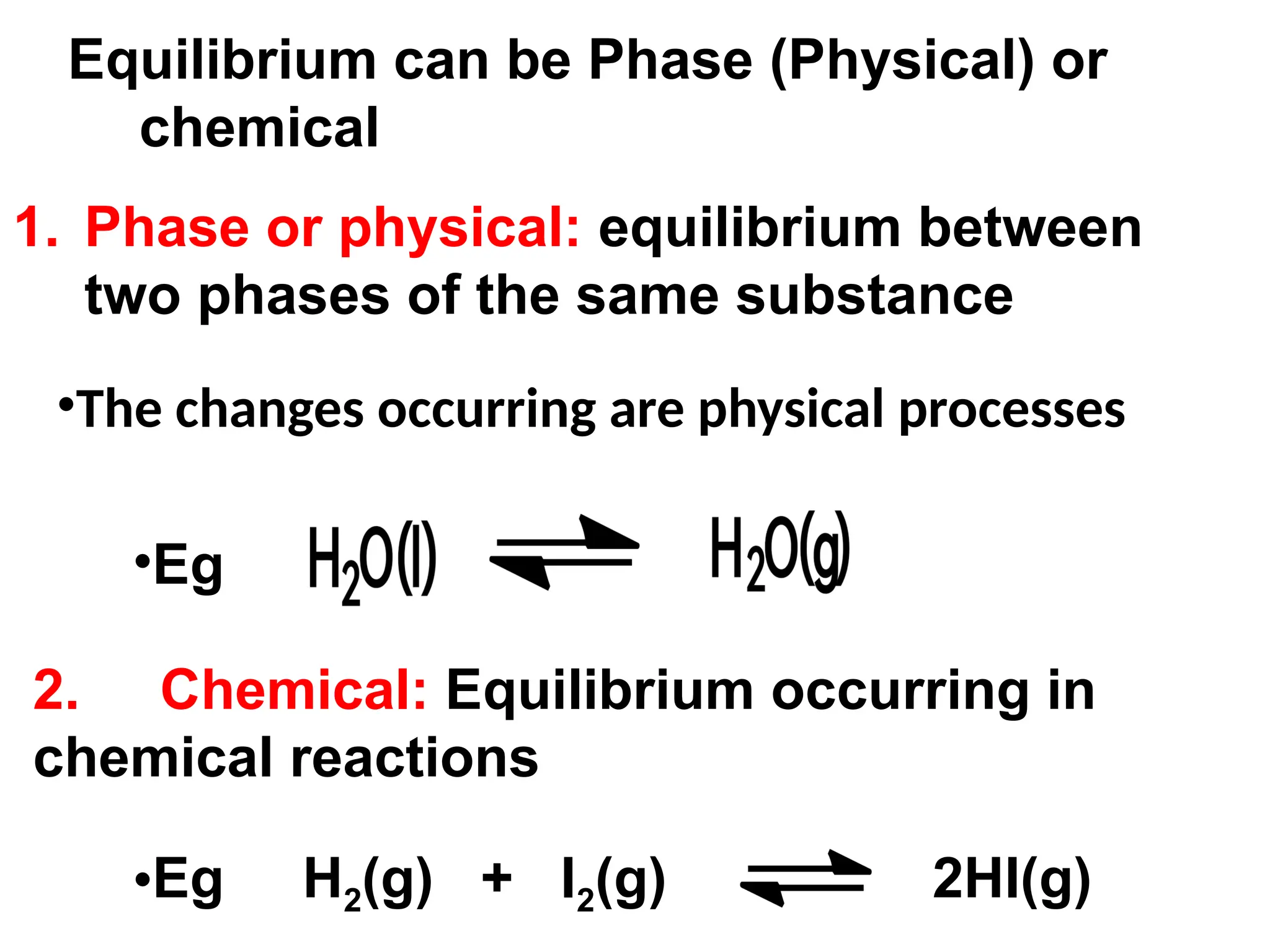
Equilibrium can be Phase (Physical) or
chemical
1. Phase or physical: equilibrium between
two phases of the same substance
•The changes occurring are physical processes
•Eg
2. Chemical: Equilibrium occurring in
chemical reactions
•Eg H2(g) + I2(g) 2HI(g)
• Let us consider decomposition of N2O4 (a colourless
gas) to N02 (a brown gas)
• If the frozen N2O4 is warmed to room temperature it
decomposes to N02
N2O4(g) → 2NO2(g)
• The colour of system starts changing from colourless
to brown
• When enough NO2 is formed it starts reacting to form
N2O4
2NO2(g) → N2O4(g).
• At some time, the color stops changing and we have a
mixture of N2O4 and NO2
• The two reactions occur together
N2O4(g) 2NO2(g)
Explanation
• When N2O4 warms to room temperature, it
decomposes to form NO2 and the formed NO2
reaches a concentration where it reacts to form
N2O4
• Thus starting with N2O4 at zero time there is a
max conc of N2O4 but zero conc of NO2
• Thus the rate of decomposition of N2O4
decreases from maximum while the reaction
of NO2 increases from zero
• The rate of a reaction depends on the
concentration of reactants
• As the decomposition of N2O4 proceeds,
its conc decreases while that of NO2
increases
• This causes an increase in the reaction of
NO2 to form N2O4
• Thus the rate of decomposition of N2O4
decreases from maximum while the
reaction of NO increases from zero
• At some stage, the two concentrations will
become constant even though the reaction
is still going on
• Ie; as much N2O4 reacts to form NO2 as
NO2 reacts to re-form N2O4
• At this point, the rate of the forward
reaction equals the rate of the reverse
reaction
Graphical explanation
1. Reaction rate versus time
forward
reaction
reverse reaction
• As a system approaches
equilibrium, both the
forward and reverse
reactions are occurring
• At equilibrium, the
forward and reverse
reactions are
proceeding at the same
rate
2. Concentration versus time
• Once equilibrium is
achieved, the
amount of each
reactant and
product remains
constant
• A system in which both the forward and reverse
reactions proceed at identical rates is described as
existing in a state of dynamic equilibrium
• At this point there is no observable change although it
can be proved experimentally that the reaction still
continues
Equilibrium constant Kc
• Consider the reversible reaction:
2HI(g) H2(g) + I2(g)
• No matter the starting composition of reactants
and products, the ratio of concentrations
gives the same value at equilibrium as long as
the temperature and pressure are kept constant
• We can thus generalize:
For any type of chemical equilibrium of the
type
aA (g) + bB (g) cC (g) + dD (g)
• Where:
A, B, C, and D denote reactants and
products, and a, b, c, and d are coefficients in
the balanced chemical equation
• The following expression is a constant (at a given
temperature)
• Where Kc is the equilibrium constant
• Equilibrium constant (Kc) is the number equal to
the ratio of the equilibrium concentrations of
products to the equilibrium concentrations of
reactants, each raised to the power of its
stoichiometric coefficient
Write the equilibrium expression for the following
reactions:
a. N2(g) + 3H2(g) 2NH3(g);
b. 2NH3(g) N2(g) +
3H2(g);
Writing equilibrium constant expressions
Manipulating equilibrium constants
Changing direction
The equilibrium constant of a reaction in the
reverse reaction is the reciprocal of the
equilibrium constant of the forward reaction
N2(g) + 3H2(g) 2NH3(g);
2NH3(g) N2(g) + 3H2(g);
Changing coefficient
The equilibrium constant of a reaction that has
been multiplied by a number is the equilibrium
constant raised to a power that is equal to that
number
N2O4(g) 2NO2(g)
2N2O4(g) 4NO2(g)
Manipulating equilibrium constants
Adding equations for reactions
Manipulating equilibrium constants
The equilibrium constant of a net reaction made
up of two or more steps is the product of the
equilibrium constants for the individual steps
CO2(g) + H2(g) CO(g) + H2O(g); K1
CO(g) + 2H2(g) CH3OH(g) K2
CO2(g) + 3H2(g) CH3OH(g) + H2O(g) K3
Find K3
CO2(g) + H2(g) CO(g) + H2O(g); K1
CO(g) + 2H2(g) CH3OH(g) K2
CO2(g) + 3H2(g) CH3OH(g) + H2O(g) K3
+
Determine the equilibrium constant ( ) for the
reaction 2NH3(g) N2(g) + 3H2(g)
given: N2(g) + 3H2(g) 2NH3(g), Kc = 1.7 x 10²
Solution:
Note that the reaction in question is the reverse of
the given reaction
.
Determine the equilibrium constant ( ) for the
reaction:
½N2(g) + 3/2 H2 (g) NH3 (g)
given: N2(g) + 3H2(g) 2NH3(g), Kc = 1.7 x 10²
Soln
:
Manipulating equilibrium constants
Estimate the equilibrium constant for the
reaction: N2O(g) + O2(g) 2NO(g);
If (a) N2(g) + O2(g) N2O(g;
and (b) N2(g) + O2(g) 2NO(g);
Manipulating equilibrium constants
½
½
The reaction in question is obtained by reversing
reaction (a) and adding it to reaction (b)
Solution
Step 1: Reverse reaction (a) to obtain reaction (c):
Step 2: Add the reversed reaction to reaction (b)
+
½
½
½
Calculate the equilibrium constant for the
reaction 3.
1
2
3
Test yourself
Equilibrium constant calculations
1. The following equilibrium process has been
studied at 230 o
C
2NO(g) + O2(g) 2NO2(g)
• calculate the equilibrium constant Kc for the
formation of NO2 if the equilibrium
concentrations of NO, O2 and NO2 are 0.0542 M,
0.127 M, and 15.5 M, respectively.
2NO(g) + O2(g) 2NO2(g)
Solution:
NOTE:
Kc is based on the molarities of reactants and
products at equilibrium
We generally omit the units of the equilibrium
constant
If reacting species are expressed in terms of moles per litre
equilibrium concentration is designated by Kc
Gaseous reactions can also be expressed in partial
pressures
If expressed in partial pressures, then equilibrium constant
is designated by Kp
Kp has the same format as Kc
Determine the equilibrium constant (Kp) for the
following reaction at 500 K if equilibrium pressures are
1.2 atm, 0.81 atm and 0.15 atm for N2, H2 and NH3
respectively:
½N2(g) + 3/2 H2 (g) NH3 (g)
Solution:
Kp is not equal Kc since pressures of reactants
and products are not equal to their
concentrations in moles/L
2. Predict the direction in which a reaction
mixture will proceed to reach equilibrium
3. Calculate the concentration of reactants and
products once equilibrium has been reached
Uses of equilibrium Constant
Equilibrium constants help us to:
1. Predict whether a particular equilibrium favours
products or reactants (extent of reaction)
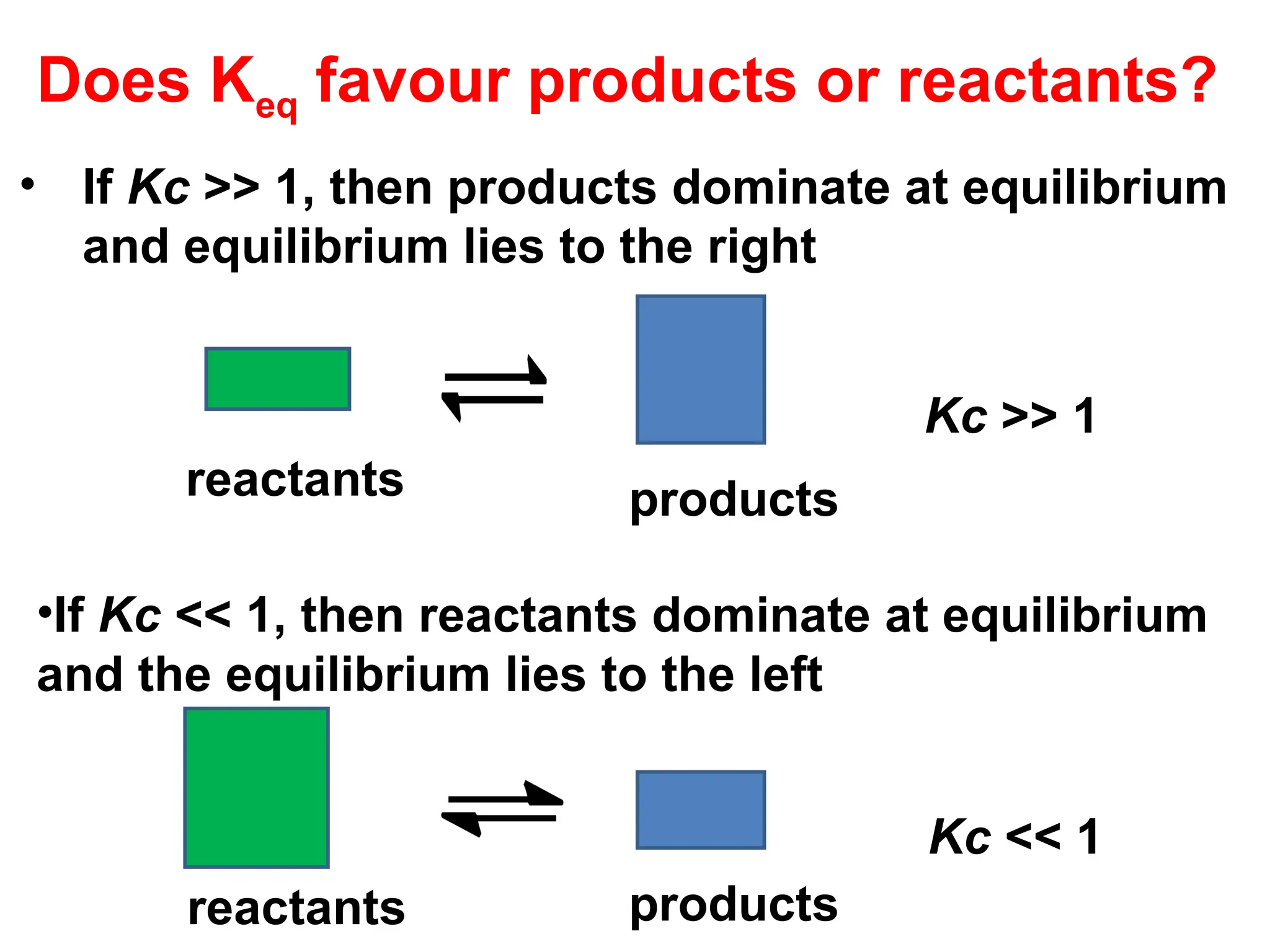
Does Keq favour products or reactants?
• If Kc >> 1, then products dominate at equilibrium
and equilibrium lies to the right
•If Kc << 1, then reactants dominate at equilibrium
and the equilibrium lies to the left
reactants
reactants products
products
Kc << 1
Kc >> 1
• If Kc is neither small nor large (between 0.1 and
10), neither reactants not products are favoured
✓ The equilibrium mixture contains significant
amounts of all substances in the reaction mixture
0.1 ≤ Kc ≤ 10
Consider following reaction at 25o
C ;
2NO(g) + O2(g) 2NO2(g); Kc = 4.0 X 10¹³
.
Does the equilibrium mixture contain predominantly
reactants or products?
2NO(g) + Cl2(g) 2NOCl(g)
In a certain experiment, 2.0 × 10⁻²
mole of NO, 8.3 × 10-
3
mole of Cl2, and 6.8 moles of NOCl are mixed in a 2.0-
L flask
In which direction will the system proceed to reach
equilibrium?
Predicting the Direction of a Reaction
The equilibrium constant (Kc) for the reaction:
is 6.5 × 10⁴
at 35°C.
• To predict the direction we use reaction
quotient, Qc
• To answer the question above, we substitute the
concentrations in the Reaction quotient (Qc) and
compare its value to that of Kc
• Qc has the same form as the equilibrium
constant expression, but the concentrations that
we substitute are those of a mixture that is not
necessarily at equilibrium
• The ratio of products over reactants is too large &
the reaction will move toward equilibrium
by forming more reactants.
• The ratio of products over reactants is too small & the
reaction will move toward
equilibrium by forming more products.
There are 3 possibilities
1. If Qc > Kc, System goes R→ L
2. If Qc < Kc, System goes L→ R
3. If Qc = Kc, the reaction mixture is already at
equilibrium, so no shift occurs.
Let’s now calculate our Qc and compare its value
to Kc
The initial concentrations of the reacting species
are:
[NO]
Therefore, the reaction will proceed towards reactants
(R→ L ) to reach equilibrium
Calculating equilibrium concentrations
• Using initial concentrations, stoichiometry and
equilibrium constant (Keq), equilibrium concentrations
of all components can be determined.
ICE method
• Set up a table of concentrations (initial, change, and
equilibrium expressions in x)
• Substitute the expressions in x for equilibrium
concentrations into the equilibrium-constant
equation
• Solve the equilibrium-constant equation for the values
of the equilibrium concentrations
• Solved Example
The decomposition of HI at low temperature was
studied by injecting 2.50 mol of HI into a 10.32 L vessel
at 25o
C. Calculate the concentrations of H2, HI and I2 at
equilibrium for the reaction:
Note the moles into a 10.32 L vessel stuff ...
calculate molarity. Starting concentration of HI:
2 HI H2 + I2
Initial:
Change:
Equil:
-2x +x +x
0.242 M 0 0
0.242-2x x x
Taking square root on both sides, we get
It is a perfect square!
Solve for x and you get : x = 0.00802
Types of stresses on equilibrium:
• Concentration of reactants or products
• Temperature
Factors that Affect chemical Equilibrium
• If a stress is applied to a system in dynamic
equilibrium, the system changes to relieve the
stress and re – establish the equilibrium
• Chemical equilibrium represents a balance
between forward and reverse reactions
• Pressure (for gaseous systems only!)
There is a general rule that is used to predict the
direction in which an equilibrium will shift when a
change in any of the above factors occurs
Le Chatelier’s Principle:
Any change in these three factors will change the
state of an equilibrium
If a stress is applied to a system in dynamic
equilibrium, the system will adjust itself in such
a way as to partially offset the stress
• Adding reactant shifts the reaction
toward the products
Why?
➢ Relief:
➢ Shift:
➢ Stress: Increasing reactants
Decreasing reactants
to the right (products)
Reactants Products
Concentration Changes
✓ Add more reactant ➔ Shift to products
✓ Remove reactants ➔ Shift to reactants
✓ Add more product Shift to reactants
Shift to products
✓ Remove products
➔
➔
Reactants Products;
• So for the reversible reaction:
Le châtelier’s principle predicts that if you:
• To optimize the amount of product at equilibrium, we
need to flood the reaction vessel with reactant and
continuously remove product (Le Châtelier)
• Consider the Haber process:
• If H2 is added while the system is at equilibrium, the
system must respond to counteract the added H2 (by Le
Châtelier).
• That is, the system must consume the H2 and produce
products until a new equilibrium is established
• Therefore, [H2] and [N2] will decrease and [NH3]
increases.
• Note: The transformation of nitrogen and hydrogen
into ammonia (NH3) is of tremendous significance in
agriculture, where ammonia-based fertilizers are of
utmost importance
For an exothermic reaction at equilibrium,
• a decrease in temperature removes heat, and
the equilibrium shifts toward the products
• an increase in temperature adds heat, and the
equilibrium shifts toward the reactants.
Effect of Temperature
i. Exothermic Reactions (∆H = -ve)
• Consider heat as a product in exothermic
reactions
N2(g) + 3H2(g) 2NH3(g) + Heat
ii. Endothermic Reactions (∆H = +ve)
• Consider the following endothermic reaction:
CH4(g) + H2O(g) CO(g) + 3H2(g), ∆Ho
= +205 kJ
• Endothermic reaction absorbs heat so heat is
a reactant
CH4(g) + H2O(g) +205kJ CO(g) + 3H2(g)
• a decrease in temperature (T) removes heat, and
the equilibrium shifts toward the reactants ie
towards formation of CH4(g) and H2O(g)
For an endothermic reaction at equilibrium,
• an increase in temperature adds heat, and the
equilibrium shifts toward the products. ie more
CO(g) and 3H2(g) will be formed
Effects of Pressure Change on Equilibrium
• Affects gases only.
• For equal number of moles of gaseous
reactants and products, no shift occurs
• Only affects equilibrium systems with unequal
number of moles of gaseous reactants and
products
• If the volume of a gas mixture is compressed,
the overall gas pressure will increase
Change
Increase in Pressure
Decrease in Pressure
Increase in Volume
Decrease in Volume
Shift in Equilibrium
Side with most moles
Side with fewest moles
Side with most moles
Side with fewest moles
N2(g) + 3H2(g) 2NH3(g)
a. Consider increasing pressure by
decreasing the volume (compression)
for the reaction:
• Thus, the reaction shifts to the product
NH3(g)
• There are 4 moles of reactants vs. 2 moles
of products
b. Consider the following reaction:
CO(g) + H2O(g) CO2(g) + H2(g);
• Reactants and products have same number of
gas molecules
• Reducing or increasing the volume will cause
equal effect on both sides
• Equilibrium is not affected by change in
pressure in this case
• No shift occurs
Presence of a Catalyst
• A Catalyst lowers the activation energy
• Therefore, a catalyst has NO EFFECT on a
system at equilibrium!
• It just gets you to equilibrium faster!
• increases the reaction rate of both the
forward and reverse reactions
Presence of an Inert Substance
• An inert substance is a substance that is
not reactive with any species in the
equilibrium system
• These will not affect the equilibrium
system.
• If the substance does react with a
species at equilibrium, then there will be
a shift!
Given:
S8(g) + 12O2(g) 8 SO3(g) + 808 kJ
•What will happen when ……
i.Oxygen gas is added?
ii. The reaction vessel is cooled?
iii. The size of the container is increased?
iv. Sulfur trioxide is removed?
v. A catalyst is added to make it faster?
Test yourself

CHE31101 CHEMICAL EQUILIBRIUM pptxrt.pptx

  • 1.
    CHEMICAL EQUILIBRIUM Basic SciencesDepartment LUANAR - Bunda College CHE 31101 Felix Daire Kumwenda
  • 2.
    Irreversible Reactions Chemical reactionswhich proceed to completion in one direction only are known as irreversible reactions. In these reactions reactants are completely converted into products in a certain time interval. In these reactions products do not form reactants again. CaCO3(s) CaO(s) + CO2(g) CaO(s) + H2O(l) Ca(OH)2(aq)
  • 3.
    Reversible Reactions Chemical reactionswhich proceed in both directions i.e. forward and backward at the same time are known as reversible reactions. These reactions never go to completion but always continue in both directions. H2 (g) + I2 (g) 2HI (g) 2SO2 (g) + O2 (g) 2SO3 (g) A reversible reaction is a chemical reaction that results in an equilibrium mixture of reactants and products.
  • 4.
    Chemical Equilibrium • Achemical equilibrium is a state reached by a reaction mixture in a closed system when the rates of the forward and reverse reactions have become equal and the concentrations of the reactants and products remain constant • When equilibrium is reached, there are no observable changes as time goes by
  • 5.
    The extent ofa reaction • Few chemical reactions proceed in one direction • In principle, every chemical reaction is reversible ie capable of moving in the forward and reverse directions • Equilibrium looks at the extent of a chemical reaction.
  • 6.
    The concept ofequilibrium •
  • 7.
    • After aperiod of time: • The concentrations of reactants and products remain constant • There are no visible changes in the system • But reactants continue to form products while products react to yield reactants at the same rate • A chemical equilibrium is now attained
  • 8.
    So a chemicalequilibrium is achieved when: 2. The concentrations of reactants and products remain constant 1. the rates of forward and reverse reactions are equal and (Note that this is in a closed system)
  • 9.
    Equilibrium can bePhase (Physical) or chemical 1. Phase or physical: equilibrium between two phases of the same substance •The changes occurring are physical processes •Eg 2. Chemical: Equilibrium occurring in chemical reactions •Eg H2(g) + I2(g) 2HI(g)
  • 10.
    • Let usconsider decomposition of N2O4 (a colourless gas) to N02 (a brown gas) • If the frozen N2O4 is warmed to room temperature it decomposes to N02 N2O4(g) → 2NO2(g) • The colour of system starts changing from colourless to brown • When enough NO2 is formed it starts reacting to form N2O4 2NO2(g) → N2O4(g). • At some time, the color stops changing and we have a mixture of N2O4 and NO2 • The two reactions occur together N2O4(g) 2NO2(g)
  • 11.
    Explanation • When N2O4warms to room temperature, it decomposes to form NO2 and the formed NO2 reaches a concentration where it reacts to form N2O4 • Thus starting with N2O4 at zero time there is a max conc of N2O4 but zero conc of NO2 • Thus the rate of decomposition of N2O4 decreases from maximum while the reaction of NO2 increases from zero
  • 12.
    • The rateof a reaction depends on the concentration of reactants • As the decomposition of N2O4 proceeds, its conc decreases while that of NO2 increases • This causes an increase in the reaction of NO2 to form N2O4 • Thus the rate of decomposition of N2O4 decreases from maximum while the reaction of NO increases from zero
  • 13.
    • At somestage, the two concentrations will become constant even though the reaction is still going on • Ie; as much N2O4 reacts to form NO2 as NO2 reacts to re-form N2O4 • At this point, the rate of the forward reaction equals the rate of the reverse reaction
  • 14.
    Graphical explanation 1. Reactionrate versus time forward reaction reverse reaction • As a system approaches equilibrium, both the forward and reverse reactions are occurring • At equilibrium, the forward and reverse reactions are proceeding at the same rate
  • 15.
    2. Concentration versustime • Once equilibrium is achieved, the amount of each reactant and product remains constant
  • 16.
    • A systemin which both the forward and reverse reactions proceed at identical rates is described as existing in a state of dynamic equilibrium • At this point there is no observable change although it can be proved experimentally that the reaction still continues
  • 17.
    Equilibrium constant Kc •Consider the reversible reaction: 2HI(g) H2(g) + I2(g) • No matter the starting composition of reactants and products, the ratio of concentrations gives the same value at equilibrium as long as the temperature and pressure are kept constant
  • 18.
    • We canthus generalize: For any type of chemical equilibrium of the type aA (g) + bB (g) cC (g) + dD (g) • Where: A, B, C, and D denote reactants and products, and a, b, c, and d are coefficients in the balanced chemical equation
  • 19.
    • The followingexpression is a constant (at a given temperature) • Where Kc is the equilibrium constant • Equilibrium constant (Kc) is the number equal to the ratio of the equilibrium concentrations of products to the equilibrium concentrations of reactants, each raised to the power of its stoichiometric coefficient
  • 20.
    Write the equilibriumexpression for the following reactions: a. N2(g) + 3H2(g) 2NH3(g); b. 2NH3(g) N2(g) + 3H2(g); Writing equilibrium constant expressions
  • 21.
    Manipulating equilibrium constants Changingdirection The equilibrium constant of a reaction in the reverse reaction is the reciprocal of the equilibrium constant of the forward reaction N2(g) + 3H2(g) 2NH3(g); 2NH3(g) N2(g) + 3H2(g);
  • 22.
    Changing coefficient The equilibriumconstant of a reaction that has been multiplied by a number is the equilibrium constant raised to a power that is equal to that number N2O4(g) 2NO2(g) 2N2O4(g) 4NO2(g) Manipulating equilibrium constants
  • 23.
    Adding equations forreactions Manipulating equilibrium constants The equilibrium constant of a net reaction made up of two or more steps is the product of the equilibrium constants for the individual steps CO2(g) + H2(g) CO(g) + H2O(g); K1 CO(g) + 2H2(g) CH3OH(g) K2 CO2(g) + 3H2(g) CH3OH(g) + H2O(g) K3 Find K3
  • 24.
    CO2(g) + H2(g)CO(g) + H2O(g); K1 CO(g) + 2H2(g) CH3OH(g) K2 CO2(g) + 3H2(g) CH3OH(g) + H2O(g) K3 +
  • 25.
    Determine the equilibriumconstant ( ) for the reaction 2NH3(g) N2(g) + 3H2(g) given: N2(g) + 3H2(g) 2NH3(g), Kc = 1.7 x 10² Solution: Note that the reaction in question is the reverse of the given reaction
  • 26.
    . Determine the equilibriumconstant ( ) for the reaction: ½N2(g) + 3/2 H2 (g) NH3 (g) given: N2(g) + 3H2(g) 2NH3(g), Kc = 1.7 x 10² Soln : Manipulating equilibrium constants
  • 27.
    Estimate the equilibriumconstant for the reaction: N2O(g) + O2(g) 2NO(g); If (a) N2(g) + O2(g) N2O(g; and (b) N2(g) + O2(g) 2NO(g); Manipulating equilibrium constants ½ ½ The reaction in question is obtained by reversing reaction (a) and adding it to reaction (b) Solution
  • 28.
    Step 1: Reversereaction (a) to obtain reaction (c): Step 2: Add the reversed reaction to reaction (b) + ½ ½ ½
  • 30.
    Calculate the equilibriumconstant for the reaction 3. 1 2 3 Test yourself
  • 31.
    Equilibrium constant calculations 1.The following equilibrium process has been studied at 230 o C 2NO(g) + O2(g) 2NO2(g) • calculate the equilibrium constant Kc for the formation of NO2 if the equilibrium concentrations of NO, O2 and NO2 are 0.0542 M, 0.127 M, and 15.5 M, respectively.
  • 32.
    2NO(g) + O2(g)2NO2(g) Solution: NOTE: Kc is based on the molarities of reactants and products at equilibrium We generally omit the units of the equilibrium constant
  • 33.
    If reacting speciesare expressed in terms of moles per litre equilibrium concentration is designated by Kc Gaseous reactions can also be expressed in partial pressures If expressed in partial pressures, then equilibrium constant is designated by Kp Kp has the same format as Kc
  • 34.
    Determine the equilibriumconstant (Kp) for the following reaction at 500 K if equilibrium pressures are 1.2 atm, 0.81 atm and 0.15 atm for N2, H2 and NH3 respectively: ½N2(g) + 3/2 H2 (g) NH3 (g) Solution:
  • 35.
    Kp is notequal Kc since pressures of reactants and products are not equal to their concentrations in moles/L
  • 36.
    2. Predict thedirection in which a reaction mixture will proceed to reach equilibrium 3. Calculate the concentration of reactants and products once equilibrium has been reached Uses of equilibrium Constant Equilibrium constants help us to: 1. Predict whether a particular equilibrium favours products or reactants (extent of reaction)
  • 37.
    Does Keq favourproducts or reactants? • If Kc >> 1, then products dominate at equilibrium and equilibrium lies to the right •If Kc << 1, then reactants dominate at equilibrium and the equilibrium lies to the left reactants reactants products products Kc << 1 Kc >> 1
  • 38.
    • If Kcis neither small nor large (between 0.1 and 10), neither reactants not products are favoured ✓ The equilibrium mixture contains significant amounts of all substances in the reaction mixture 0.1 ≤ Kc ≤ 10 Consider following reaction at 25o C ; 2NO(g) + O2(g) 2NO2(g); Kc = 4.0 X 10¹³ . Does the equilibrium mixture contain predominantly reactants or products?
  • 39.
    2NO(g) + Cl2(g)2NOCl(g) In a certain experiment, 2.0 × 10⁻² mole of NO, 8.3 × 10- 3 mole of Cl2, and 6.8 moles of NOCl are mixed in a 2.0- L flask In which direction will the system proceed to reach equilibrium? Predicting the Direction of a Reaction The equilibrium constant (Kc) for the reaction: is 6.5 × 10⁴ at 35°C.
  • 40.
    • To predictthe direction we use reaction quotient, Qc • To answer the question above, we substitute the concentrations in the Reaction quotient (Qc) and compare its value to that of Kc • Qc has the same form as the equilibrium constant expression, but the concentrations that we substitute are those of a mixture that is not necessarily at equilibrium
  • 41.
    • The ratioof products over reactants is too large & the reaction will move toward equilibrium by forming more reactants. • The ratio of products over reactants is too small & the reaction will move toward equilibrium by forming more products. There are 3 possibilities 1. If Qc > Kc, System goes R→ L 2. If Qc < Kc, System goes L→ R 3. If Qc = Kc, the reaction mixture is already at equilibrium, so no shift occurs.
  • 42.
    Let’s now calculateour Qc and compare its value to Kc The initial concentrations of the reacting species are: [NO]
  • 43.
    Therefore, the reactionwill proceed towards reactants (R→ L ) to reach equilibrium
  • 44.
    Calculating equilibrium concentrations •Using initial concentrations, stoichiometry and equilibrium constant (Keq), equilibrium concentrations of all components can be determined. ICE method • Set up a table of concentrations (initial, change, and equilibrium expressions in x) • Substitute the expressions in x for equilibrium concentrations into the equilibrium-constant equation • Solve the equilibrium-constant equation for the values of the equilibrium concentrations
  • 45.
    • Solved Example Thedecomposition of HI at low temperature was studied by injecting 2.50 mol of HI into a 10.32 L vessel at 25o C. Calculate the concentrations of H2, HI and I2 at equilibrium for the reaction:
  • 46.
    Note the molesinto a 10.32 L vessel stuff ... calculate molarity. Starting concentration of HI: 2 HI H2 + I2 Initial: Change: Equil: -2x +x +x 0.242 M 0 0 0.242-2x x x
  • 47.
    Taking square rooton both sides, we get It is a perfect square! Solve for x and you get : x = 0.00802
  • 48.
    Types of stresseson equilibrium: • Concentration of reactants or products • Temperature Factors that Affect chemical Equilibrium • If a stress is applied to a system in dynamic equilibrium, the system changes to relieve the stress and re – establish the equilibrium • Chemical equilibrium represents a balance between forward and reverse reactions • Pressure (for gaseous systems only!)
  • 49.
    There is ageneral rule that is used to predict the direction in which an equilibrium will shift when a change in any of the above factors occurs Le Chatelier’s Principle: Any change in these three factors will change the state of an equilibrium If a stress is applied to a system in dynamic equilibrium, the system will adjust itself in such a way as to partially offset the stress
  • 50.
    • Adding reactantshifts the reaction toward the products Why? ➢ Relief: ➢ Shift: ➢ Stress: Increasing reactants Decreasing reactants to the right (products) Reactants Products Concentration Changes
  • 51.
    ✓ Add morereactant ➔ Shift to products ✓ Remove reactants ➔ Shift to reactants ✓ Add more product Shift to reactants Shift to products ✓ Remove products ➔ ➔ Reactants Products; • So for the reversible reaction: Le châtelier’s principle predicts that if you:
  • 52.
    • To optimizethe amount of product at equilibrium, we need to flood the reaction vessel with reactant and continuously remove product (Le Châtelier) • Consider the Haber process: • If H2 is added while the system is at equilibrium, the system must respond to counteract the added H2 (by Le Châtelier). • That is, the system must consume the H2 and produce products until a new equilibrium is established • Therefore, [H2] and [N2] will decrease and [NH3] increases.
  • 53.
    • Note: Thetransformation of nitrogen and hydrogen into ammonia (NH3) is of tremendous significance in agriculture, where ammonia-based fertilizers are of utmost importance
  • 54.
    For an exothermicreaction at equilibrium, • a decrease in temperature removes heat, and the equilibrium shifts toward the products • an increase in temperature adds heat, and the equilibrium shifts toward the reactants. Effect of Temperature i. Exothermic Reactions (∆H = -ve) • Consider heat as a product in exothermic reactions N2(g) + 3H2(g) 2NH3(g) + Heat
  • 55.
    ii. Endothermic Reactions(∆H = +ve) • Consider the following endothermic reaction: CH4(g) + H2O(g) CO(g) + 3H2(g), ∆Ho = +205 kJ • Endothermic reaction absorbs heat so heat is a reactant CH4(g) + H2O(g) +205kJ CO(g) + 3H2(g)
  • 56.
    • a decreasein temperature (T) removes heat, and the equilibrium shifts toward the reactants ie towards formation of CH4(g) and H2O(g) For an endothermic reaction at equilibrium, • an increase in temperature adds heat, and the equilibrium shifts toward the products. ie more CO(g) and 3H2(g) will be formed
  • 57.
    Effects of PressureChange on Equilibrium • Affects gases only. • For equal number of moles of gaseous reactants and products, no shift occurs • Only affects equilibrium systems with unequal number of moles of gaseous reactants and products • If the volume of a gas mixture is compressed, the overall gas pressure will increase
  • 58.
    Change Increase in Pressure Decreasein Pressure Increase in Volume Decrease in Volume Shift in Equilibrium Side with most moles Side with fewest moles Side with most moles Side with fewest moles
  • 59.
    N2(g) + 3H2(g)2NH3(g) a. Consider increasing pressure by decreasing the volume (compression) for the reaction: • Thus, the reaction shifts to the product NH3(g) • There are 4 moles of reactants vs. 2 moles of products
  • 60.
    b. Consider thefollowing reaction: CO(g) + H2O(g) CO2(g) + H2(g); • Reactants and products have same number of gas molecules • Reducing or increasing the volume will cause equal effect on both sides • Equilibrium is not affected by change in pressure in this case • No shift occurs
  • 61.
    Presence of aCatalyst • A Catalyst lowers the activation energy • Therefore, a catalyst has NO EFFECT on a system at equilibrium! • It just gets you to equilibrium faster! • increases the reaction rate of both the forward and reverse reactions
  • 62.
    Presence of anInert Substance • An inert substance is a substance that is not reactive with any species in the equilibrium system • These will not affect the equilibrium system. • If the substance does react with a species at equilibrium, then there will be a shift!
  • 63.
    Given: S8(g) + 12O2(g)8 SO3(g) + 808 kJ •What will happen when …… i.Oxygen gas is added? ii. The reaction vessel is cooled? iii. The size of the container is increased? iv. Sulfur trioxide is removed? v. A catalyst is added to make it faster? Test yourself