IA on polyphenol quantification using potassium permanganate titration (Lowenthal permanganate).
This document describes the quantification of polyphenols using potassium permanganate titration. Some key points:
1. Polyphenols are antioxidants found in fruits like grapes, berries, and cider that can be quantified using a redox titration with potassium permanganate.
2. The procedure involves preparing a 0.004M potassium permanganate solution and titrating fruit extracts with it using indigo carmine as an indicator, until the solution turns greenish yellow at the endpoint.
3. The volume of permanganate used corresponds to the amount of polyphenols present, with green grapes containing the most at 665 mg/L tannic acid equivalents based on the titration
IA on polyphenol quantification using potassium permanganate titration (Lowenthal permanganate).
1.
Polyphenol quantification usingpotassium permanganate titration (Lowenthal permanganate)
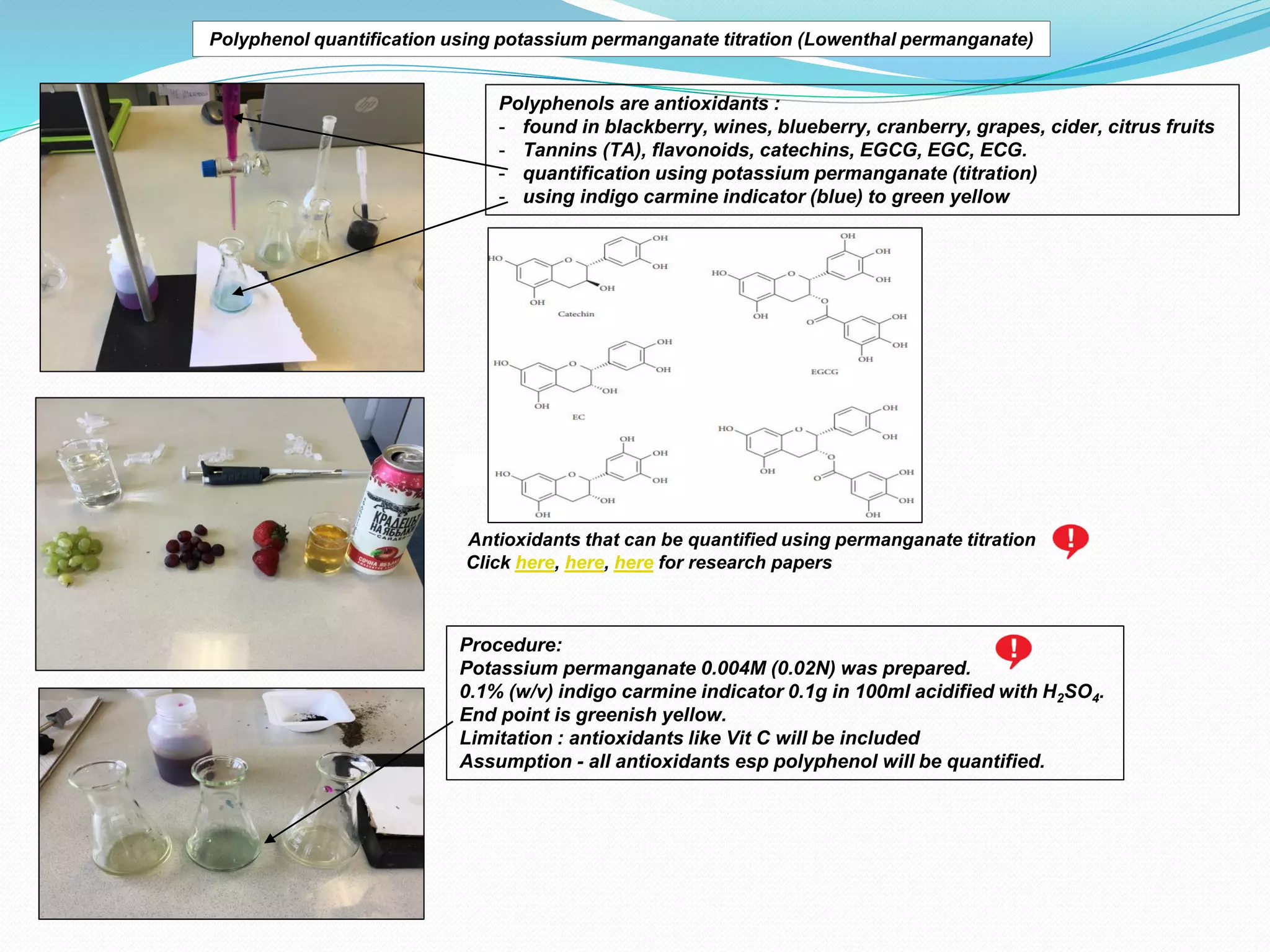
Polyphenols are antioxidants :
- found in blackberry, wines, blueberry, cranberry, grapes, cider, citrus fruits
- Tannins (TA), flavonoids, catechins, EGCG, EGC, ECG.
- quantification using potassium permanganate (titration)
- using indigo carmine indicator (blue) to green yellow
Antioxidants that can be quantified using permanganate titration
Procedure:
Potassium permanganate 0.004M (0.02N) was prepared.
0.1% (w/v) indigo carmine indicator 0.1g in 100ml acidified with H2SO4.
End point is greenish yellow.
Limitation : antioxidants like Vit C will be included
Assumption - all antioxidants esp polyphenol will be quantified.
Click here, here, here for research papers
2.
Polyphenol quantification usingpotassium permanganate titration (Lowenthal permanganate)
Green/red grapes – pure extract using cheese cloth Strawberry and apple cider – apple cider is great for IA study
due to its pale starting colour
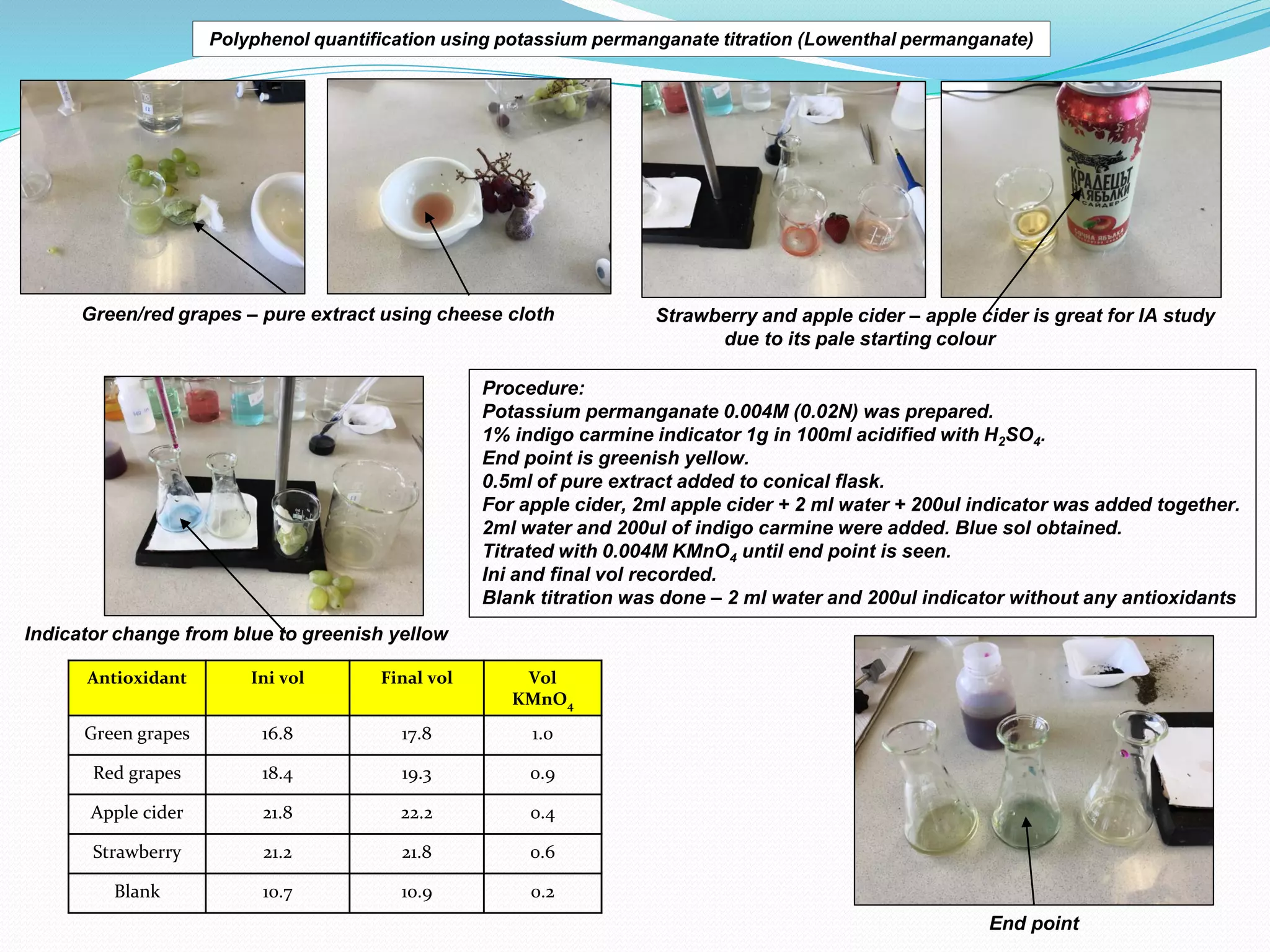
Indicator change from blue to greenish yellow
Procedure:
Potassium permanganate 0.004M (0.02N) was prepared.
1% indigo carmine indicator 1g in 100ml acidified with H2SO4.
End point is greenish yellow.
0.5ml of pure extract added to conical flask.
For apple cider, 2ml apple cider + 2 ml water + 200ul indicator was added together.
2ml water and 200ul of indigo carmine were added. Blue sol obtained.
Titrated with 0.004M KMnO4 until end point is seen.
Ini and final vol recorded.
Blank titration was done – 2 ml water and 200ul indicator without any antioxidants
Antioxidant Ini vol Final vol Vol
KMnO4
Green grapes 16.8 17.8 1.0
Red grapes 18.4 19.3 0.9
Apple cider 21.8 22.2 0.4
Strawberry 21.2 21.8 0.6
Blank 10.7 10.9 0.2
End point
3.
Polyphenol quantification usingpotassium permanganate titration (Lowenthal permanganate)
Green/red grapes – pure extract using cheese cloth Strawberry and apple cider – apple cider is great for IA study
due to its pale starting color
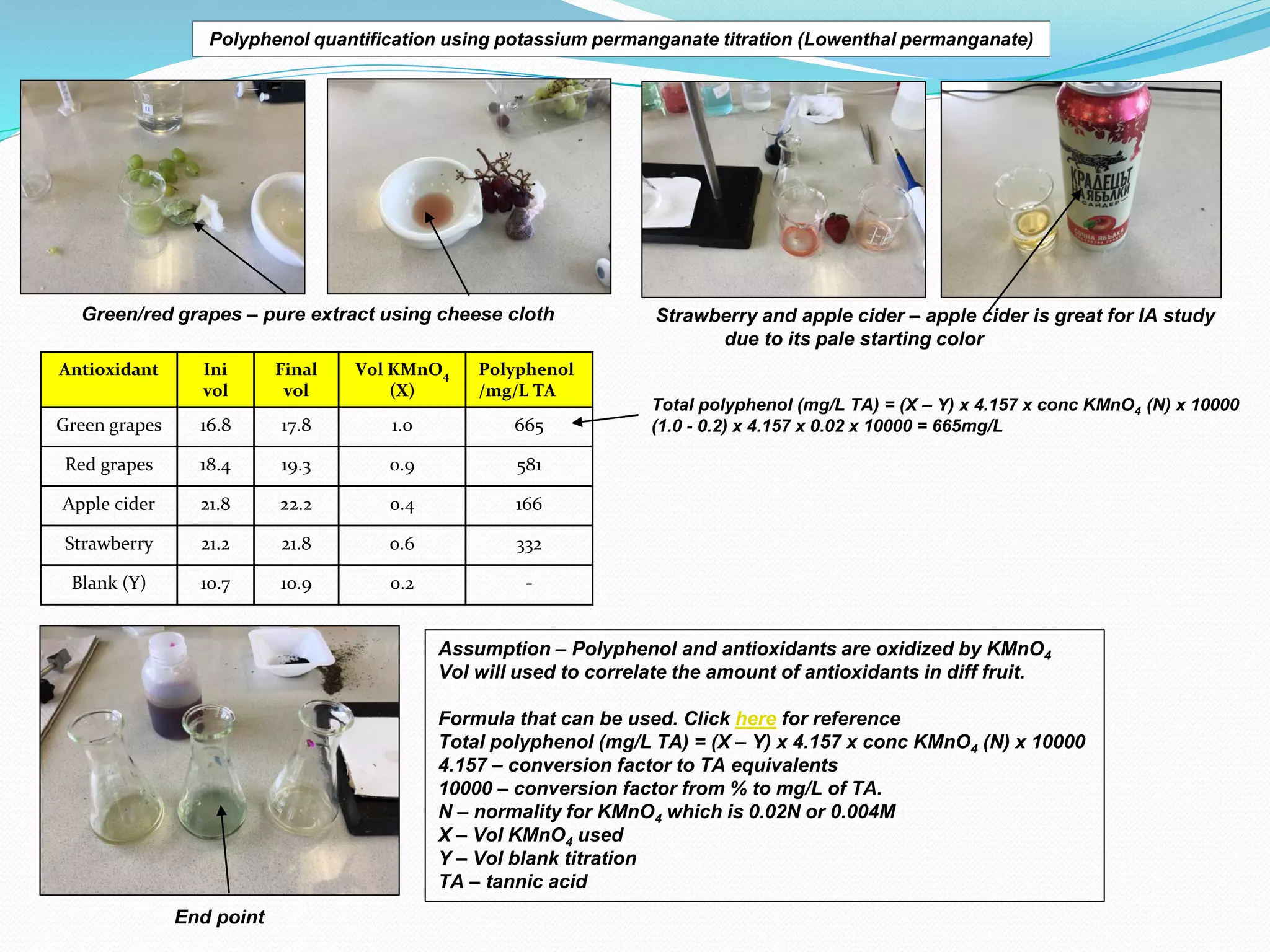
Antioxidant Ini
vol
Final
vol
Vol KMnO4
(X)
Polyphenol
/mg/L TA
Green grapes 16.8 17.8 1.0 665
Red grapes 18.4 19.3 0.9 581
Apple cider 21.8 22.2 0.4 166
Strawberry 21.2 21.8 0.6 332
Blank (Y) 10.7 10.9 0.2 -
End point
Assumption – Polyphenol and antioxidants are oxidized by KMnO4
Vol will used to correlate the amount of antioxidants in diff fruit.
Formula that can be used. Click here for reference
Total polyphenol (mg/L TA) = (X – Y) x 4.157 x conc KMnO4 (N) x 10000
4.157 – conversion factor to TA equivalents
10000 – conversion factor from % to mg/L of TA.
N – normality for KMnO4 which is 0.02N or 0.004M
X – Vol KMnO4 used
Y – Vol blank titration
TA – tannic acid
Total polyphenol (mg/L TA) = (X – Y) x 4.157 x conc KMnO4 (N) x 10000
(1.0 - 0.2) x 4.157 x 0.02 x 10000 = 665mg/L
4.
Polyphenol quantification usingpotassium permanganate titration (Lowenthal permanganate)
Green/red grapes – pure extract using cheese cloth Strawberry and apple cider – apple cider is great for IA study
due to its pale starting color
Antioxidant Ini
vol
Final
vol
Vol KMnO4
(X)
Polyphenol
/mg/L TA
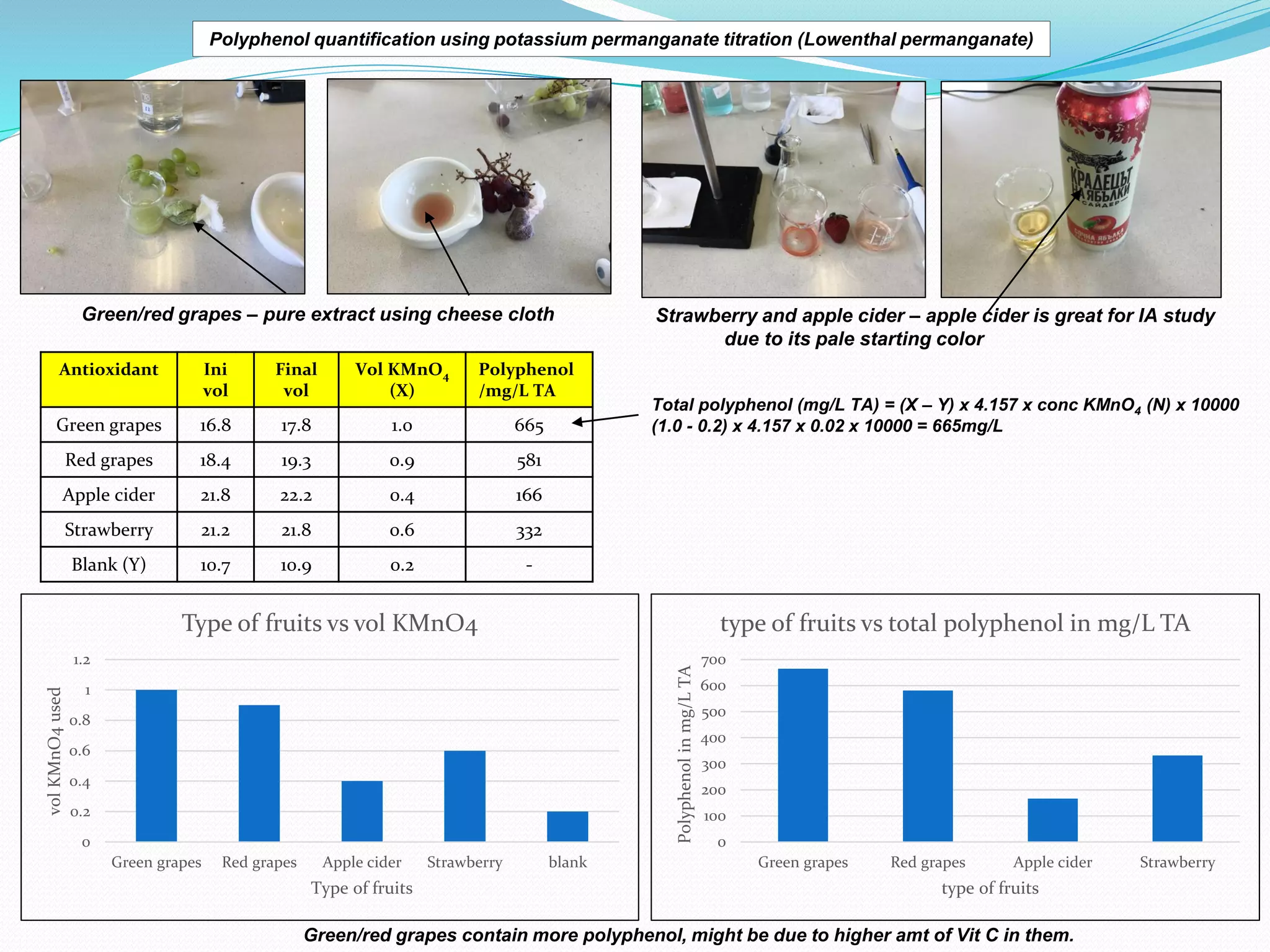
Green grapes 16.8 17.8 1.0 665
Red grapes 18.4 19.3 0.9 581
Apple cider 21.8 22.2 0.4 166
Strawberry 21.2 21.8 0.6 332
Blank (Y) 10.7 10.9 0.2 -
Total polyphenol (mg/L TA) = (X – Y) x 4.157 x conc KMnO4 (N) x 10000
(1.0 - 0.2) x 4.157 x 0.02 x 10000 = 665mg/L
0
0.2
0.4
0.6
0.8
1
1.2
Green grapes Red grapes Apple cider Strawberry blank
vol
KMnO4
used
Type of fruits
Type of fruits vs vol KMnO4
0
100
200
300
400
500
600
700
Green grapes Red grapes Apple cider Strawberry
Polyphenol
in
mg/L
TA
type of fruits
type of fruits vs total polyphenol in mg/L TA
Green/red grapes contain more polyphenol, might be due to higher amt of Vit C in them.
5.
Oxidizing
Agent
Reducing
Agent
MnO4
- Fe2+
Cr2O7
2- SO2
HNO3I-
H2O2 H2S
CI2 SO3
2-
KIO3 Vitamin C
OCI-/Cu2+ Oxalate/
C2O4
2-
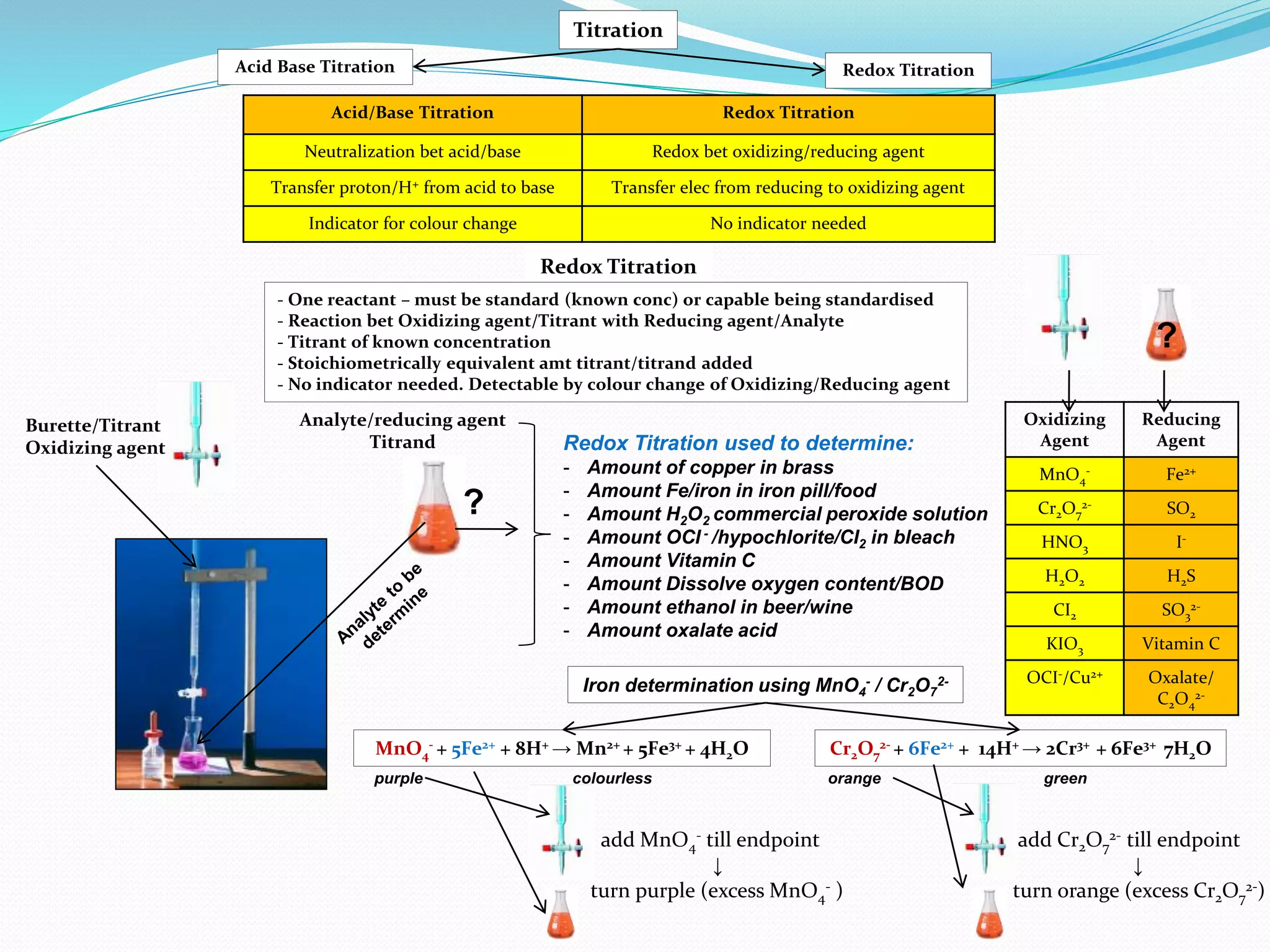
Titration
Redox Titration
Acid Base Titration
Burette/Titrant
Oxidizing agent
?
Acid/Base Titration Redox Titration
Neutralization bet acid/base Redox bet oxidizing/reducing agent
Transfer proton/H+ from acid to base Transfer elec from reducing to oxidizing agent
Indicator for colour change No indicator needed
Redox Titration
- One reactant – must be standard (known conc) or capable being standardised
- Reaction bet Oxidizing agent/Titrant with Reducing agent/Analyte
- Titrant of known concentration
- Stoichiometrically equivalent amt titrant/titrand added
- No indicator needed. Detectable by colour change of Oxidizing/Reducing agent
Analyte/reducing agent
Titrand Redox Titration used to determine:
- Amount of copper in brass
- Amount Fe/iron in iron pill/food
- Amount H2O2 commercial peroxide solution
- Amount OCI - /hypochlorite/CI2 in bleach
- Amount Vitamin C
- Amount Dissolve oxygen content/BOD
- Amount ethanol in beer/wine
- Amount oxalate acid
?
MnO4
- + 5Fe2+ + 8H+ → Mn2+ + 5Fe3+ + 4H2O Cr2O7
2- + 6Fe2+ + 14H+ → 2Cr3+ + 6Fe3+ 7H2O
Iron determination using MnO4
- / Cr2O7
2-
purple colourless orange green
add MnO4
- till endpoint
↓
turn purple (excess MnO4
- )
add Cr2O7
2- till endpoint
↓
turn orange (excess Cr2O7
2-)
6.
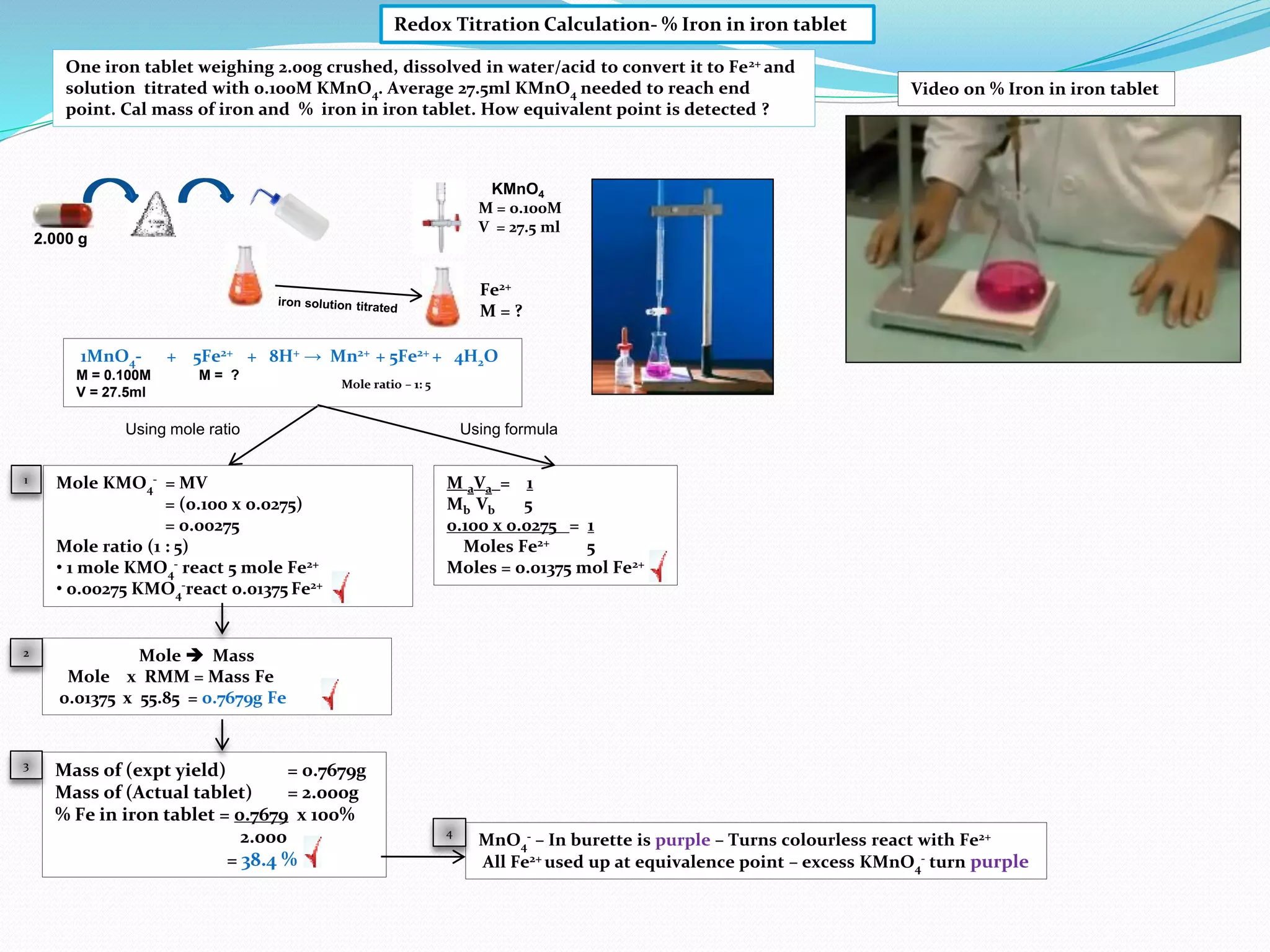
Redox Titration Calculation-% Iron in iron tablet
One iron tablet weighing 2.00g crushed, dissolved in water/acid to convert it to Fe2+ and
solution titrated with 0.100M KMnO4. Average 27.5ml KMnO4 needed to reach end
point. Cal mass of iron and % iron in iron tablet. How equivalent point is detected ?
2.000 g
KMnO4
M = 0.100M
V = 27.5 ml
Fe2+
M = ?
1MnO4- + 5Fe2+ + 8H+ → Mn2+ + 5Fe2+ + 4H2O
M = 0.100M M = ?
V = 27.5ml
Mole ratio – 1: 5
Using mole ratio
Mole KMO4
- = MV
= (0.100 x 0.0275)
= 0.00275
Mole ratio (1 : 5)
• 1 mole KMO4
- react 5 mole Fe2+
• 0.00275 KMO4
-react 0.01375 Fe2+
M aVa = 1
Mb Vb 5
0.100 x 0.0275 = 1
Moles Fe2+ 5
Moles = 0.01375 mol Fe2+
Mass of (expt yield) = 0.7679g
Mass of (Actual tablet) = 2.000g
% Fe in iron tablet = 0.7679 x 100%
2.000
= 38.4 %
Mole Mass
Mole x RMM = Mass Fe
0.01375 x 55.85 = 0.7679g Fe
Using formula
1
2
3
Video on % Iron in iron tablet
MnO4
- – In burette is purple – Turns colourless react with Fe2+
All Fe2+ used up at equivalence point – excess KMnO4
- turn purple
4
7.
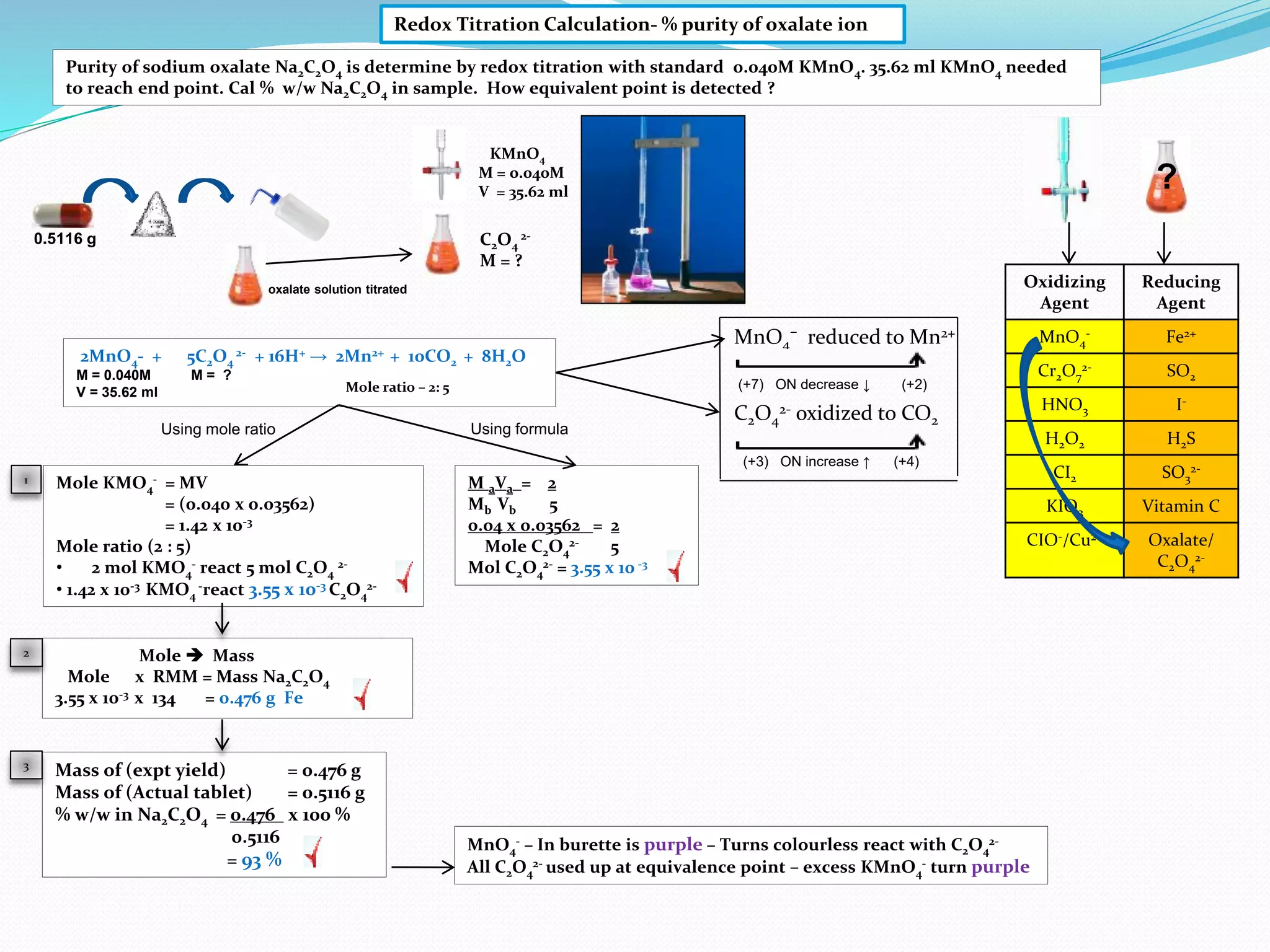
Redox Titration Calculation-% purity of oxalate ion
Purity of sodium oxalate Na2C2O4 is determine by redox titration with standard 0.040M KMnO4. 35.62 ml KMnO4 needed
to reach end point. Cal % w/w Na2C2O4 in sample. How equivalent point is detected ?
oxalate solution titrated
0.5116 g
KMnO4
M = 0.040M
V = 35.62 ml
C2O4
2-
M = ?
2MnO4- + 5C2O4
2- + 16H+ → 2Mn2+ + 10CO2 + 8H2O
M = 0.040M M = ?
V = 35.62 ml Mole ratio – 2: 5
Using mole ratio
Mole KMO4
- = MV
= (0.040 x 0.03562)
= 1.42 x 10⁻³
Mole ratio (2 : 5)
• 2 mol KMO4
- react 5 mol C2O4
2-
• 1.42 x 10⁻³ KMO4
-react 3.55 x 10⁻³ C2O4
2-
M aVa = 2
Mb Vb 5
0.04 x 0.03562 = 2
Mole C2O4
2- 5
Mol C2O4
2- = 3.55 x 10 -3
Mass of (expt yield) = 0.476 g
Mass of (Actual tablet) = 0.5116 g
% w/w in Na2C2O4 = 0.476 x 100 %
0.5116
= 93 %
Mole Mass
Mole x RMM = Mass Na2C2O4
3.55 x 10-3 x 134 = 0.476 g Fe
Using formula
1
2
3
MnO4
- – In burette is purple – Turns colourless react with C2O4
2-
All C2O4
2- used up at equivalence point – excess KMnO4
- turn purple
?
Oxidizing
Agent
Reducing
Agent
MnO4
- Fe2+
Cr2O7
2- SO2
HNO3 I-
H2O2 H2S
CI2 SO3
2-
KIO3 Vitamin C
CIO-/Cu2+ Oxalate/
C2O4
2-
MnO4
–
reduced to Mn2+
C2O4
2- oxidized to CO2
(+7) ON decrease ↓ (+2)
(+3) ON increase ↑ (+4)