Chemistry presentation
chemical
equilibrium
Equilibrium represent the state of process in which the properties like
temperature ,pressure , concentration of the system do not show any change
with the passage of time .
Equilibrium is a general term which applies not only to chemical reactions but
applies to physical changes as well . e.g. ice and water are In equilibrium at Oo C
and atmospheric pressure .
In all process which attain equilibrium two opposing processes are involved
Equilibrium is attained when the rate of the two processes becomes equal &
takes place at equal rate
The mixture of reactants and products at equilibrium is called
equilibrium mixture
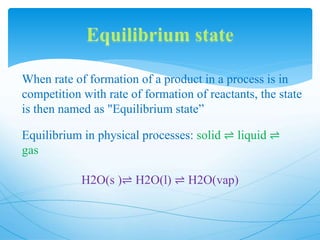
When rate of formation of a product in a process is in
competition with rate of formation of reactants, the state
is then named as "Equilibrium state”
Equilibrium in physical processes: solid ⇌ liquid ⇌
gas
H2O(s )⇌ H2O(l) ⇌ H2O(vap)
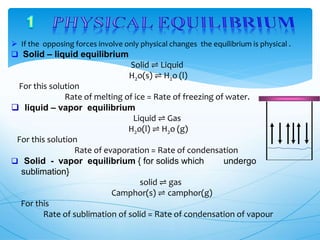
 If the opposing forces involve only physical changes the equilibrium is physical .
 Solid – liquid equilibrium
Solid ⇌ Liquid
H2o(s) ⇌ H2o (l)
For this solution
Rate of melting of ice = Rate of freezing of water.
 liquid – vapor equilibrium
Liquid ⇌ Gas
H2o(l) ⇌ H2o (g)
For this solution
Rate of evaporation = Rate of condensation
 Solid - vapor equilibrium { for solids which undergo
sublimation}
solid ⇌ gas
Camphor(s) ⇌ camphor(g)
For this
Rate of sublimation of solid = Rate of condensation of vapour
 Solid - solution equilibrium { dissolution of sugar in water}
sugar(solid) ⇌ sugar (in solution)
For this solution
Rate of dissolution = Rate of precipitation
 gas – solution equilibrium { dissolution of a gas in liquid under
pressure In closed vessel}
CO2 (g) ⇌ CO2 (in solution)
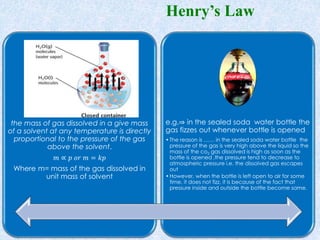
the mass of gas dissolved in a give mass
of a solvent at any temperature is directly
proportional to the pressure of the gas
above the solvent.
𝑚 ∝ 𝑝 𝑜𝑟 𝑚 = 𝑘𝑝
Where m= mass of the gas dissolved in
unit mass of solvent
e.g.⇒ in the sealed soda water bottle the
gas fizzes out whenever bottle is opened
•The reason is …… in the sealed soda water bottle the
pressure of the gas is very high above the liquid so the
mass of the co2 gas dissolved is high as soon as the
bottle is opened ,the pressure tend to decrease to
atmospheric pressure i.e. the dissolved gas escapes
out
•However, when the bottle is left open to air for some
time, it does not fizz, it is because of the fact that
pressure inside and outside the bottle become same.
Henry’s Law
General characteristics if equilibrium involving physical
processes
1. At equilibrium some observable property of the system becomes constant
2. Equiibria involving gases can be attained only in closed vessels
3. Equilibrium is dynamic in nature i.e. the two opposing processes takes place
at equal rates
4. At equilibrium the concentrations of different substances becomes constant
at constant temperature
5. At equilibrium there exist an expression involving concentrations of the
substances which is constant at constant temperature e.g.
CO2 (g) ⇌ CO2 (aq)
CO2(aq)
CO2(g)
=constant at constant temperature
6. The magnitude of equilibrium constant is related to the extent to which the
process proceeds before acquiring equilibrium eg;
CO2 aq ⇌ CO2(g)
 If the opposing forces involve only chemical changes i.e. the
opposing forces are chemical reactions . The equilibrium is called
chemical equilibrium.
 REVERSIBLE REACTION:- a reaction which takes place not only in
forward direction but also in backward direction under the same
condition . Eg-
3fe (s) +4H2o (g) ⇌ Fe3o4 (s) + 4H2 (g)
 IRREVERSIBLE REACTION:- a reaction which can not take place in
the reverse direction i.e. the products formed do not react to give
back the same reactants under same conditions. Eg –
2Mg + O2 → 2MgO
consider a reversible reaction :
A + B ⇌ C+D
As the reaction is carried out in a closed vessel .after some time , ultimately a
stage comes when the rate of forward reaction is equal to the rate of backward
reaction the reaction is then said to be in the state of chemical equilibrium
The concentrations of the reactants and products remain constant.
E.g.-
𝑁2 𝑂4(𝑔) ⇌ 2𝑁𝑂2(𝑔)
CaCO3 ⇌ CaO(s) + CO2(g)
 Dynamic nature of chemical equilibrium
As much of the reactants react to form products ,then same amount of products
react to give back the reactants in the same time ; hence it is dynamic in nature .
Dynamic chemical equilibrium
Dynamic equilibrium is the state of a reversible reaction where the forward
reaction rate is equal to the reverse reaction rate, resulting in no observable
net change in the system.
Reactions are continuing to proceed in the forward and reverse direction
dynamically; however, there is no net change in the amount of product or
starting material.
Dynamic equilibrium is also called steady state.
In the early stage of a reversible reaction, the forward reaction proceeds
more quickly than the reverse until the equilibrium state is reached when the
forward and reverse rates are equal.
An example
of a dynamic
equilibrium
is…
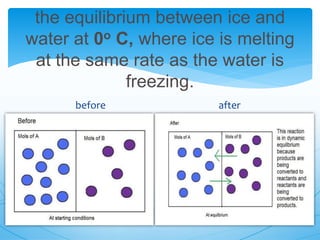
the equilibrium between ice and
water at 0o C, where ice is melting
at the same rate as the water is
freezing.
before after
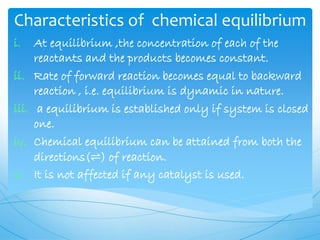
Characteristics of chemical equilibrium
i. At equilibrium ,the concentration of each of the
reactants and the products becomes constant.
ii. Rate of forward reaction becomes equal to backward
reaction , i.e. equilibrium is dynamic in nature.
iii. a equilibrium is established only if system is closed
one.
iv. Chemical equilibrium can be attained from both the
directions(⇌) of reaction.
v. It is not affected if any catalyst is used.
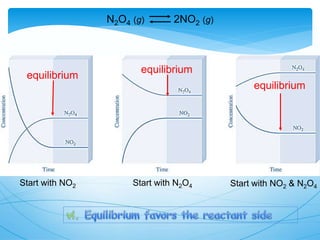
N2O4 (g) 2NO2 (g)
Start with NO2 Start with N2O4 Start with NO2 & N2O4
equilibrium
equilibrium
equilibrium
Law of mass action
 “The rate at which a substance reacts is proportional to its active mass and
hence the rate of a chemical reaction is proportional to the product of the
active masses of the reaction”
 Active mass = molar concentration OR it is the number of moles dissolved
per litre of solution
example: x g NaOH is dissolved in V liters of soln.
Then, active mass or molar concn
= 𝑥
40 moles in V liters
 Consider a reaction A+B⟶products
Then
Rate at which A &B react together ∝ [A][B]
Or rate = k [A][B]
Law of chemical equilibrium
& Equilibrium constant
“the product of the molar concentrations of the product ,
each raised to power equal to its stoichiometric
coefficient divided by the product of molar concentration
of the reactants each raised to a power each raised to
power equal to its stoichiometric coefficient is constant at
constant temperature and is called equilibrium constant”
consider a reversible reaction
A+B⇌C+D
thenAt equilibrium state,
Rate of forward reaction= kf [A][B] {kf is constant of proportionality}
Rate of backward reaction= kb [C][D] {kb is constant of proportionality}
Rate of forward reaction= Rate of backward reaction.
𝑘 𝑓 𝐴 𝐵 = 𝐾 𝐵 𝐶 𝐷
𝑘 𝑓
𝑘 𝑏
=
𝐶 𝐷
𝐴 𝐵
At constant temperature 𝑘 𝑓 and 𝑘 𝑏are constant. Therefore, substituting
𝑘 𝑓
𝑘 𝑏
by another
constant K we get,
𝐾 =
𝑘 𝑓
𝑘 𝑏
=
𝐶 𝐷
𝐴 𝐵
Here K is also a constant at constant temperature
And K is called EQUILIBRIUM CONSTANT
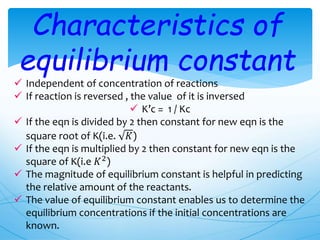
Characteristics of
equilibrium constant
 Independent of concentration of reactions
 If reaction is reversed , the value of it is inversed
 K’c = 1 / Kc
 If the eqn is divided by 2 then constant for new eqn is the
square root of K(i.e. 𝐾)
 If the eqn is multiplied by 2 then constant for new eqn is the
square of K(i.e 𝐾2)
 The magnitude of equilibrium constant is helpful in predicting
the relative amount of the reactants.
 The value of equilibrium constant enables us to determine the
equilibrium concentrations if the initial concentrations are
known.
General form
 aA +bB⇌cC + dD
 Kc =[C]c [D]d / [A]a [B]b
 Where a, b, c and d have the same values as those in
the balanced chemical equation.
Chemical equation
aA + b B⇌c C + D
cC + d D⇌a A + b B
na A + nb B ⇌ncC + ndD
Equilibrium constant
K
K′c=(1/Kc)
K′″c= (Kcn)
Concentrations or partial pressure of pure solids or liquids do not appear
in the expression of the equilibrium constant.
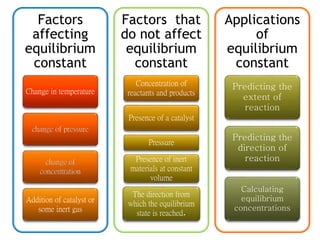
Factors
affecting
equilibrium
constant
Change in temperature
change of pressure
change of
concentration
Addition of catalyst or
some inert gas
Factors that
do not affect
equilibrium
constant
Concentration of
reactants and products
Presence of a catalyst
Pressure
Presence of inert
materials at constant
volume
The direction from
which the equilibrium
state is reached.
Applications
of
equilibrium
constant
Predicting the
extent of
reaction
Predicting the
direction of
reaction
Calculating
equilibrium
concentrations
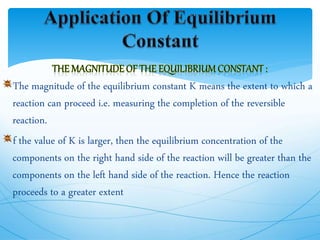
The magnitude of the equilibrium constant K means the extent to which a
reaction can proceed i.e. measuring the completion of the reversible
reaction.
f the value of K is larger, then the equilibrium concentration of the
components on the right hand side of the reaction will be greater than the
components on the left hand side of the reaction. Hence the reaction
proceeds to a greater extent
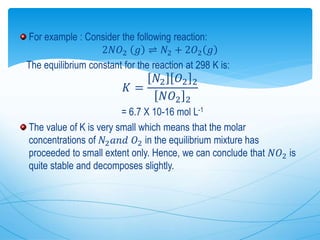
For example : Consider the following reaction:
2𝑁𝑂2 𝑔 ⇌ 𝑁2 + 2𝑂2 𝑔
The equilibrium constant for the reaction at 298 K is:
𝐾 =
𝑁2 𝑂2 2
𝑁𝑂2 2
= 6.7 X 10⁻¹⁶ mol L-1
The value of K is very small which means that the molar
concentrations of 𝑁2 𝑎𝑛𝑑 𝑂2 in the equilibrium mixture has
proceeded to small extent only. Hence, we can conclude that 𝑁𝑂2 is
quite stable and decomposes slightly.
The equilibrium constant helps in finding the direction in which
reaction proceeds. For this, we have to calculate the reaction
quotient [Q].
The reaction quotient [Q] is the ratio of the product of
concentrations of the products to that of the reactants. For
example:
Consider the following reaction:
A + B ⇌ X + Y
The reaction quotient, 𝑄 = 𝑋 𝑌
𝐴 𝐵
The reaction quotient is defined as : the equilibrium constant
with molar concentrations to give Qc or partial pressures to
give 𝑄 𝑐as:
𝑙𝐴 + 𝑚𝐵 ⇌ 𝑥𝐶 + 𝑦𝐷
𝑄 𝑐 = 𝐶 𝑥 𝐷 𝑦
𝐴 𝑙 𝐵 𝑚
At equilibrium, 𝑄 𝑐 = 𝐾 . Hence,
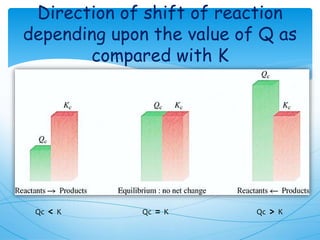
If Qc > Kc, the reaction will proceed in the reverse direction i.e.
in the direction of reactants.
If Qc < Kc, the reaction will proceed in the forward direction i.e.
in the direction of products.
note
If Qc = Kc, the reaction will not proceed
as reaction is already in equilibrium.
Hence we concluded that a reaction has
the tendency to form products if Q < K
and to form reactants if Q > K.
Direction of shift of reaction
depending upon the value of Q as
compared with K
Qc < K Qc = K Qc > K
When Qc<K
Reaction will proceed in backward direction
When Qc=K
Reaction will be at equilibrium
When Qc>K
Reaction will proceed in forward direction
NOTE
Homogeneous equilibrium- In a homogeneous system, all the
reactants and products are in the same phase.
For e.g.
𝑁𝟐 𝑔 + 3𝐻2 𝑔 ⇌ 2𝑁𝐻3 𝑔
In this gaseous reaction, reactants and products are in the
homogeneous phase(all are in gaseous phase).
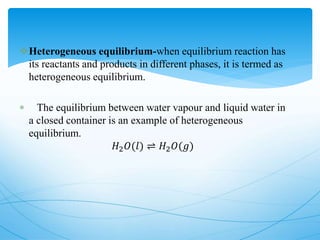
Heterogeneous equilibrium-when equilibrium reaction has
its reactants and products in different phases, it is termed as
heterogeneous equilibrium.
 The equilibrium between water vapour and liquid water in
a closed container is an example of heterogeneous
equilibrium.
𝐻2 𝑂(𝑙) ⇌ 𝐻2 𝑂(𝑔)
THANK
YOU.....
 A PRESENTATION BY :
ANKIT KUMAR
11TH B
ROLL NO 35

Chemistryppt chemical equilibrium

  • 1.
  • 2.
    Equilibrium represent thestate of process in which the properties like temperature ,pressure , concentration of the system do not show any change with the passage of time . Equilibrium is a general term which applies not only to chemical reactions but applies to physical changes as well . e.g. ice and water are In equilibrium at Oo C and atmospheric pressure . In all process which attain equilibrium two opposing processes are involved Equilibrium is attained when the rate of the two processes becomes equal & takes place at equal rate The mixture of reactants and products at equilibrium is called equilibrium mixture
  • 3.
    When rate offormation of a product in a process is in competition with rate of formation of reactants, the state is then named as "Equilibrium state” Equilibrium in physical processes: solid ⇌ liquid ⇌ gas H2O(s )⇌ H2O(l) ⇌ H2O(vap)
  • 5.
     If theopposing forces involve only physical changes the equilibrium is physical .  Solid – liquid equilibrium Solid ⇌ Liquid H2o(s) ⇌ H2o (l) For this solution Rate of melting of ice = Rate of freezing of water.  liquid – vapor equilibrium Liquid ⇌ Gas H2o(l) ⇌ H2o (g) For this solution Rate of evaporation = Rate of condensation  Solid - vapor equilibrium { for solids which undergo sublimation} solid ⇌ gas Camphor(s) ⇌ camphor(g) For this Rate of sublimation of solid = Rate of condensation of vapour
  • 6.
     Solid -solution equilibrium { dissolution of sugar in water} sugar(solid) ⇌ sugar (in solution) For this solution Rate of dissolution = Rate of precipitation  gas – solution equilibrium { dissolution of a gas in liquid under pressure In closed vessel} CO2 (g) ⇌ CO2 (in solution)
  • 7.
    the mass ofgas dissolved in a give mass of a solvent at any temperature is directly proportional to the pressure of the gas above the solvent. 𝑚 ∝ 𝑝 𝑜𝑟 𝑚 = 𝑘𝑝 Where m= mass of the gas dissolved in unit mass of solvent e.g.⇒ in the sealed soda water bottle the gas fizzes out whenever bottle is opened •The reason is …… in the sealed soda water bottle the pressure of the gas is very high above the liquid so the mass of the co2 gas dissolved is high as soon as the bottle is opened ,the pressure tend to decrease to atmospheric pressure i.e. the dissolved gas escapes out •However, when the bottle is left open to air for some time, it does not fizz, it is because of the fact that pressure inside and outside the bottle become same. Henry’s Law
  • 8.
    General characteristics ifequilibrium involving physical processes 1. At equilibrium some observable property of the system becomes constant 2. Equiibria involving gases can be attained only in closed vessels 3. Equilibrium is dynamic in nature i.e. the two opposing processes takes place at equal rates 4. At equilibrium the concentrations of different substances becomes constant at constant temperature 5. At equilibrium there exist an expression involving concentrations of the substances which is constant at constant temperature e.g. CO2 (g) ⇌ CO2 (aq) CO2(aq) CO2(g) =constant at constant temperature 6. The magnitude of equilibrium constant is related to the extent to which the process proceeds before acquiring equilibrium eg; CO2 aq ⇌ CO2(g)
  • 9.
     If theopposing forces involve only chemical changes i.e. the opposing forces are chemical reactions . The equilibrium is called chemical equilibrium.  REVERSIBLE REACTION:- a reaction which takes place not only in forward direction but also in backward direction under the same condition . Eg- 3fe (s) +4H2o (g) ⇌ Fe3o4 (s) + 4H2 (g)  IRREVERSIBLE REACTION:- a reaction which can not take place in the reverse direction i.e. the products formed do not react to give back the same reactants under same conditions. Eg – 2Mg + O2 → 2MgO
  • 10.
    consider a reversiblereaction : A + B ⇌ C+D As the reaction is carried out in a closed vessel .after some time , ultimately a stage comes when the rate of forward reaction is equal to the rate of backward reaction the reaction is then said to be in the state of chemical equilibrium The concentrations of the reactants and products remain constant. E.g.- 𝑁2 𝑂4(𝑔) ⇌ 2𝑁𝑂2(𝑔) CaCO3 ⇌ CaO(s) + CO2(g)  Dynamic nature of chemical equilibrium As much of the reactants react to form products ,then same amount of products react to give back the reactants in the same time ; hence it is dynamic in nature .
  • 11.
    Dynamic chemical equilibrium Dynamicequilibrium is the state of a reversible reaction where the forward reaction rate is equal to the reverse reaction rate, resulting in no observable net change in the system. Reactions are continuing to proceed in the forward and reverse direction dynamically; however, there is no net change in the amount of product or starting material. Dynamic equilibrium is also called steady state. In the early stage of a reversible reaction, the forward reaction proceeds more quickly than the reverse until the equilibrium state is reached when the forward and reverse rates are equal.
  • 12.
    An example of adynamic equilibrium is…
  • 13.
    the equilibrium betweenice and water at 0o C, where ice is melting at the same rate as the water is freezing. before after
  • 14.
    Characteristics of chemicalequilibrium i. At equilibrium ,the concentration of each of the reactants and the products becomes constant. ii. Rate of forward reaction becomes equal to backward reaction , i.e. equilibrium is dynamic in nature. iii. a equilibrium is established only if system is closed one. iv. Chemical equilibrium can be attained from both the directions(⇌) of reaction. v. It is not affected if any catalyst is used.
  • 15.
    N2O4 (g) 2NO2(g) Start with NO2 Start with N2O4 Start with NO2 & N2O4 equilibrium equilibrium equilibrium
  • 16.
    Law of massaction  “The rate at which a substance reacts is proportional to its active mass and hence the rate of a chemical reaction is proportional to the product of the active masses of the reaction”  Active mass = molar concentration OR it is the number of moles dissolved per litre of solution example: x g NaOH is dissolved in V liters of soln. Then, active mass or molar concn = 𝑥 40 moles in V liters  Consider a reaction A+B⟶products Then Rate at which A &B react together ∝ [A][B] Or rate = k [A][B]
  • 17.
    Law of chemicalequilibrium & Equilibrium constant “the product of the molar concentrations of the product , each raised to power equal to its stoichiometric coefficient divided by the product of molar concentration of the reactants each raised to a power each raised to power equal to its stoichiometric coefficient is constant at constant temperature and is called equilibrium constant”
  • 18.
    consider a reversiblereaction A+B⇌C+D thenAt equilibrium state, Rate of forward reaction= kf [A][B] {kf is constant of proportionality} Rate of backward reaction= kb [C][D] {kb is constant of proportionality} Rate of forward reaction= Rate of backward reaction. 𝑘 𝑓 𝐴 𝐵 = 𝐾 𝐵 𝐶 𝐷 𝑘 𝑓 𝑘 𝑏 = 𝐶 𝐷 𝐴 𝐵 At constant temperature 𝑘 𝑓 and 𝑘 𝑏are constant. Therefore, substituting 𝑘 𝑓 𝑘 𝑏 by another constant K we get, 𝐾 = 𝑘 𝑓 𝑘 𝑏 = 𝐶 𝐷 𝐴 𝐵 Here K is also a constant at constant temperature And K is called EQUILIBRIUM CONSTANT
  • 19.
    Characteristics of equilibrium constant Independent of concentration of reactions  If reaction is reversed , the value of it is inversed  K’c = 1 / Kc  If the eqn is divided by 2 then constant for new eqn is the square root of K(i.e. 𝐾)  If the eqn is multiplied by 2 then constant for new eqn is the square of K(i.e 𝐾2)  The magnitude of equilibrium constant is helpful in predicting the relative amount of the reactants.  The value of equilibrium constant enables us to determine the equilibrium concentrations if the initial concentrations are known.
  • 20.
    General form  aA+bB⇌cC + dD  Kc =[C]c [D]d / [A]a [B]b  Where a, b, c and d have the same values as those in the balanced chemical equation. Chemical equation aA + b B⇌c C + D cC + d D⇌a A + b B na A + nb B ⇌ncC + ndD Equilibrium constant K K′c=(1/Kc) K′″c= (Kcn) Concentrations or partial pressure of pure solids or liquids do not appear in the expression of the equilibrium constant.
  • 21.
    Factors affecting equilibrium constant Change in temperature changeof pressure change of concentration Addition of catalyst or some inert gas Factors that do not affect equilibrium constant Concentration of reactants and products Presence of a catalyst Pressure Presence of inert materials at constant volume The direction from which the equilibrium state is reached. Applications of equilibrium constant Predicting the extent of reaction Predicting the direction of reaction Calculating equilibrium concentrations
  • 22.
    The magnitude ofthe equilibrium constant K means the extent to which a reaction can proceed i.e. measuring the completion of the reversible reaction. f the value of K is larger, then the equilibrium concentration of the components on the right hand side of the reaction will be greater than the components on the left hand side of the reaction. Hence the reaction proceeds to a greater extent
  • 23.
    For example :Consider the following reaction: 2𝑁𝑂2 𝑔 ⇌ 𝑁2 + 2𝑂2 𝑔 The equilibrium constant for the reaction at 298 K is: 𝐾 = 𝑁2 𝑂2 2 𝑁𝑂2 2 = 6.7 X 10⁻¹⁶ mol L-1 The value of K is very small which means that the molar concentrations of 𝑁2 𝑎𝑛𝑑 𝑂2 in the equilibrium mixture has proceeded to small extent only. Hence, we can conclude that 𝑁𝑂2 is quite stable and decomposes slightly.
  • 24.
    The equilibrium constanthelps in finding the direction in which reaction proceeds. For this, we have to calculate the reaction quotient [Q]. The reaction quotient [Q] is the ratio of the product of concentrations of the products to that of the reactants. For example: Consider the following reaction: A + B ⇌ X + Y The reaction quotient, 𝑄 = 𝑋 𝑌 𝐴 𝐵
  • 25.
    The reaction quotientis defined as : the equilibrium constant with molar concentrations to give Qc or partial pressures to give 𝑄 𝑐as: 𝑙𝐴 + 𝑚𝐵 ⇌ 𝑥𝐶 + 𝑦𝐷 𝑄 𝑐 = 𝐶 𝑥 𝐷 𝑦 𝐴 𝑙 𝐵 𝑚 At equilibrium, 𝑄 𝑐 = 𝐾 . Hence, If Qc > Kc, the reaction will proceed in the reverse direction i.e. in the direction of reactants. If Qc < Kc, the reaction will proceed in the forward direction i.e. in the direction of products.
  • 26.
    note If Qc =Kc, the reaction will not proceed as reaction is already in equilibrium. Hence we concluded that a reaction has the tendency to form products if Q < K and to form reactants if Q > K.
  • 27.
    Direction of shiftof reaction depending upon the value of Q as compared with K Qc < K Qc = K Qc > K
  • 28.
    When Qc<K Reaction willproceed in backward direction When Qc=K Reaction will be at equilibrium When Qc>K Reaction will proceed in forward direction NOTE
  • 29.
    Homogeneous equilibrium- Ina homogeneous system, all the reactants and products are in the same phase. For e.g. 𝑁𝟐 𝑔 + 3𝐻2 𝑔 ⇌ 2𝑁𝐻3 𝑔 In this gaseous reaction, reactants and products are in the homogeneous phase(all are in gaseous phase).
  • 30.
    Heterogeneous equilibrium-when equilibriumreaction has its reactants and products in different phases, it is termed as heterogeneous equilibrium.  The equilibrium between water vapour and liquid water in a closed container is an example of heterogeneous equilibrium. 𝐻2 𝑂(𝑙) ⇌ 𝐻2 𝑂(𝑔)
  • 31.
    THANK YOU.....  A PRESENTATIONBY : ANKIT KUMAR 11TH B ROLL NO 35