interactive immunologyIntroduction Taradi 1
Prof. dr. Milan Taradi, M.D. PhDProf. dr. Milan Taradi, M.D. PhD
Department of Physiology and ImmunologyDepartment of Physiology and Immunology
IMMUNOLOGYIMMUNOLOGY
IntroductionIntroduction
interactive immunologyIntroduction Taradi 2
Learning ObjectivesLearning Objectives
 DefinitionDefinition
 Overview of theOverview of the iimmunemmune ssystemystem
 ComparativeComparative iimmunitymmunity
 HistoryHistory
 Basic type of immunityBasic type of immunity
 innate (natural), adaptive (specific)
 active, passive, adoptive
 humoral, cellular
 Parts ofParts of iimmune systemmmune system
 organs of the immune system
 primary
 secondary
 cells of the immune system
 lymphocytes
 antigen-presenting cells
 molecules, genes
 ImmuneImmune ddysfunction andysfunction and iitsts cconsequencesonsequences
interactive immunologyIntroduction Taradi 3
DefinitionDefinition
 The discipline of immunology grew out of theThe discipline of immunology grew out of the
observation that individuals who had recoveredobservation that individuals who had recovered
from certain infectious diseases were thereafterfrom certain infectious diseases were thereafter
protected from the disease.protected from the disease.
 TheThe specificspecific immune system is a remarkablyimmune system is a remarkably
adaptive defenadaptive defensse system that has evolved ine system that has evolved in
vertebrates to protect them from invadingvertebrates to protect them from invading
pathogenic microorganisms and cancer.pathogenic microorganisms and cancer.
 The Latin term immunis, meaning “exemptThe Latin term immunis, meaning “exempt””, is, is
the source of the English word immunity,the source of the English word immunity,
meaning the state of protection from infectiousmeaning the state of protection from infectious
disease.disease.
interactive immunologyIntroduction Taradi 4
FunctionFunction of the Immune Systemof the Immune System
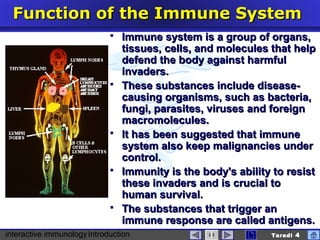
 Immune system is a group of organs,Immune system is a group of organs,
tissues, celltissues, cellss, and molecules that help, and molecules that help
defend the body against harmfuldefend the body against harmful
invaders.invaders.
 These substances include disease-These substances include disease-
causing organisms, such as bacteria,causing organisms, such as bacteria,
fungi, parasites, virusesfungi, parasites, viruses and foreignand foreign
macromoleculesmacromolecules..
 It has been suggested that immuneIt has been suggested that immune
system also keep malignancies undersystem also keep malignancies under
control.control.
 Immunity is the body's ability to resistImmunity is the body's ability to resist
these invadersthese invaders and is crucial toand is crucial to
human survival.human survival.
 The substances that trigger anThe substances that trigger an
immune response are called antigens.immune response are called antigens.
interactive immunologyIntroduction Taradi 5
FunctionFunction of immunityof immunity
 immune defenceimmune defence (anti-infection)(anti-infection)
 immune surveillanceimmune surveillance (anti-tumour)(anti-tumour)
 immune homeostasisimmune homeostasis ((eliminateeliminate
injured or died cellsinjured or died cells))
interactive immunologyIntroduction Taradi 6
Comparative ImmunityComparative Immunity
 All animals have innate (non-adaptive, native,All animals have innate (non-adaptive, native,
natural) system that acts as a first line of defensenatural) system that acts as a first line of defense
against foreign invaders.against foreign invaders.
 SSome typeome typess of innate immunity appear to beof innate immunity appear to be
characteristiccharacteristicss of multicellular organisms, andof multicellular organisms, and
immunity has been demonstrated in organisms asimmunity has been demonstrated in organisms as
different as insects, earthworms, and higherdifferent as insects, earthworms, and higher
plants.plants.
 The signature elements ofThe signature elements of specific (specific (adaptiveadaptive))
immunity, lymphocytes and antibodies, are foundimmunity, lymphocytes and antibodies, are found
only in vertebrates.only in vertebrates.
interactive immunologyIntroduction Taradi 7
History -History - EEarlyarly DDiscoveriesiscoveries
 The scientific study of the immuneThe scientific study of the immune
system, known as immunology,system, known as immunology,
dates from about the late 1800's.dates from about the late 1800's.
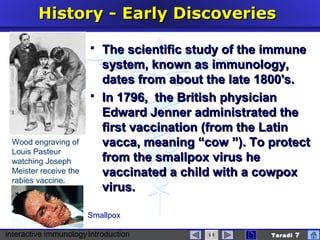
 InIn 1791796, the British physician6, the British physician
Edward Jenner administEdward Jenner administratedrated thethe
first vaccination (from the Latinfirst vaccination (from the Latin
vacca, meaning “cow ”). To protectvacca, meaning “cow ”). To protect
from the smallpox virus hefrom the smallpox virus he
vaccinated a child with a cowpoxvaccinated a child with a cowpox
virus.virus.
Wood engraving of
Louis Pasteur
watching Joseph
Meister receive the
rabies vaccine.
Smallpox
interactive immunologyIntroduction Taradi 8
History -History - EEarlyarly DDiscoveriesiscoveries
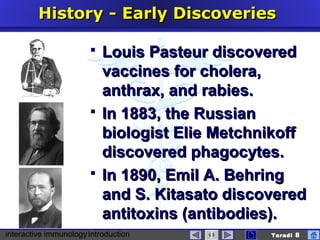
 Louis Pasteur discoveredLouis Pasteur discovered
vaccines for cholera,vaccines for cholera,
anthrax, and rabieanthrax, and rabies.s.
 In 1883, the RussianIn 1883, the Russian
biologist Elie Metchnikoffbiologist Elie Metchnikoff
discovered phagocytes.discovered phagocytes.
 In 1890, Emil A. BehringIn 1890, Emil A. Behring
and S. Kitasato discoveredand S. Kitasato discovered
antitoxinantitoxinss (antibodies).(antibodies).
interactive immunologyIntroduction Taradi 9
History -History - FFurtherurther BBreakthroughsreakthroughs
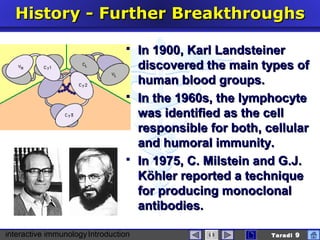
 InIn 19001900,, Karl LandsteinerKarl Landsteiner
discovered the main types ofdiscovered the main types of
human blood groups.human blood groups.
 In the 1960s, the lymphocyteIn the 1960s, the lymphocyte
was identified as the cellwas identified as the cell
responsible for bothresponsible for both,, cellularcellular
and humoral immunity.and humoral immunity.
 In 1975In 1975,, C. Milstein and G.J.C. Milstein and G.J.
Köhler reported a techniqueKöhler reported a technique
for producing monoclonalfor producing monoclonal
antibodies.antibodies.
interactive immunologyIntroduction Taradi 10
TwoTwo BBasicasic TTypeypess ofof IImmunitymmunity
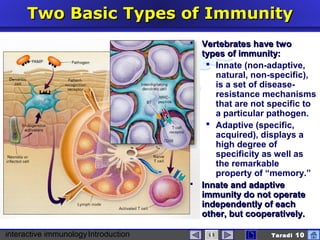
 Vertebrates have twoVertebrates have two
types of immunity:types of immunity:
 Innate (non-adaptive,
natural, non-specific),
is a set of disease-
resistance mechanisms
that are not specific to
a particular pathogen.
 Adaptive (specific,
acquired), displays a
high degree of
specificity as well as
the remarkable
property of “memory.”
 Innate and adaptiveInnate and adaptive
immunity do not operateimmunity do not operate
independently of eachindependently of each
other, but cooperatively.other, but cooperatively.
interactive immunologyIntroduction Taradi 11
1)1) Innate (NonInnate (Non--specific) Immunityspecific) Immunity
 Innate immune responsesInnate immune responses
begin much more quicklybegin much more quickly
than adaptive ones andthan adaptive ones and
therefore constitute the firsttherefore constitute the first
line of defenline of defensse.e.
 The innate immune systemThe innate immune system
consists of all the immuneconsists of all the immune
defendefensses that lackes that lack
immunologic memory.immunologic memory.
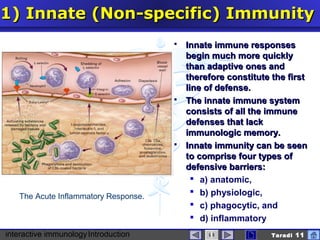
 Innate immunity can be seenInnate immunity can be seen
to comprise four types ofto comprise four types of
defensive barriers:defensive barriers:
 a) anatomic,
 b) physiologic,
 c) phagocytic, and
 d) inflammatory
The Acute Inflammatory Response.
interactive immunologyIntroduction Taradi 12
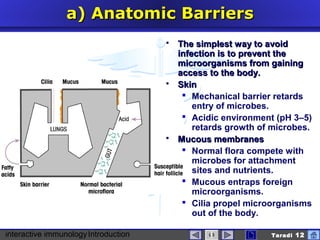
a)a) AnatomicAnatomic BBarriersarriers
 The simplest way to avoidThe simplest way to avoid
infection is to prevent theinfection is to prevent the
microorganisms from gainingmicroorganisms from gaining
access to the body.access to the body.
 SkinSkin
 Mechanical barrier retards
entry of microbes.
 Acidic environment (pH 3–5)
retards growth of microbes.
 Mucous membranesMucous membranes
 Normal flora compete with
microbes for attachment
sites and nutrients.
 Mucous entraps foreign
microorganisms.
 Cilia propel microorganisms
out of the body.
interactive immunologyIntroduction Taradi 13
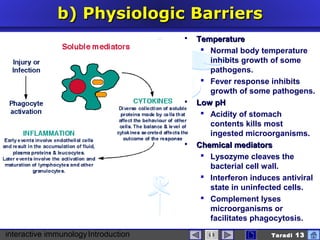
b)b) PhysiologicPhysiologic BBarriersarriers
 TemperatureTemperature
 Normal body temperature
inhibits growth of some
pathogens.
 Fever response inhibits
growth of some pathogens.
 Low pHLow pH
 Acidity of stomach
contents kills most
ingested microorganisms.
 Chemical mediatorsChemical mediators
 Lysozyme cleaves the
bacterial cell wall.
 Interferon induces antiviral
state in uninfected cells.
 Complement lyses
microorganisms or
facilitates phagocytosis.
interactive immunologyIntroduction Taradi 14
c)c) Phagocytic/Phagocytic/EEndocyticndocytic BBarriersarriers
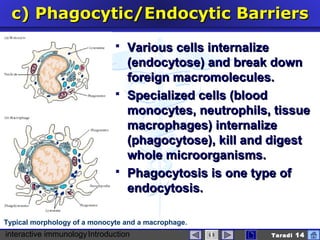
 Various cells internalizeVarious cells internalize
(endocytose) and break down(endocytose) and break down
foreign macromolecules.foreign macromolecules.
 Specialized cells (bloodSpecialized cells (blood
monocytes, neutrophils, tissuemonocytes, neutrophils, tissue
macrophages) internalizemacrophages) internalize
(phagocytose), kill and digest(phagocytose), kill and digest
whole microorganisms.whole microorganisms.
 Phagocytosis is one type ofPhagocytosis is one type of
endocytosis.endocytosis.
Typical morphology of a monocyte and a macrophage.
interactive immunologyIntroduction Taradi 15
d)d) InflammatoryInflammatory BBarriersarriers
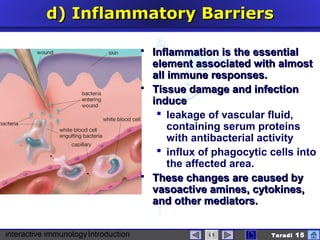
 Inflammation isInflammation is thethe essentialessential
element associated with almostelement associated with almost
all immune responses.all immune responses.
 Tissue damage and infectionTissue damage and infection
induceinduce
 leakage of vascular fluid,
containing serum proteins
with antibacterial activity
 influx of phagocytic cells into
the affected area.
 These changes are caused byThese changes are caused by
vasoactive amines, cytokines,vasoactive amines, cytokines,
and other mediators.and other mediators.
interactive immunologyIntroduction Taradi 16
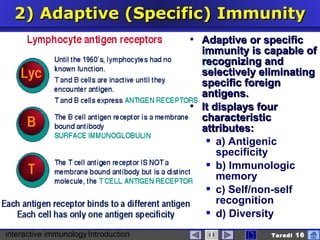
2)2) Adaptive (Specific) ImmunityAdaptive (Specific) Immunity
 Adaptive or specificAdaptive or specific
immunity is capable ofimmunity is capable of
recognizing andrecognizing and
selectively eliminatingselectively eliminating
specific foreignspecific foreign
antigens.antigens.
 It displays fourIt displays four
characteristiccharacteristic
attributes:attributes:
 a) Antigenic
specificity
 b) Immunologic
memory
 c) Self/non-self
recognition
 d) Diversity
interactive immunologyIntroduction Taradi 17
a)a) AntigenicAntigenic SSpecificitypecificity
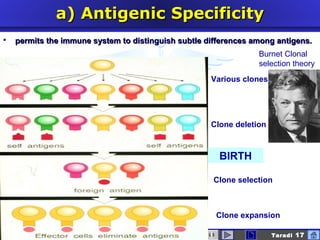
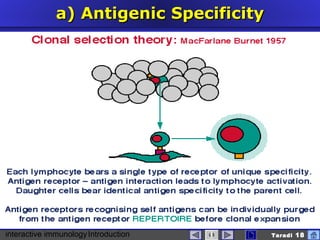
 ppermits the immune system to distinguish subtle differences among antigens.ermits the immune system to distinguish subtle differences among antigens.
Burnet Clonal
selection theory
Various clones
Clone deletion
Clone selection
Clone expansion
BIRTH
interactive immunologyIntroduction Taradi 18
a)a) AntigenicAntigenic SSpecificitypecificity
interactive immunologyIntroduction Taradi 19
b)b) ImmunologicImmunologic MMemoryemory
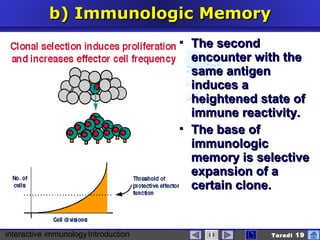
 The secondThe second
encounter with theencounter with the
same antigensame antigen
induces ainduces a
heightened state ofheightened state of
immune reactivity.immune reactivity.
 The base ofThe base of
immunologicimmunologic
memory is selectivememory is selective
expansion ofexpansion of aa
certain clone.certain clone.
interactive immunologyIntroduction Taradi 20
Primary and SecondaryPrimary and Secondary RResponseesponse
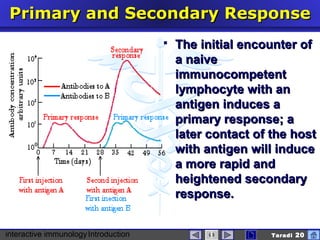
 The initial encounter ofThe initial encounter of
a naivea naive
immunocompetentimmunocompetent
lymphocyte with anlymphocyte with an
antigen induces aantigen induces a
primary response; aprimary response; a
later contact of the hostlater contact of the host
with antigen will inducewith antigen will induce
a more rapid anda more rapid and
heightened secondaryheightened secondary
response.response.
interactive immunologyIntroduction Taradi 21
c)c) Self/NonSelf/Non--self Recognitionself Recognition
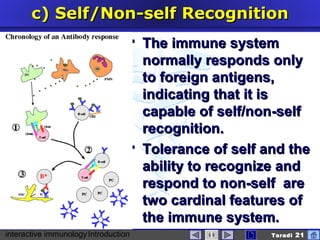
 The immune systemThe immune system
normally responds onlynormally responds only
to foreign antigens,to foreign antigens,
indicating that it isindicating that it is
capable of self/noncapable of self/non--selfself
recognition.recognition.
 Tolerance of self and theTolerance of self and the
ability to recognize andability to recognize and
respond to non-self arerespond to non-self are
two cardinal features oftwo cardinal features of
thethe immune system.immune system.
interactive immunologyIntroduction Taradi 22
d)d) DiversityDiversity
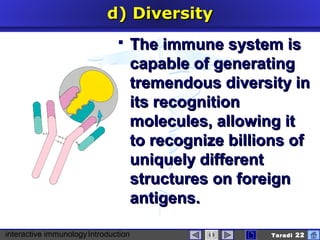
 The immune system isThe immune system is
capable of generatingcapable of generating
tremendous diversity intremendous diversity in
its recognitionits recognition
molecules, allowing itmolecules, allowing it
to recognize billions ofto recognize billions of
uniquely differentuniquely different
structures on foreignstructures on foreign
antigenantigenss..
interactive immunologyIntroduction Taradi 23
ThreeThree KKinds ofinds of SSpecificpecific IImmunitymmunity
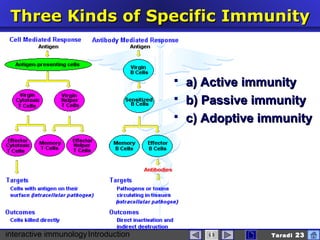
 a)a) Active immunityActive immunity
 b)b) Passive immunityPassive immunity
 c)c) Adoptive immunityAdoptive immunity
interactive immunologyIntroduction Taradi 24
a)a) ActiveActive IImmunitymmunity
 Active immunity is acquired after a certainActive immunity is acquired after a certain
antigen enters the body.antigen enters the body.
 Natural acquiredNatural acquired
 - through infection (disease)
 Artificial acquiredArtificial acquired
 - through vaccination (immunization, active
immunoprophylaxis)
 A vaccine contains bacteria or viruses that haveA vaccine contains bacteria or viruses that have
been killed or weakened so they produce onlybeen killed or weakened so they produce only
mild symptoms of the disease or no symptoms atmild symptoms of the disease or no symptoms at
all.all.
interactive immunologyIntroduction Taradi 25
b)b) PassivePassive IImmunitymmunity
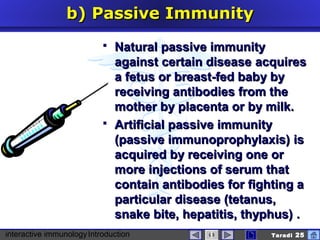
 NaturalNatural passive immunitypassive immunity
against certain diseaseagainst certain disease acquireacquiress
aa fetus or breast-fed babfetus or breast-fed babyy byby
receiving antibodies from thereceiving antibodies from the
mother by placenta or by milk.mother by placenta or by milk.
 Artificial pArtificial passive immunityassive immunity
(passive immunoprophylaxis)(passive immunoprophylaxis) isis
acquired by receiving one oracquired by receiving one or
more injections of serummore injections of serum thatthat
contain antibodies for fighting acontain antibodies for fighting a
particular diseaseparticular disease (tetanus,(tetanus,
snake bite, hepatitis, thyphus)snake bite, hepatitis, thyphus) ..
interactive immunologyIntroduction Taradi 26
c)c) AdoptiveAdoptive IImmunitymmunity
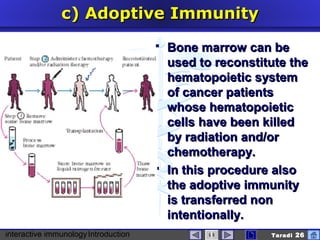
 Bone marrow can beBone marrow can be
used to reconstitute theused to reconstitute the
hematopoietic systemhematopoietic system
of cancer patientsof cancer patients
whose hematopoieticwhose hematopoietic
cells have been killedcells have been killed
by radiation and/orby radiation and/or
chemotherapy.chemotherapy.
 In this procedure alsoIn this procedure also
the adoptive immunitythe adoptive immunity
is transferred nonis transferred non
intentionally.intentionally.
interactive immunologyIntroduction Taradi 27
Humoral and Cellular ImmunityHumoral and Cellular Immunity
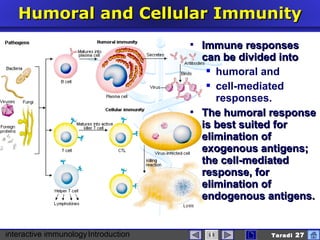
 Immune responsesImmune responses
can be divided intocan be divided into
 humoral and
 cell-mediated
responses.
 The humoral responseThe humoral response
is best suited foris best suited for
elimination ofelimination of
exogenous antigens;exogenous antigens;
the cell-mediatedthe cell-mediated
response, forresponse, for
elimination ofelimination of
endogenous antigens.endogenous antigens.
interactive immunologyIntroduction Taradi 28
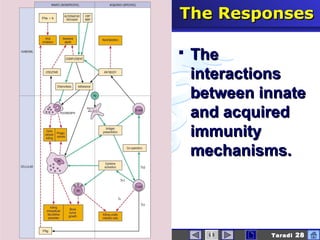
The ResponsesThe Responses
 TheThe
interactionsinteractions
between innatebetween innate
and acquiredand acquired
immunityimmunity
mechanisms.mechanisms.
interactive immunologyIntroduction Taradi 29
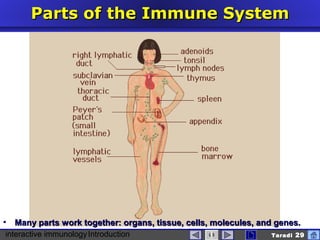
Parts ofParts of thethe ImmuneImmune SSystemystem
 Many parts work together: organs, tissue, cells, molecules, and genes.Many parts work together: organs, tissue, cells, molecules, and genes.
interactive immunologyIntroduction Taradi 30
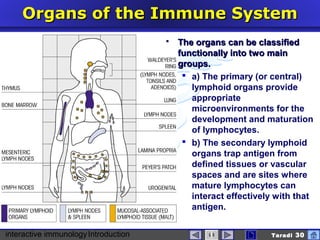
Organs of the Immune SystemOrgans of the Immune System
 The organs can be classifiedThe organs can be classified
functionally into two mainfunctionally into two main
groups.groups.
 a) The primary (or central)
lymphoid organs provide
appropriate
microenvironments for the
development and maturation
of lymphocytes.
 b) The secondary lymphoid
organs trap antigen from
defined tissues or vascular
spaces and are sites where
mature lymphocytes can
interact effectively with that
antigen.
interactive immunologyIntroduction Taradi 31
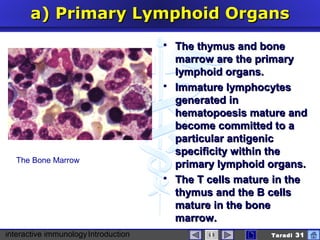
a)a) Primary Lymphoid OrgansPrimary Lymphoid Organs
 The thymus and boneThe thymus and bone
marrow are the primarymarrow are the primary
lymphoid organs.lymphoid organs.
 Immature lymphocytesImmature lymphocytes
generated ingenerated in
hematopoesis mature andhematopoesis mature and
become committed to abecome committed to a
particular antigenicparticular antigenic
specificity within thespecificity within the
primary lymphoid organs.primary lymphoid organs.
 TheThe T cells matureT cells mature iin then the
thymus andthymus and thethe B cellsB cells
mature in the bonemature in the bone
marrow.marrow.
The Bone Marrow
interactive immunologyIntroduction Taradi 32
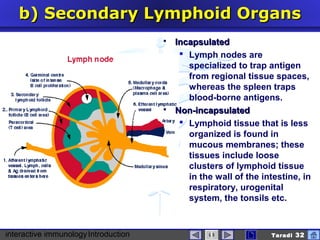
b)b) Secondary Lymphoid OrgansSecondary Lymphoid Organs
 IncapsulatedIncapsulated
 Lymph nodes are
specialized to trap antigen
from regional tissue spaces,
whereas the spleen traps
blood-borne antigens.
 Non-incapsulatedNon-incapsulated
 Lymphoid tissue that is less
organized is found in
mucous membranes; these
tissues include loose
clusters of lymphoid tissue
in the wall of the intestine, in
respiratory, urogenital
system, the tonsils etc.
interactive immunologyIntroduction Taradi 33
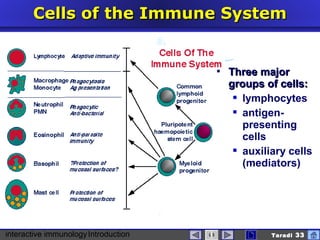
Cells of the Immune SystemCells of the Immune System
 Three majorThree major
groups of cells:groups of cells:
 lymphocytes
 antigen-
presenting
cells
 auxiliary cells
(mediators)
interactive immunologyIntroduction Taradi 34
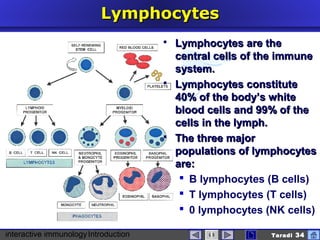
LymphocytesLymphocytes
 Lymphocytes are theLymphocytes are the
central cells of the immunecentral cells of the immune
system.system.
 Lymphocytes constituteLymphocytes constitute
40% of the body’s white40% of the body’s white
blood cells and 99% of theblood cells and 99% of the
cells in the lymph.cells in the lymph.
 The three majorThe three major
populations of lymphocytespopulations of lymphocytes
are:are:
 B lymphocytes (B cells)
 T lymphocytes (T cells)
 0 lymphocytes (NK cells)
interactive immunologyIntroduction Taradi 35
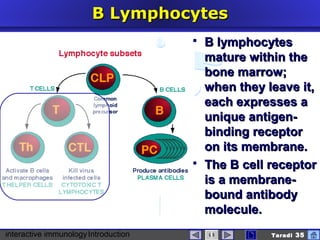
B LymphocytesB Lymphocytes
 B lymphocytesB lymphocytes
mature within themature within the
bone marrow;bone marrow;
when they leave it,when they leave it,
each expresses aeach expresses a
unique antigen-unique antigen-
binding receptorbinding receptor
on its membrane.on its membrane.
 The BThe B cell receptorcell receptor
is a membrane-is a membrane-
bound antibodybound antibody
molecule.molecule.
interactive immunologyIntroduction Taradi 36
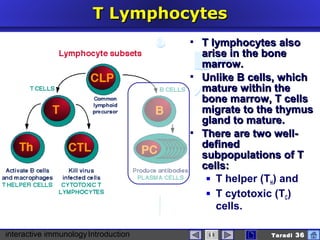
T LymphocytesT Lymphocytes
 T lymphocytes alsoT lymphocytes also
arise in the bonearise in the bone
marrow.marrow.
 Unlike B cells, whichUnlike B cells, which
mature within themature within the
bone marrow, T cellsbone marrow, T cells
migrate to the thymusmigrate to the thymus
gland to mature.gland to mature.
 There are two well-There are two well-
defineddefined
subpopulations of Tsubpopulations of T
cells:cells:
 T helper (TH) and
 T cytotoxic (TC)
cells.
interactive immunologyIntroduction Taradi 37
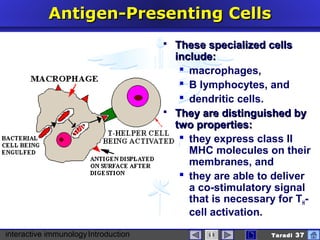
Antigen-Presenting CellsAntigen-Presenting Cells
 These specialized cellsThese specialized cells
include:include:
 macrophages,
 B lymphocytes, and
 dendritic cells.
 They are distinguished byThey are distinguished by
two properties:two properties:
 they express class II
MHC molecules on their
membranes, and
 they are able to deliver
a co-stimulatory signal
that is necessary for TH-
cell activation.
interactive immunologyIntroduction Taradi 38
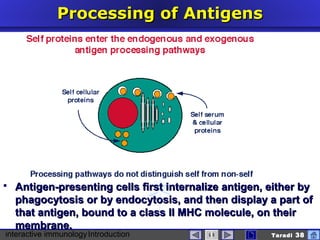
Processing of AntigensProcessing of Antigens
 Antigen-presenting cells first internalize antigen, either byAntigen-presenting cells first internalize antigen, either by
phagocytosis or by endocytosis, and then display a part ofphagocytosis or by endocytosis, and then display a part of
that antigen, bound to a class II MHC molecule, on theirthat antigen, bound to a class II MHC molecule, on their
membrane.membrane.
interactive immunologyIntroduction Taradi 39
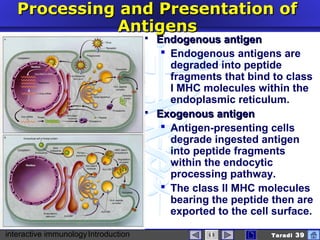
Processing and Presentation ofProcessing and Presentation of
AntigensAntigens
 Endogenous antigenEndogenous antigen
 Endogenous antigens are
degraded into peptide
fragments that bind to class
I MHC molecules within the
endoplasmic reticulum.
 Exogenous antigenExogenous antigen
 Antigen-presenting cells
degrade ingested antigen
into peptide fragments
within the endocytic
processing pathway.
 The class II MHC molecules
bearing the peptide then are
exported to the cell surface.
interactive immunologyIntroduction Taradi 40
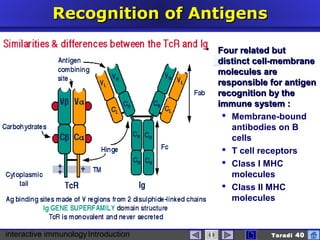
Recognition of AntigenRecognition of Antigenss
 Four related butFour related but
distinct cell-membranedistinct cell-membrane
molecules aremolecules are
responsible for antigenresponsible for antigen
recognition by therecognition by the
immune system :immune system :
 Membrane-bound
antibodies on B
cells
 T cell receptors
 Class I MHC
molecules
 Class II MHC
molecules
interactive immunologyIntroduction Taradi 41
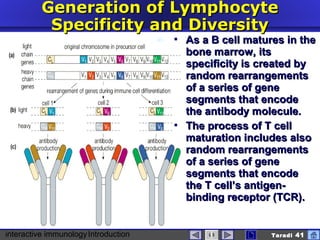
Generation of LymphocyteGeneration of Lymphocyte
Specificity and DiversitySpecificity and Diversity
 As a B cell matures in theAs a B cell matures in the
bone marrow, itsbone marrow, its
specificity is created byspecificity is created by
random rearrangementsrandom rearrangements
of a series of geneof a series of gene
segments that encodesegments that encode
the antibody molecule.the antibody molecule.
 The process of TThe process of T cellcell
maturation includes alsomaturation includes also
random rearrangementsrandom rearrangements
of a series of geneof a series of gene
segments that encodesegments that encode
the Tthe T cell’s antigen-cell’s antigen-
binding receptor (TCR).binding receptor (TCR).
interactive immunologyIntroduction Taradi 42
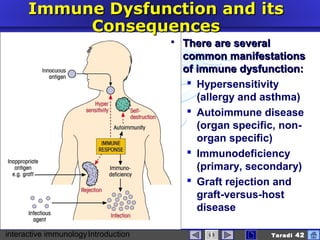
Immune Dysfunction andImmune Dysfunction and iitsts
ConsequencesConsequences
 There are severalThere are several
common manifestationscommon manifestations
of immune dysfunction:of immune dysfunction:
 Hypersensitivity
(allergy and asthma)
 Autoimmune disease
(organ specific, non-
organ specific)
 Immunodeficiency
(primary, secondary)
 Graft rejection and
graft-versus-host
disease
interactive immunologyIntroduction Taradi 43
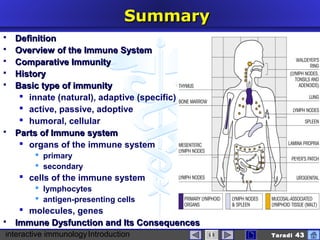
SummarySummary
 DefinitionDefinition
 Overview of the Immune SystemOverview of the Immune System
 Comparative ImmunityComparative Immunity
 HistoryHistory
 Basic type of immunityBasic type of immunity
 innate (natural), adaptive (specific)
 active, passive, adoptive
 humoral, cellular
 Parts of Immune systemParts of Immune system
 organs of the immune system
 primary
 secondary
 cells of the immune system
 lymphocytes
 antigen-presenting cells
 molecules, genes
 Immune Dysfunction and Its ConsequencesImmune Dysfunction and Its Consequences

Introduction to Immunology

  • 1.
    interactive immunologyIntroduction Taradi1 Prof. dr. Milan Taradi, M.D. PhDProf. dr. Milan Taradi, M.D. PhD Department of Physiology and ImmunologyDepartment of Physiology and Immunology IMMUNOLOGYIMMUNOLOGY IntroductionIntroduction
  • 2.
    interactive immunologyIntroduction Taradi2 Learning ObjectivesLearning Objectives  DefinitionDefinition  Overview of theOverview of the iimmunemmune ssystemystem  ComparativeComparative iimmunitymmunity  HistoryHistory  Basic type of immunityBasic type of immunity  innate (natural), adaptive (specific)  active, passive, adoptive  humoral, cellular  Parts ofParts of iimmune systemmmune system  organs of the immune system  primary  secondary  cells of the immune system  lymphocytes  antigen-presenting cells  molecules, genes  ImmuneImmune ddysfunction andysfunction and iitsts cconsequencesonsequences
  • 3.
    interactive immunologyIntroduction Taradi3 DefinitionDefinition  The discipline of immunology grew out of theThe discipline of immunology grew out of the observation that individuals who had recoveredobservation that individuals who had recovered from certain infectious diseases were thereafterfrom certain infectious diseases were thereafter protected from the disease.protected from the disease.  TheThe specificspecific immune system is a remarkablyimmune system is a remarkably adaptive defenadaptive defensse system that has evolved ine system that has evolved in vertebrates to protect them from invadingvertebrates to protect them from invading pathogenic microorganisms and cancer.pathogenic microorganisms and cancer.  The Latin term immunis, meaning “exemptThe Latin term immunis, meaning “exempt””, is, is the source of the English word immunity,the source of the English word immunity, meaning the state of protection from infectiousmeaning the state of protection from infectious disease.disease.
  • 4.
    interactive immunologyIntroduction Taradi4 FunctionFunction of the Immune Systemof the Immune System  Immune system is a group of organs,Immune system is a group of organs, tissues, celltissues, cellss, and molecules that help, and molecules that help defend the body against harmfuldefend the body against harmful invaders.invaders.  These substances include disease-These substances include disease- causing organisms, such as bacteria,causing organisms, such as bacteria, fungi, parasites, virusesfungi, parasites, viruses and foreignand foreign macromoleculesmacromolecules..  It has been suggested that immuneIt has been suggested that immune system also keep malignancies undersystem also keep malignancies under control.control.  Immunity is the body's ability to resistImmunity is the body's ability to resist these invadersthese invaders and is crucial toand is crucial to human survival.human survival.  The substances that trigger anThe substances that trigger an immune response are called antigens.immune response are called antigens.
  • 5.
    interactive immunologyIntroduction Taradi5 FunctionFunction of immunityof immunity  immune defenceimmune defence (anti-infection)(anti-infection)  immune surveillanceimmune surveillance (anti-tumour)(anti-tumour)  immune homeostasisimmune homeostasis ((eliminateeliminate injured or died cellsinjured or died cells))
  • 6.
    interactive immunologyIntroduction Taradi6 Comparative ImmunityComparative Immunity  All animals have innate (non-adaptive, native,All animals have innate (non-adaptive, native, natural) system that acts as a first line of defensenatural) system that acts as a first line of defense against foreign invaders.against foreign invaders.  SSome typeome typess of innate immunity appear to beof innate immunity appear to be characteristiccharacteristicss of multicellular organisms, andof multicellular organisms, and immunity has been demonstrated in organisms asimmunity has been demonstrated in organisms as different as insects, earthworms, and higherdifferent as insects, earthworms, and higher plants.plants.  The signature elements ofThe signature elements of specific (specific (adaptiveadaptive)) immunity, lymphocytes and antibodies, are foundimmunity, lymphocytes and antibodies, are found only in vertebrates.only in vertebrates.
  • 7.
    interactive immunologyIntroduction Taradi7 History -History - EEarlyarly DDiscoveriesiscoveries  The scientific study of the immuneThe scientific study of the immune system, known as immunology,system, known as immunology, dates from about the late 1800's.dates from about the late 1800's.  InIn 1791796, the British physician6, the British physician Edward Jenner administEdward Jenner administratedrated thethe first vaccination (from the Latinfirst vaccination (from the Latin vacca, meaning “cow ”). To protectvacca, meaning “cow ”). To protect from the smallpox virus hefrom the smallpox virus he vaccinated a child with a cowpoxvaccinated a child with a cowpox virus.virus. Wood engraving of Louis Pasteur watching Joseph Meister receive the rabies vaccine. Smallpox
  • 8.
    interactive immunologyIntroduction Taradi8 History -History - EEarlyarly DDiscoveriesiscoveries  Louis Pasteur discoveredLouis Pasteur discovered vaccines for cholera,vaccines for cholera, anthrax, and rabieanthrax, and rabies.s.  In 1883, the RussianIn 1883, the Russian biologist Elie Metchnikoffbiologist Elie Metchnikoff discovered phagocytes.discovered phagocytes.  In 1890, Emil A. BehringIn 1890, Emil A. Behring and S. Kitasato discoveredand S. Kitasato discovered antitoxinantitoxinss (antibodies).(antibodies).
  • 9.
    interactive immunologyIntroduction Taradi9 History -History - FFurtherurther BBreakthroughsreakthroughs  InIn 19001900,, Karl LandsteinerKarl Landsteiner discovered the main types ofdiscovered the main types of human blood groups.human blood groups.  In the 1960s, the lymphocyteIn the 1960s, the lymphocyte was identified as the cellwas identified as the cell responsible for bothresponsible for both,, cellularcellular and humoral immunity.and humoral immunity.  In 1975In 1975,, C. Milstein and G.J.C. Milstein and G.J. Köhler reported a techniqueKöhler reported a technique for producing monoclonalfor producing monoclonal antibodies.antibodies.
  • 10.
    interactive immunologyIntroduction Taradi10 TwoTwo BBasicasic TTypeypess ofof IImmunitymmunity  Vertebrates have twoVertebrates have two types of immunity:types of immunity:  Innate (non-adaptive, natural, non-specific), is a set of disease- resistance mechanisms that are not specific to a particular pathogen.  Adaptive (specific, acquired), displays a high degree of specificity as well as the remarkable property of “memory.”  Innate and adaptiveInnate and adaptive immunity do not operateimmunity do not operate independently of eachindependently of each other, but cooperatively.other, but cooperatively.
  • 11.
    interactive immunologyIntroduction Taradi11 1)1) Innate (NonInnate (Non--specific) Immunityspecific) Immunity  Innate immune responsesInnate immune responses begin much more quicklybegin much more quickly than adaptive ones andthan adaptive ones and therefore constitute the firsttherefore constitute the first line of defenline of defensse.e.  The innate immune systemThe innate immune system consists of all the immuneconsists of all the immune defendefensses that lackes that lack immunologic memory.immunologic memory.  Innate immunity can be seenInnate immunity can be seen to comprise four types ofto comprise four types of defensive barriers:defensive barriers:  a) anatomic,  b) physiologic,  c) phagocytic, and  d) inflammatory The Acute Inflammatory Response.
  • 12.
    interactive immunologyIntroduction Taradi12 a)a) AnatomicAnatomic BBarriersarriers  The simplest way to avoidThe simplest way to avoid infection is to prevent theinfection is to prevent the microorganisms from gainingmicroorganisms from gaining access to the body.access to the body.  SkinSkin  Mechanical barrier retards entry of microbes.  Acidic environment (pH 3–5) retards growth of microbes.  Mucous membranesMucous membranes  Normal flora compete with microbes for attachment sites and nutrients.  Mucous entraps foreign microorganisms.  Cilia propel microorganisms out of the body.
  • 13.
    interactive immunologyIntroduction Taradi13 b)b) PhysiologicPhysiologic BBarriersarriers  TemperatureTemperature  Normal body temperature inhibits growth of some pathogens.  Fever response inhibits growth of some pathogens.  Low pHLow pH  Acidity of stomach contents kills most ingested microorganisms.  Chemical mediatorsChemical mediators  Lysozyme cleaves the bacterial cell wall.  Interferon induces antiviral state in uninfected cells.  Complement lyses microorganisms or facilitates phagocytosis.
  • 14.
    interactive immunologyIntroduction Taradi14 c)c) Phagocytic/Phagocytic/EEndocyticndocytic BBarriersarriers  Various cells internalizeVarious cells internalize (endocytose) and break down(endocytose) and break down foreign macromolecules.foreign macromolecules.  Specialized cells (bloodSpecialized cells (blood monocytes, neutrophils, tissuemonocytes, neutrophils, tissue macrophages) internalizemacrophages) internalize (phagocytose), kill and digest(phagocytose), kill and digest whole microorganisms.whole microorganisms.  Phagocytosis is one type ofPhagocytosis is one type of endocytosis.endocytosis. Typical morphology of a monocyte and a macrophage.
  • 15.
    interactive immunologyIntroduction Taradi15 d)d) InflammatoryInflammatory BBarriersarriers  Inflammation isInflammation is thethe essentialessential element associated with almostelement associated with almost all immune responses.all immune responses.  Tissue damage and infectionTissue damage and infection induceinduce  leakage of vascular fluid, containing serum proteins with antibacterial activity  influx of phagocytic cells into the affected area.  These changes are caused byThese changes are caused by vasoactive amines, cytokines,vasoactive amines, cytokines, and other mediators.and other mediators.
  • 16.
    interactive immunologyIntroduction Taradi16 2)2) Adaptive (Specific) ImmunityAdaptive (Specific) Immunity  Adaptive or specificAdaptive or specific immunity is capable ofimmunity is capable of recognizing andrecognizing and selectively eliminatingselectively eliminating specific foreignspecific foreign antigens.antigens.  It displays fourIt displays four characteristiccharacteristic attributes:attributes:  a) Antigenic specificity  b) Immunologic memory  c) Self/non-self recognition  d) Diversity
  • 17.
    interactive immunologyIntroduction Taradi17 a)a) AntigenicAntigenic SSpecificitypecificity  ppermits the immune system to distinguish subtle differences among antigens.ermits the immune system to distinguish subtle differences among antigens. Burnet Clonal selection theory Various clones Clone deletion Clone selection Clone expansion BIRTH
  • 18.
    interactive immunologyIntroduction Taradi18 a)a) AntigenicAntigenic SSpecificitypecificity
  • 19.
    interactive immunologyIntroduction Taradi19 b)b) ImmunologicImmunologic MMemoryemory  The secondThe second encounter with theencounter with the same antigensame antigen induces ainduces a heightened state ofheightened state of immune reactivity.immune reactivity.  The base ofThe base of immunologicimmunologic memory is selectivememory is selective expansion ofexpansion of aa certain clone.certain clone.
  • 20.
    interactive immunologyIntroduction Taradi20 Primary and SecondaryPrimary and Secondary RResponseesponse  The initial encounter ofThe initial encounter of a naivea naive immunocompetentimmunocompetent lymphocyte with anlymphocyte with an antigen induces aantigen induces a primary response; aprimary response; a later contact of the hostlater contact of the host with antigen will inducewith antigen will induce a more rapid anda more rapid and heightened secondaryheightened secondary response.response.
  • 21.
    interactive immunologyIntroduction Taradi21 c)c) Self/NonSelf/Non--self Recognitionself Recognition  The immune systemThe immune system normally responds onlynormally responds only to foreign antigens,to foreign antigens, indicating that it isindicating that it is capable of self/noncapable of self/non--selfself recognition.recognition.  Tolerance of self and theTolerance of self and the ability to recognize andability to recognize and respond to non-self arerespond to non-self are two cardinal features oftwo cardinal features of thethe immune system.immune system.
  • 22.
    interactive immunologyIntroduction Taradi22 d)d) DiversityDiversity  The immune system isThe immune system is capable of generatingcapable of generating tremendous diversity intremendous diversity in its recognitionits recognition molecules, allowing itmolecules, allowing it to recognize billions ofto recognize billions of uniquely differentuniquely different structures on foreignstructures on foreign antigenantigenss..
  • 23.
    interactive immunologyIntroduction Taradi23 ThreeThree KKinds ofinds of SSpecificpecific IImmunitymmunity  a)a) Active immunityActive immunity  b)b) Passive immunityPassive immunity  c)c) Adoptive immunityAdoptive immunity
  • 24.
    interactive immunologyIntroduction Taradi24 a)a) ActiveActive IImmunitymmunity  Active immunity is acquired after a certainActive immunity is acquired after a certain antigen enters the body.antigen enters the body.  Natural acquiredNatural acquired  - through infection (disease)  Artificial acquiredArtificial acquired  - through vaccination (immunization, active immunoprophylaxis)  A vaccine contains bacteria or viruses that haveA vaccine contains bacteria or viruses that have been killed or weakened so they produce onlybeen killed or weakened so they produce only mild symptoms of the disease or no symptoms atmild symptoms of the disease or no symptoms at all.all.
  • 25.
    interactive immunologyIntroduction Taradi25 b)b) PassivePassive IImmunitymmunity  NaturalNatural passive immunitypassive immunity against certain diseaseagainst certain disease acquireacquiress aa fetus or breast-fed babfetus or breast-fed babyy byby receiving antibodies from thereceiving antibodies from the mother by placenta or by milk.mother by placenta or by milk.  Artificial pArtificial passive immunityassive immunity (passive immunoprophylaxis)(passive immunoprophylaxis) isis acquired by receiving one oracquired by receiving one or more injections of serummore injections of serum thatthat contain antibodies for fighting acontain antibodies for fighting a particular diseaseparticular disease (tetanus,(tetanus, snake bite, hepatitis, thyphus)snake bite, hepatitis, thyphus) ..
  • 26.
    interactive immunologyIntroduction Taradi26 c)c) AdoptiveAdoptive IImmunitymmunity  Bone marrow can beBone marrow can be used to reconstitute theused to reconstitute the hematopoietic systemhematopoietic system of cancer patientsof cancer patients whose hematopoieticwhose hematopoietic cells have been killedcells have been killed by radiation and/orby radiation and/or chemotherapy.chemotherapy.  In this procedure alsoIn this procedure also the adoptive immunitythe adoptive immunity is transferred nonis transferred non intentionally.intentionally.
  • 27.
    interactive immunologyIntroduction Taradi27 Humoral and Cellular ImmunityHumoral and Cellular Immunity  Immune responsesImmune responses can be divided intocan be divided into  humoral and  cell-mediated responses.  The humoral responseThe humoral response is best suited foris best suited for elimination ofelimination of exogenous antigens;exogenous antigens; the cell-mediatedthe cell-mediated response, forresponse, for elimination ofelimination of endogenous antigens.endogenous antigens.
  • 28.
    interactive immunologyIntroduction Taradi28 The ResponsesThe Responses  TheThe interactionsinteractions between innatebetween innate and acquiredand acquired immunityimmunity mechanisms.mechanisms.
  • 29.
    interactive immunologyIntroduction Taradi29 Parts ofParts of thethe ImmuneImmune SSystemystem  Many parts work together: organs, tissue, cells, molecules, and genes.Many parts work together: organs, tissue, cells, molecules, and genes.
  • 30.
    interactive immunologyIntroduction Taradi30 Organs of the Immune SystemOrgans of the Immune System  The organs can be classifiedThe organs can be classified functionally into two mainfunctionally into two main groups.groups.  a) The primary (or central) lymphoid organs provide appropriate microenvironments for the development and maturation of lymphocytes.  b) The secondary lymphoid organs trap antigen from defined tissues or vascular spaces and are sites where mature lymphocytes can interact effectively with that antigen.
  • 31.
    interactive immunologyIntroduction Taradi31 a)a) Primary Lymphoid OrgansPrimary Lymphoid Organs  The thymus and boneThe thymus and bone marrow are the primarymarrow are the primary lymphoid organs.lymphoid organs.  Immature lymphocytesImmature lymphocytes generated ingenerated in hematopoesis mature andhematopoesis mature and become committed to abecome committed to a particular antigenicparticular antigenic specificity within thespecificity within the primary lymphoid organs.primary lymphoid organs.  TheThe T cells matureT cells mature iin then the thymus andthymus and thethe B cellsB cells mature in the bonemature in the bone marrow.marrow. The Bone Marrow
  • 32.
    interactive immunologyIntroduction Taradi32 b)b) Secondary Lymphoid OrgansSecondary Lymphoid Organs  IncapsulatedIncapsulated  Lymph nodes are specialized to trap antigen from regional tissue spaces, whereas the spleen traps blood-borne antigens.  Non-incapsulatedNon-incapsulated  Lymphoid tissue that is less organized is found in mucous membranes; these tissues include loose clusters of lymphoid tissue in the wall of the intestine, in respiratory, urogenital system, the tonsils etc.
  • 33.
    interactive immunologyIntroduction Taradi33 Cells of the Immune SystemCells of the Immune System  Three majorThree major groups of cells:groups of cells:  lymphocytes  antigen- presenting cells  auxiliary cells (mediators)
  • 34.
    interactive immunologyIntroduction Taradi34 LymphocytesLymphocytes  Lymphocytes are theLymphocytes are the central cells of the immunecentral cells of the immune system.system.  Lymphocytes constituteLymphocytes constitute 40% of the body’s white40% of the body’s white blood cells and 99% of theblood cells and 99% of the cells in the lymph.cells in the lymph.  The three majorThe three major populations of lymphocytespopulations of lymphocytes are:are:  B lymphocytes (B cells)  T lymphocytes (T cells)  0 lymphocytes (NK cells)
  • 35.
    interactive immunologyIntroduction Taradi35 B LymphocytesB Lymphocytes  B lymphocytesB lymphocytes mature within themature within the bone marrow;bone marrow; when they leave it,when they leave it, each expresses aeach expresses a unique antigen-unique antigen- binding receptorbinding receptor on its membrane.on its membrane.  The BThe B cell receptorcell receptor is a membrane-is a membrane- bound antibodybound antibody molecule.molecule.
  • 36.
    interactive immunologyIntroduction Taradi36 T LymphocytesT Lymphocytes  T lymphocytes alsoT lymphocytes also arise in the bonearise in the bone marrow.marrow.  Unlike B cells, whichUnlike B cells, which mature within themature within the bone marrow, T cellsbone marrow, T cells migrate to the thymusmigrate to the thymus gland to mature.gland to mature.  There are two well-There are two well- defineddefined subpopulations of Tsubpopulations of T cells:cells:  T helper (TH) and  T cytotoxic (TC) cells.
  • 37.
    interactive immunologyIntroduction Taradi37 Antigen-Presenting CellsAntigen-Presenting Cells  These specialized cellsThese specialized cells include:include:  macrophages,  B lymphocytes, and  dendritic cells.  They are distinguished byThey are distinguished by two properties:two properties:  they express class II MHC molecules on their membranes, and  they are able to deliver a co-stimulatory signal that is necessary for TH- cell activation.
  • 38.
    interactive immunologyIntroduction Taradi38 Processing of AntigensProcessing of Antigens  Antigen-presenting cells first internalize antigen, either byAntigen-presenting cells first internalize antigen, either by phagocytosis or by endocytosis, and then display a part ofphagocytosis or by endocytosis, and then display a part of that antigen, bound to a class II MHC molecule, on theirthat antigen, bound to a class II MHC molecule, on their membrane.membrane.
  • 39.
    interactive immunologyIntroduction Taradi39 Processing and Presentation ofProcessing and Presentation of AntigensAntigens  Endogenous antigenEndogenous antigen  Endogenous antigens are degraded into peptide fragments that bind to class I MHC molecules within the endoplasmic reticulum.  Exogenous antigenExogenous antigen  Antigen-presenting cells degrade ingested antigen into peptide fragments within the endocytic processing pathway.  The class II MHC molecules bearing the peptide then are exported to the cell surface.
  • 40.
    interactive immunologyIntroduction Taradi40 Recognition of AntigenRecognition of Antigenss  Four related butFour related but distinct cell-membranedistinct cell-membrane molecules aremolecules are responsible for antigenresponsible for antigen recognition by therecognition by the immune system :immune system :  Membrane-bound antibodies on B cells  T cell receptors  Class I MHC molecules  Class II MHC molecules
  • 41.
    interactive immunologyIntroduction Taradi41 Generation of LymphocyteGeneration of Lymphocyte Specificity and DiversitySpecificity and Diversity  As a B cell matures in theAs a B cell matures in the bone marrow, itsbone marrow, its specificity is created byspecificity is created by random rearrangementsrandom rearrangements of a series of geneof a series of gene segments that encodesegments that encode the antibody molecule.the antibody molecule.  The process of TThe process of T cellcell maturation includes alsomaturation includes also random rearrangementsrandom rearrangements of a series of geneof a series of gene segments that encodesegments that encode the Tthe T cell’s antigen-cell’s antigen- binding receptor (TCR).binding receptor (TCR).
  • 42.
    interactive immunologyIntroduction Taradi42 Immune Dysfunction andImmune Dysfunction and iitsts ConsequencesConsequences  There are severalThere are several common manifestationscommon manifestations of immune dysfunction:of immune dysfunction:  Hypersensitivity (allergy and asthma)  Autoimmune disease (organ specific, non- organ specific)  Immunodeficiency (primary, secondary)  Graft rejection and graft-versus-host disease
  • 43.
    interactive immunologyIntroduction Taradi43 SummarySummary  DefinitionDefinition  Overview of the Immune SystemOverview of the Immune System  Comparative ImmunityComparative Immunity  HistoryHistory  Basic type of immunityBasic type of immunity  innate (natural), adaptive (specific)  active, passive, adoptive  humoral, cellular  Parts of Immune systemParts of Immune system  organs of the immune system  primary  secondary  cells of the immune system  lymphocytes  antigen-presenting cells  molecules, genes  Immune Dysfunction and Its ConsequencesImmune Dysfunction and Its Consequences

Editor's Notes