Autoimmunity
•Introduction
•Immune tolerance
•Pathogenesis of Autoimmunity
•Classification of autoimmune diseases
Introduction
• Autoimmunity is the failure of the body’s
defence system in recognizing its own
constituent parts as self, as a result of which an
immune response is generated against its own
cells and tissues.
• Any disease that results from such an aberrant
immune response is termed an autoimmune
disease
Immunological Tolerance
It is the ability of the immune system to identify
the antigen as “self” and to protect it from an
immunological response
Tolerance occurs in 3 forms:
• Central Tolerance
• Peripheral Tolerance
• Induced Tolerance
Central Tolerance
• It refers to deletion of self reactive T and B
lymphocytes during their maturation in central
lymphoid organ (Thymus and Bone Marrow)
• During the thymic maturation many self antigen
are processed and presented to the developing T
cells , and developing T cell that expresses a
receptor for such a self antigen is negatively
selected and depleted by apoptosis
Peripheral Tolerance
• However, many of the T cells cannot be
presented in the thymus hence T cell bearing
receptors for such antigen escape into the
periphery.
• In the periphery these T lymphocytes are
agained deactivated by 3 processes:
– Anergy
– Supression by regulatory T cells
– Apoptosis
Development of Autoimmunity
The failure to recognise the antigen as self will
lead to development of immunological
response
The possible Etiology are:
Genetic Suseptibility
Microbial influnce
• Genetic susceptibility: Following evidence
support the genetic factors for the
development of autoimmunity
– Familial predisposition: greater incidence in
monozygotic twins
– Role of HLA: Several autoimmune diseases are
linked to HLA, the relative risk of association of
HLA B27 and Ankylosing spondylitis is as high as
90 to 100
• Tissue Injury:
A large variety of microbes have been implicated
for triggering the autoimmunity due to
following mechanism
– Molecular mimicry: Viruses and microbes such as
streptococci and klebsiella share a cross reacting
epitope with the self antigen, the responses to
such microbial antigen may attack self tissue
ex: Rheumatic heart Disease
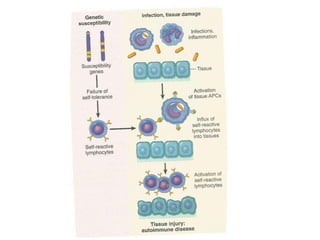
• Microbial infection with tissue necrosis and
inflammation may lead to up regulation of
resting APC’s in the tissue and subsequent
breakage of anergy
• The display of tissue antigens may be altered
by infections , local tissue injury may lead to
release of self antigen autoimmune response
Autoimmune Diseases
• Organ Specific
– Hashimato’s thyroiditis
– Antoimmune Haemolytic Anaemia
– Multiple Sclerosis
– Goodpasture Syndrome
– Autoimmune Thrombocytopenia
– Autoimmune Orchitis
– Type 1 Diabetes Mellitus
– Myasthenia Gravis
– Grave’s Disease
– Autoimmune Hepatitis
– Ulcerative Colitis
• Systemic
– Systemic Lupus erythematosus
– Rheumatoid Arthritis
– Sjogren syndrome
– Reiter’s syndrome
– Systemic Sclerosis
– Polyarthritis nodosa
– Inflammatory myopathies

Autoimmunity

  • 1.
    Autoimmunity •Introduction •Immune tolerance •Pathogenesis ofAutoimmunity •Classification of autoimmune diseases
  • 2.
    Introduction • Autoimmunity isthe failure of the body’s defence system in recognizing its own constituent parts as self, as a result of which an immune response is generated against its own cells and tissues. • Any disease that results from such an aberrant immune response is termed an autoimmune disease
  • 3.
    Immunological Tolerance It isthe ability of the immune system to identify the antigen as “self” and to protect it from an immunological response Tolerance occurs in 3 forms: • Central Tolerance • Peripheral Tolerance • Induced Tolerance
  • 5.
    Central Tolerance • Itrefers to deletion of self reactive T and B lymphocytes during their maturation in central lymphoid organ (Thymus and Bone Marrow) • During the thymic maturation many self antigen are processed and presented to the developing T cells , and developing T cell that expresses a receptor for such a self antigen is negatively selected and depleted by apoptosis
  • 6.
    Peripheral Tolerance • However,many of the T cells cannot be presented in the thymus hence T cell bearing receptors for such antigen escape into the periphery. • In the periphery these T lymphocytes are agained deactivated by 3 processes: – Anergy – Supression by regulatory T cells – Apoptosis
  • 8.
    Development of Autoimmunity Thefailure to recognise the antigen as self will lead to development of immunological response The possible Etiology are: Genetic Suseptibility Microbial influnce
  • 9.
    • Genetic susceptibility:Following evidence support the genetic factors for the development of autoimmunity – Familial predisposition: greater incidence in monozygotic twins – Role of HLA: Several autoimmune diseases are linked to HLA, the relative risk of association of HLA B27 and Ankylosing spondylitis is as high as 90 to 100
  • 10.
    • Tissue Injury: Alarge variety of microbes have been implicated for triggering the autoimmunity due to following mechanism – Molecular mimicry: Viruses and microbes such as streptococci and klebsiella share a cross reacting epitope with the self antigen, the responses to such microbial antigen may attack self tissue ex: Rheumatic heart Disease
  • 11.
    • Microbial infectionwith tissue necrosis and inflammation may lead to up regulation of resting APC’s in the tissue and subsequent breakage of anergy • The display of tissue antigens may be altered by infections , local tissue injury may lead to release of self antigen autoimmune response
  • 13.
    Autoimmune Diseases • OrganSpecific – Hashimato’s thyroiditis – Antoimmune Haemolytic Anaemia – Multiple Sclerosis – Goodpasture Syndrome – Autoimmune Thrombocytopenia – Autoimmune Orchitis – Type 1 Diabetes Mellitus – Myasthenia Gravis – Grave’s Disease – Autoimmune Hepatitis – Ulcerative Colitis
  • 14.
    • Systemic – SystemicLupus erythematosus – Rheumatoid Arthritis – Sjogren syndrome – Reiter’s syndrome – Systemic Sclerosis – Polyarthritis nodosa – Inflammatory myopathies