Hyperbaric Oxygen Therapy
INTRODUCTION
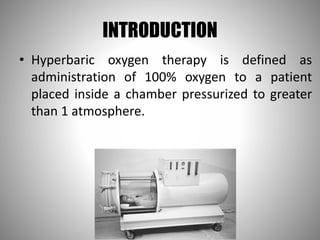
• Hyperbaric oxygen therapy is defined as
administration of 100% oxygen to a patient
placed inside a chamber pressurized to greater
than 1 atmosphere.
Not Hyperbaric Therapy!!!
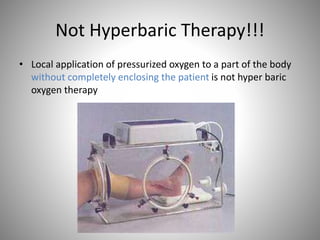
• Local application of pressurized oxygen to a part of the body
without completely enclosing the patient is not hyper baric
oxygen therapy
History
• Initial discovery
– 1662  Henshaw built first hyperbaric chamber
• English physician and clergyman Called the chamber
the “Domicilum”
Background
• Elemental Oxygen
– 1775  Discovered by Priestly (English)
• Surgical use
– 1870’s Fontaine & Bert (France)
• Prolong anesthesia
• Improved surgical outcomes
– Wound healing
• Decompression sickness
– 1910-30’s Drager, then Behnke & Shaw
• Reduced morbidity of decompression
• Studies of cardiopulmonary effects initiated
Physiology
• Cardiopulmonary
– Increase in PaO2
• Saturation of available hemoglobin molecules
– Hb 97% saturated at atmospheric pressure
– Maximization does NOT significantly increase O2 delivery
• Increase in dissolved O2
– PAO2 is 100mm Hg at atmospheric pressure
– Using 100% FiO2 at 3 atm  up to 2000mm Hg
» Increase O2 from 3ml/L blood to to 60ml/L
» 20 times more O2 circulating in plasma
Mechanisms of Action
Increased Oxygen Tension
Vasoconstriction
Increased Fibroblast Replication
Increased Collagen Response
Angiogenesis
Enhanced Leukocyte Function
Attenuation of Reperfusion Injury
Mechanism of Action
• Three main effects of HBO2:
1) Delivery of O2 to hypoperfused tissues
• Limit ischemic damage, cell death, and inflammation
• Promotes collagen synthesis and angiogenesis
• Decreases lactate production and tissue acidosis
2) Generation of oxygen free radicals
• Aids in oxygen-dependent killing of bacteria
• Facilitates oxygen dependent transport of antibiotics
3) Vasoconstriction
• Limits leukocyte adhesion and degrannulation
• Decreases tissue edema
Dosing and Delivery
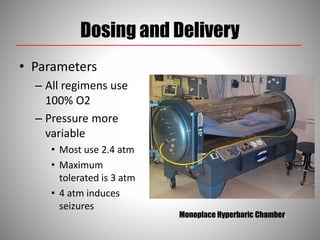
• Parameters
– All regimens use
100% O2
– Pressure more
variable
• Most use 2.4 atm
• Maximum
tolerated is 3 atm
• 4 atm induces
seizures
Monoplace Hyperbaric Chamber.
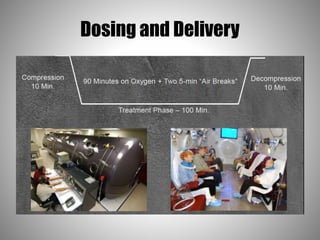
Dosing and Delivery
Dosing and Delivery
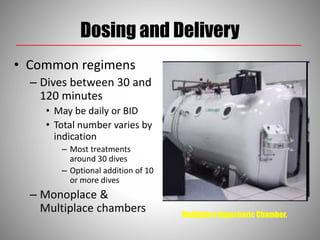
• Common regimens
– Dives between 30 and
120 minutes
• May be daily or BID
• Total number varies by
indication
– Most treatments
around 30 dives
– Optional addition of 10
or more dives
– Monoplace &
Multiplace chambers Multiplace Hyperbaric Chamber.
Advantages of a Monoplace Chamber
1. Patients are cared for individually thereby maintaining
patient privacy.
2. Isolation of patients insures that there is no
amplification or spread of disease or infection from other
patients.
3. Patient can enjoy a more comfortable and relaxing
treatment.
4. Multiplace chambers require an awkward and
restraining facemask, Monoplace Chambers do not.
6. Technicians can easily monitor patients.
7. Ideal for patients confined to bed in acute stages of
illness or injury.
INDICATIONS
Investigational
Autism
Auto-immune Disorders
Cancer Treatment
Cerebral Palsy
Chemical Toxicity
Chronic Fatigue Syndrome
Crohn’s Disease
Fibromyalgia
Headache Syndromes
Lyme Disease
Macular Degeneration
Pre And Post Surgical Healing (Cosmetic Surgery)
Multiple Sclerosis
Near Drowning
Respiratory distress syndrome
Seizure Disorder
Spinal Cord Injury
Sports Injuries
Stem Cell Recovery Treatment
Stroke
Tinnitus
Traumatic Brain Injury
•
Applications
Today’s review
1. Osteoradionecrosis
2. Enhancement of graft & flap viability
3. Malignant otitis externa
4. Sudden SNHL
5. Radiation sensitization
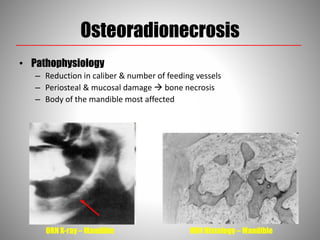
Osteoradionecrosis
• Pathophysiology
– Reduction in caliber & number of feeding vessels
– Periosteal & mucosal damage  bone necrosis
– Body of the mandible most affected
ORN Histology – MandibleORN X-ray – Mandible
Chronic Non-healing Wounds
• Generalising from other fields
– Diabetic foot ulcers
• Significant reduction in morbidity
• Significant improvement in functional outcomes
• Significant cost savings
Clinical Uses and Therapeutic Effects of
Hyperbaric Oxygen
– Rationale for Hyperbaric Oxygen in
Problem Wounds:
• Enhances fibroblast replication
•  collagen synthesis
•  neovascularization
•  leukocyte bacteriocidal activity
Skin Grafts & Free Flaps
• Pathophysiology
– Grafted or transplanted tissue may be healthy
– But… implantation site may be hypoxic
• Due to vasospasm, edema, infection
• Oxygen & nutrient supply compromised
• Must establish vascular connection for survival
• HBOT:
– Improves tissue PO2
– Promotes angiogenesis
– Augments immune response & limits inflammation
(oedema)
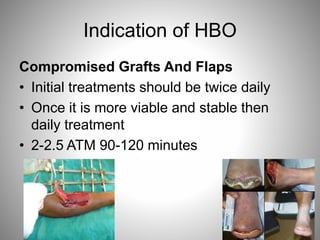
Indication of HBO
Compromised Grafts And Flaps
• Initial treatments should be twice daily
• Once it is more viable and stable then
daily treatment
• 2-2.5 ATM 90-120 minutes
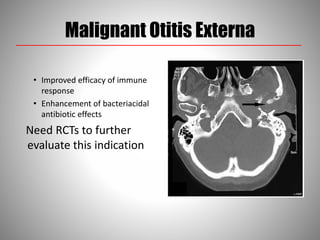
Malignant Otitis Externa
• Improved efficacy of immune
response
• Enhancement of bacteriacidal
antibiotic effects
Need RCTs to further
evaluate this indication
Radiation Sensitization
• Among first studied uses of HBO2 (1960’s)
– Areas of hypoxia in tumors are resistant to therapy
– Increasing oxygen pressure in the tumor can aid
tumoricidal therapies
• Administration of radiation sensitizing agents (oxygen donors)
Radiation Sensitization
• Systematic review (Bennett, et al. 2008)
– Found 19 randomized trials of HBO2 with XRT
• H&N, cervix, bladder, rectum, esophagus, brain
– H&N
• Significant mortality reduction
• Significant decrease in recurrence
HBOT in Sudden Sensorineural
Hearing Loss (SSNHL)
• Idiopathic sudden sensorineural hearing loss
(ISSNHL) is an otologic emergency with an
incidence of about 5–20 per 100,000
population per year
• It is a sudden,
usually unilateral and greater than 30 dB
hearing loss (HL) over at least 3 contiguous
frequencies, occurring over a period of 72 hr
Management
• Controversial: The use of more than one
agent in treatment is exceedingly common
• Choice of agents used varies substantially
among clinicians
SSNHL
• A Cochrane Review
(first published in The Cochrane Library in Issue
1, 2005 and previously updated in 2007)
•Comparing the effect on ISSHL and tinnitus of
HBOT and alternative therapies
Selection criteria
• Randomized controlled trials that compared
the effect of treatment for either acute or
chronic idiopathic sensorineural hearing loss
and/or tinnitus where hyperbaric oxygen
administration is included
• FolLwing trials were included in the review
– Cavallazzi 1996
– Fattori 2001
– Hoffmann 1995a; Hoffmann 1995b;
– Pilgramm 1985
– Schwab 1998
– Topuz 2004
R E S U L T S
• 1. Acute ISSHL: pure tone audiometric
change in hearing
• There was a 22% greater chance of
improvement with HBOT
• There was a statistically significant
improvement in those with severe hearing
loss and moderate hearing loss
2. Chronic ISSHL:
• Difference was not statistically significant
• There were no significant improvements in
hearing reported for chronic presentation (6
months) of ISSHL
3. Acute tinnitus:
• The significance of any improvement in
tinnitus could not be assessed
4. Chronic tinnitus: relief of tinnitus
• The difference was not statistically significant
Adverse events
– No trials reported any data on adverse events
in a systematic way
– 3 participants suffered middle ear
barotrauma(Pilgramm 1985)
Barotrauma
Barotrauma
• Barotrauma refers to injury sustained from
failure to equalize the pressure of an air-
containing space with that of the surrounding
environment
• Affects several different areas of the body,
including the ear, face and lungs.
Introduction
• Diving
• Aviators (after rapid ascent to altitude)
• Astronauts
• Rarely HBOT
Symptoms
• Symptoms of barotrauma include ear pain,
hearing loss, dizziness, tinnitus and
hemorrhage from the ear.
Differential diagnosis of
decompression
illness
• Middle-ear or maxillary sinus overinflation
• Gas expansion during ascent and an
obstructed eustachian tube or sinus ostium
• Contaminated diving gas and oxygen toxic
effects
Treatment
• Recompression is usually advised even if
manifestations resolve with first aid
(Since untreated decompression sickness can
recur days after the initial onset)
• Complete relief of symptoms in 50-98% of
individuals
Outcome
• Depending on the severity of illness
• Period of time that has elapsed between
development of DCI and recompression
Contraindications
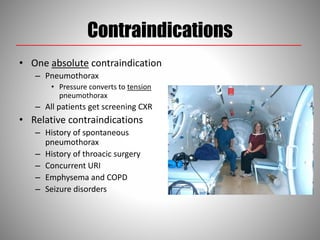
• One absolute contraindication
– Pneumothorax
• Pressure converts to tension
pneumothorax
– All patients get screening CXR
• Relative contraindications
– History of spontaneous
pneumothorax
– History of throacic surgery
– Concurrent URI
– Emphysema and COPD
– Seizure disorders
Complications
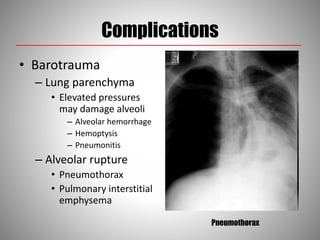
• Barotrauma
– Lung parenchyma
• Elevated pressures
may damage alveoli
– Alveolar hemorrhage
– Hemoptysis
– Pneumonitis
– Alveolar rupture
• Pneumothorax
• Pulmonary interstitial
emphysema
Pneumothorax
Complications..
• Lens deformation causes temporary myopia
• Exacerbation of other processes
– Dental abscess, sinusitis, laryngocele, etc.
• Claustrophobia, anxiety, etc.
• Oxygen toxicity
– Very rare, but may cause seizures
• Potential effects on tumor growth
– Controversial
Fire Risk
• Especially monoplace
– 100% oxygen
– Highly pressurized
– Enclosed space
• Rare… but not rare enough
– 50 deaths due to HBO2-related fires since 1980
– Must remove all flammable materials
– Fire safety protocol is essential
• Risk reduced in multiplace chambers
– Chamber pressurized
– O2 delivered individually via tight-fitting masks
– Attendants may enter in an emergency
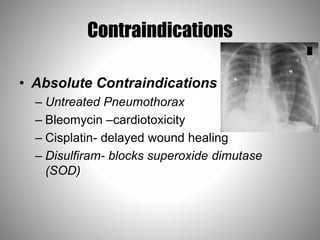
Contraindications
• Absolute Contraindications
– Untreated Pneumothorax
– Bleomycin –cardiotoxicity
– Cisplatin- delayed wound healing
– Disulfiram- blocks superoxide dimutase
(SOD)
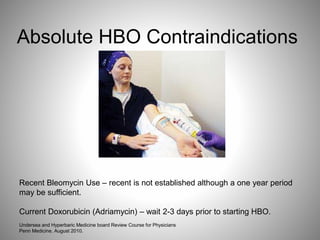
Absolute HBO Contraindications
Recent Bleomycin Use – recent is not established although a one year period
may be sufficient.
Current Doxorubicin (Adriamycin) – wait 2-3 days prior to starting HBO.
Undersea and Hyperbaric Medicine board Review Course for Physicians
Penn Medicine. August 2010.
Absolute HBO Contraindications
Disulfiram (Antabuse) – blocks superoxide
dismutase which decreases the body’s ability to
neutralize oxygen free radicals; inhibits
hyperoxic induction of cytochrome P450.
Potential for pulmonary toxicity.
Contraindications
Relative Contraindications
• URI
• COPD with bullous emphysema or CO2 retention
• Claustrophobia
• Seizures
• Ear or sinus surgery or recent thoracic surgery
• Optic neuritis
• Pacemakers (verify for pressure tolerance)
• Pregnancy
• Congenital Spherocytosis
Costs
• HBO2 is relatively expensive…
– Monoplace chamber < Multiplace chambers
– Most facilities have multiplace chamberss, etc.
– But…
• Medicare reimburses for most accepted indications
Summary
• HBO2 derives its clinical benefit via
– Increase in the oxygen delivery to hypoxic tissue
– Promoting native mechanisms of healing
– Decreasing tissue edema & reperfusion injury
• Dosing
– Most commonly 30-40 dives of 90 min at 2.4atm but
less than 3 atm
• Costs
– Significant, yet analyses support cost savings in proven
indications
Summary
• Supported ORL-HNS indications
– ORN & CRN, radiation soft tissue injury
– Flap & graft survival
• Unsupported ORL-HNS indications
– Sudden SNHL, tinnitus, Bell’s palsy
• Areas of uncertainty
– Likely effect: MOE & skull base osteo, fistulas
– Poor side effect profile: radiation sensitization
Summary
• Further research
– Molecular mechanism incompletely understood
• Animal studies
• Human tissue studies
– Need ethical randomized control trials
• Variety of indications
– More combination regimens for cancer treatment
& post-XRT reconstruction salvage
• What are the optimal dose & delivery shemes?

Hyperbaric oxygen therapy

  • 1.
  • 2.
    INTRODUCTION • Hyperbaric oxygentherapy is defined as administration of 100% oxygen to a patient placed inside a chamber pressurized to greater than 1 atmosphere.
  • 3.
    Not Hyperbaric Therapy!!! •Local application of pressurized oxygen to a part of the body without completely enclosing the patient is not hyper baric oxygen therapy
  • 4.
    History • Initial discovery –1662  Henshaw built first hyperbaric chamber • English physician and clergyman Called the chamber the “Domicilum”
  • 5.
    Background • Elemental Oxygen –1775  Discovered by Priestly (English) • Surgical use – 1870’s Fontaine & Bert (France) • Prolong anesthesia • Improved surgical outcomes – Wound healing • Decompression sickness – 1910-30’s Drager, then Behnke & Shaw • Reduced morbidity of decompression • Studies of cardiopulmonary effects initiated
  • 6.
    Physiology • Cardiopulmonary – Increasein PaO2 • Saturation of available hemoglobin molecules – Hb 97% saturated at atmospheric pressure – Maximization does NOT significantly increase O2 delivery • Increase in dissolved O2 – PAO2 is 100mm Hg at atmospheric pressure – Using 100% FiO2 at 3 atm  up to 2000mm Hg » Increase O2 from 3ml/L blood to to 60ml/L » 20 times more O2 circulating in plasma
  • 7.
    Mechanisms of Action IncreasedOxygen Tension Vasoconstriction Increased Fibroblast Replication Increased Collagen Response Angiogenesis Enhanced Leukocyte Function Attenuation of Reperfusion Injury
  • 8.
    Mechanism of Action •Three main effects of HBO2: 1) Delivery of O2 to hypoperfused tissues • Limit ischemic damage, cell death, and inflammation • Promotes collagen synthesis and angiogenesis • Decreases lactate production and tissue acidosis 2) Generation of oxygen free radicals • Aids in oxygen-dependent killing of bacteria • Facilitates oxygen dependent transport of antibiotics 3) Vasoconstriction • Limits leukocyte adhesion and degrannulation • Decreases tissue edema
  • 9.
    Dosing and Delivery •Parameters – All regimens use 100% O2 – Pressure more variable • Most use 2.4 atm • Maximum tolerated is 3 atm • 4 atm induces seizures Monoplace Hyperbaric Chamber.
  • 10.
  • 11.
    Dosing and Delivery •Common regimens – Dives between 30 and 120 minutes • May be daily or BID • Total number varies by indication – Most treatments around 30 dives – Optional addition of 10 or more dives – Monoplace & Multiplace chambers Multiplace Hyperbaric Chamber.
  • 12.
    Advantages of aMonoplace Chamber 1. Patients are cared for individually thereby maintaining patient privacy. 2. Isolation of patients insures that there is no amplification or spread of disease or infection from other patients. 3. Patient can enjoy a more comfortable and relaxing treatment. 4. Multiplace chambers require an awkward and restraining facemask, Monoplace Chambers do not. 6. Technicians can easily monitor patients. 7. Ideal for patients confined to bed in acute stages of illness or injury.
  • 14.
    INDICATIONS Investigational Autism Auto-immune Disorders Cancer Treatment CerebralPalsy Chemical Toxicity Chronic Fatigue Syndrome Crohn’s Disease Fibromyalgia Headache Syndromes Lyme Disease Macular Degeneration Pre And Post Surgical Healing (Cosmetic Surgery) Multiple Sclerosis Near Drowning Respiratory distress syndrome Seizure Disorder Spinal Cord Injury Sports Injuries Stem Cell Recovery Treatment Stroke Tinnitus Traumatic Brain Injury •
  • 15.
    Applications Today’s review 1. Osteoradionecrosis 2.Enhancement of graft & flap viability 3. Malignant otitis externa 4. Sudden SNHL 5. Radiation sensitization
  • 16.
    Osteoradionecrosis • Pathophysiology – Reductionin caliber & number of feeding vessels – Periosteal & mucosal damage  bone necrosis – Body of the mandible most affected ORN Histology – MandibleORN X-ray – Mandible
  • 17.
    Chronic Non-healing Wounds •Generalising from other fields – Diabetic foot ulcers • Significant reduction in morbidity • Significant improvement in functional outcomes • Significant cost savings
  • 18.
    Clinical Uses andTherapeutic Effects of Hyperbaric Oxygen – Rationale for Hyperbaric Oxygen in Problem Wounds: • Enhances fibroblast replication •  collagen synthesis •  neovascularization •  leukocyte bacteriocidal activity
  • 19.
    Skin Grafts &Free Flaps • Pathophysiology – Grafted or transplanted tissue may be healthy – But… implantation site may be hypoxic • Due to vasospasm, edema, infection • Oxygen & nutrient supply compromised • Must establish vascular connection for survival • HBOT: – Improves tissue PO2 – Promotes angiogenesis – Augments immune response & limits inflammation (oedema)
  • 20.
    Indication of HBO CompromisedGrafts And Flaps • Initial treatments should be twice daily • Once it is more viable and stable then daily treatment • 2-2.5 ATM 90-120 minutes
  • 21.
    Malignant Otitis Externa •Improved efficacy of immune response • Enhancement of bacteriacidal antibiotic effects Need RCTs to further evaluate this indication
  • 22.
    Radiation Sensitization • Amongfirst studied uses of HBO2 (1960’s) – Areas of hypoxia in tumors are resistant to therapy – Increasing oxygen pressure in the tumor can aid tumoricidal therapies • Administration of radiation sensitizing agents (oxygen donors)
  • 23.
    Radiation Sensitization • Systematicreview (Bennett, et al. 2008) – Found 19 randomized trials of HBO2 with XRT • H&N, cervix, bladder, rectum, esophagus, brain – H&N • Significant mortality reduction • Significant decrease in recurrence
  • 24.
    HBOT in SuddenSensorineural Hearing Loss (SSNHL)
  • 25.
    • Idiopathic suddensensorineural hearing loss (ISSNHL) is an otologic emergency with an incidence of about 5–20 per 100,000 population per year • It is a sudden, usually unilateral and greater than 30 dB hearing loss (HL) over at least 3 contiguous frequencies, occurring over a period of 72 hr
  • 26.
    Management • Controversial: Theuse of more than one agent in treatment is exceedingly common • Choice of agents used varies substantially among clinicians
  • 27.
    SSNHL • A CochraneReview (first published in The Cochrane Library in Issue 1, 2005 and previously updated in 2007) •Comparing the effect on ISSHL and tinnitus of HBOT and alternative therapies
  • 28.
    Selection criteria • Randomizedcontrolled trials that compared the effect of treatment for either acute or chronic idiopathic sensorineural hearing loss and/or tinnitus where hyperbaric oxygen administration is included
  • 29.
    • FolLwing trialswere included in the review – Cavallazzi 1996 – Fattori 2001 – Hoffmann 1995a; Hoffmann 1995b; – Pilgramm 1985 – Schwab 1998 – Topuz 2004
  • 30.
    R E SU L T S • 1. Acute ISSHL: pure tone audiometric change in hearing • There was a 22% greater chance of improvement with HBOT • There was a statistically significant improvement in those with severe hearing loss and moderate hearing loss
  • 31.
    2. Chronic ISSHL: •Difference was not statistically significant • There were no significant improvements in hearing reported for chronic presentation (6 months) of ISSHL
  • 32.
    3. Acute tinnitus: •The significance of any improvement in tinnitus could not be assessed 4. Chronic tinnitus: relief of tinnitus • The difference was not statistically significant
  • 33.
    Adverse events – Notrials reported any data on adverse events in a systematic way – 3 participants suffered middle ear barotrauma(Pilgramm 1985)
  • 34.
  • 35.
    Barotrauma • Barotrauma refersto injury sustained from failure to equalize the pressure of an air- containing space with that of the surrounding environment • Affects several different areas of the body, including the ear, face and lungs.
  • 36.
    Introduction • Diving • Aviators(after rapid ascent to altitude) • Astronauts • Rarely HBOT
  • 37.
    Symptoms • Symptoms ofbarotrauma include ear pain, hearing loss, dizziness, tinnitus and hemorrhage from the ear.
  • 38.
    Differential diagnosis of decompression illness •Middle-ear or maxillary sinus overinflation • Gas expansion during ascent and an obstructed eustachian tube or sinus ostium • Contaminated diving gas and oxygen toxic effects
  • 39.
    Treatment • Recompression isusually advised even if manifestations resolve with first aid (Since untreated decompression sickness can recur days after the initial onset) • Complete relief of symptoms in 50-98% of individuals
  • 40.
    Outcome • Depending onthe severity of illness • Period of time that has elapsed between development of DCI and recompression
  • 41.
    Contraindications • One absolutecontraindication – Pneumothorax • Pressure converts to tension pneumothorax – All patients get screening CXR • Relative contraindications – History of spontaneous pneumothorax – History of throacic surgery – Concurrent URI – Emphysema and COPD – Seizure disorders
  • 42.
    Complications • Barotrauma – Lungparenchyma • Elevated pressures may damage alveoli – Alveolar hemorrhage – Hemoptysis – Pneumonitis – Alveolar rupture • Pneumothorax • Pulmonary interstitial emphysema Pneumothorax
  • 43.
    Complications.. • Lens deformationcauses temporary myopia • Exacerbation of other processes – Dental abscess, sinusitis, laryngocele, etc. • Claustrophobia, anxiety, etc. • Oxygen toxicity – Very rare, but may cause seizures • Potential effects on tumor growth – Controversial
  • 44.
    Fire Risk • Especiallymonoplace – 100% oxygen – Highly pressurized – Enclosed space • Rare… but not rare enough – 50 deaths due to HBO2-related fires since 1980 – Must remove all flammable materials – Fire safety protocol is essential • Risk reduced in multiplace chambers – Chamber pressurized – O2 delivered individually via tight-fitting masks – Attendants may enter in an emergency
  • 45.
    Contraindications • Absolute Contraindications –Untreated Pneumothorax – Bleomycin –cardiotoxicity – Cisplatin- delayed wound healing – Disulfiram- blocks superoxide dimutase (SOD)
  • 46.
    Absolute HBO Contraindications RecentBleomycin Use – recent is not established although a one year period may be sufficient. Current Doxorubicin (Adriamycin) – wait 2-3 days prior to starting HBO. Undersea and Hyperbaric Medicine board Review Course for Physicians Penn Medicine. August 2010.
  • 47.
    Absolute HBO Contraindications Disulfiram(Antabuse) – blocks superoxide dismutase which decreases the body’s ability to neutralize oxygen free radicals; inhibits hyperoxic induction of cytochrome P450. Potential for pulmonary toxicity.
  • 48.
    Contraindications Relative Contraindications • URI •COPD with bullous emphysema or CO2 retention • Claustrophobia • Seizures • Ear or sinus surgery or recent thoracic surgery • Optic neuritis • Pacemakers (verify for pressure tolerance) • Pregnancy • Congenital Spherocytosis
  • 49.
    Costs • HBO2 isrelatively expensive… – Monoplace chamber < Multiplace chambers – Most facilities have multiplace chamberss, etc. – But… • Medicare reimburses for most accepted indications
  • 50.
    Summary • HBO2 derivesits clinical benefit via – Increase in the oxygen delivery to hypoxic tissue – Promoting native mechanisms of healing – Decreasing tissue edema & reperfusion injury • Dosing – Most commonly 30-40 dives of 90 min at 2.4atm but less than 3 atm • Costs – Significant, yet analyses support cost savings in proven indications
  • 51.
    Summary • Supported ORL-HNSindications – ORN & CRN, radiation soft tissue injury – Flap & graft survival • Unsupported ORL-HNS indications – Sudden SNHL, tinnitus, Bell’s palsy • Areas of uncertainty – Likely effect: MOE & skull base osteo, fistulas – Poor side effect profile: radiation sensitization
  • 52.
    Summary • Further research –Molecular mechanism incompletely understood • Animal studies • Human tissue studies – Need ethical randomized control trials • Variety of indications – More combination regimens for cancer treatment & post-XRT reconstruction salvage • What are the optimal dose & delivery shemes?

Editor's Notes

  • #17 ORN Body of mandible; histology shows increased bone resorption and turnover, with relative hypocellularity 2/2 microvasculature ischemia.
  • #45 No deaths at U.S. facilities, but 2 fires reports in U.S. during this time period. Monoplace chambers are filled with O2; multiplace chambers are pressurized and O2 delivered by mask or hood.