HYPERBARIC OXYGEN THERAPY
FOR NEUROLOGICAL CONDITIONS
ADE WIJAYA, MD – NOVEMBER 2018
DEFINITION
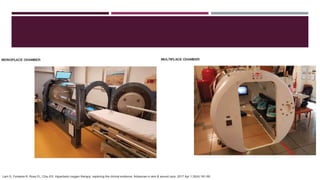
Hyperbaric oxygen therapy (HBOT) is
a treatment in which patients breathe 100% oxygen while inside
a hyperbaric chamber pressurized to greater than sea level (1 atmosphere absolute [ATA])
 For clinical efficacy, the Undersea and Hyperbaric Medical Society specifies that the pressure must be
greater than or equal to 1.4 ATA
 In clinical practice, pressures applied usually range from 2 to 3 ATA
Undersea and Hyperbaric Medical Society. Indications for hyperbaric oxygen therapy. https://www.uhms.org/resources/hbo-indications.html.
Thom SR. Hyperbaric oxygen: its mechanisms and efficacy. Plast Reconstr Surg 2011; 127(Suppl 1):131S-41S.
Lam G, Fontaine R, Ross FL, Chiu ES. Hyperbaric oxygen therapy: exploring the clinical evidence. Advances in skin & wound care. 2017 Apr 1;30(4):181-90.
HISTORY
 Attempted since 1600s
 1956, first paper from Boerema, father of hyperbaric therapy  prolong safe operating times during
cardiac surgery
 Later reported on its beneficial effects for the treatment of necrotizing infections and ischemic leg ulcers
Camporesi EM, Bosco G. Mechanisms of action of hyperbaric oxygen therapy. Undersea Hyperb Med 2014;41:247-52.
Oztrk F, Ermertcan AT, Inanir I. Hyperbaric oxygen therapy for the management of chronic wounds. Cutan Ocul Toxicol 2013;32:72-7.
Dauwe PB, Pulikkottil BJ, Lavery L, Stuzin JM, Rohrich RJ. Does hyperbaric oxygen therapy work in facilitating acute wound healing: a systematic review. Plast Reconstr Surg2014;133:208e-15e.
Kranke P, Bennett MH, Martyn-St James M, Schnabel A, Debus SE, Weibel S. Hyperbaric oxygen therapy for chronic wounds. Cochrane Database Syst Rev 2015;6:CD004123
MECHANISM OF ACTION
 Elevation of both the partial pressure of inspired O2 and of the hydrostatic pressure
 Contributes to a compression of all gas-filled spaces in the body (Boyle's Law) and is relevant to treat
conditions where gas bubbles are present in the body and cause the disease
 High O2 partial pressures in various tissues increase the production of reactive O2 species (ROS) and
also of reactive nitrogen species (RNS) because of hyperoxia
 Modulation of intracellular transduction cascades, leading to synthesis of growth factors and promoting
wound healing and ameliorating post-ischemic and post-inflammatory injuries
Camporesi EM, Bosco G. Mechanisms of action of hyperbaric oxygen therapy. Undersea & hyperbaric medicine: journal of the Undersea and Hyperbaric Medical Society, Inc. 2014;41(3):247-52.
MECHANISM OF ACTION
 In normal circumstances O2 is transported in the blood only with haemoglobin in red blood cells, which
constitutes 98% of blood saturated with O2
 In the conditions of normal atmospheric pressure (1 ATA), red blood cells make up only 45% of the
blood whereas the plasma transports very small quantities of O2
 What is crucial in the case of HBOT, when the pressure rises to 3 ATA, the amount of O2 delivered with
the blood increases from 10 to 15 times above the norm, which gives us a quantity sufficient for life
support even in the case of absence of haemoglobin
Bennett M, Heard R. Hyperbaric oxygen therapy for multiple sclerosis. CNS Neurosci Ther. 2010 Apr;16(2):115-24. doi: 10.1111/j.1755- 5949.2009.00129.x
MECHANISM OF ACTION
Thom SR. Hyperbaric oxygen: its mechanisms and efficacy. Plast Reconstr Surg 2011 127(Suppl 1):131S-41S.
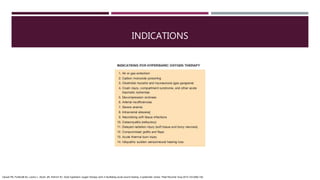
INDICATIONS
Dauwe PB, Pulikkottil BJ, Lavery L, Stuzin JM, Rohrich RJ. Does hyperbaric oxygen therapy work in facilitating acute wound healing: a systematic review. Plast Reconstr Surg 2014;133:208e-15e.
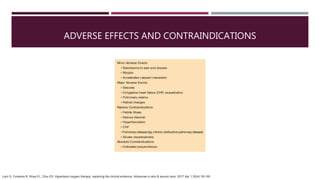
ADVERSE EFFECTS AND CONTRAINDICATIONS
Lam G, Fontaine R, Ross FL, Chiu ES. Hyperbaric oxygen therapy: exploring the clinical evidence. Advances in skin & wound care. 2017 Apr 1;30(4):181-90.
METHODS
 The scope of pressures used in HBOT oscillates between 1.5 ATA and 3 ATA
 Duration is set between 30 and 120 minutes
 Inhaling oxygen at 3 ATA increases the partial pressure of oxygen in the blood to 200 kPa and more,
which leads to an increase in the product of oxygen concentration in arterial blood from 6.6 to 6.8 ml
(O2/100ml)
Huang L, Obenaus A. Hyperbaric oxygen therapy for traumatic brain injury. Med Gas Res. 2011 Sep 6;1(1):21. doi: 10.1186/2045-9912-1-21.
Harch PG, Andrews SR, Fogarty EF, Amen D, Pezzullo JC, Lucarini J, et al. A phase I study of low-pressure hyperbaric oxygen therapy for blastinduced post-concussion syndrome and post-traumatic stress disorder. J Neurotrauma.
2012 Jan 1;29(1):168-85. doi: 10.1089/neu.2011.1895. Epub 2011 Nov 22.
Wolf G, Cifu D, Baugh L, Carne W, Profenna L. The effect of hyperbaric oxygen on symptoms after mild traumatic brain injury. J Neurotrauma. 2012 Nov 20;29(17):2606-12. doi: 10.1089/neu.2012.2549. Epub 2012 Nov 9.
Rockswold SB, Rockswold GL, Zaun DA, Zhang X, Cerra CE, Bergman TA, Liu J. A prospective, randomized clinical trial to compare the effect of hyperbaric to normobaric hyperoxia on cerebral metabolism, intracranial pressure, and
oxygen toxicity in severe traumatic brain injury. J Neurosurg. 2010 May;112(5):1080-94. doi: 10.3171/2009.7.JNS09363.
Rockswold SB, Rockswold GL, Vargo JM, Erickson CA, Sutton RL, Bergman TA, Biros MH. Effects of hyperbaric oxygenation therapy on cerebral metabolism and intracranial pressure in severely brain injured patients.J Neurosurg. 2001
Mar;94(3):403-11. doi: 10.3171/jns.2001.94.3.0403.
Klugar M, Nytra I, Bocková S, Klugarová J, Kelnarová Z, Marečková J.The effectiveness of hyperbaric oxygen therapy on mortality in adults with craniotrauma: a systematic review protocol. JBI Database System Rev Implement Rep.
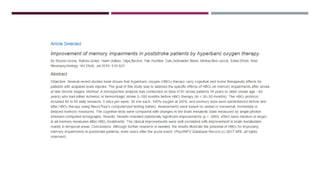
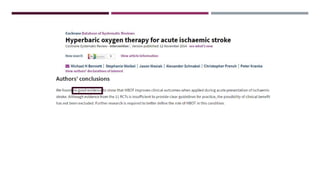
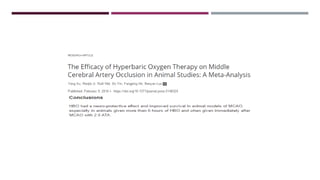
STUDIES IN NEUROLOGICAL CONDITIONS
STROKE
 Stroke and cerebrocranial injury may in consequence intensify depolarisation of mitochondrial
membranes and increase their permeability, which reduces the energy productivity and elevates the level
of reactive forms of oxygen
 HBOT may decrease permeability of mitochondrial membranes and has the potential to reverse this
anomaly
 Oxygen delivered by use of HBOT may be conducive to the reperfusion of an ischaemic area due to a
greater pressure gradient, even with the presence of a reduced blood flow in the brain
Huang L, Obenaus A. Hyperbaric oxygen therapy for traumatic brain injury. Med Gas Res. 2011 Sep 6;1(1):21. doi: 10.1186/2045-9912-1-21
Wang W, Fang H, Groom L, Cheng A, Zhang W, Liu J, et al. Superoxide flashes in single mitochondria. Cell. 2008 Jul 25;134(2):279-90. doi: 10.1016/j.cell.2008.06.017.
Zhang JH, Lo T, Mychaskiw G, Colohan A. Mechanisms of hyperbaric oxygen and neuroprotection in stroke. Pathophysiology. 2005 Jul;12(1):63- 77.
SUMMARY
 Hyperbaric oxygen therapy is a treatment in which patients breathe 100% oxygen while inside a
pressurized hyperbaric chamber.
 HBOT has been used in trial of various neurological conditions. However until today, only air/gas
embolism and intracranial abscess are indicated by The Undersea and Hyperbaric Medical Society as an
evidence-based list of indications.
Hyperbaric Oxygen Therapy for Neurological Conditions

Hyperbaric Oxygen Therapy for Neurological Conditions

  • 1.
    HYPERBARIC OXYGEN THERAPY FORNEUROLOGICAL CONDITIONS ADE WIJAYA, MD – NOVEMBER 2018
  • 2.
    DEFINITION Hyperbaric oxygen therapy(HBOT) is a treatment in which patients breathe 100% oxygen while inside a hyperbaric chamber pressurized to greater than sea level (1 atmosphere absolute [ATA])  For clinical efficacy, the Undersea and Hyperbaric Medical Society specifies that the pressure must be greater than or equal to 1.4 ATA  In clinical practice, pressures applied usually range from 2 to 3 ATA Undersea and Hyperbaric Medical Society. Indications for hyperbaric oxygen therapy. https://www.uhms.org/resources/hbo-indications.html. Thom SR. Hyperbaric oxygen: its mechanisms and efficacy. Plast Reconstr Surg 2011; 127(Suppl 1):131S-41S.
  • 3.
    Lam G, FontaineR, Ross FL, Chiu ES. Hyperbaric oxygen therapy: exploring the clinical evidence. Advances in skin & wound care. 2017 Apr 1;30(4):181-90.
  • 4.
    HISTORY  Attempted since1600s  1956, first paper from Boerema, father of hyperbaric therapy  prolong safe operating times during cardiac surgery  Later reported on its beneficial effects for the treatment of necrotizing infections and ischemic leg ulcers Camporesi EM, Bosco G. Mechanisms of action of hyperbaric oxygen therapy. Undersea Hyperb Med 2014;41:247-52. Oztrk F, Ermertcan AT, Inanir I. Hyperbaric oxygen therapy for the management of chronic wounds. Cutan Ocul Toxicol 2013;32:72-7. Dauwe PB, Pulikkottil BJ, Lavery L, Stuzin JM, Rohrich RJ. Does hyperbaric oxygen therapy work in facilitating acute wound healing: a systematic review. Plast Reconstr Surg2014;133:208e-15e. Kranke P, Bennett MH, Martyn-St James M, Schnabel A, Debus SE, Weibel S. Hyperbaric oxygen therapy for chronic wounds. Cochrane Database Syst Rev 2015;6:CD004123
  • 5.
    MECHANISM OF ACTION Elevation of both the partial pressure of inspired O2 and of the hydrostatic pressure  Contributes to a compression of all gas-filled spaces in the body (Boyle's Law) and is relevant to treat conditions where gas bubbles are present in the body and cause the disease  High O2 partial pressures in various tissues increase the production of reactive O2 species (ROS) and also of reactive nitrogen species (RNS) because of hyperoxia  Modulation of intracellular transduction cascades, leading to synthesis of growth factors and promoting wound healing and ameliorating post-ischemic and post-inflammatory injuries Camporesi EM, Bosco G. Mechanisms of action of hyperbaric oxygen therapy. Undersea & hyperbaric medicine: journal of the Undersea and Hyperbaric Medical Society, Inc. 2014;41(3):247-52.
  • 6.
    MECHANISM OF ACTION In normal circumstances O2 is transported in the blood only with haemoglobin in red blood cells, which constitutes 98% of blood saturated with O2  In the conditions of normal atmospheric pressure (1 ATA), red blood cells make up only 45% of the blood whereas the plasma transports very small quantities of O2  What is crucial in the case of HBOT, when the pressure rises to 3 ATA, the amount of O2 delivered with the blood increases from 10 to 15 times above the norm, which gives us a quantity sufficient for life support even in the case of absence of haemoglobin Bennett M, Heard R. Hyperbaric oxygen therapy for multiple sclerosis. CNS Neurosci Ther. 2010 Apr;16(2):115-24. doi: 10.1111/j.1755- 5949.2009.00129.x
  • 7.
    MECHANISM OF ACTION ThomSR. Hyperbaric oxygen: its mechanisms and efficacy. Plast Reconstr Surg 2011 127(Suppl 1):131S-41S.
  • 8.
    INDICATIONS Dauwe PB, PulikkottilBJ, Lavery L, Stuzin JM, Rohrich RJ. Does hyperbaric oxygen therapy work in facilitating acute wound healing: a systematic review. Plast Reconstr Surg 2014;133:208e-15e.
  • 9.
    ADVERSE EFFECTS ANDCONTRAINDICATIONS Lam G, Fontaine R, Ross FL, Chiu ES. Hyperbaric oxygen therapy: exploring the clinical evidence. Advances in skin & wound care. 2017 Apr 1;30(4):181-90.
  • 10.
    METHODS  The scopeof pressures used in HBOT oscillates between 1.5 ATA and 3 ATA  Duration is set between 30 and 120 minutes  Inhaling oxygen at 3 ATA increases the partial pressure of oxygen in the blood to 200 kPa and more, which leads to an increase in the product of oxygen concentration in arterial blood from 6.6 to 6.8 ml (O2/100ml) Huang L, Obenaus A. Hyperbaric oxygen therapy for traumatic brain injury. Med Gas Res. 2011 Sep 6;1(1):21. doi: 10.1186/2045-9912-1-21. Harch PG, Andrews SR, Fogarty EF, Amen D, Pezzullo JC, Lucarini J, et al. A phase I study of low-pressure hyperbaric oxygen therapy for blastinduced post-concussion syndrome and post-traumatic stress disorder. J Neurotrauma. 2012 Jan 1;29(1):168-85. doi: 10.1089/neu.2011.1895. Epub 2011 Nov 22. Wolf G, Cifu D, Baugh L, Carne W, Profenna L. The effect of hyperbaric oxygen on symptoms after mild traumatic brain injury. J Neurotrauma. 2012 Nov 20;29(17):2606-12. doi: 10.1089/neu.2012.2549. Epub 2012 Nov 9. Rockswold SB, Rockswold GL, Zaun DA, Zhang X, Cerra CE, Bergman TA, Liu J. A prospective, randomized clinical trial to compare the effect of hyperbaric to normobaric hyperoxia on cerebral metabolism, intracranial pressure, and oxygen toxicity in severe traumatic brain injury. J Neurosurg. 2010 May;112(5):1080-94. doi: 10.3171/2009.7.JNS09363. Rockswold SB, Rockswold GL, Vargo JM, Erickson CA, Sutton RL, Bergman TA, Biros MH. Effects of hyperbaric oxygenation therapy on cerebral metabolism and intracranial pressure in severely brain injured patients.J Neurosurg. 2001 Mar;94(3):403-11. doi: 10.3171/jns.2001.94.3.0403. Klugar M, Nytra I, Bocková S, Klugarová J, Kelnarová Z, Marečková J.The effectiveness of hyperbaric oxygen therapy on mortality in adults with craniotrauma: a systematic review protocol. JBI Database System Rev Implement Rep.
  • 11.
  • 12.
    STROKE  Stroke andcerebrocranial injury may in consequence intensify depolarisation of mitochondrial membranes and increase their permeability, which reduces the energy productivity and elevates the level of reactive forms of oxygen  HBOT may decrease permeability of mitochondrial membranes and has the potential to reverse this anomaly  Oxygen delivered by use of HBOT may be conducive to the reperfusion of an ischaemic area due to a greater pressure gradient, even with the presence of a reduced blood flow in the brain Huang L, Obenaus A. Hyperbaric oxygen therapy for traumatic brain injury. Med Gas Res. 2011 Sep 6;1(1):21. doi: 10.1186/2045-9912-1-21 Wang W, Fang H, Groom L, Cheng A, Zhang W, Liu J, et al. Superoxide flashes in single mitochondria. Cell. 2008 Jul 25;134(2):279-90. doi: 10.1016/j.cell.2008.06.017. Zhang JH, Lo T, Mychaskiw G, Colohan A. Mechanisms of hyperbaric oxygen and neuroprotection in stroke. Pathophysiology. 2005 Jul;12(1):63- 77.
  • 32.
    SUMMARY  Hyperbaric oxygentherapy is a treatment in which patients breathe 100% oxygen while inside a pressurized hyperbaric chamber.  HBOT has been used in trial of various neurological conditions. However until today, only air/gas embolism and intracranial abscess are indicated by The Undersea and Hyperbaric Medical Society as an evidence-based list of indications.