NEURALGIA
Presented by:
Sarin A.Nizar
[PG/Oral and Maxillofacial Surgery]
CONTENTS
 Introduction
 Definition
 Historical review of Trigeminal Neuralgia
 Classification
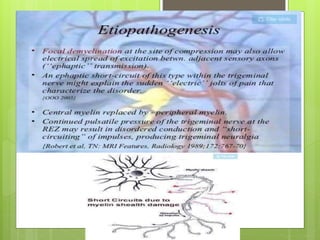
 Etio-pathogenesis
 General characteristics
 Clinical characteristics
 Diagnosis
 Treatment modalities
 Recent Advances
INTRODUCTION
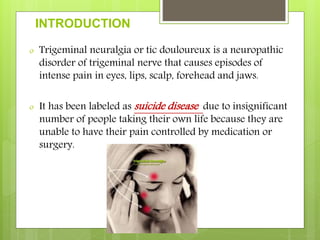
o Trigeminal neuralgia or tic douloureux is a neuropathic
disorder of trigeminal nerve that causes episodes of
intense pain in eyes, lips, scalp, forehead and jaws.
o It has been labeled as suicide disease due to insignificant
number of people taking their own life because they are
unable to have their pain controlled by medication or
surgery.
DEFINITIONS
(International association for study of pain; clinical journal of
pain 2002)
Sudden,usually unilateral,severe brief stabbing recurrent
pain in the distribution of one or more branches of Vth
cranial nerve.
PETERSON:
It usually presents with sharp, electric shock like pain in
the face or mouth. pain is intense, lasting for brief period of
seconds to 1min.after which there is refractory period during
which pain cannot be reinitiated for a period of time.
DEFINITIONS
HIS (International Headache society)
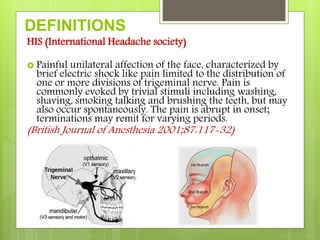
 Painful unilateral affection of the face, characterized by
brief electric shock like pain limited to the distribution of
one or more divisions of trigeminal nerve. Pain is
commonly evoked by trivial stimuli including washing,
shaving, smoking talking and brushing the teeth, but may
also occur spontaneously. The pain is abrupt in onset;
terminations may remit for varying periods.
(British Journal of Anesthesia 2001;87:117-32)
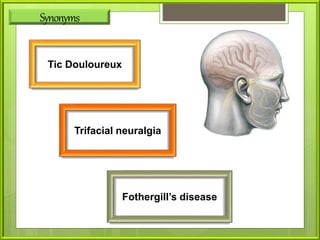
Synonyms
Tic Douloureux
Trifacial neuralgia
Fothergill’s disease
TIC
DOULOUREUX:
Tic douloureux Painful jerking
It is a truly agonizing condition, in which the patient may
clunch the hand over the face & experience severe,
lancinating pain associated with spasmodic contractions of
the facial muscles during attacks
– a feature that led to use of this term
HISTORY
Aretaeus of Cappadocia –At the end of first
century -1st clinical description of TN
1677 John Locke, gave the first full description
with its treatment.
In 1756, Nicolaus Andre - tic
douloureux
John Fothergill in 1773 published detailed
description of TN
CLASSSIFICATION
ATYPICAL TN
TYPICAL TN
 TN
IDIOPATHIC/PRIMARY SECONDARY
 ACCORDING TO DANTY[1934]
TN HAS BEEN CLASSIFIED AS
CLASSIC TRU
E
TYPES OF TRIGEMINAL
NEURALGIA :
 TYPICAL TRIGEMINAL NEURALGIA
 ATYPICAL TRIGEMINAL NEURALGIA
 PRE- TRIGEMINAL NEURALGIA
 MULTIPLE SCLEROSIS RELATED TRIGEMINAL
NEURALGIA
 SECONDARY OR TUMOR RELATED
TRIGEMINAL NEURALGIA
 TRIGEMINAL NEUROPATHY OR POST-
TRAUMATIC TRIGEMINAL NEURALGIA
 FAILED TRIGEMINAL NEURALGIA
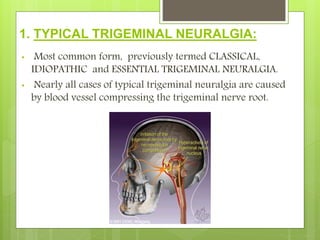
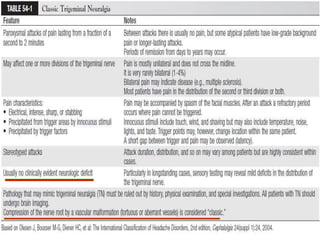
1. TYPICAL TRIGEMINAL NEURALGIA:
• Most common form, previously termed CLASSICAL,
IDIOPATHIC and ESSENTIAL TRIGEMINAL NEURALGIA.
• Nearly all cases of typical trigeminal neuralgia are caused
by blood vessel compressing the trigeminal nerve root.
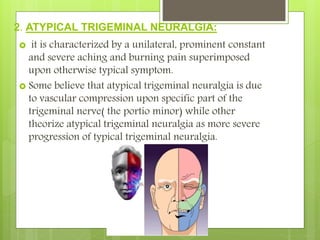
2. ATYPICAL TRIGEMINAL NEURALGIA:
 it is characterized by a unilateral, prominent constant
and severe aching and burning pain superimposed
upon otherwise typical symptom.
 Some believe that atypical trigeminal neuralgia is due
to vascular compression upon specific part of the
trigeminal nerve( the portio minor) while other
theorize atypical trigeminal neuralgia as more severe
progression of typical trigeminal neuralgia.
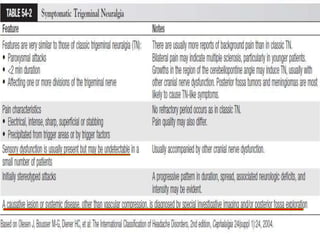
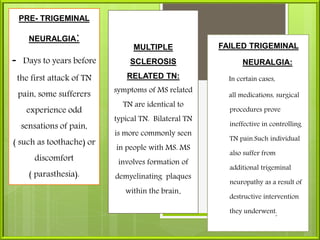
MULTIPLE
SCLEROSIS
RELATED TN:
symptoms of MS related
TN are identical to
typical TN. Bilateral TN
is more commonly seen
in people with MS. MS
involves formation of
demyelinating plaques
within the brain.
PRE- TRIGEMINAL
NEURALGIA:
- Days to years before
the first attack of TN
pain, some sufferers
experience odd
sensations of pain,
( such as toothache) or
discomfort
( parasthesia).
FAILED TRIGEMINAL
NEURALGIA:
In certain cases,
all medications, surgical
procedures prove
ineffective in controlling
TN pain.Such individual
also suffer from
additional trigeminal
neuropathy as a result of
destructive intervention
they underwent.
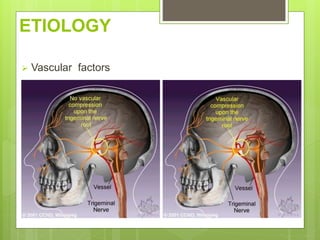
ETIOLOGY
 Vascular factors
ETIOLOGY
 Dental etiology(WESTRUM & BLACK 1976)
 Infection
 Multiple sclerosis(Olfson 1979)
 Petrous ridge(basilar compression,Lee 1937)
 Post traumatic neuralgia
 Intracranial vascular abnormalities..
 Viral etiology
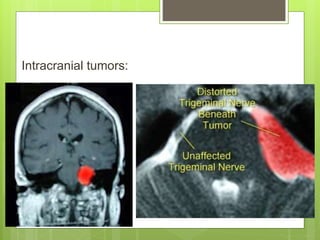
Intracranial tumors:
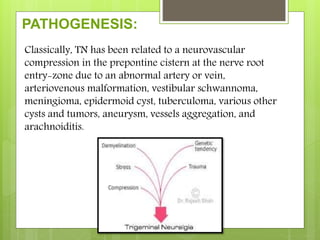
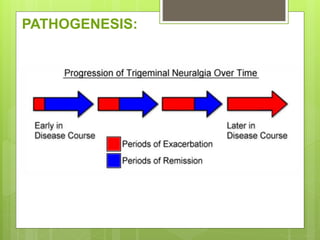
PATHOGENESIS:
Classically, TN has been related to a neurovascular
compression in the prepontine cistern at the nerve root
entry-zone due to an abnormal artery or vein,
arteriovenous malformation, vestibular schwannoma,
meningioma, epidermoid cyst, tuberculoma, various other
cysts and tumors, aneurysm, vessels aggregation, and
arachnoiditis.
Trigeminal convergence-projection theory
In the trigeminal convergence-projection theory, it has
been hypothesized that continuous or recurrent nociceptive
inputs from head and neck converge on spinal trigeminal
nucleus (subnucleus caudalis), where the release of
neurotransmitters and vasoactive substances may be
promoted.
This release decreases the threshold of adjacent second-
order neurons that receive input from sites other than
nociceptive sources.
The signals from these excited second-order neurons may
be transmitted to the thalamus, limbic system, and
somatosensory cortex and interpreted as pain.
Bioresonance hypothesis
Recently, the bioresonance hypothesis for TN pathogenesis
has been proposed. This theory states that when the
vibration frequency of a structure surrounding the
trigeminal nerve becomes close to its natural frequency,
the resonance of the trigeminal nerve occurs. The
bioresonance can damage trigeminal nerve fibers and lead
to the abnormal transmission of the impulse, which may
finally result in facial pain.
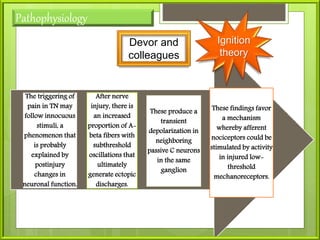
Pathophysiology
These findings favor
a mechanism
whereby afferent
nociceptors could be
stimulated by activity
in injured low-
threshold
mechanoreceptors.
These produce a
transient
depolarization in
neighboring
passive C neurons
in the same
ganglion
After nerve
injury, there is
an increased
proportion of A-
beta fibers with
subthreshold
oscillations that
ultimately
generate ectopic
discharges.
The triggering of
pain in TN may
follow innocuous
stimuli, a
phenomenon that
is probably
explained by
postinjury
changes in
neuronal function.
Ignition
theory
Devor and
colleagues
PATHOGENESIS:
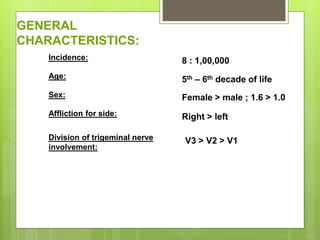
GENERAL
CHARACTERISTICS:
Incidence:
Age:
Sex:
Affliction for side:
Division of trigeminal nerve
involvement:
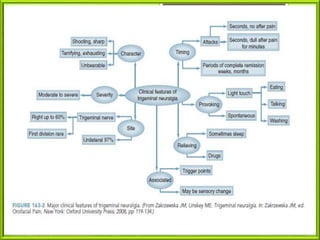
8 : 1,00,000
5th – 6th decade of life
Female > male ; 1.6 > 1.0
Right > left
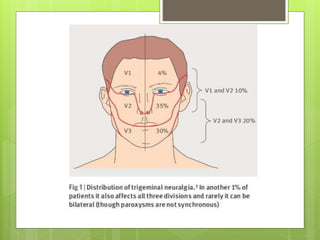
V3 > V2 > V1
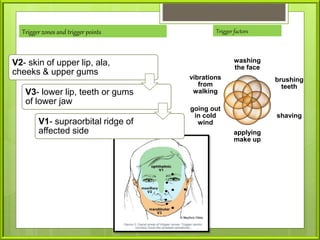
washing
the face
brushing
teeth
shaving
applying
make up
going out
in cold
wind
vibrations
from
walking
Trigger factorsTrigger zones and trigger points
V2- skin of upper lip, ala,
cheeks & upper gums
V3- lower lip, teeth or gums
of lower jaw
V1- supraorbital ridge of
affected side
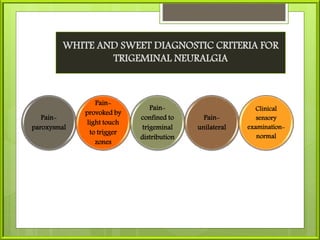
WHITE AND SWEET DIAGNOSTIC CRITERIA FOR
TRIGEMINAL NEURALGIA
Pain-
paroxysmal
Pain-
provoked by
light touch
to trigger
zones
Pain-
confined to
trigeminal
distribution
Pain-
unilateral
Clinical
sensory
examination-
normal
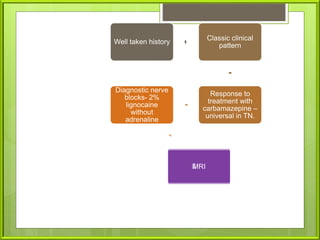
INVESTIGATIONS
Well taken history
Classic clinical
pattern
Response to
treatment with
carbamazepine –
universal in TN.
Diagnostic nerve
blocks- 2%
lignocaine
without
adrenaline
MRI
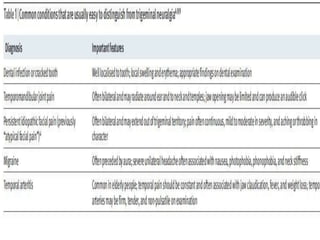
DIFFERENTIAL
DIAGNOSIS
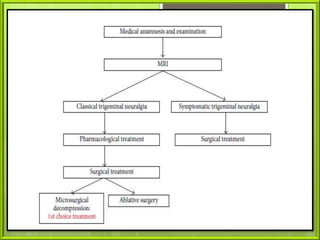
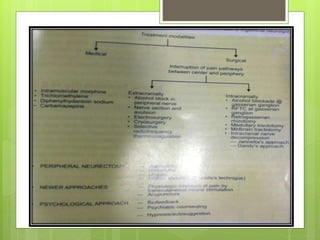
Treatment
Pharmacological
treatment
Surgical
treatment
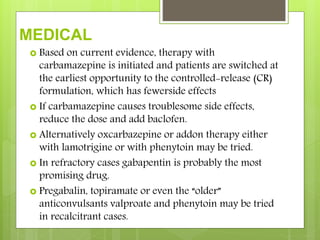
MEDICAL
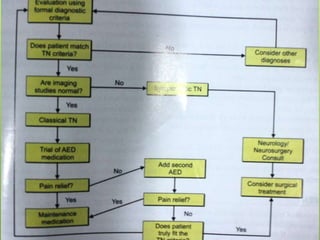
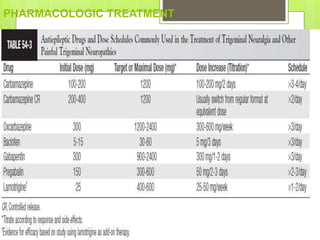
 Based on current evidence, therapy with
carbamazepine is initiated and patients are switched at
the earliest opportunity to the controlled-release (CR)
formulation, which has fewerside effects
 If carbamazepine causes troublesome side effects,
reduce the dose and add baclofen.
 Alternatively oxcarbazepine or addon therapy either
with lamotrigine or with phenytoin may be tried.
 In refractory cases gabapentin is probably the most
promising drug.
 Pregabalin, topiramate or even the “older”
anticonvulsants valproate and phenytoin may be tried
in recalcitrant cases.
PHARMACOLOGIC TREATMENT
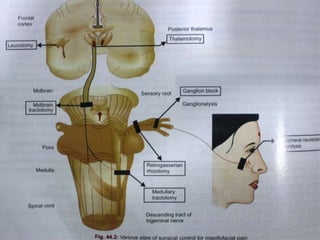
SURGERY
 Medically resistant patients who are physically able to
withstand neurosurgery, particularly with typical CTN, are
prime candidates for surgery
 The decision to opt for surgery is based on response to and
side effects from medical treatment, the patient’s age and
profession, and the surgical facilities and expertise available.
 Surgery may be aimed peripherally at the affected nerve or
centrally at the trigeminal ganglion or the posterior fossa
SURGICAL MANAGEMENT:
PERIPHERAL INJECTION:
It has been known that injection of destructive substance
into peripheral branches of the trigeminal nerve, produces
anaesthesia in the trigger zones or in areas of distribution of
spontaneous pain.
(A) LONG ACTING ANAESTHETIC AGENTS:
Without adrenaline such as bupivacaine with or
without corticosteroids may be injected at the most
proximal possible nerve site.
(B) ALCOHOL INJECTION:
0.5 – 2 ml of 95 % absolute alcohol can be used to
block the peripheral branches of the trigeminal nerve.
Aim is to destroy the nerve fibres.
It produces total numbness in the region of distribution
of the nerve that was anaesthetized.
Complication:
Necrosis of the adjacent tissue
Fibrosis
Alcohol induced neuritis
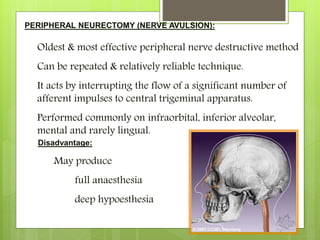
PERIPHERAL NEURECTOMY (NERVE AVULSION):
Oldest & most effective peripheral nerve destructive method
Can be repeated & relatively reliable technique.
It acts by interrupting the flow of a significant number of
afferent impulses to central trigeminal apparatus.
Performed commonly on infraorbital, inferior alveolar,
mental and rarely lingual.
Disadvantage:
May produce
full anaesthesia
deep hypoesthesia
INFRAORBITAL NEURECTOMY:
(i) Conventional intraoral approach
(ii)Braun’s transantral approach
Conventional intraoral approach:
A ‘U’ - shaped Caldwell – Luc incision is made in the
upper buccal vestibule in the canine fossa region.
Mucoperiosteal flap is reflected superiorly to locate
the infraorbital foramen.
Once the nerve is exposed, all the peripheral
branches are held with the hemostat & avulsed from
the skin surface intra orally.
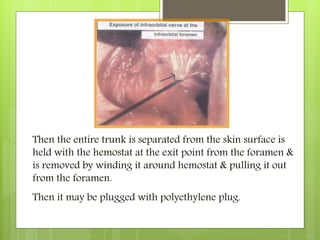
Then the entire trunk is separated from the skin surface is
held with the hemostat at the exit point from the foramen &
is removed by winding it around hemostat & pulling it out
from the foramen.
Then it may be plugged with polyethylene plug.
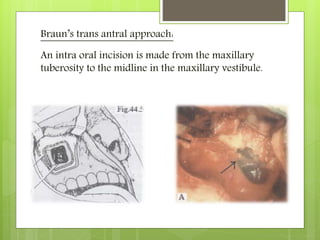
Braun’s trans antral approach:
An intra oral incision is made from the maxillary
tuberosity to the midline in the maxillary vestibule.
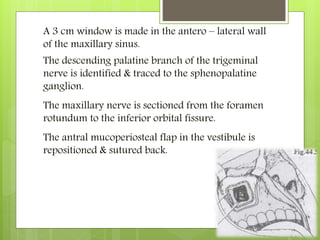
The descending palatine branch of the trigeminal
nerve is identified & traced to the sphenopalatine
ganglion.
The maxillary nerve is sectioned from the foramen
rotundum to the inferior orbital fissure.
The antral mucoperiosteal flap in the vestibule is
repositioned & sutured back.
A 3 cm window is made in the antero – lateral wall
of the maxillary sinus.
INFERIOR ALVEOLAR NEURECTOMY:
(i) Extra oral approach
(ii)Intra oral approach
The extra oral approach:
Done through Risdon’s incision
After reflection of masseter, a bony window is drilled
in outer cortex & nerve is lifted with nerve hook &
avulsed from its superior attachment & mental nerve
is avulsed anteriorly through the same approach.
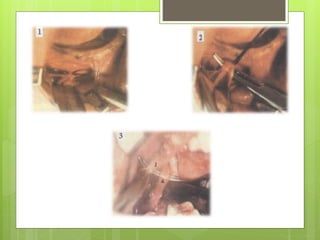
The intra oral approach:
Done via Dr Ginwalla’s incision
Incision is made along with the anterior border of
ascending ramus, extending lingually & buccally &
ending in a fork like an inverted Y.
Incision is then deepened on the medial aspect of
ramus.
The temporalis & medial pterygoid muscles are split
at their insertion & inferior alveolar nerve is located.
The nerve is ligated at two points in the most
superior part visible & divided between the ligature.
The superior end is cauterized & the lower end is
held securely using a hemostat.
The mental nerve is also similarly ligated in two
points close to the mental foramen & divided
between two.
The remaining nerve is held at the inferior alveolar
end & wound around the hemostat & excised from
the canal.
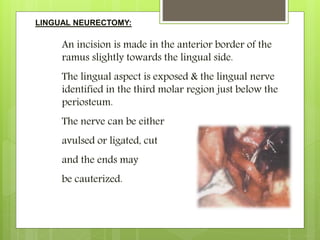
LINGUAL NEURECTOMY:
An incision is made in the anterior border of the
ramus slightly towards the lingual side.
The lingual aspect is exposed & the lingual nerve
identified in the third molar region just below the
periosteum.
The nerve can be either
avulsed or ligated, cut
and the ends may
be cauterized.
CRYOTHERAPHY:
• Barnard first used cryotheraphy in 1981 for the
treatment of the trigeminal neuralgia.
• After identifying the affected nerve , it is then exposed
to the cryoprobe intraorally.
• Direct application of cryotheraphy probe at
temperatures colder than -60 C are known to produce
Wallerian degeneration without destroying the nerve
sheath itself.
• Nerve is exposed for 2 mm freeze followed by 5 mm
thaw cycle.
• The freeze – thaw cycle is repeated at least 3 times.
GASSERIAN GANGLION PROCEDURES:
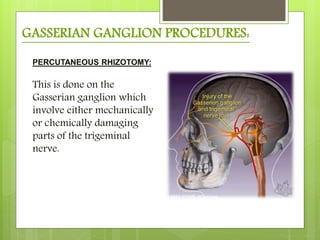
PERCUTANEOUS RHIZOTOMY:
This is done on the
Gasserian ganglion which
involve either mechanically
or chemically damaging
parts of the trigeminal
nerve.
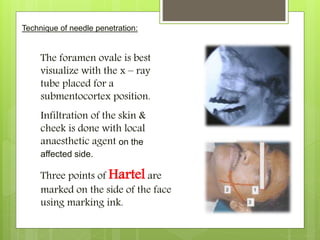
Technique of needle penetration:
The foramen ovale is best
visualize with the x – ray
tube placed for a
submentocortex position.
Infiltration of the skin &
cheek is done with local
anaesthetic agent on the
affected side.
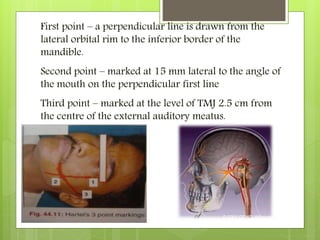
Three points of Hartel are
marked on the side of the face
using marking ink.
First point – a perpendicular line is drawn from the
lateral orbital rim to the inferior border of the
mandible.
Second point – marked at 15 mm lateral to the angle of
the mouth on the perpendicular first line
Third point – marked at the level of TMJ 2.5 cm from
the centre of the external auditory meatus.
(A) Controlled radiofrequency thermocoagulation:
It was first introduced by Kirschner (1931) & later
modified by Sweet (1970).
Technique:
The patient is sedated with a short acting sedative
and vital signs are monitored.
The electrode is inserted through the cheek under
fluoroscopy into foramen ovale.
The patient is awakened briefly to accurately locate
the position of the electrode.
Indication:
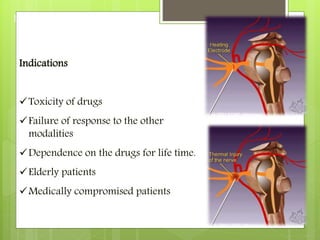
Indications
Toxicity of drugs
Failure of response to the other
modalities
Dependence on the drugs for life time.
Elderly patients
Medically compromised patients
Advantages:
Comparative low rate of recurrence
Zero mortality
Thermocoagulation preserves the motor function of
the trigeminal nerve
Can avoid major surgical procedure
Disadvantage:
May cause
anaesthesia dolorosa
loss of corneal reflex
Meningitis (rarely)
Lesion production:
• Thermal lesion of 30-90 sec. duration are made at 65 to
75 degree centigrade.
Power:
• 25 watt,voltage 40-45 volts.Current 120-140mA.
• Temp. 65-75 degrees.
• 5mm bare tip electrode with 2mm diameter
• Leison produced of 10*6mm within trigeminal ganglion
root at temp. 75 degrees.
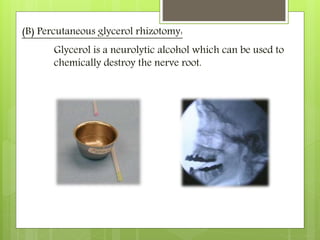
(B) Percutaneous glycerol rhizotomy:
Glycerol is a neurolytic alcohol which can be used to
chemically destroy the nerve root.
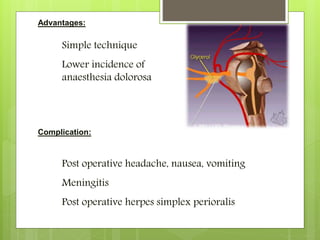
Advantages:
Simple technique
Lower incidence of
anaesthesia dolorosa
Complication:
Post operative headache, nausea, vomiting
Meningitis
Post operative herpes simplex perioralis
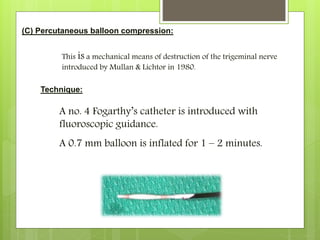
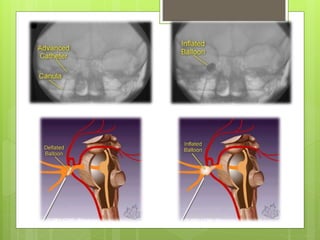
(C) Percutaneous balloon compression:
This is a mechanical means of destruction of the trigeminal nerve
introduced by Mullan & Lichtor in 1980.
Technique:
A no. 4 Fogarthy’s catheter is introduced with
fluoroscopic guidance.
A 0.7 mm balloon is inflated for 1 – 2 minutes.
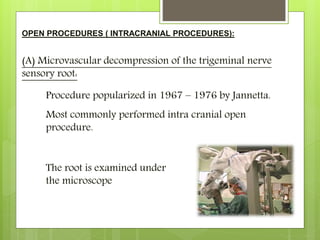
OPEN PROCEDURES ( INTRACRANIAL PROCEDURES):
(A) Microvascular decompression of the trigeminal nerve
sensory root:
Procedure popularized in 1967 – 1976 by Jannetta.
Most commonly performed intra cranial open
procedure.
The root is examined under
the microscope
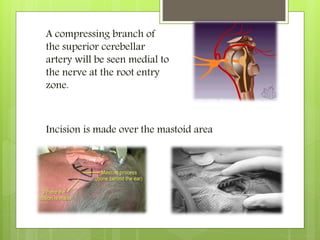
A compressing branch of
the superior cerebellar
artery will be seen medial to
the nerve at the root entry
zone.
Incision is made over the mastoid area
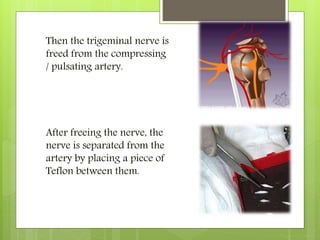
Then the trigeminal nerve is
freed from the compressing
/ pulsating artery.
After freeing the nerve, the
nerve is separated from the
artery by placing a piece of
Teflon between them.
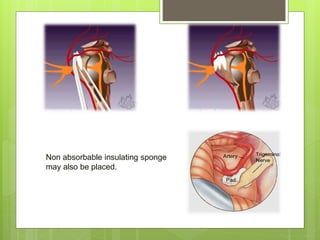
Non absorbable insulating sponge
may also be placed.
(B) Trigeminal root section:
(a) Extradural sensory root section:Frazier Approach[1901]
It is also known as the subtemporal extradural
retrogasserian rhizotomy.
It is no longer used now.
In this, sensory root is divided, sparing the motor
root, as close to the brainstem as possible.
Disadvantage:
Profound sensory loss
High incidence of anaesthesia dolorosa
(b) Intradural rhizotomy:
Described by Wilkins[1966]
This is an intradural procedure that is done when
the pain recurs after MVD.
This is usually done in the posterior cranial fossa.
It can be selective or complete.
(c) Trigeminal tractotomy:
It is also known as the medullary tractotomy.
This is not usually done.
The descending tract of the trigeminal nerve is
sectioned at the junction of the cervicomedullary
region.
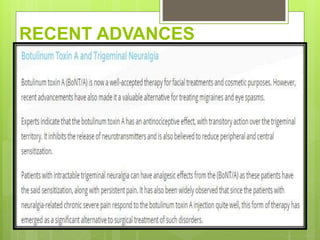
RECENT ADVANCES
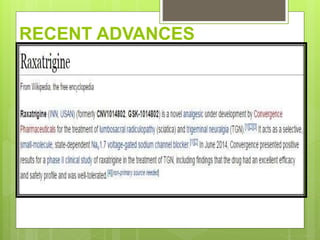
RECENT ADVANCES
Conclusion
 Trigeminal Neuralgia has been an enigma to
physicians for a long course of time. There have
been various advances in the understanding of the
pathogenesis of the disease per se and the
treatment modalities.
 However various treatment modalities suggests
dissatisfaction with any one single procedure.
 Hence the golden rule still remains optimum
scrutinisation and authentic diagnosis which is a key
to the success of any treatment.
THANK
YOU…….

trigeminal neuralgia

  • 2.
  • 3.
    CONTENTS  Introduction  Definition Historical review of Trigeminal Neuralgia  Classification  Etio-pathogenesis  General characteristics  Clinical characteristics  Diagnosis  Treatment modalities  Recent Advances
  • 4.
    INTRODUCTION o Trigeminal neuralgiaor tic douloureux is a neuropathic disorder of trigeminal nerve that causes episodes of intense pain in eyes, lips, scalp, forehead and jaws. o It has been labeled as suicide disease due to insignificant number of people taking their own life because they are unable to have their pain controlled by medication or surgery.
  • 5.
    DEFINITIONS (International association forstudy of pain; clinical journal of pain 2002) Sudden,usually unilateral,severe brief stabbing recurrent pain in the distribution of one or more branches of Vth cranial nerve. PETERSON: It usually presents with sharp, electric shock like pain in the face or mouth. pain is intense, lasting for brief period of seconds to 1min.after which there is refractory period during which pain cannot be reinitiated for a period of time.
  • 6.
    DEFINITIONS HIS (International Headachesociety)  Painful unilateral affection of the face, characterized by brief electric shock like pain limited to the distribution of one or more divisions of trigeminal nerve. Pain is commonly evoked by trivial stimuli including washing, shaving, smoking talking and brushing the teeth, but may also occur spontaneously. The pain is abrupt in onset; terminations may remit for varying periods. (British Journal of Anesthesia 2001;87:117-32)
  • 7.
  • 8.
    TIC DOULOUREUX: Tic douloureux Painfuljerking It is a truly agonizing condition, in which the patient may clunch the hand over the face & experience severe, lancinating pain associated with spasmodic contractions of the facial muscles during attacks – a feature that led to use of this term
  • 9.
    HISTORY Aretaeus of Cappadocia–At the end of first century -1st clinical description of TN 1677 John Locke, gave the first full description with its treatment. In 1756, Nicolaus Andre - tic douloureux John Fothergill in 1773 published detailed description of TN
  • 10.
    CLASSSIFICATION ATYPICAL TN TYPICAL TN TN IDIOPATHIC/PRIMARY SECONDARY  ACCORDING TO DANTY[1934] TN HAS BEEN CLASSIFIED AS CLASSIC TRU E
  • 11.
    TYPES OF TRIGEMINAL NEURALGIA:  TYPICAL TRIGEMINAL NEURALGIA  ATYPICAL TRIGEMINAL NEURALGIA  PRE- TRIGEMINAL NEURALGIA  MULTIPLE SCLEROSIS RELATED TRIGEMINAL NEURALGIA  SECONDARY OR TUMOR RELATED TRIGEMINAL NEURALGIA  TRIGEMINAL NEUROPATHY OR POST- TRAUMATIC TRIGEMINAL NEURALGIA  FAILED TRIGEMINAL NEURALGIA
  • 12.
    1. TYPICAL TRIGEMINALNEURALGIA: • Most common form, previously termed CLASSICAL, IDIOPATHIC and ESSENTIAL TRIGEMINAL NEURALGIA. • Nearly all cases of typical trigeminal neuralgia are caused by blood vessel compressing the trigeminal nerve root.
  • 15.
    2. ATYPICAL TRIGEMINALNEURALGIA:  it is characterized by a unilateral, prominent constant and severe aching and burning pain superimposed upon otherwise typical symptom.  Some believe that atypical trigeminal neuralgia is due to vascular compression upon specific part of the trigeminal nerve( the portio minor) while other theorize atypical trigeminal neuralgia as more severe progression of typical trigeminal neuralgia.
  • 16.
    MULTIPLE SCLEROSIS RELATED TN: symptoms ofMS related TN are identical to typical TN. Bilateral TN is more commonly seen in people with MS. MS involves formation of demyelinating plaques within the brain. PRE- TRIGEMINAL NEURALGIA: - Days to years before the first attack of TN pain, some sufferers experience odd sensations of pain, ( such as toothache) or discomfort ( parasthesia). FAILED TRIGEMINAL NEURALGIA: In certain cases, all medications, surgical procedures prove ineffective in controlling TN pain.Such individual also suffer from additional trigeminal neuropathy as a result of destructive intervention they underwent.
  • 17.
  • 18.
    ETIOLOGY  Dental etiology(WESTRUM& BLACK 1976)  Infection  Multiple sclerosis(Olfson 1979)  Petrous ridge(basilar compression,Lee 1937)  Post traumatic neuralgia  Intracranial vascular abnormalities..  Viral etiology
  • 19.
  • 21.
    PATHOGENESIS: Classically, TN hasbeen related to a neurovascular compression in the prepontine cistern at the nerve root entry-zone due to an abnormal artery or vein, arteriovenous malformation, vestibular schwannoma, meningioma, epidermoid cyst, tuberculoma, various other cysts and tumors, aneurysm, vessels aggregation, and arachnoiditis.
  • 22.
    Trigeminal convergence-projection theory Inthe trigeminal convergence-projection theory, it has been hypothesized that continuous or recurrent nociceptive inputs from head and neck converge on spinal trigeminal nucleus (subnucleus caudalis), where the release of neurotransmitters and vasoactive substances may be promoted. This release decreases the threshold of adjacent second- order neurons that receive input from sites other than nociceptive sources. The signals from these excited second-order neurons may be transmitted to the thalamus, limbic system, and somatosensory cortex and interpreted as pain.
  • 23.
    Bioresonance hypothesis Recently, thebioresonance hypothesis for TN pathogenesis has been proposed. This theory states that when the vibration frequency of a structure surrounding the trigeminal nerve becomes close to its natural frequency, the resonance of the trigeminal nerve occurs. The bioresonance can damage trigeminal nerve fibers and lead to the abnormal transmission of the impulse, which may finally result in facial pain.
  • 24.
    Pathophysiology These findings favor amechanism whereby afferent nociceptors could be stimulated by activity in injured low- threshold mechanoreceptors. These produce a transient depolarization in neighboring passive C neurons in the same ganglion After nerve injury, there is an increased proportion of A- beta fibers with subthreshold oscillations that ultimately generate ectopic discharges. The triggering of pain in TN may follow innocuous stimuli, a phenomenon that is probably explained by postinjury changes in neuronal function. Ignition theory Devor and colleagues
  • 25.
  • 26.
    GENERAL CHARACTERISTICS: Incidence: Age: Sex: Affliction for side: Divisionof trigeminal nerve involvement: 8 : 1,00,000 5th – 6th decade of life Female > male ; 1.6 > 1.0 Right > left V3 > V2 > V1
  • 28.
    washing the face brushing teeth shaving applying make up goingout in cold wind vibrations from walking Trigger factorsTrigger zones and trigger points V2- skin of upper lip, ala, cheeks & upper gums V3- lower lip, teeth or gums of lower jaw V1- supraorbital ridge of affected side
  • 30.
    WHITE AND SWEETDIAGNOSTIC CRITERIA FOR TRIGEMINAL NEURALGIA Pain- paroxysmal Pain- provoked by light touch to trigger zones Pain- confined to trigeminal distribution Pain- unilateral Clinical sensory examination- normal
  • 31.
  • 32.
    Well taken history Classicclinical pattern Response to treatment with carbamazepine – universal in TN. Diagnostic nerve blocks- 2% lignocaine without adrenaline MRI
  • 33.
  • 36.
  • 39.
    MEDICAL  Based oncurrent evidence, therapy with carbamazepine is initiated and patients are switched at the earliest opportunity to the controlled-release (CR) formulation, which has fewerside effects  If carbamazepine causes troublesome side effects, reduce the dose and add baclofen.  Alternatively oxcarbazepine or addon therapy either with lamotrigine or with phenytoin may be tried.  In refractory cases gabapentin is probably the most promising drug.  Pregabalin, topiramate or even the “older” anticonvulsants valproate and phenytoin may be tried in recalcitrant cases.
  • 40.
  • 41.
    SURGERY  Medically resistantpatients who are physically able to withstand neurosurgery, particularly with typical CTN, are prime candidates for surgery  The decision to opt for surgery is based on response to and side effects from medical treatment, the patient’s age and profession, and the surgical facilities and expertise available.  Surgery may be aimed peripherally at the affected nerve or centrally at the trigeminal ganglion or the posterior fossa
  • 42.
    SURGICAL MANAGEMENT: PERIPHERAL INJECTION: Ithas been known that injection of destructive substance into peripheral branches of the trigeminal nerve, produces anaesthesia in the trigger zones or in areas of distribution of spontaneous pain. (A) LONG ACTING ANAESTHETIC AGENTS: Without adrenaline such as bupivacaine with or without corticosteroids may be injected at the most proximal possible nerve site.
  • 43.
    (B) ALCOHOL INJECTION: 0.5– 2 ml of 95 % absolute alcohol can be used to block the peripheral branches of the trigeminal nerve. Aim is to destroy the nerve fibres. It produces total numbness in the region of distribution of the nerve that was anaesthetized. Complication: Necrosis of the adjacent tissue Fibrosis Alcohol induced neuritis
  • 44.
    PERIPHERAL NEURECTOMY (NERVEAVULSION): Oldest & most effective peripheral nerve destructive method Can be repeated & relatively reliable technique. It acts by interrupting the flow of a significant number of afferent impulses to central trigeminal apparatus. Performed commonly on infraorbital, inferior alveolar, mental and rarely lingual. Disadvantage: May produce full anaesthesia deep hypoesthesia
  • 45.
    INFRAORBITAL NEURECTOMY: (i) Conventionalintraoral approach (ii)Braun’s transantral approach Conventional intraoral approach: A ‘U’ - shaped Caldwell – Luc incision is made in the upper buccal vestibule in the canine fossa region. Mucoperiosteal flap is reflected superiorly to locate the infraorbital foramen. Once the nerve is exposed, all the peripheral branches are held with the hemostat & avulsed from the skin surface intra orally.
  • 46.
    Then the entiretrunk is separated from the skin surface is held with the hemostat at the exit point from the foramen & is removed by winding it around hemostat & pulling it out from the foramen. Then it may be plugged with polyethylene plug.
  • 47.
    Braun’s trans antralapproach: An intra oral incision is made from the maxillary tuberosity to the midline in the maxillary vestibule.
  • 48.
    The descending palatinebranch of the trigeminal nerve is identified & traced to the sphenopalatine ganglion. The maxillary nerve is sectioned from the foramen rotundum to the inferior orbital fissure. The antral mucoperiosteal flap in the vestibule is repositioned & sutured back. A 3 cm window is made in the antero – lateral wall of the maxillary sinus.
  • 49.
    INFERIOR ALVEOLAR NEURECTOMY: (i)Extra oral approach (ii)Intra oral approach The extra oral approach: Done through Risdon’s incision After reflection of masseter, a bony window is drilled in outer cortex & nerve is lifted with nerve hook & avulsed from its superior attachment & mental nerve is avulsed anteriorly through the same approach.
  • 50.
    The intra oralapproach: Done via Dr Ginwalla’s incision Incision is made along with the anterior border of ascending ramus, extending lingually & buccally & ending in a fork like an inverted Y. Incision is then deepened on the medial aspect of ramus. The temporalis & medial pterygoid muscles are split at their insertion & inferior alveolar nerve is located.
  • 52.
    The nerve isligated at two points in the most superior part visible & divided between the ligature. The superior end is cauterized & the lower end is held securely using a hemostat. The mental nerve is also similarly ligated in two points close to the mental foramen & divided between two. The remaining nerve is held at the inferior alveolar end & wound around the hemostat & excised from the canal.
  • 53.
    LINGUAL NEURECTOMY: An incisionis made in the anterior border of the ramus slightly towards the lingual side. The lingual aspect is exposed & the lingual nerve identified in the third molar region just below the periosteum. The nerve can be either avulsed or ligated, cut and the ends may be cauterized.
  • 54.
    CRYOTHERAPHY: • Barnard firstused cryotheraphy in 1981 for the treatment of the trigeminal neuralgia. • After identifying the affected nerve , it is then exposed to the cryoprobe intraorally. • Direct application of cryotheraphy probe at temperatures colder than -60 C are known to produce Wallerian degeneration without destroying the nerve sheath itself. • Nerve is exposed for 2 mm freeze followed by 5 mm thaw cycle. • The freeze – thaw cycle is repeated at least 3 times.
  • 56.
    GASSERIAN GANGLION PROCEDURES: PERCUTANEOUSRHIZOTOMY: This is done on the Gasserian ganglion which involve either mechanically or chemically damaging parts of the trigeminal nerve.
  • 57.
    Technique of needlepenetration: The foramen ovale is best visualize with the x – ray tube placed for a submentocortex position. Infiltration of the skin & cheek is done with local anaesthetic agent on the affected side. Three points of Hartel are marked on the side of the face using marking ink.
  • 58.
    First point –a perpendicular line is drawn from the lateral orbital rim to the inferior border of the mandible. Second point – marked at 15 mm lateral to the angle of the mouth on the perpendicular first line Third point – marked at the level of TMJ 2.5 cm from the centre of the external auditory meatus.
  • 59.
    (A) Controlled radiofrequencythermocoagulation: It was first introduced by Kirschner (1931) & later modified by Sweet (1970). Technique: The patient is sedated with a short acting sedative and vital signs are monitored. The electrode is inserted through the cheek under fluoroscopy into foramen ovale. The patient is awakened briefly to accurately locate the position of the electrode.
  • 60.
    Indication: Indications Toxicity of drugs Failureof response to the other modalities Dependence on the drugs for life time. Elderly patients Medically compromised patients
  • 61.
    Advantages: Comparative low rateof recurrence Zero mortality Thermocoagulation preserves the motor function of the trigeminal nerve Can avoid major surgical procedure Disadvantage: May cause anaesthesia dolorosa loss of corneal reflex Meningitis (rarely)
  • 62.
    Lesion production: • Thermallesion of 30-90 sec. duration are made at 65 to 75 degree centigrade. Power: • 25 watt,voltage 40-45 volts.Current 120-140mA. • Temp. 65-75 degrees. • 5mm bare tip electrode with 2mm diameter • Leison produced of 10*6mm within trigeminal ganglion root at temp. 75 degrees.
  • 63.
    (B) Percutaneous glycerolrhizotomy: Glycerol is a neurolytic alcohol which can be used to chemically destroy the nerve root.
  • 64.
    Advantages: Simple technique Lower incidenceof anaesthesia dolorosa Complication: Post operative headache, nausea, vomiting Meningitis Post operative herpes simplex perioralis
  • 65.
    (C) Percutaneous ballooncompression: This is a mechanical means of destruction of the trigeminal nerve introduced by Mullan & Lichtor in 1980. Technique: A no. 4 Fogarthy’s catheter is introduced with fluoroscopic guidance. A 0.7 mm balloon is inflated for 1 – 2 minutes.
  • 67.
    OPEN PROCEDURES (INTRACRANIAL PROCEDURES): (A) Microvascular decompression of the trigeminal nerve sensory root: Procedure popularized in 1967 – 1976 by Jannetta. Most commonly performed intra cranial open procedure. The root is examined under the microscope
  • 68.
    A compressing branchof the superior cerebellar artery will be seen medial to the nerve at the root entry zone. Incision is made over the mastoid area
  • 69.
    Then the trigeminalnerve is freed from the compressing / pulsating artery. After freeing the nerve, the nerve is separated from the artery by placing a piece of Teflon between them.
  • 70.
    Non absorbable insulatingsponge may also be placed.
  • 71.
    (B) Trigeminal rootsection: (a) Extradural sensory root section:Frazier Approach[1901] It is also known as the subtemporal extradural retrogasserian rhizotomy. It is no longer used now. In this, sensory root is divided, sparing the motor root, as close to the brainstem as possible. Disadvantage: Profound sensory loss High incidence of anaesthesia dolorosa
  • 72.
    (b) Intradural rhizotomy: Describedby Wilkins[1966] This is an intradural procedure that is done when the pain recurs after MVD. This is usually done in the posterior cranial fossa. It can be selective or complete. (c) Trigeminal tractotomy: It is also known as the medullary tractotomy. This is not usually done. The descending tract of the trigeminal nerve is sectioned at the junction of the cervicomedullary region.
  • 77.
  • 78.
  • 79.
    Conclusion  Trigeminal Neuralgiahas been an enigma to physicians for a long course of time. There have been various advances in the understanding of the pathogenesis of the disease per se and the treatment modalities.  However various treatment modalities suggests dissatisfaction with any one single procedure.  Hence the golden rule still remains optimum scrutinisation and authentic diagnosis which is a key to the success of any treatment.
  • 80.

Editor's Notes

  • #25 It is likely that both central and peripheral changes occur, which would explain why not all patients with a treated compression of the nerve get permanent relief
  • #29  The pain is provoked by light touch- trigger zones is an area of facial skin or oral mucosa where low intensity mechanical stimulation (light touch,an air puff, or even hair bending can elicit typical facial pain). Reported trigger factors are: specific area that, when stimulated by touch, pain, or pressure, excites an attack of neurologic pain.