INDUCTION,MAINTENCE &
REVERSAL OF ANAESTHESIA
PRESENTED BY ALEX LAGOH
SUPERVISED BY DR. SARPONG
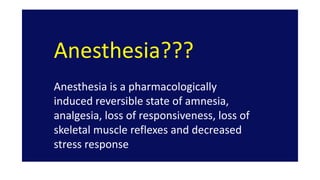
Anesthesia???
Anesthesia is a pharmacologically
induced reversible state of amnesia,
analgesia, loss of responsiveness, loss of
skeletal muscle reflexes and decreased
stress response
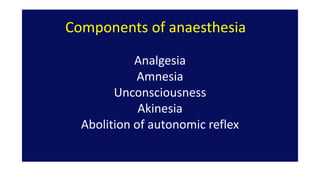
Components of anaesthesia
Analgesia
Amnesia
Unconsciousness
Akinesia
Abolition of autonomic reflex
Components of anaesthesia
• Analgesia
• Amnesia
• Unconsciousness
• Akinesia
• Abolition of autonomic reflex
Stages Of Anaesthesia
• Stage I: the stage of analgesia.
• Stage II: stage of excitement.
• Stage III: surgical anaesthesia.
• Stage IV: stage of impending respiratory and circulatory failure.
(Medullary Paralysis)
Stages of Anaesthesia
• Anaesthesia performed with general anaesthetics occurs in four stages
which may or may not be observable because they can occur very rapidly:
• Stage One: Analgesia. The patient experiences analgesia or a loss of pain
sensation but remains conscious and can carry on a conversation.
• Stage Two: Excitement. The patient may experience delirium or become
violent. Blood pressure rises and becomes irregular, and breathing rate
increases. This stage is typically bypassed by administering a barbiturate,
such as sodium pentothal, before the anaesthesia.
Stages of Anaesthesia
• Stage Three: Surgical Anaesthesia. During this stage, the skeletal
muscles relax, and the patient's breathing becomes regular. Eye
movements slow, then stop, and surgery can begin.
• Stage Four: Medullary Paralysis. This stage occurs if the
respiratory centres in the medulla oblongata of the brain that
control breathing and other vital functions cease to function.
Death can result if the patient cannot be revived quickly. This
stage should never be reached. Careful control of the amounts of
anaesthetics administered prevent this occurrence.
Induction of Anaesthesia
• It refers to transition from an awake to an
anaesthetized state through the administration of a
drug or combination of drugs at the beginning of an
anaesthetic procedure.
• . Induction aims at achieving the triad of Anaesthesia
1. Loss of Consciousness: IV or Inhalational
2. Muscle relaxation: using muscle relaxants
3. Analgesia
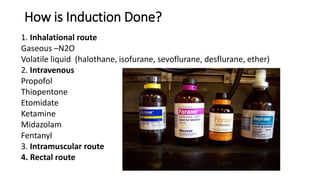
How is Induction Done?
1. Inhalational route
Gaseous –N2O
Volatile liquid (halothane, isofurane, sevoflurane, desflurane, ether)
2. Intravenous
Propofol
Thiopentone
Etomidate
Ketamine
Midazolam
Fentanyl
3. Intramuscular route
4. Rectal route
Indications For Inhalational Induction
• Young children
• Upper airway obstruction .eg epiglottitis
• Lower airway obstruction eg. Foreign body
• Bronchopulmonary fistula
• Inaccessible veins
Complications and Difficulties
Assoc. with Inhalational Induction
• Slow induction of anesthesia
• Problems with second stage of anesthesia
• Airway obstruction eg. Bronchospasm
• Laryngospasm and hiccups
• Environmental pollution
Intravenous induction of anaesthesia
• Induction by IV agents is the commonest and can be done for
ALL patients, but there are indications for induction using
Inhalational agents.
• This is most frequently achieved in adults by the IV injection
of a drug. Consciousness is lost rapidly as the concentration
of the drug in the brain rises very quickly. The drug is then
redistributed to other tissues and the plasma concentration
falls; this is followed by a fall in brain concentration and the
patient recovers consciousness, that’s why maintenance is
important.
INDUCTION CONT’D
Preparation in theatre
- Check anaesthetic equipment – Machines & Monitors
- Check tracheal intubation trolley
- Check emergency drugs
- Draw drugs for anaesthesia
-ATTACH MONITORS AND RECORD BASELINE READING
-IV ACCESS
-PRE-OXYGENATION
-INDUCTION: IV OR INHALATIONAL
Rapid Sequence Induction
• Used where the risk of aspiration is high
- pre-oxygenate with 100% oxygen for 3-5 minutes
- Sellick’s manoeuvre on induction. Firm backward pressure on cricoid
cartilage occluding the oesophagus to prevent gastric reflux into the larynx
- Short-acting muscle relaxant is given immediately after induction
- The trachea is then intubated and the cuff of the endotracheal tube
inflated
- Once the ET tube is correctly positioned, cricoid pressure maybe released
and maintenance of anaesthesia continues
- Give a longer-acting muscle relaxant when the shorter acting one wears off
MUSCLE RELAXANTS
• Mild muscle relaxation can be attained by increasing the depth of
general anesthesia with potent inhalational agents but the amount
required for useful muscle relaxation is too high to be practical
• Muscle relaxation often desired during surgical procedures for various
reasons
• facilitate intubation
• prevent muscle stretch reflex and suppresses muscle resting tone
• facilitate controlled ventilation
• allow access to the surgical field (intracavitary surgery)
NEUROMUSCULAR BLOCKING AGENTS
These drugs fall into two groups:
• DEPOLARIZING BLOCKING AGENTS: These agents act by depolarizing the plasma
membrane of the skeletal muscle fiber. This persistent depolarization makes the
muscle fiber resistant to further stimulation by ACh. eg Suxamethonium
• NON-DEPOLARIZING BLOCKING AGENT: These agents constitute the majority of
the clinically-relevant neuromuscular blockers. They act by competitively blocking
the binding of ACh to its receptors.
-Benzylisoquinolinium compounds
• – eg Atracurium, Cisatracurium, Mivacurium
-Aminosteroidal compounds– eg Vecuronium, Rocuronium, Pancuronium
MAINTENANCE OF ANAESTHESIA
• The duration of action of IV induction agents is
generally 5 to 10 minutes, after which time
spontaneous recovery of consciousness will occur. In
order to prolong anaesthesia for the required duration
(usually the duration of surgery), anaesthesia must
be maintained
• Either be by inhalational or by TIVA
Maintenance of Anaesthesia
• Gauging the depth of anaesthesia will involve monitoring the
following parameters
- Heart rate
- Blood pressure
- Lacrimation
- Pupil size
- Movement
Minimum Alveolar Concentration
• This is the minimum alveolar concentration that
produces no movement to standard surgical stimulus
for 50% of patients.
• This allows for comparison with other agents and
gives us an idea of the depth of anaesthesia.
• Compounds with high MAC – low potency(desflurane)
• Compounds with low MAC – High potency(halothane)
Minimum Alveolar Concentration
• The effect of inhalational anaesthetic are additive
therefore the values for MAC are often quoted as the
value in oxygen and the value when given with a
stated percentage of nitrous oxide(which has its own
MAC) which will be clearly less
FACTORS THAT AFFECT MAC
• INCREASES MAC
• Decreasing age (infants)
• Pyrexia
• Chronic alcohol ingestion
• Thyrotoxicosis
• Presence of ephedrine or amphetamine
• Chronic drug abuser
FACTORS THAT AFFECT MAC
• REDUCES THE MAC
• Increasing age(the elderly)
• Hypotension
• Hypothermia
• Hypothyroidism
• Pregnancy
• Current use of Opiods
Maintenance Cont’d
• Maintenance of the airway is important if you will maintain
anesthesia by inhalational
facemask,
laryngeal mask airway (LMA)
or a tracheal tube.
Can be used.
TOTAL INTRAVEENOUS ANAESTHESIA (TIVA)
•When IV drugs are given to induce and maintain
anesthesia the term TIVA is used eg ketamine,
propofol
•Anaesthesia is maintained by infusion or
intermittent I.V injection
TIVA
• For a drug to be of use in maintaining anaesthesia, it
must be rapidly eliminated or metabolised to inactive
substance to prevent accumulation and delayed
recovery and have no unpleasant side effects.
• Currently an infusion of propofol is the most common
and widely used technique
TIVA USING PROPFOL
• With this technique an approximate brain
concentration of propofol must be achieved and
maintained to prevent awareness and any response to
surgery
• The simplest way is to give the usual IV induction dose
followed by repeated injections at intervals depending
on the patients response
TIVA USING PROPFOL
• Advantages
• The potential toxic effect an inhalational anaesthetic are
avoided
• The problem associated with nitrous oxide is also avoided
• A better quality of recovery
• May be beneficial esp in neurosurgery
• Pollution is reduced
TIVA USING PROPFOL
• Disadvantages
• Secure reliable iv access is required
• Risk of awareness if the iv infusion fails
• Cost of electronic infusion pumps
• May cause profound hypotension
REVERSAL OF ANAESTHESIA
• "Paralysis" or temporary muscle relaxation with
a neuromuscular blocker is an integral part of modern
anaesthesia. The first drug used for this purpose was curare,
introduced in the 1940s, which has now been superseded by
drugs with fewer side effects and generally shorter duration
of action.
• Muscle relaxation allows surgery within major body cavities,
eg. Abdomen and thorax without the need for very deep
anaesthesia, and is also used to facilitate endotracheal
intubation.
Reversal of Anaesthesia
These drugs fall into two groups:
• Non-depolarizing blocking agent: These agents constitute the
majority of the clinically-relevant neuromuscular blockers. They act by
competitively blocking the binding of ACh to its receptors.
• Depolarizing blocking agents: These agents act by depolarizing
the plasma membrane of the skeletal muscle fiber. This persistent
depolarization makes the muscle fiber resistant to further stimulation
by ACh.
Reversal of Anaesthesia
•Acetylcholine, the
natural neurotransmitter substance at
the neuromuscular junction, causes muscles to
contract when it is released from nerve endings.
Muscle relaxants work by preventing
acetylcholine from attaching to its receptor. The
effects of muscle relaxants are commonly
reversed at the termination of surgery
by anticholinesterase drugs
Anticholinesterase
• This inhibit the accumulation of the enzyme
acetylicholinesterase resulting in an increase in acetyl
choline at the neuromuscular junction(nicotinic effect).
• Anticholinesterase also function at the parasympathetic
nerve endings (muscarinic effect) causing bradycardia,
Spasm of the bowel, bladder and bronchi and increased
bronchial secretions
Anticholinesterase
• Therefore they are always admistered with a suitable dose of atropine
or glycopyrolate to block the unwanted muscarinic effect
• Most commonly used anticholinesterase is neostigmine(a dose of
0.05mg/kg iv is used in adults) and its maximum effect is seen in
approx 5mins and last 20-30mins.
• Atropine 0.02mg/kg or glycopyrolate 0.5mg
Assessing neuromuscular blockage
•This can be achieved either by clinical or by using
a peripheral nerve stimulation
Clinical Assesment
• This requires a conscious, co-operative patient to
perform a sustained activity and therefore limited in
its application
• Test commonly used include
• Lifting of the head off the pillow for 5seconds
• A hand grip for 5sec
• The ability to produce vital capacity breath >10ml/kg
Clinical Assesment
• Inability to perform this task and/or the presence of
‘see-saw’ or ‘paradoxical’ respiration suggest a degree
of residual neuromuscular block.
• A further dose of neostigmine and an
anticholinesterase may be required
Peripheral nerve stimulation
• A peripheral nerve supply a discrete muscle group is
stimulated transcutaneously with a current of 20mA.
The resulting contractions are observed and measured

ANAESTHESIA: INDUCTION, MAINTENACE & REVERSAL

  • 1.
    INDUCTION,MAINTENCE & REVERSAL OFANAESTHESIA PRESENTED BY ALEX LAGOH SUPERVISED BY DR. SARPONG
  • 3.
    Anesthesia??? Anesthesia is apharmacologically induced reversible state of amnesia, analgesia, loss of responsiveness, loss of skeletal muscle reflexes and decreased stress response
  • 4.
  • 6.
    Components of anaesthesia •Analgesia • Amnesia • Unconsciousness • Akinesia • Abolition of autonomic reflex
  • 7.
    Stages Of Anaesthesia •Stage I: the stage of analgesia. • Stage II: stage of excitement. • Stage III: surgical anaesthesia. • Stage IV: stage of impending respiratory and circulatory failure. (Medullary Paralysis)
  • 8.
    Stages of Anaesthesia •Anaesthesia performed with general anaesthetics occurs in four stages which may or may not be observable because they can occur very rapidly: • Stage One: Analgesia. The patient experiences analgesia or a loss of pain sensation but remains conscious and can carry on a conversation. • Stage Two: Excitement. The patient may experience delirium or become violent. Blood pressure rises and becomes irregular, and breathing rate increases. This stage is typically bypassed by administering a barbiturate, such as sodium pentothal, before the anaesthesia.
  • 9.
    Stages of Anaesthesia •Stage Three: Surgical Anaesthesia. During this stage, the skeletal muscles relax, and the patient's breathing becomes regular. Eye movements slow, then stop, and surgery can begin. • Stage Four: Medullary Paralysis. This stage occurs if the respiratory centres in the medulla oblongata of the brain that control breathing and other vital functions cease to function. Death can result if the patient cannot be revived quickly. This stage should never be reached. Careful control of the amounts of anaesthetics administered prevent this occurrence.
  • 10.
    Induction of Anaesthesia •It refers to transition from an awake to an anaesthetized state through the administration of a drug or combination of drugs at the beginning of an anaesthetic procedure. • . Induction aims at achieving the triad of Anaesthesia 1. Loss of Consciousness: IV or Inhalational 2. Muscle relaxation: using muscle relaxants 3. Analgesia
  • 11.
    How is InductionDone? 1. Inhalational route Gaseous –N2O Volatile liquid (halothane, isofurane, sevoflurane, desflurane, ether) 2. Intravenous Propofol Thiopentone Etomidate Ketamine Midazolam Fentanyl 3. Intramuscular route 4. Rectal route
  • 12.
    Indications For InhalationalInduction • Young children • Upper airway obstruction .eg epiglottitis • Lower airway obstruction eg. Foreign body • Bronchopulmonary fistula • Inaccessible veins
  • 13.
    Complications and Difficulties Assoc.with Inhalational Induction • Slow induction of anesthesia • Problems with second stage of anesthesia • Airway obstruction eg. Bronchospasm • Laryngospasm and hiccups • Environmental pollution
  • 14.
    Intravenous induction ofanaesthesia • Induction by IV agents is the commonest and can be done for ALL patients, but there are indications for induction using Inhalational agents. • This is most frequently achieved in adults by the IV injection of a drug. Consciousness is lost rapidly as the concentration of the drug in the brain rises very quickly. The drug is then redistributed to other tissues and the plasma concentration falls; this is followed by a fall in brain concentration and the patient recovers consciousness, that’s why maintenance is important.
  • 15.
    INDUCTION CONT’D Preparation intheatre - Check anaesthetic equipment – Machines & Monitors - Check tracheal intubation trolley - Check emergency drugs - Draw drugs for anaesthesia -ATTACH MONITORS AND RECORD BASELINE READING -IV ACCESS -PRE-OXYGENATION -INDUCTION: IV OR INHALATIONAL
  • 16.
    Rapid Sequence Induction •Used where the risk of aspiration is high - pre-oxygenate with 100% oxygen for 3-5 minutes - Sellick’s manoeuvre on induction. Firm backward pressure on cricoid cartilage occluding the oesophagus to prevent gastric reflux into the larynx - Short-acting muscle relaxant is given immediately after induction - The trachea is then intubated and the cuff of the endotracheal tube inflated - Once the ET tube is correctly positioned, cricoid pressure maybe released and maintenance of anaesthesia continues - Give a longer-acting muscle relaxant when the shorter acting one wears off
  • 17.
    MUSCLE RELAXANTS • Mildmuscle relaxation can be attained by increasing the depth of general anesthesia with potent inhalational agents but the amount required for useful muscle relaxation is too high to be practical • Muscle relaxation often desired during surgical procedures for various reasons • facilitate intubation • prevent muscle stretch reflex and suppresses muscle resting tone • facilitate controlled ventilation • allow access to the surgical field (intracavitary surgery)
  • 18.
    NEUROMUSCULAR BLOCKING AGENTS Thesedrugs fall into two groups: • DEPOLARIZING BLOCKING AGENTS: These agents act by depolarizing the plasma membrane of the skeletal muscle fiber. This persistent depolarization makes the muscle fiber resistant to further stimulation by ACh. eg Suxamethonium • NON-DEPOLARIZING BLOCKING AGENT: These agents constitute the majority of the clinically-relevant neuromuscular blockers. They act by competitively blocking the binding of ACh to its receptors. -Benzylisoquinolinium compounds • – eg Atracurium, Cisatracurium, Mivacurium -Aminosteroidal compounds– eg Vecuronium, Rocuronium, Pancuronium
  • 19.
    MAINTENANCE OF ANAESTHESIA •The duration of action of IV induction agents is generally 5 to 10 minutes, after which time spontaneous recovery of consciousness will occur. In order to prolong anaesthesia for the required duration (usually the duration of surgery), anaesthesia must be maintained • Either be by inhalational or by TIVA
  • 20.
    Maintenance of Anaesthesia •Gauging the depth of anaesthesia will involve monitoring the following parameters - Heart rate - Blood pressure - Lacrimation - Pupil size - Movement
  • 21.
    Minimum Alveolar Concentration •This is the minimum alveolar concentration that produces no movement to standard surgical stimulus for 50% of patients. • This allows for comparison with other agents and gives us an idea of the depth of anaesthesia. • Compounds with high MAC – low potency(desflurane) • Compounds with low MAC – High potency(halothane)
  • 22.
    Minimum Alveolar Concentration •The effect of inhalational anaesthetic are additive therefore the values for MAC are often quoted as the value in oxygen and the value when given with a stated percentage of nitrous oxide(which has its own MAC) which will be clearly less
  • 23.
    FACTORS THAT AFFECTMAC • INCREASES MAC • Decreasing age (infants) • Pyrexia • Chronic alcohol ingestion • Thyrotoxicosis • Presence of ephedrine or amphetamine • Chronic drug abuser
  • 24.
    FACTORS THAT AFFECTMAC • REDUCES THE MAC • Increasing age(the elderly) • Hypotension • Hypothermia • Hypothyroidism • Pregnancy • Current use of Opiods
  • 25.
    Maintenance Cont’d • Maintenanceof the airway is important if you will maintain anesthesia by inhalational facemask, laryngeal mask airway (LMA) or a tracheal tube. Can be used.
  • 26.
    TOTAL INTRAVEENOUS ANAESTHESIA(TIVA) •When IV drugs are given to induce and maintain anesthesia the term TIVA is used eg ketamine, propofol •Anaesthesia is maintained by infusion or intermittent I.V injection
  • 27.
    TIVA • For adrug to be of use in maintaining anaesthesia, it must be rapidly eliminated or metabolised to inactive substance to prevent accumulation and delayed recovery and have no unpleasant side effects. • Currently an infusion of propofol is the most common and widely used technique
  • 28.
    TIVA USING PROPFOL •With this technique an approximate brain concentration of propofol must be achieved and maintained to prevent awareness and any response to surgery • The simplest way is to give the usual IV induction dose followed by repeated injections at intervals depending on the patients response
  • 29.
    TIVA USING PROPFOL •Advantages • The potential toxic effect an inhalational anaesthetic are avoided • The problem associated with nitrous oxide is also avoided • A better quality of recovery • May be beneficial esp in neurosurgery • Pollution is reduced
  • 30.
    TIVA USING PROPFOL •Disadvantages • Secure reliable iv access is required • Risk of awareness if the iv infusion fails • Cost of electronic infusion pumps • May cause profound hypotension
  • 31.
    REVERSAL OF ANAESTHESIA •"Paralysis" or temporary muscle relaxation with a neuromuscular blocker is an integral part of modern anaesthesia. The first drug used for this purpose was curare, introduced in the 1940s, which has now been superseded by drugs with fewer side effects and generally shorter duration of action. • Muscle relaxation allows surgery within major body cavities, eg. Abdomen and thorax without the need for very deep anaesthesia, and is also used to facilitate endotracheal intubation.
  • 32.
    Reversal of Anaesthesia Thesedrugs fall into two groups: • Non-depolarizing blocking agent: These agents constitute the majority of the clinically-relevant neuromuscular blockers. They act by competitively blocking the binding of ACh to its receptors. • Depolarizing blocking agents: These agents act by depolarizing the plasma membrane of the skeletal muscle fiber. This persistent depolarization makes the muscle fiber resistant to further stimulation by ACh.
  • 33.
    Reversal of Anaesthesia •Acetylcholine,the natural neurotransmitter substance at the neuromuscular junction, causes muscles to contract when it is released from nerve endings. Muscle relaxants work by preventing acetylcholine from attaching to its receptor. The effects of muscle relaxants are commonly reversed at the termination of surgery by anticholinesterase drugs
  • 34.
    Anticholinesterase • This inhibitthe accumulation of the enzyme acetylicholinesterase resulting in an increase in acetyl choline at the neuromuscular junction(nicotinic effect). • Anticholinesterase also function at the parasympathetic nerve endings (muscarinic effect) causing bradycardia, Spasm of the bowel, bladder and bronchi and increased bronchial secretions
  • 35.
    Anticholinesterase • Therefore theyare always admistered with a suitable dose of atropine or glycopyrolate to block the unwanted muscarinic effect • Most commonly used anticholinesterase is neostigmine(a dose of 0.05mg/kg iv is used in adults) and its maximum effect is seen in approx 5mins and last 20-30mins. • Atropine 0.02mg/kg or glycopyrolate 0.5mg
  • 36.
    Assessing neuromuscular blockage •Thiscan be achieved either by clinical or by using a peripheral nerve stimulation
  • 37.
    Clinical Assesment • Thisrequires a conscious, co-operative patient to perform a sustained activity and therefore limited in its application • Test commonly used include • Lifting of the head off the pillow for 5seconds • A hand grip for 5sec • The ability to produce vital capacity breath >10ml/kg
  • 38.
    Clinical Assesment • Inabilityto perform this task and/or the presence of ‘see-saw’ or ‘paradoxical’ respiration suggest a degree of residual neuromuscular block. • A further dose of neostigmine and an anticholinesterase may be required
  • 39.
    Peripheral nerve stimulation •A peripheral nerve supply a discrete muscle group is stimulated transcutaneously with a current of 20mA. The resulting contractions are observed and measured