HYPERBARIC OXYGEN
THERAPY
- ADITYA
PRAKASH
BDS
FINAL YEAR
CONTENTS
 Introduction
 What is HBO?
 Mechanism of action
 Types of hyperbaric chambers
 Process of treatment
 Indication (application in dentistry)
 Contraindication
 Complications
 Disadvantages
 Conclusion
 References
INTRODUCTION
Hyperbaric Oxygen Therapy is a treatment where patients breathe 100% oxygen while
exposed to high environmental pressure in a Hyperbaric chamber.
This hyperoxygenation has several beneficial effects as an adjunctive treatment in
number of diseases.For clinical efficacy,the Undersea and Hyperbaric Medical Society
specifies that the pressure must be greater than or equal to 1.4atm;in clinical practice,
pressure applied usually ranges from 2-3atm.
Treatment is delivered in Monoplace and Multiplace chamber.
This therapy can be summarized as antiischemic effects,anti-infectious and wound
healing effects.Since HBO therapy has clear physiological rationale,a demonstrated
effect is seen in certain Indications and contraindications.It is proposed that it should be
considered an integral part of treatment for patients and not only as a supplementation
oxygenation.
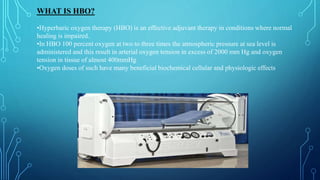
WHAT IS HBO?
•Hyperbaric oxygen therapy (HBO) is an effective adjuvant therapy in conditions where normal
healing is impaired.
•In HBO 100 percent oxygen at two to three times the atmospheric pressure at sea level is
administered and this result in arterial oxygen tension in excess of 2000 mm Hg and oxygen
tension in tissue of almost 400mmHg
•Oxygen doses of such have many beneficial biochemical cellular and physiologic effects
MECHANISM OF ACTION
 Effect of pressure: Reduces volume of gas bubbles allows them to move freely through
small blood vessels thereby reducing chances of infarction.
 Effect of increasing oxygen pressure: Administration of oxygen at high pressure helps in
rapid elimination of toxic gases like carbon monoxide, hence used in treatment of carbon
monoxide poisoning.
 Effect of reactive vasoconstriction: HBO acts as an alphaadrenergic agent this causes
reactive vasoconstriction in small vessels thereby reducing vascularoedema without altering
normal tissue oxygenation.
 Antibacterial effect:oxygen dependent, HBO optimizes anti-infective properties of
polymorphonuclear neutrophil through formation of enzymes and superoxide ions.
 Anti-ischemic effect: HBO therapy results in excess dissolved oxygen in blood also it
increases deformability of red blood cells.
 Healing effect: HBO promotes osteoclast and osteoblast growth, facilitates collagen
synthesis stimulates angiogenesis hence used in management refractory lesions,
osteoradionecrosis, extensive burns and compromised grafts.
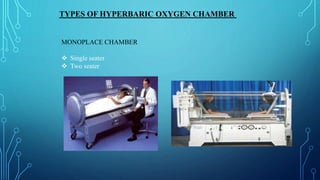
TYPES OF HYPERBARIC OXYGEN CHAMBER
MONOPLACE CHAMBER
 Single seater
 Two seater
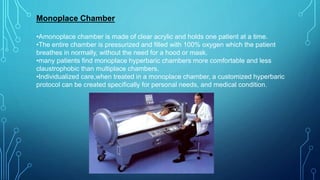
Monoplace Chamber
•Amonoplace chamber is made of clear acrylic and holds one patient at a time.
•The entire chamber is pressurized and filled with 100% oxygen which the patient
breathes in normally, without the need for a hood or mask.
•many patients find monoplace hyperbaric chambers more comfortable and less
claustrophobic than multiplace chambers.
•Individualized care,when treated in a monoplace chamber, a customized hyperbaric
protocol can be created specifically for personal needs, and medical condition.
Advantages
Cost efficient delivery of HB02.
• No risk of decompression sickness.
• Portable, less space, less equipment, no hood or mask.
•No risk of iatrogenic decompression sickness in patient or staff.
Disadvantages
•Relative patient isolation.
•Associated fire hazard.
• Inability to use certain diagnostic and/or therapeutic equipment.
•Limited access to the patient inside chamber with only visual and auditory communication
available to the patient and observers.
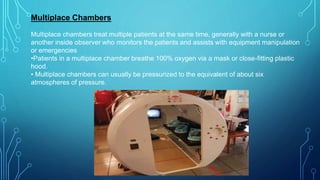
Multiplace Chambers
Multiplace chambers treat multiple patients at the same time, generally with a nurse or
another inside observer who monitors the patients and assists with equipment manipulation
or emergencies
•Patients in a multiplace chamber breathe 100% oxygen via a mask or close-fitting plastic
hood.
• Multiplace chambers can usually be pressurized to the equivalent of about six
atmospheres of pressure.
Advantages
constant patient attendance and evaluation is useful in treating evolving neurological
diseases such as decompression sickness and cerebral arterial gas embolism)
•Multiple patients treated per session.
•Greater working pressure.
•Reduced fire risk •More room available, which allows medical personnel to enter to deal
with acute problems, e.g., pneumothorax
Disadvantage
•Higher capitalization requirements.
•risk of cross infection when used to treat wounds • Major space requirements; basement
and/or ground floor level limitations.
•Higher operating costs.
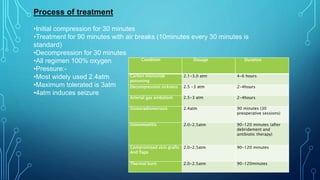
Condition Dosage Duration
Carbon monoxide
poisoning
2.1-3.0 atm 4-6 hours
Decompression sickness 2.5 -3 atm 2-4hours
Arterial gas embolism 2.5-3 atm 2-4hours
Osteoradionecrosis 2.4atm 90 minutes (30
preoperative sessions)
Osteomyelitis 2.0-2.5atm 90-120 minutes (after
debridement and
antibiotic therapy)
Compromised skin grafts
And flaps
2.0-2.5atm 90-120 minutes
Thermal burn 2.0-2.5atm 90-120minutes
Process of treatment
•Initial compression for 30 minutes
•Treatment for 90 minutes with air breaks (10minutes every 30 minutes is
standard)
•Decompression for 30 minutes
•All regimen 100% oxygen
•Pressure:-
•Most widely used 2.4atm
•Maximum tolerated is 3atm
•4atm induces seizure
INDICATIONS FOR HYPERBARIC OXYGEN THERAPY .
1.Air embolism
2.Carbon monoxide poisoning
3.Clostridial myositis and myonecrosis (gas gangrene)
4.Crush injury, compartment syndrome, and other acute traumatic ischemia
5. Decompression sickness
6. Arterial insufficiencies
7. Severe anaemia
8. Intracranial abscess
9. Necrotizing soft tissue infections
10. Osteomyelitis (refractory)
11. Delayed radiation injury (soft tissue and bony necrosis)
12. Compromised grafts and flaps
13. Acute thermal burn injury
14. Idiopathic sudden sensorineural hearing loss
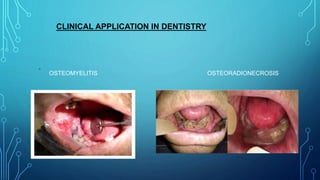
CLINICAL APPLICATION IN DENTISTRY
OSTEOMYELITIS OSTEORADIONECROSIS
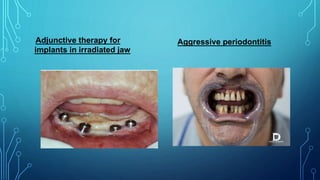
Aggressive periodontitis
Adjunctive therapy for
implants in irradiated jaw
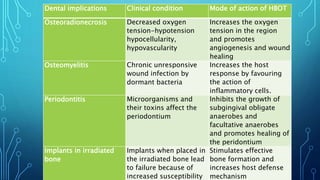
Dental implications Clinical condition Mode of action of HBOT
Osteoradionecrosis Decreased oxygen
tension-hypotension
hypocellularity,
hypovascularity
Increases the oxygen
tension in the region
and promotes
angiogenesis and wound
healing
Osteomyelitis Chronic unresponsive
wound infection by
dormant bacteria
Increases the host
response by favouring
the action of
inflammatory cells.
Periodontitis Microorganisms and
their toxins affect the
periodontium
Inhibits the growth of
subgingival obligate
anaerobes and
facultative anaerobes
and promotes healing of
the peridontium
Implants in irradiated
bone
Implants when placed in
the irradiated bone lead
to failure because of
increased susceptibility
Stimulates effective
bone formation and
increases host defense
mechanism
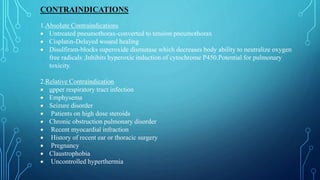
CONTRAINDICATIONS
1.Absolute Contraindications
 Untreated pneumothorax-converted to tension pneumothorax
 Cisplatin-Delayed wound healing
 Disulfiram-blocks superoxide dismutase which decreases body ability to neutralize oxygen
free radicals ;Inhibits hyperoxic induction of cytochrome P450.Potential for pulmonary
toxicity.
2.Relative Contraindication
 upper respiratory tract infection
 Emphysema
 Seizure disorder
 Patients on high dose steroids
 Chronic obstruction pulmonary disorder
 Recent myocardial infraction
 History of recent ear or thoracic surgery
 Pregnancy
 Claustrophobia
 Uncontrolled hyperthermia
COMPLICATIONS
1.Mild complications
 Claustrophobia in Monoplace Chamber
 Fatigue
 Headache
2.More Serious Complications
 Myopia that can last for few weeks to months
 Sinus damage
 Ruptured middle ear
 Lung Damage
3.Major Complications
 Oxygen toxicity can result in convulsions, fluid in the lungs, and even respiratory failure
DISADVANTAGES
 Higher capitalization requirements.
 Major space requirements; basement and/or ground floor level limitations.
 Higher operating costs.
 Larger and experienced staffing requirements.
 Risk of decompression sickness in internal personnel.
 Facility fire-associated decompression requirements.
 Significant equipment maintenance and system upkeep requirements.
 Associated fire hazard with pure oxygen environment.
 Risk of oxygen toxicity as well as increased risk of complications from pneumothorax
and/or tension pneumothorax and arterial air embolism developing during decompression.
 Permit requirements by FDA, local health department, and fire marshal
CONCLUSION
Though HBO therapy has lot of disadvantages and risks the benefits overweigh in
using it. But clearer evidences are available for few diseases like decompression
sickness and gas gangrene. Hence a lot of work is required to be done to establish the
indication, dosage and duration of the therapy. Doctors need to be trained to administer
this mode of management and more centres are required to make it a regular treatment
modality as it has synergistic effects with the conventional treatment modalities.
REFERENCES
1. Textbook of ORAL MEDICINE-Burket’s11th Edition
2. Textbook of ORAL MEDICINE-2nd Edition
3. Undersea and Hyperbaric Medical Society.Indication for Hyperbaric
Oxygen Therapy
HYPERBARIC OXYGEN THERAPY.pptx

HYPERBARIC OXYGEN THERAPY.pptx

  • 1.
  • 2.
    CONTENTS  Introduction  Whatis HBO?  Mechanism of action  Types of hyperbaric chambers  Process of treatment  Indication (application in dentistry)  Contraindication  Complications  Disadvantages  Conclusion  References
  • 3.
    INTRODUCTION Hyperbaric Oxygen Therapyis a treatment where patients breathe 100% oxygen while exposed to high environmental pressure in a Hyperbaric chamber. This hyperoxygenation has several beneficial effects as an adjunctive treatment in number of diseases.For clinical efficacy,the Undersea and Hyperbaric Medical Society specifies that the pressure must be greater than or equal to 1.4atm;in clinical practice, pressure applied usually ranges from 2-3atm. Treatment is delivered in Monoplace and Multiplace chamber. This therapy can be summarized as antiischemic effects,anti-infectious and wound healing effects.Since HBO therapy has clear physiological rationale,a demonstrated effect is seen in certain Indications and contraindications.It is proposed that it should be considered an integral part of treatment for patients and not only as a supplementation oxygenation.
  • 4.
    WHAT IS HBO? •Hyperbaricoxygen therapy (HBO) is an effective adjuvant therapy in conditions where normal healing is impaired. •In HBO 100 percent oxygen at two to three times the atmospheric pressure at sea level is administered and this result in arterial oxygen tension in excess of 2000 mm Hg and oxygen tension in tissue of almost 400mmHg •Oxygen doses of such have many beneficial biochemical cellular and physiologic effects
  • 5.
    MECHANISM OF ACTION Effect of pressure: Reduces volume of gas bubbles allows them to move freely through small blood vessels thereby reducing chances of infarction.  Effect of increasing oxygen pressure: Administration of oxygen at high pressure helps in rapid elimination of toxic gases like carbon monoxide, hence used in treatment of carbon monoxide poisoning.  Effect of reactive vasoconstriction: HBO acts as an alphaadrenergic agent this causes reactive vasoconstriction in small vessels thereby reducing vascularoedema without altering normal tissue oxygenation.  Antibacterial effect:oxygen dependent, HBO optimizes anti-infective properties of polymorphonuclear neutrophil through formation of enzymes and superoxide ions.
  • 6.
     Anti-ischemic effect:HBO therapy results in excess dissolved oxygen in blood also it increases deformability of red blood cells.  Healing effect: HBO promotes osteoclast and osteoblast growth, facilitates collagen synthesis stimulates angiogenesis hence used in management refractory lesions, osteoradionecrosis, extensive burns and compromised grafts.
  • 7.
    TYPES OF HYPERBARICOXYGEN CHAMBER MONOPLACE CHAMBER  Single seater  Two seater
  • 8.
    Monoplace Chamber •Amonoplace chamberis made of clear acrylic and holds one patient at a time. •The entire chamber is pressurized and filled with 100% oxygen which the patient breathes in normally, without the need for a hood or mask. •many patients find monoplace hyperbaric chambers more comfortable and less claustrophobic than multiplace chambers. •Individualized care,when treated in a monoplace chamber, a customized hyperbaric protocol can be created specifically for personal needs, and medical condition.
  • 9.
    Advantages Cost efficient deliveryof HB02. • No risk of decompression sickness. • Portable, less space, less equipment, no hood or mask. •No risk of iatrogenic decompression sickness in patient or staff. Disadvantages •Relative patient isolation. •Associated fire hazard. • Inability to use certain diagnostic and/or therapeutic equipment. •Limited access to the patient inside chamber with only visual and auditory communication available to the patient and observers.
  • 10.
    Multiplace Chambers Multiplace chamberstreat multiple patients at the same time, generally with a nurse or another inside observer who monitors the patients and assists with equipment manipulation or emergencies •Patients in a multiplace chamber breathe 100% oxygen via a mask or close-fitting plastic hood. • Multiplace chambers can usually be pressurized to the equivalent of about six atmospheres of pressure.
  • 11.
    Advantages constant patient attendanceand evaluation is useful in treating evolving neurological diseases such as decompression sickness and cerebral arterial gas embolism) •Multiple patients treated per session. •Greater working pressure. •Reduced fire risk •More room available, which allows medical personnel to enter to deal with acute problems, e.g., pneumothorax Disadvantage •Higher capitalization requirements. •risk of cross infection when used to treat wounds • Major space requirements; basement and/or ground floor level limitations. •Higher operating costs.
  • 12.
    Condition Dosage Duration Carbonmonoxide poisoning 2.1-3.0 atm 4-6 hours Decompression sickness 2.5 -3 atm 2-4hours Arterial gas embolism 2.5-3 atm 2-4hours Osteoradionecrosis 2.4atm 90 minutes (30 preoperative sessions) Osteomyelitis 2.0-2.5atm 90-120 minutes (after debridement and antibiotic therapy) Compromised skin grafts And flaps 2.0-2.5atm 90-120 minutes Thermal burn 2.0-2.5atm 90-120minutes Process of treatment •Initial compression for 30 minutes •Treatment for 90 minutes with air breaks (10minutes every 30 minutes is standard) •Decompression for 30 minutes •All regimen 100% oxygen •Pressure:- •Most widely used 2.4atm •Maximum tolerated is 3atm •4atm induces seizure
  • 13.
    INDICATIONS FOR HYPERBARICOXYGEN THERAPY . 1.Air embolism 2.Carbon monoxide poisoning 3.Clostridial myositis and myonecrosis (gas gangrene) 4.Crush injury, compartment syndrome, and other acute traumatic ischemia 5. Decompression sickness 6. Arterial insufficiencies 7. Severe anaemia 8. Intracranial abscess 9. Necrotizing soft tissue infections 10. Osteomyelitis (refractory) 11. Delayed radiation injury (soft tissue and bony necrosis) 12. Compromised grafts and flaps 13. Acute thermal burn injury 14. Idiopathic sudden sensorineural hearing loss
  • 14.
    CLINICAL APPLICATION INDENTISTRY OSTEOMYELITIS OSTEORADIONECROSIS
  • 15.
    Aggressive periodontitis Adjunctive therapyfor implants in irradiated jaw
  • 16.
    Dental implications Clinicalcondition Mode of action of HBOT Osteoradionecrosis Decreased oxygen tension-hypotension hypocellularity, hypovascularity Increases the oxygen tension in the region and promotes angiogenesis and wound healing Osteomyelitis Chronic unresponsive wound infection by dormant bacteria Increases the host response by favouring the action of inflammatory cells. Periodontitis Microorganisms and their toxins affect the periodontium Inhibits the growth of subgingival obligate anaerobes and facultative anaerobes and promotes healing of the peridontium Implants in irradiated bone Implants when placed in the irradiated bone lead to failure because of increased susceptibility Stimulates effective bone formation and increases host defense mechanism
  • 17.
    CONTRAINDICATIONS 1.Absolute Contraindications  Untreatedpneumothorax-converted to tension pneumothorax  Cisplatin-Delayed wound healing  Disulfiram-blocks superoxide dismutase which decreases body ability to neutralize oxygen free radicals ;Inhibits hyperoxic induction of cytochrome P450.Potential for pulmonary toxicity. 2.Relative Contraindication  upper respiratory tract infection  Emphysema  Seizure disorder  Patients on high dose steroids  Chronic obstruction pulmonary disorder  Recent myocardial infraction  History of recent ear or thoracic surgery  Pregnancy  Claustrophobia  Uncontrolled hyperthermia
  • 18.
    COMPLICATIONS 1.Mild complications  Claustrophobiain Monoplace Chamber  Fatigue  Headache 2.More Serious Complications  Myopia that can last for few weeks to months  Sinus damage  Ruptured middle ear  Lung Damage 3.Major Complications  Oxygen toxicity can result in convulsions, fluid in the lungs, and even respiratory failure
  • 19.
    DISADVANTAGES  Higher capitalizationrequirements.  Major space requirements; basement and/or ground floor level limitations.  Higher operating costs.  Larger and experienced staffing requirements.  Risk of decompression sickness in internal personnel.  Facility fire-associated decompression requirements.  Significant equipment maintenance and system upkeep requirements.  Associated fire hazard with pure oxygen environment.  Risk of oxygen toxicity as well as increased risk of complications from pneumothorax and/or tension pneumothorax and arterial air embolism developing during decompression.  Permit requirements by FDA, local health department, and fire marshal
  • 20.
    CONCLUSION Though HBO therapyhas lot of disadvantages and risks the benefits overweigh in using it. But clearer evidences are available for few diseases like decompression sickness and gas gangrene. Hence a lot of work is required to be done to establish the indication, dosage and duration of the therapy. Doctors need to be trained to administer this mode of management and more centres are required to make it a regular treatment modality as it has synergistic effects with the conventional treatment modalities.
  • 21.
    REFERENCES 1. Textbook ofORAL MEDICINE-Burket’s11th Edition 2. Textbook of ORAL MEDICINE-2nd Edition 3. Undersea and Hyperbaric Medical Society.Indication for Hyperbaric Oxygen Therapy