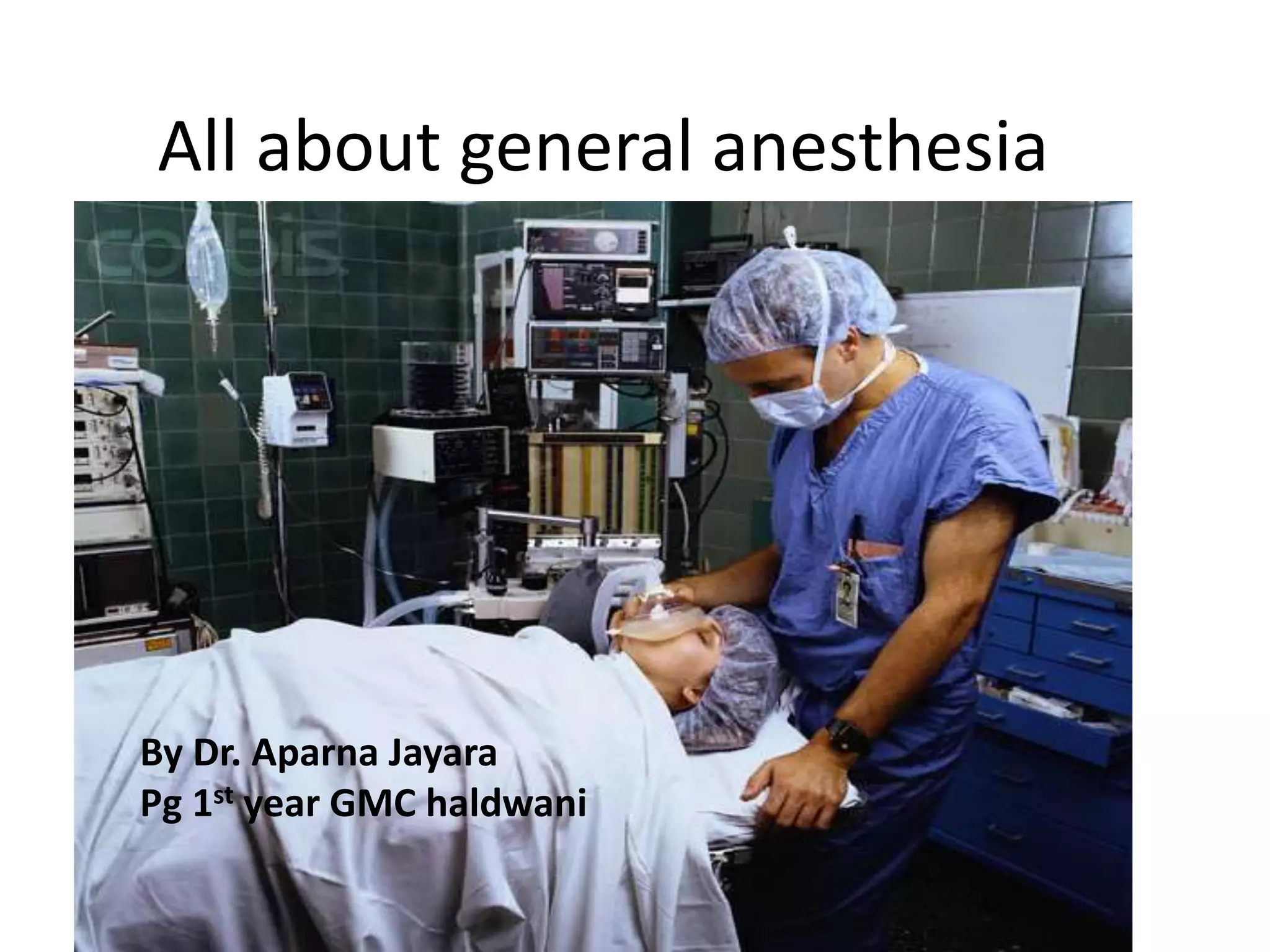
All about general anesthesia
By Dr. Aparna Jayara
Pg 1st year GMC haldwani
Definition
• General anesthesia is described as a reversible
state of unconsciousness with inability to
respond to a standardized surgical stimulus.
• In modern anesthetic practice it involves a
triad of unconsciousness analgesia and muscle
relaxation .
Brief history
General anesthetics have been performed
since 1846 when Morton demonstrated the
first anesthetic (using ether) in Boston, USA.
Local anesthetics arrived later, the first being
scientifically described in1884.
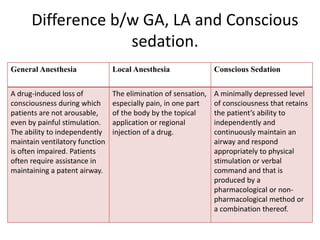
Difference b/w GA, LA and Conscious
sedation.
General Anesthesia Local Anesthesia Conscious Sedation
A drug-induced loss of
consciousness during which
patients are not arousable,
even by painful stimulation.
The ability to independently
maintain ventilatory function
is often impaired. Patients
often require assistance in
maintaining a patent airway.
The elimination of sensation,
especially pain, in one part
of the body by the topical
application or regional
injection of a drug.
A minimally depressed level
of consciousness that retains
the patient’s ability to
independently and
continuously maintain an
airway and respond
appropriately to physical
stimulation or verbal
command and that is
produced by a
pharmacological or non-
pharmacological method or
a combination thereof.
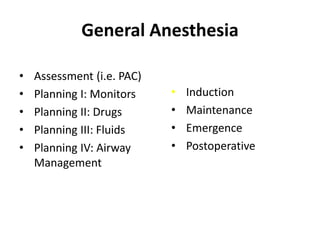
General Anesthesia
• Assessment (i.e. PAC)
• Planning I: Monitors
• Planning II: Drugs
• Planning III: Fluids
• Planning IV: Airway
Management
• Induction
• Maintenance
• Emergence
• Postoperative
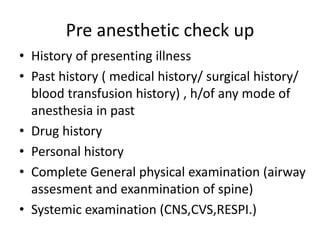
Pre anesthetic check up
• History of presenting illness
• Past history ( medical history/ surgical history/
blood transfusion history) , h/of any mode of
anesthesia in past
• Drug history
• Personal history
• Complete General physical examination (airway
assesment and exanmination of spine)
• Systemic examination (CNS,CVS,RESPI.)
PAC (cont..)
• Investigations
• CBC
• RBS
• Coagulation profile
• LFT
• KFT
• Viral markers
• Other investigations if needed ( thyroid profile,
lipid profile)
Airway assesment
• Mallampati score
• Assesment of atlanto occipital extension
• Upper lip bite test
• Interincisor gap
• Thyromental distance
• Hyomental distance
• Sternomental distance
• Mandibular protrusion test
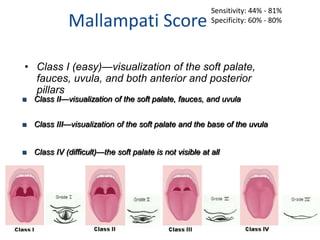
Mallampati Score
• Class I (easy)—visualization of the soft palate,
fauces, uvula, and both anterior and posterior
pillars
 Class II—visualization of the soft palate, fauces, and uvula
 Class III—visualization of the soft palate and the base of the uvula
 Class IV (difficult)—the soft palate is not visible at all
Sensitivity: 44% - 81%
Specificity: 60% - 80%
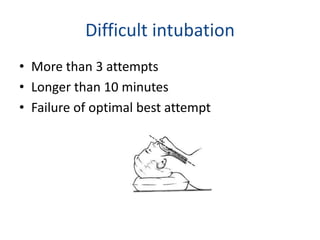
Difficult intubation
• More than 3 attempts
• Longer than 10 minutes
• Failure of optimal best attempt
Physical status classification (ASA)
• Class I: A normal healthy patients
• Class II: A patient with mild systemic disease (no functional
limitation)
• Class III: A patient with severe systemic disease (some
• functional limitation)
• Class IV: A patient with severe systemic disease that is a
constant threat to life (functionality incapacitated)
• Class V: A moribund patient who is not expected to survive
without the operation
• Class VI: A brain-dead patient whose organs are being
removed for donor purposes
• Class E: Emergent procedure
Anesthetic plan
Premedication
Intraoperative Postoperative
management management
General Monitoring Pain control
PONV
Airway management Positioning Complications
Induction Fluid management postop ventilation
Maintenance Special techniques Hemodynanic monitorin
Muscle relaxation
NPO status
• NPO, Nil Per Os, means nothing by mouth
• Solid food: 8 hrs before induction
• Liquid: 4 hrs before induction
• Clear water: 2 hrs before induction
• Pediatrics: stop breast milk feeding 4 hrs
before induction
• ANTI-PSILOGOGUS
• ANTI-EMETIC
• ANTI-HISTAMINIC
• ANTA-ACID
• ANALGESIC
• AMNESIA
• ADDITIVE
PRE MEDICATION
• INDUCTION
• MUCSLE RELAXATION
• INTUBATION
• VENTILATION
• REVERSAL
STEPS OF ANESTHESIA
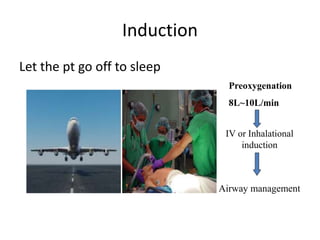
Induction
Let the pt go off to sleep
Preoxygenation
8L~10L/min
IV or Inhalational
induction
Airway management
Induction techniques
• Intravenous: the most common method ( with
thiopentone, propofol, ketamine etc.)
• Inhalation: for special pt (as pt with difficult
airway, pediatric pt)
• Intramuscular :rarely used, only used in
uncooperative pts and young children
Induction agents
• Opioids – fentanyl
• Propofol, Thiopental and Etomidate
• Muscle relaxants:
Depolarizing
Nondepolarizing
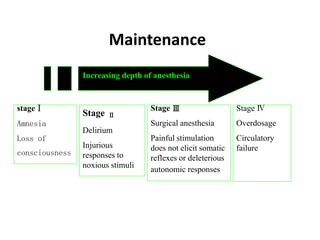
Maintenance
Increasing depth of anesthesia
stageⅠ
Amnesia
Loss of
consciousness
Stage Ⅱ
Delirium
Injurious
responses to
noxious stimuli
Stage Ⅲ
Surgical anesthesia
Painful stimulation
does not elicit somatic
reflexes or deleterious
autonomic responses
Stage Ⅳ
Overdosage
Circulatory
failure
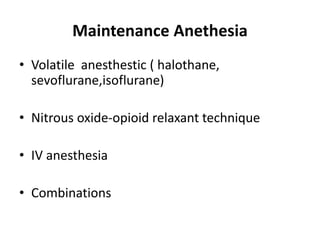
Maintenance Anethesia
• Volatile anesthestic ( halothane,
sevoflurane,isoflurane)
• Nitrous oxide-opioid relaxant technique
• IV anesthesia
• Combinations
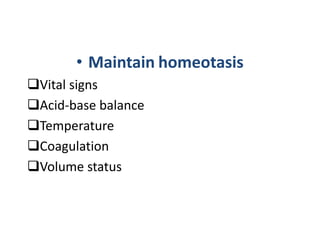
• Maintain homeotasis
Vital signs
Acid-base balance
Temperature
Coagulation
Volume status
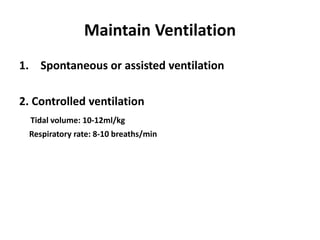
Maintain Ventilation
1. Spontaneous or assisted ventilation
2. Controlled ventilation
Tidal volume: 10-12ml/kg
Respiratory rate: 8-10 breaths/min
Maintain Intravascular Volume
 1. fluids
Crystalloid sollutions:
Colloid sollutions:
 2. Blood & blood products
• PULSE
• BP
• SPO2
• ETCO2
• TEMPERATURE
• GLUCOSE
• ECG
MONITORING
Emergence
• Turn off the agent (inhalation or IV agents)
• Reverse the muscle relaxants
• Return to spontaneous ventilation with
adequate ventilation and oxygenation
• Suction upper airway
• Wait for pts to wake up and follow command
• Hemodynamically stable
Postoperative management
• Post-anesthesia care unit (PACU)
- Oxygen supplement
- Pain control
- Nausea and vomiting
- Hypertension and hypotension
- Agitation
• Surgical intensive care unit (SICU)
- Mechanical ventilation
- Hemodynamic monitoring
General Anesthesia
Complications and Management
• Respiratory complication
- Aspiration – airway obstruction and pneumonia
- Bronchospasm
- Atelectasis
- Hypoventilation
• Cardiovascular complication
- Hypertension and hypotension
- Arrhythmia
- Myocardial ischemia and infarction
- Cardiac arrest
General Anesthesia
Complication and Management
• Neurological complication
- Slow wake-up
- Stroke
• Malignant hyperthermia
Goals to be met before discharge from recovery:
awake
Responsive
Full muscle strength
Adequate pain control
WAIT TILL PATIENT CAN BREATH ON ROOM
AIR MINIMUM FOR 5 MIN
CONSCIOUS
RESPONDING
REGULAR RESPIRATION
RRGULAR HR
NORMAL BP
Advantages of general anesthesia
1. Patients cooperation in not absolutely
essential for the success of GA.
2. Patient is unconscious.
3. Patient does not respond to pain.
4. Amnesia is present.
5. GA may be the only technique that will prove
successful for certain patients.
6. Rapid onset of action.
7. Titration is possible.
Disadvantages of general anesthesia
1. The patient is unconscious.
2. Protective reflexes are depressed.
3. Vital sign are depressed.
4. Advanced training is required.
5. An ‘‘anaesthesia team’’ is required.
6. Special equipment is required wherever general
anaesthesia.
7. A recovery area must be available for the patient.
8. Intaoperative complications are more likely to
occur during general anaesthesia than during
conscious sedation.
9. Postanesthetic complications are more
common following general anaesthesia than
after conscious sedation
10. The patient receiving general anaesthesia
must receive nothing by mouth for 6 hours
before the procedure.
11. Patients receiving general anaesthesia must
be evaluated more extensively preoperatively
than patients receiving conscious sedation.
Contraindications for general anesthesia
1. Lack of adequate training by the doctor.
2. Lack of adequate trained personnel.
3. Lack of adequate equipment.
4. Lack of adequate facilities.
5. ASA IV and certain ASA III medically
compromised patients.
Indications for general anesthesia
1. Extreme anxiety and fear.
2. Adults or children who have mental or
physical disabilities, senile patients, or
disoriented patients.
3. Age-infants and children.
4. Short, traumatic procedures.
5. Prolonged traumatic procedures.
Thank you

Conduct of general anesthesia

  • 1.
    All about generalanesthesia By Dr. Aparna Jayara Pg 1st year GMC haldwani
  • 2.
    Definition • General anesthesiais described as a reversible state of unconsciousness with inability to respond to a standardized surgical stimulus. • In modern anesthetic practice it involves a triad of unconsciousness analgesia and muscle relaxation .
  • 3.
    Brief history General anestheticshave been performed since 1846 when Morton demonstrated the first anesthetic (using ether) in Boston, USA. Local anesthetics arrived later, the first being scientifically described in1884.
  • 4.
    Difference b/w GA,LA and Conscious sedation. General Anesthesia Local Anesthesia Conscious Sedation A drug-induced loss of consciousness during which patients are not arousable, even by painful stimulation. The ability to independently maintain ventilatory function is often impaired. Patients often require assistance in maintaining a patent airway. The elimination of sensation, especially pain, in one part of the body by the topical application or regional injection of a drug. A minimally depressed level of consciousness that retains the patient’s ability to independently and continuously maintain an airway and respond appropriately to physical stimulation or verbal command and that is produced by a pharmacological or non- pharmacological method or a combination thereof.
  • 5.
    General Anesthesia • Assessment(i.e. PAC) • Planning I: Monitors • Planning II: Drugs • Planning III: Fluids • Planning IV: Airway Management • Induction • Maintenance • Emergence • Postoperative
  • 6.
    Pre anesthetic checkup • History of presenting illness • Past history ( medical history/ surgical history/ blood transfusion history) , h/of any mode of anesthesia in past • Drug history • Personal history • Complete General physical examination (airway assesment and exanmination of spine) • Systemic examination (CNS,CVS,RESPI.)
  • 7.
    PAC (cont..) • Investigations •CBC • RBS • Coagulation profile • LFT • KFT • Viral markers • Other investigations if needed ( thyroid profile, lipid profile)
  • 8.
    Airway assesment • Mallampatiscore • Assesment of atlanto occipital extension • Upper lip bite test • Interincisor gap • Thyromental distance • Hyomental distance • Sternomental distance • Mandibular protrusion test
  • 9.
    Mallampati Score • ClassI (easy)—visualization of the soft palate, fauces, uvula, and both anterior and posterior pillars  Class II—visualization of the soft palate, fauces, and uvula  Class III—visualization of the soft palate and the base of the uvula  Class IV (difficult)—the soft palate is not visible at all Sensitivity: 44% - 81% Specificity: 60% - 80%
  • 10.
    Difficult intubation • Morethan 3 attempts • Longer than 10 minutes • Failure of optimal best attempt
  • 11.
    Physical status classification(ASA) • Class I: A normal healthy patients • Class II: A patient with mild systemic disease (no functional limitation) • Class III: A patient with severe systemic disease (some • functional limitation) • Class IV: A patient with severe systemic disease that is a constant threat to life (functionality incapacitated) • Class V: A moribund patient who is not expected to survive without the operation • Class VI: A brain-dead patient whose organs are being removed for donor purposes • Class E: Emergent procedure
  • 12.
    Anesthetic plan Premedication Intraoperative Postoperative managementmanagement General Monitoring Pain control PONV Airway management Positioning Complications Induction Fluid management postop ventilation Maintenance Special techniques Hemodynanic monitorin Muscle relaxation
  • 13.
    NPO status • NPO,Nil Per Os, means nothing by mouth • Solid food: 8 hrs before induction • Liquid: 4 hrs before induction • Clear water: 2 hrs before induction • Pediatrics: stop breast milk feeding 4 hrs before induction
  • 14.
    • ANTI-PSILOGOGUS • ANTI-EMETIC •ANTI-HISTAMINIC • ANTA-ACID • ANALGESIC • AMNESIA • ADDITIVE PRE MEDICATION
  • 15.
    • INDUCTION • MUCSLERELAXATION • INTUBATION • VENTILATION • REVERSAL STEPS OF ANESTHESIA
  • 16.
    Induction Let the ptgo off to sleep Preoxygenation 8L~10L/min IV or Inhalational induction Airway management
  • 17.
    Induction techniques • Intravenous:the most common method ( with thiopentone, propofol, ketamine etc.) • Inhalation: for special pt (as pt with difficult airway, pediatric pt) • Intramuscular :rarely used, only used in uncooperative pts and young children
  • 18.
    Induction agents • Opioids– fentanyl • Propofol, Thiopental and Etomidate • Muscle relaxants: Depolarizing Nondepolarizing
  • 19.
    Maintenance Increasing depth ofanesthesia stageⅠ Amnesia Loss of consciousness Stage Ⅱ Delirium Injurious responses to noxious stimuli Stage Ⅲ Surgical anesthesia Painful stimulation does not elicit somatic reflexes or deleterious autonomic responses Stage Ⅳ Overdosage Circulatory failure
  • 20.
    Maintenance Anethesia • Volatileanesthestic ( halothane, sevoflurane,isoflurane) • Nitrous oxide-opioid relaxant technique • IV anesthesia • Combinations
  • 21.
    • Maintain homeotasis Vitalsigns Acid-base balance Temperature Coagulation Volume status
  • 22.
    Maintain Ventilation 1. Spontaneousor assisted ventilation 2. Controlled ventilation Tidal volume: 10-12ml/kg Respiratory rate: 8-10 breaths/min
  • 23.
    Maintain Intravascular Volume 1. fluids Crystalloid sollutions: Colloid sollutions:  2. Blood & blood products
  • 24.
    • PULSE • BP •SPO2 • ETCO2 • TEMPERATURE • GLUCOSE • ECG MONITORING
  • 25.
    Emergence • Turn offthe agent (inhalation or IV agents) • Reverse the muscle relaxants • Return to spontaneous ventilation with adequate ventilation and oxygenation • Suction upper airway • Wait for pts to wake up and follow command • Hemodynamically stable
  • 26.
    Postoperative management • Post-anesthesiacare unit (PACU) - Oxygen supplement - Pain control - Nausea and vomiting - Hypertension and hypotension - Agitation • Surgical intensive care unit (SICU) - Mechanical ventilation - Hemodynamic monitoring
  • 27.
    General Anesthesia Complications andManagement • Respiratory complication - Aspiration – airway obstruction and pneumonia - Bronchospasm - Atelectasis - Hypoventilation • Cardiovascular complication - Hypertension and hypotension - Arrhythmia - Myocardial ischemia and infarction - Cardiac arrest
  • 28.
    General Anesthesia Complication andManagement • Neurological complication - Slow wake-up - Stroke • Malignant hyperthermia
  • 29.
    Goals to bemet before discharge from recovery: awake Responsive Full muscle strength Adequate pain control WAIT TILL PATIENT CAN BREATH ON ROOM AIR MINIMUM FOR 5 MIN CONSCIOUS RESPONDING REGULAR RESPIRATION RRGULAR HR NORMAL BP
  • 30.
    Advantages of generalanesthesia 1. Patients cooperation in not absolutely essential for the success of GA. 2. Patient is unconscious. 3. Patient does not respond to pain. 4. Amnesia is present. 5. GA may be the only technique that will prove successful for certain patients. 6. Rapid onset of action. 7. Titration is possible.
  • 31.
    Disadvantages of generalanesthesia 1. The patient is unconscious. 2. Protective reflexes are depressed. 3. Vital sign are depressed. 4. Advanced training is required. 5. An ‘‘anaesthesia team’’ is required. 6. Special equipment is required wherever general anaesthesia. 7. A recovery area must be available for the patient. 8. Intaoperative complications are more likely to occur during general anaesthesia than during conscious sedation.
  • 32.
    9. Postanesthetic complicationsare more common following general anaesthesia than after conscious sedation 10. The patient receiving general anaesthesia must receive nothing by mouth for 6 hours before the procedure. 11. Patients receiving general anaesthesia must be evaluated more extensively preoperatively than patients receiving conscious sedation.
  • 33.
    Contraindications for generalanesthesia 1. Lack of adequate training by the doctor. 2. Lack of adequate trained personnel. 3. Lack of adequate equipment. 4. Lack of adequate facilities. 5. ASA IV and certain ASA III medically compromised patients.
  • 34.
    Indications for generalanesthesia 1. Extreme anxiety and fear. 2. Adults or children who have mental or physical disabilities, senile patients, or disoriented patients. 3. Age-infants and children. 4. Short, traumatic procedures. 5. Prolonged traumatic procedures.
  • 35.