CURRENT ROLE OF
HYPERBARIC THERAPY (HBOT)
DR. YOGESH RATHOD
INTRODUCTION
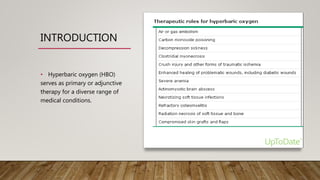
• Hyperbaric oxygen (HBO)
serves as primary or adjunctive
therapy for a diverse range of
medical conditions.
MECHANISMS OF ACTION
• Increased oxygen delivery — plasma O2 conc. of 0.3 mL/dL at sea level (1.0 atm) increases to 1.5 mL/dL upon
administration of 100 percent O2, while HBO delivered at 3.0 atm yields a dissolved O2 content of 6 mL/dL.
• Reduction of gas bubble size — the volume of N2 bubbles at 3.0 atm decreases by approximately two-thirds.
Bubble dissolution is done by the replacement of N2 with HBO, which is then rapidly metabolized by tissues.
• Antagonism of carbon monoxide — CO binds to Hb with an affinity 200 to 250 times that of oxygen. 4-6 hour
half-life of COHb decreases to 40-80 minutes with 100 percent normobaric oxygen. With HBO half-life
decreases to 15-30 minutes.
• Improved wound healing — HBO ameliorates ischemia-reperfusion-induced leukocyte influx. HBO facilitates
fibroblast proliferation, angiogenesis, and wound healing. HBO augments neutrophil bactericidal activity, limits
clostridial exotoxin and spore production, kills anaerobes such as Clostridium perfringens, and inhibits the
growth of several other bacterial pathogens.
TECHNIQUE
• Multiplace chambers allow closer monitoring of critically ill patients
• Single occupancy chambers are most appropriate for the treatment of chronic medical
conditions in stable patients.
• Chamber pressure is usually maintained between 2.5 and 3.0 atm, with treatment lasting 45 to
300 minutes depending upon the indication.
• Acute therapy may require only one or two treatments, while chronic medical conditions may
warrant up to 30 or more sessions.
• HBO is administered with pressurized oxygen or air. Pressures exceeding 2.8 to 3.0 atm increase
the risk of both neurologic and pulmonary oxygen toxicity.
• Helium/oxygen (heliox) or nitrogen/oxygen (nitrox) mixtures are indicated only in certain
instances of decompression illness
CONTRAINDICATIONS
• Absolute contraindication
• untreated pneumothorax.
• Relative contraindications include
• obstructive lung disease,
• asymptomatic pulmonary blebs or bullae on chest radiograph,
• upper respiratory or sinus infections,
• recent ear or thoracic surgery,
• uncontrolled fever, and
• Claustrophobia
• Pregnancy is a contraindication to HBO ( except for CO intoxication)
• Patients with a seizure disorder are at risk for CNS toxicity from high oxygen concentrations
• HBO use in these patients must be made on a case by case basis after careful consideration of the
potential (but manageable) risks and benefits, and the patient’s values and preferences.
• Administration of supplemental O2 with bleomycin has been associated with pulmonary toxicity.
However in a review of 15 bleomycin-exposed patientsno such synergistic effect was not found.
• Concurrent treatment with doxorubicin has also been believed to cause oxidative stress which may
worsen doxorubicin-induced cardiotoxicity. But in animal studies HBO exposure was found to reduce
cardiac systolic dysfunction and the histopathologic changes associated with doxorubicin
COMPLICATIONS
• Hyperbaric therapy is generally safe and well tolerated. Most side effects are mild and
reversible, although severe consequences can occur in rare cases
• Middle ear barotrauma (most common)
• Sinus barotrauma (sinus squeeze)(second most common)
• Reversible myopia
• Pulmonary barotrauma
• Pulmonary oxygen toxicity
• Seizures due to CNS oxygen toxicity
• Decompression sickness may occur in patients breathing compressed air (IRONY)
CLINICAL USE
• HBO serves as primary or adjunctive therapy for a diverse range of medical conditions
• Carbon monoxide or cyanide poisoning - HBO reduces the half-life of
carboxyhemoglobin
• Decompression sickness and air embolism - Treatment consists of a two to five hour
session at 2.5 to 3.0 atm, until symptoms abate. Adjunctive treatment with
glucocorticoids, lidocaine, or a combination of prostacyclin, indomethacin, and heparin
has been reported, but the efficacy of these interventions is unclear
• Acute traumatic or thermal injury — HBO has been recommended as adjunctive therapy
for a range of acute traumatic and ischemic syndromes, including crush injuries,
compartment syndromes, and situations of vascular compromise.
• Radiation injury — HBO has the potential to improve patients with laryngeal, oropharyngeal, and
other head and neck cancers who develop osteoradionecrosis because of its impact on collagen
synthesis and vascular density.
• Infection — As an adjunctive treatment to primary treatment regimen for aggressive soft tissue
infections such as clostridial myonecrosis (gas gangrene), necrotizing fasciitis, and Fournier's
HBO may reduce mortality and better define necrotic tissue, facilitating more precise amputation
debridement.
• Nonhealing ulcers, skin grafts, and wound healing — As an adjunct therapy in the treatment of
nonhealing wounds, compromised skin grafts, and other wounds.
• Future directions — Future indications for HBO may be derived from its apparent modulation of
ischemia-reperfusion injury and inflammation. Preliminary animal and human studies evaluating
in syndromes as disparate as acute coronary syndrome, including myocardial infarction, the systemic
inflammatory response syndrome, traumatic brain or spinal cord injury, sickle cell crisis, frostbite,
fibromyalgia, and acute stroke have been conducted, with variable results
SUMMARY AND RECOMMENDATIONS
• Severe decompression sickness or arterial gas embolism.
• Significant cases of carbon monoxide poisoning
• HBO may be useful in the care of patients with severe anemia, actinomycotic
brain abscesses, acute crush injuries, prior radiation therapy, aggressive soft
tissue infections, nonhealing ulcers, or compromised skin grafts and flaps.
• Further research is required in these situations in order to confirm the benefits of
HBO and justify its significant costs and potential risks.
•Thank You!!!!

Current role of hyperbaric therapy (hbot)

  • 1.
    CURRENT ROLE OF HYPERBARICTHERAPY (HBOT) DR. YOGESH RATHOD
  • 2.
    INTRODUCTION • Hyperbaric oxygen(HBO) serves as primary or adjunctive therapy for a diverse range of medical conditions.
  • 3.
    MECHANISMS OF ACTION •Increased oxygen delivery — plasma O2 conc. of 0.3 mL/dL at sea level (1.0 atm) increases to 1.5 mL/dL upon administration of 100 percent O2, while HBO delivered at 3.0 atm yields a dissolved O2 content of 6 mL/dL. • Reduction of gas bubble size — the volume of N2 bubbles at 3.0 atm decreases by approximately two-thirds. Bubble dissolution is done by the replacement of N2 with HBO, which is then rapidly metabolized by tissues. • Antagonism of carbon monoxide — CO binds to Hb with an affinity 200 to 250 times that of oxygen. 4-6 hour half-life of COHb decreases to 40-80 minutes with 100 percent normobaric oxygen. With HBO half-life decreases to 15-30 minutes. • Improved wound healing — HBO ameliorates ischemia-reperfusion-induced leukocyte influx. HBO facilitates fibroblast proliferation, angiogenesis, and wound healing. HBO augments neutrophil bactericidal activity, limits clostridial exotoxin and spore production, kills anaerobes such as Clostridium perfringens, and inhibits the growth of several other bacterial pathogens.
  • 4.
    TECHNIQUE • Multiplace chambersallow closer monitoring of critically ill patients • Single occupancy chambers are most appropriate for the treatment of chronic medical conditions in stable patients. • Chamber pressure is usually maintained between 2.5 and 3.0 atm, with treatment lasting 45 to 300 minutes depending upon the indication. • Acute therapy may require only one or two treatments, while chronic medical conditions may warrant up to 30 or more sessions. • HBO is administered with pressurized oxygen or air. Pressures exceeding 2.8 to 3.0 atm increase the risk of both neurologic and pulmonary oxygen toxicity. • Helium/oxygen (heliox) or nitrogen/oxygen (nitrox) mixtures are indicated only in certain instances of decompression illness
  • 5.
    CONTRAINDICATIONS • Absolute contraindication •untreated pneumothorax. • Relative contraindications include • obstructive lung disease, • asymptomatic pulmonary blebs or bullae on chest radiograph, • upper respiratory or sinus infections, • recent ear or thoracic surgery, • uncontrolled fever, and • Claustrophobia • Pregnancy is a contraindication to HBO ( except for CO intoxication)
  • 6.
    • Patients witha seizure disorder are at risk for CNS toxicity from high oxygen concentrations • HBO use in these patients must be made on a case by case basis after careful consideration of the potential (but manageable) risks and benefits, and the patient’s values and preferences. • Administration of supplemental O2 with bleomycin has been associated with pulmonary toxicity. However in a review of 15 bleomycin-exposed patientsno such synergistic effect was not found. • Concurrent treatment with doxorubicin has also been believed to cause oxidative stress which may worsen doxorubicin-induced cardiotoxicity. But in animal studies HBO exposure was found to reduce cardiac systolic dysfunction and the histopathologic changes associated with doxorubicin
  • 7.
    COMPLICATIONS • Hyperbaric therapyis generally safe and well tolerated. Most side effects are mild and reversible, although severe consequences can occur in rare cases • Middle ear barotrauma (most common) • Sinus barotrauma (sinus squeeze)(second most common) • Reversible myopia • Pulmonary barotrauma • Pulmonary oxygen toxicity • Seizures due to CNS oxygen toxicity • Decompression sickness may occur in patients breathing compressed air (IRONY)
  • 8.
    CLINICAL USE • HBOserves as primary or adjunctive therapy for a diverse range of medical conditions • Carbon monoxide or cyanide poisoning - HBO reduces the half-life of carboxyhemoglobin • Decompression sickness and air embolism - Treatment consists of a two to five hour session at 2.5 to 3.0 atm, until symptoms abate. Adjunctive treatment with glucocorticoids, lidocaine, or a combination of prostacyclin, indomethacin, and heparin has been reported, but the efficacy of these interventions is unclear • Acute traumatic or thermal injury — HBO has been recommended as adjunctive therapy for a range of acute traumatic and ischemic syndromes, including crush injuries, compartment syndromes, and situations of vascular compromise.
  • 9.
    • Radiation injury— HBO has the potential to improve patients with laryngeal, oropharyngeal, and other head and neck cancers who develop osteoradionecrosis because of its impact on collagen synthesis and vascular density. • Infection — As an adjunctive treatment to primary treatment regimen for aggressive soft tissue infections such as clostridial myonecrosis (gas gangrene), necrotizing fasciitis, and Fournier's HBO may reduce mortality and better define necrotic tissue, facilitating more precise amputation debridement. • Nonhealing ulcers, skin grafts, and wound healing — As an adjunct therapy in the treatment of nonhealing wounds, compromised skin grafts, and other wounds. • Future directions — Future indications for HBO may be derived from its apparent modulation of ischemia-reperfusion injury and inflammation. Preliminary animal and human studies evaluating in syndromes as disparate as acute coronary syndrome, including myocardial infarction, the systemic inflammatory response syndrome, traumatic brain or spinal cord injury, sickle cell crisis, frostbite, fibromyalgia, and acute stroke have been conducted, with variable results
  • 10.
    SUMMARY AND RECOMMENDATIONS •Severe decompression sickness or arterial gas embolism. • Significant cases of carbon monoxide poisoning • HBO may be useful in the care of patients with severe anemia, actinomycotic brain abscesses, acute crush injuries, prior radiation therapy, aggressive soft tissue infections, nonhealing ulcers, or compromised skin grafts and flaps. • Further research is required in these situations in order to confirm the benefits of HBO and justify its significant costs and potential risks.
  • 11.