HYPERBARIC OXYGEN
THERAPY
DEFINITIONs
• HYPER (increase) + BARIC(pressure)
• Hyperbaric oxygen therapy (HBOT) involves the
“intermittent, usually daily, inhalation of 100 percent
humidified oxygen under pressure,greater than 1
atmospheric absolute pressure(ATA).”-
• The Committee on Hyperbaric Medicine defines HBO
therapy as “Amode of medical treatment in which the
patient is entirely enclosed in a pressure chamber and
breathes 100% oxygen at a pressure >1 atmosphere
absolute (ATA).”
•ATAis the unit ofpressure
•1 ATAis equal to 760 mm of mercury or pressure at sea level.
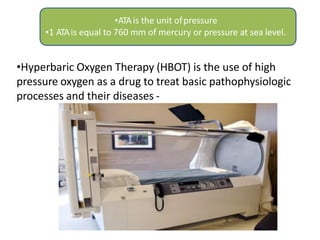
•Hyperbaric Oxygen Therapy (HBOT) is the use of high
pressure oxygen as a drug to treat basic pathophysiologic
processes and their diseases -
HISTORY
• 1662- Henshaw built first hyperbaric chamber
• 1960 – Boerema -performs first surgery with HBO
• 1965: It was first used to assist wound healing
when it was noted that burns of the victims of
coal mine explosions treated with HBO2 healed
faster.
PRINCIPLES OF HBOT
• based on how gases of different solubilities,
most importantly oxygen, behave under
changing pressures and volumes, within
tissues and fluid -
1. Hyperoxygenation
• results from an increase in dissolved oxygen in
plasma as a result of increased partial pressure of
arterial oxygen(pO2).
• management of crush injury, compartment
syndrome, flap salvage and acute blood loss
anaemia.
A pressure of 3 ATAresults in 6 ml of
O2being dissolved per 100 ml of plasma,
thus rendering as much O2 delivery as by
haemoglobin bound O2.
MECHANISM OF ACTION
2.Vasoconstriction
• Hyperoxia in normal
tissues causes
vasoconstriction which reduces post-traumatic tissue
oedema.
• This contributes to the treatment of crush injuries,
compartment syndromes and burns.
• Vasoconstriction, however, does not cause hypoxia as
this is more than compensated by increased plasma
oxygen content and microvascular blood flow.
3.Collagen formation
Oxygen is vital for
• hydroxylation of lysine and proline residues
during collagen synthesis
• for cross linking and maturation of collagen
which is required for strong wound healing.
• Lack of oxygen is corrected during HBOT,
leading to adequate amounts of mature
collagen formation.
4.Angiogenesis
Hypoxia is a vital stimulant for angiogenesis, but
development of adequate capillary network requires
adequate amounts of tissue oxygen concentration..
This along with fibroblastic proliferation leads to
increased neovascularisation.
HBOT increases the oxygen gradient between the
centre and periphery of the wound, thus creating a
strong angiogenic stimulus.
• HBO exerts both direct and indirect effects against
bacteria.
• Direct bactericidal and bacteriostatic effects occur
through the generation of oxygen free radicals.
• This free radical oxidizes proteins and membrane
lipids, damages DNA, and inhibits metabolic
functions essential for the growth of organisms.
Hyperoxia and HBO influence the activity of
some antibiotics, enhancing the effectiveness of
some and inhibiting others.
6.Toxin Inhibition
Suppression of alpha-toxin production
by Clostridium perfringenes.
• Bacteriostatic for some species of
Escherichia and Pseudomonas and also for a
range of enteric bacteria (Salmonella, Shigella
and Proteus).
5. Antibiotic synergy
Dosage and Delivery
• All regimens use 100% oxygen
• Pressures are more variable-
 Mostly used 2.4 atm
 Maximum tolerated is 3 atm
 4 atm induces seizures
Compression
10min
Decompression
10min
90 min on Oxygen + Two 5min- “Air Breaks”
Treatment Phase – 100min
• Dives between 30 and 120 minutes
• May be daily or BID
• Total number varies by indication
• Most treatments include 30 dives
• Optional addition of 10 or more dives are accepted.
HBOT is carried out in 2 chambers-
1. Monoplace chamber
2. Multiplace chamber
Monoplace chambers
•Small and designed to accommodate only one adult individual,
usually in a supine or semi-recumbent position
•pressure capability of 3.0 ATA,and compressed with 100% oxygen
•The high flow oxygen requirement is ideally supplied via a hospital’s
existing liquid oxygen system.
•Cost efficient delivery of
HBO2.
•No risk of decompression
sickness.
•Portable, less space, less
equipments, no hood or
mask.
•No risk of iatrogenic
decompression sickness in
patient or staff
Advantages
•Relative patient isolation.
•Inability to use certain
diagnostic and/or
therapeutic equipment.
•Limited access to the
patient inside chamber
with only visual and
auditory communication
available to the patient
and observers.
Disadvantages
Multiplace chambers
• These units can accommodate between 2 and 18 or
more patients and commonly incorporate a
minimum pressure capability of 6.0 ATA.
•Constant patient attendance
and evaluation
•Multiple patients treated per
session.
•Greater working pressure.
•Reduced fire risk
•More room available, which
allows medical personnel to
enter to deal with acute
problems, e.g., pneumothorax
•Higher capitalization
requirements.
•risk of cross infection when
used to treat wounds
•Major space requirements;
basement and/or ground
floor level limitations.
•Higher operating costs.
Advantages Disadvantages
INDICATIONS
• According to Undersea and Hyperbaric Medicine Society
(UHMS)-
1.Air or gas embolism.
2. Carbon monoxide poisoning or carbon monoxide poisoning
complicated by cyanide poisoning.
3. Clostridal myositis and myonecrosis (gas gangrene).
4. Crush injury, compartment syndrome, and other acute
traumatic ischemia.
5. Decompression sickness.
6. Enhancement of healing in selected problem wounds;
a. Diabetically derived illness, such as diabetic foot,
diabetic retinopathy, diabetic nephropathy.
7. Exceptional blood loss (anemia)
8. Intracranial abscess.
9. Necrotizing soft tissue infections (necrotizing fasciitis).
10. Osteomyelitis (refractory).
11. Delayed radiation injury (soft tissue and bony necrosis).
12. Skin grafts and flaps (compromised).
13. Thermal burns.
Additional indications recommended by European Concensus
Conference 2004 –
1. Surgery and implant in irradiated tissue(Preventive action)
2. Sudden deafness
3. Neuroblastoma stage IV
4. Post anoxic encephalopathy
5. Limb replantation
CONTRAINDICATIONS
Absolute
1. Untreated pneumothorax
2. Pt on following
cisplatin, alcohol, nicotine, steroids, sulfamylon or doxorubicin
• Relative
1. Upper respiratory tract infection
2. Chronic pulmonary obstructive disease
3. Eustachian tube dysfunction
4. Asthma
5. Pregnancy
6. Claustrophobia
7. Seizure disorder
8. Hyperthermia
PREPARATIONS BEFORE HYPERBARIC
OXYGEN THERAPY
1. Medication
•complete drug history before treatment
Drugs that are not compatible with HBOT include:
• High doses of prednisolone (or similar cortisone type
drugs), and morphine, or alcohol, insulin within 8 h of
treatment.
• Such drugs should be substituted for another drug.
• Patients will be instructed to take a regimen of high
potency nutritional supplements containing vitamin E and
other antioxidants during a course of HBOT
2.Cold and other symptoms
Patients with the symptoms of
a cold or the flu, fever, cough, sore
throat, runny nose, cold sore, nausea,
vomiting or diarrhea are not helped by oxygen.
• HBO treatments may need to be postponed until
symptoms have subsided.
3.Smoking
• Hyperbaric oxygen therapy will not
be effective in patients who use
tobacco in any form like cigarettes,
pipe tobacco, and cigars, as well as
chewing tobacco and snuff.
4. Cosmetics
• Cosmetics, hair spray, nail polish, perfume, or shaving
lotion containing petroleum, alcohol or oil base are not
allowed while in the HBO chamber.
• It is important to discuss all skin care products with the
HBO technician, so they may assure safety.
5. Clothing (Moon & Grande)
•Patients are provided with 100% cotton gowns
to wear during treatment.
•No articles containing nylon or polyester can be
worn in the chamber.
Negative affects after therapy??
• A “cracking” sensation in their ears
between treatments as a pressure
difference develops between their
middle ear and the chamber atmosphere.
• Feeling of light headedness for a few minutes
immediately following a treatment.
Potential complications after HBO
1.Oxygen toxicity - Seizures, dry cough, chest
pain or burning.
2.Visual refraction changes - Cataract,
progressive myopia with prolonged number of
treatments.
3. Barotrauma - In ears, sinus, lungs,
tooth caries/fillings.
4. Pulmonary changes
APPLICATIONS IN DENTISTRY
hyperbaric oxygen therapy is used in
• Osteoradionecrosis
• Osteomyelitis of jaws
• Aggressive periodontitis
• Adjunctive therapy for the placement of the
implants in irradiated jaws.
Osteoradionecrosis
complication of the jaws which occurs
after head and neck radiotherapy
Patients are subjected to HBOT to
prevent the necrosis of the bone after
extraction in irradiated patients.
Necrosis occurs since blood supply is
compromised after radiotherapy
characterized by hypocellularity,
hypovascularity and hypoxia
Mode of action of HBOT
•Increases the oxygen tension in the
region and promotes angiogenesis and
wound healing
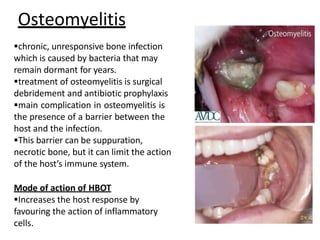
Osteomyelitis
chronic, unresponsive bone infection
which is caused by bacteria that may
remain dormant for years.
treatment of osteomyelitis is surgical
debridement and antibiotic prophylaxis
main complication in osteomyelitis is
the presence of a barrier between the
host and the infection.
This barrier can be suppuration,
necrotic bone, but it can limit the action
of the host’s immune system.
Mode of action of HBOT
Increases the host response by
favouring the action of inflammatory
cells.
HBO and Periodontitis
Mechanism
• Hyperbaric oxygen therapy showed to increase oxygen
distribution at the base of the pocket which is
deleterious to periodontal pathogens, particularly to
the anaerobic microorganisms.
• HBO increases generation of oxygen free radicals,
which oxidize proteins and membrane lipids, damage
deoxyribonucleic acid and inhibit bacterial metabolic
functions.
• It also facilitates the oxygen-dependent peroxidase
system by which leukocytes kill bacteria.
HBO and Implant
Mechanism
• The exact mechanisms at the cellular level where
HBO2 act remain obscure.
• It has been recently shown that HBO2 and basic
fibroblast growth factor (bFGF) acts synergistically in
irradiated bone.
• Factors that could be involved in bone protection by
bFGF and HBO2 are bone marrow radioprotection,
induction of oxygen radical scavengers and
production of different cytokines.
HBOT in OMFS
HBOT in OMFS

HBOT in OMFS

  • 1.
  • 2.
    DEFINITIONs • HYPER (increase)+ BARIC(pressure) • Hyperbaric oxygen therapy (HBOT) involves the “intermittent, usually daily, inhalation of 100 percent humidified oxygen under pressure,greater than 1 atmospheric absolute pressure(ATA).”- • The Committee on Hyperbaric Medicine defines HBO therapy as “Amode of medical treatment in which the patient is entirely enclosed in a pressure chamber and breathes 100% oxygen at a pressure >1 atmosphere absolute (ATA).”
  • 3.
    •ATAis the unitofpressure •1 ATAis equal to 760 mm of mercury or pressure at sea level. •Hyperbaric Oxygen Therapy (HBOT) is the use of high pressure oxygen as a drug to treat basic pathophysiologic processes and their diseases -
  • 4.
    HISTORY • 1662- Henshawbuilt first hyperbaric chamber • 1960 – Boerema -performs first surgery with HBO • 1965: It was first used to assist wound healing when it was noted that burns of the victims of coal mine explosions treated with HBO2 healed faster.
  • 5.
    PRINCIPLES OF HBOT •based on how gases of different solubilities, most importantly oxygen, behave under changing pressures and volumes, within tissues and fluid -
  • 7.
    1. Hyperoxygenation • resultsfrom an increase in dissolved oxygen in plasma as a result of increased partial pressure of arterial oxygen(pO2). • management of crush injury, compartment syndrome, flap salvage and acute blood loss anaemia. A pressure of 3 ATAresults in 6 ml of O2being dissolved per 100 ml of plasma, thus rendering as much O2 delivery as by haemoglobin bound O2. MECHANISM OF ACTION
  • 8.
    2.Vasoconstriction • Hyperoxia innormal tissues causes vasoconstriction which reduces post-traumatic tissue oedema. • This contributes to the treatment of crush injuries, compartment syndromes and burns. • Vasoconstriction, however, does not cause hypoxia as this is more than compensated by increased plasma oxygen content and microvascular blood flow.
  • 9.
    3.Collagen formation Oxygen isvital for • hydroxylation of lysine and proline residues during collagen synthesis • for cross linking and maturation of collagen which is required for strong wound healing. • Lack of oxygen is corrected during HBOT, leading to adequate amounts of mature collagen formation.
  • 10.
    4.Angiogenesis Hypoxia is avital stimulant for angiogenesis, but development of adequate capillary network requires adequate amounts of tissue oxygen concentration.. This along with fibroblastic proliferation leads to increased neovascularisation. HBOT increases the oxygen gradient between the centre and periphery of the wound, thus creating a strong angiogenic stimulus.
  • 11.
    • HBO exertsboth direct and indirect effects against bacteria. • Direct bactericidal and bacteriostatic effects occur through the generation of oxygen free radicals. • This free radical oxidizes proteins and membrane lipids, damages DNA, and inhibits metabolic functions essential for the growth of organisms.
  • 12.
    Hyperoxia and HBOinfluence the activity of some antibiotics, enhancing the effectiveness of some and inhibiting others. 6.Toxin Inhibition Suppression of alpha-toxin production by Clostridium perfringenes. • Bacteriostatic for some species of Escherichia and Pseudomonas and also for a range of enteric bacteria (Salmonella, Shigella and Proteus). 5. Antibiotic synergy
  • 13.
    Dosage and Delivery •All regimens use 100% oxygen • Pressures are more variable-  Mostly used 2.4 atm  Maximum tolerated is 3 atm  4 atm induces seizures
  • 14.
    Compression 10min Decompression 10min 90 min onOxygen + Two 5min- “Air Breaks” Treatment Phase – 100min
  • 15.
    • Dives between30 and 120 minutes • May be daily or BID • Total number varies by indication • Most treatments include 30 dives • Optional addition of 10 or more dives are accepted. HBOT is carried out in 2 chambers- 1. Monoplace chamber 2. Multiplace chamber
  • 16.
    Monoplace chambers •Small anddesigned to accommodate only one adult individual, usually in a supine or semi-recumbent position •pressure capability of 3.0 ATA,and compressed with 100% oxygen •The high flow oxygen requirement is ideally supplied via a hospital’s existing liquid oxygen system.
  • 17.
    •Cost efficient deliveryof HBO2. •No risk of decompression sickness. •Portable, less space, less equipments, no hood or mask. •No risk of iatrogenic decompression sickness in patient or staff Advantages •Relative patient isolation. •Inability to use certain diagnostic and/or therapeutic equipment. •Limited access to the patient inside chamber with only visual and auditory communication available to the patient and observers. Disadvantages
  • 18.
    Multiplace chambers • Theseunits can accommodate between 2 and 18 or more patients and commonly incorporate a minimum pressure capability of 6.0 ATA.
  • 19.
    •Constant patient attendance andevaluation •Multiple patients treated per session. •Greater working pressure. •Reduced fire risk •More room available, which allows medical personnel to enter to deal with acute problems, e.g., pneumothorax •Higher capitalization requirements. •risk of cross infection when used to treat wounds •Major space requirements; basement and/or ground floor level limitations. •Higher operating costs. Advantages Disadvantages
  • 20.
    INDICATIONS • According toUndersea and Hyperbaric Medicine Society (UHMS)- 1.Air or gas embolism. 2. Carbon monoxide poisoning or carbon monoxide poisoning complicated by cyanide poisoning. 3. Clostridal myositis and myonecrosis (gas gangrene). 4. Crush injury, compartment syndrome, and other acute traumatic ischemia. 5. Decompression sickness. 6. Enhancement of healing in selected problem wounds; a. Diabetically derived illness, such as diabetic foot, diabetic retinopathy, diabetic nephropathy.
  • 21.
    7. Exceptional bloodloss (anemia) 8. Intracranial abscess. 9. Necrotizing soft tissue infections (necrotizing fasciitis). 10. Osteomyelitis (refractory). 11. Delayed radiation injury (soft tissue and bony necrosis). 12. Skin grafts and flaps (compromised). 13. Thermal burns. Additional indications recommended by European Concensus Conference 2004 – 1. Surgery and implant in irradiated tissue(Preventive action) 2. Sudden deafness 3. Neuroblastoma stage IV 4. Post anoxic encephalopathy 5. Limb replantation
  • 22.
    CONTRAINDICATIONS Absolute 1. Untreated pneumothorax 2.Pt on following cisplatin, alcohol, nicotine, steroids, sulfamylon or doxorubicin • Relative 1. Upper respiratory tract infection 2. Chronic pulmonary obstructive disease 3. Eustachian tube dysfunction 4. Asthma 5. Pregnancy 6. Claustrophobia 7. Seizure disorder 8. Hyperthermia
  • 23.
    PREPARATIONS BEFORE HYPERBARIC OXYGENTHERAPY 1. Medication •complete drug history before treatment Drugs that are not compatible with HBOT include: • High doses of prednisolone (or similar cortisone type drugs), and morphine, or alcohol, insulin within 8 h of treatment. • Such drugs should be substituted for another drug. • Patients will be instructed to take a regimen of high potency nutritional supplements containing vitamin E and other antioxidants during a course of HBOT
  • 24.
    2.Cold and othersymptoms Patients with the symptoms of a cold or the flu, fever, cough, sore throat, runny nose, cold sore, nausea, vomiting or diarrhea are not helped by oxygen. • HBO treatments may need to be postponed until symptoms have subsided. 3.Smoking • Hyperbaric oxygen therapy will not be effective in patients who use tobacco in any form like cigarettes, pipe tobacco, and cigars, as well as chewing tobacco and snuff.
  • 25.
    4. Cosmetics • Cosmetics,hair spray, nail polish, perfume, or shaving lotion containing petroleum, alcohol or oil base are not allowed while in the HBO chamber. • It is important to discuss all skin care products with the HBO technician, so they may assure safety. 5. Clothing (Moon & Grande) •Patients are provided with 100% cotton gowns to wear during treatment. •No articles containing nylon or polyester can be worn in the chamber.
  • 26.
    Negative affects aftertherapy?? • A “cracking” sensation in their ears between treatments as a pressure difference develops between their middle ear and the chamber atmosphere. • Feeling of light headedness for a few minutes immediately following a treatment.
  • 27.
    Potential complications afterHBO 1.Oxygen toxicity - Seizures, dry cough, chest pain or burning. 2.Visual refraction changes - Cataract, progressive myopia with prolonged number of treatments. 3. Barotrauma - In ears, sinus, lungs, tooth caries/fillings. 4. Pulmonary changes
  • 28.
    APPLICATIONS IN DENTISTRY hyperbaricoxygen therapy is used in • Osteoradionecrosis • Osteomyelitis of jaws • Aggressive periodontitis • Adjunctive therapy for the placement of the implants in irradiated jaws.
  • 29.
    Osteoradionecrosis complication of thejaws which occurs after head and neck radiotherapy Patients are subjected to HBOT to prevent the necrosis of the bone after extraction in irradiated patients. Necrosis occurs since blood supply is compromised after radiotherapy characterized by hypocellularity, hypovascularity and hypoxia Mode of action of HBOT •Increases the oxygen tension in the region and promotes angiogenesis and wound healing
  • 30.
    Osteomyelitis chronic, unresponsive boneinfection which is caused by bacteria that may remain dormant for years. treatment of osteomyelitis is surgical debridement and antibiotic prophylaxis main complication in osteomyelitis is the presence of a barrier between the host and the infection. This barrier can be suppuration, necrotic bone, but it can limit the action of the host’s immune system. Mode of action of HBOT Increases the host response by favouring the action of inflammatory cells.
  • 31.
    HBO and Periodontitis Mechanism •Hyperbaric oxygen therapy showed to increase oxygen distribution at the base of the pocket which is deleterious to periodontal pathogens, particularly to the anaerobic microorganisms. • HBO increases generation of oxygen free radicals, which oxidize proteins and membrane lipids, damage deoxyribonucleic acid and inhibit bacterial metabolic functions. • It also facilitates the oxygen-dependent peroxidase system by which leukocytes kill bacteria.
  • 32.
    HBO and Implant Mechanism •The exact mechanisms at the cellular level where HBO2 act remain obscure. • It has been recently shown that HBO2 and basic fibroblast growth factor (bFGF) acts synergistically in irradiated bone. • Factors that could be involved in bone protection by bFGF and HBO2 are bone marrow radioprotection, induction of oxygen radical scavengers and production of different cytokines.