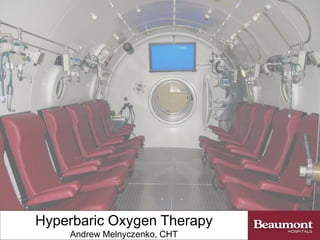
Hyperbaric Oxygen Therapy
Andrew Melnyczenko, CHT
Media Sensationalism
at work!
“Sleeping” in a
hyperbaric chamber
“And now you
know……
……the rest of the
story!”
The air we breathe is composed of 21% oxygen and 79%
nitrogen. During treatment, patients breathe 100% oxygen.
Due to atmospheric pressure, our bodies are
constantly subjected to approximately 14.7
pounds per square inch.
Hyperbaric Oxygen Therapy
What is it?
Science has discovered that breathing pure
oxygen under pressure can help certain
wounds to heal.
 The process by which inspired oxygen is given at
increased atmospheric pressure
 Oxygen enters the body through the lungs and is
diffused throughout the body
 This process greatly increases oxygen levels in
the blood.
 Non-healing wounds have low oxygen levels due
to poor circulation; HBOT restores this to normal
levels
Hyperbaric Oxygen Therapy
What is it?
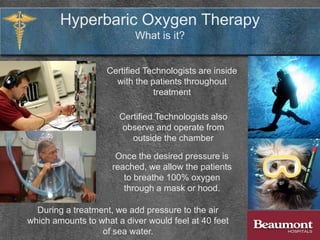
During a treatment, we add pressure to the air
which amounts to what a diver would feel at 40 feet
of sea water.
Once the desired pressure is
reached, we allow the patients
to breathe 100% oxygen
through a mask or hood.
Hyperbaric Oxygen Therapy
What is it?
Certified Technologists are inside
with the patients throughout
treatment
Certified Technologists also
observe and operate from
outside the chamber
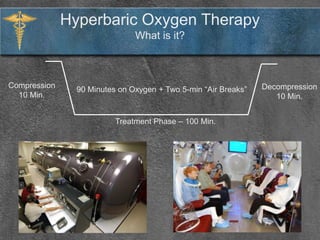
Compression
10 Min.
Decompression
10 Min.
Treatment Phase – 100 Min.
90 Minutes on Oxygen + Two 5-min “Air Breaks”
Hyperbaric Oxygen Therapy
What is it?
Hyperbaric Oxygen Therapy
Monoplace Chambers
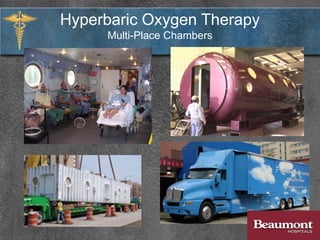
Hyperbaric Oxygen Therapy
Multi-Place Chambers
Hyperbaric Oxygen Therapy
Multi-Place Chamber
Treatment is approved by Medicare and covered by most
insurance companies.
Hyperbaric Oxygen Therapy
Other types of Chambers – some not considered HBO!
Hyperbaric Oxygen Therapy
Are There Any Complications?
Pain in the ears caused by pressure + Inability to “clear”
Diabetics may experience a temporary drop in blood sugar
Temporary Nearsightedness (subsides 4-6 weeks post-
treatment
Sinus Pain (Patients do not dive with sinus congestion)
Some patients may be sensitive to oxygen at higher
pressures. This may cause a seizure, but no long-term
effects are expected. We are able to reduce this risk by
giving them periodic Air Breaks
Claustrophobia (Rarely seen due to the size of our
Chamber)
Collapsed Lung (Extremely Rare in Occurrence. X-Ray
Screening is Required)
Fire inside the Chamber (Many Precautions are taken to
prevent this occurrence.)
Overall, Complications are very rare, and
almost all of them are preventable.
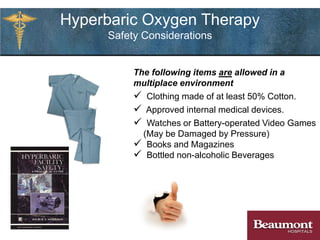
The following items are allowed in
a multiplace air environment
 Clothing made of at least 50% Cotton.
 Approved internal medical devices.
 Some watches or battery powered devices
(Verify with HBO Staff and Safety Director)
 Books and Magazines
 Bottled non-alcoholic Beverages
Hyperbaric Oxygen Therapy
Safety Considerations
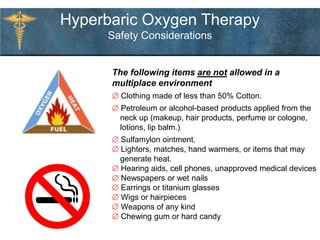
The following items are not allowed in a
multiplace environment
 Clothing made of less than 50% Cotton.
 Petroleum or alcohol-based products applied from the
neck up (makeup, hair products, perfume or cologne,
lotions, lip balm.)
 Sulfamylon ointment.
 Lighters, matches, hand warmers, or items that may
generate heat.
 Hearing aids, cell phones, unapproved medical devices
 Newspapers or wet nails
 Earrings or titanium glasses
 Wigs or hairpieces
 Weapons of any kind
 Chewing gum or hard candy
Hyperbaric Oxygen Therapy
Safety Considerations
Hyperbaric Oxygen Therapy
Contraindications
Chemotherapy agents Bleomycin,
Cisplatin or Adriamycin
History of Untreated Pneumothorax
Severe COPD
Untested Pacemakers, etc.
Hyperbaric Oxygen Therapy
CO2 Retention
 Excessive supplemental oxygen
 May be caused by the “hypoxic
drive”
 Increases in CO2 (hypercapnia)
can cause acidosis
 Most patients with mild to
moderate COPD may safely
receive hyperbaric oxygen under
close supervision
 Severe COPD could cause
alveoli to burst at depth
Hyperbaric Oxygen Therapy
Therapeutic Effects
Mechanisms of Action
 Increased Oxygen Tension
 Vasoconstriction
 Increased Fibroblast Replication
 Increased Collagen Response
 Angiogenesis
 Enhanced Leukocyte Function
 Attenuation of Reperfusion Injury
Hyperbaric Oxygen Therapy
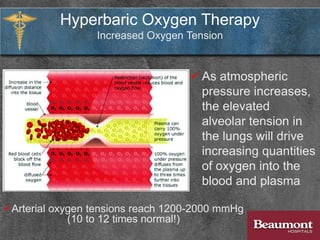
Increased Oxygen Tension
 As atmospheric
pressure increases,
the elevated
alveolar tension in
the lungs will drive
increasing quantities
of oxygen into the
blood and plasma
Arterial oxygen tensions reach 1200-2000 mmHg
(10 to 12 times normal!)
Hyperbaric Oxygen Therapy
Vasoconstriction
 Inflow vs Outflow
 Reduction of Edema by 20%
 Hyperoxygenation in the
plasma maintains oxygen
delivery during
vasoconstriction
Hyperbaric Oxygen Therapy
Increased Fibroblast Replication
 Hyperbaric oxygen provides adequate oxygen for
fibroblast activity, cells which promote healing in
hypoxic tissues
 Tissue oxygen tensions of a least 30 to 40 mmHg
are necessary for fibroblast turnover, collagen
synthesis, and the development of a collagen
matrix to support capillary budding into avascular
areas.
Hyperbaric Oxygen Therapy
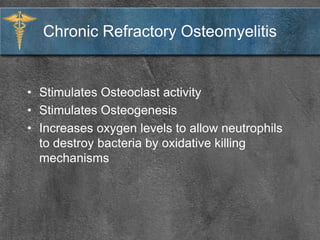
Bactericidal Effect
 Oxygen halts alpha-toxin production of C.
Perfringens at 250 mmHg
 Oxygen Tensions of 1500 mmHg is bactericidal
 Enhances neutrophil activity leading to oxidative
killing mechanisms (leukocytes / WBCs)
 Certain antibiotics may be more readily
incorporated into the bacterial cell wall in the
presence of elevated oxygen tensions.
Hyperbaric Oxygen Therapy
Angiogenesis
 The restoration of
abnormally low po2
levels to normal will
result in capillary
growth.
 Increased fibroblast
activity provides a
scaffolding and
infrastructure for
new blood vessels
Hyperbaric Oxygen Therapy
Delayed Radiation Injuries
 Hyperbaric Oxygen can aid the healing of radiation
injuries of the bone and soft tissues
 Common areas where Radiation Injuries occur:
- Head and Neck
- Jaw
- Bladder
- Colon
- Intestines
- Chest wall
- Extremities
Hyperbaric Oxygen Therapy
Diabetic Wounds
The Diabetic Effect:
 Neuropathy
 Atherosclerosis
 Reduced Blood Flow
 Insulin Deficiency
 Delayed Wound Healing
Hyperbaric Oxygen Therapy
Wound Prevention
 Maintain a proper diabetic diet
 Provide nutrients needed to heal
 Aids in management of glucose levels
 Talk to your Doctor
 Regular exercise
 Prevents weight gain
 Promotes vascular health
 Helps control blood sugar
Hyperbaric Oxygen Therapy
Wound Prevention
 Proper foot care
 Nerve damage in the feet can hide symptoms
 Abrasions can develop into serious ulcers quickly
 Wear proper shoes – ask a specialist
 Baby your feet!
 Quit Smoking
 Manage your blood sugar
Wagner Grade III Ulcer
Lower extremity wounds that probe
down to bone, tendon, or joint
capsule with abscess, tendonitis, or
osteomyelitis, which have failed 30
days of wound therapy including
debridement and glucose control
Wagner Grade IV & V Ulcer
Gangrene or nonhealing
amputation sites which have failed
30 days of wound care including
debridement and glucose control
Diabetic Indications
Hyperbaric Oxygen Therapy
Diabetic Wounds
Hyperbaric Oxygen Therapy
Diabetic Wounds
After 59 TreatmentsBefore HBO Treatment
3/20/06
62 YO NIDDM with a Wagner III plantar ulcer of the
left foot that had failed to heal within 30 days
Hyperbaric Oxygen Therapy
Diabetic Wounds
56 Year-old male with diabetes
was referred for treatment of a
non-healing, Wagner Grade III
ulcer of the left foot. The ulcer
had not improved despite
standard wound care, including
regular debridements,
optimization of nutritional status
and glucose control.
Hyperbaric Oxygen Therapy
Diabetic Wounds
The patient received a total of 42
treatments over a period of 2
months. The ulcer was
completely healed less than two
weeks after completion of
treatment.
Hyperbaric Oxygen Therapy
Diabetic Wounds
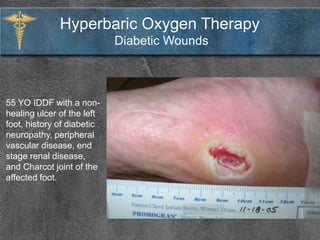
55 YO IDDF with a non-
healing ulcer of the left
foot, history of diabetic
neuropathy, peripheral
vascular disease, end
stage renal disease,
and Charcot joint of the
affected foot.
Hyperbaric Oxygen Therapy
Diabetic Wounds
Patient received 49
treatments over a 3 month
period.
Hyperbaric Oxygen Therapy
Diabetic Wounds
64 YO IDDM
with a diabetic
ulcer and failed
skin graft of the
right lateral calf.
Hyperbaric Oxygen Therapy
Diabetic Wounds
After 1 month of
therapy…
5/6/05
Hyperbaric Oxygen Therapy
Diabetic Wounds
5/18/06
Patient received
87 treatments
during two
courses of
therapy, lasting
five months.
Hyperbaric Oxygen Therapy
Diabetic Wounds
• Hearing loss of at least 30dB
occurring over the course of
three days
• About 20 cases per 100,000
annually in the US
• Cause is unknown
• Treatment is most effective
when given within two weeks
of onset
Newest indication, recognized by most private insurances
Hyperbaric Oxygen Therapy
Sudden Ideopathic Hearing Loss
Insurance Considerations
• Air or Gas Embolism
• Carbon Monoxide/Cyanide
Poisoning
• Clostridial Myositis and
Myonecrosis (Gas Gangrene)
• Crush Injury, Compartment
Syndrome and Other Acute
Traumatic Ischemias
• Decompression Sickness
• Arterial Insufficiencies
• Central Retinal Artery
Occlusion
• Enhancement of Healing In
Selected Problem Wounds
• Severe Anemia
• Intracranial Abscess
• Necrotizing Soft Tissue
Infections
• Osteomyelitis (Refractory)
• Delayed Radiation Injury (Soft
Tissue and Bony Necrosis)
• Compromised Grafts and
Flaps
• Acute Thermal Burn Injury
Hyperbaric Oxygen Therapy is approved by Medicare and
covered by most insurances for the following indications:
Any Questions?
Hyperbaric Oxygen Therapy

Hyperbaric oxygen therapy

  • 1.
  • 2.
  • 3.
  • 4.
    The air webreathe is composed of 21% oxygen and 79% nitrogen. During treatment, patients breathe 100% oxygen. Due to atmospheric pressure, our bodies are constantly subjected to approximately 14.7 pounds per square inch. Hyperbaric Oxygen Therapy What is it? Science has discovered that breathing pure oxygen under pressure can help certain wounds to heal.
  • 5.
     The processby which inspired oxygen is given at increased atmospheric pressure  Oxygen enters the body through the lungs and is diffused throughout the body  This process greatly increases oxygen levels in the blood.  Non-healing wounds have low oxygen levels due to poor circulation; HBOT restores this to normal levels Hyperbaric Oxygen Therapy What is it?
  • 6.
    During a treatment,we add pressure to the air which amounts to what a diver would feel at 40 feet of sea water. Once the desired pressure is reached, we allow the patients to breathe 100% oxygen through a mask or hood. Hyperbaric Oxygen Therapy What is it? Certified Technologists are inside with the patients throughout treatment Certified Technologists also observe and operate from outside the chamber
  • 7.
    Compression 10 Min. Decompression 10 Min. TreatmentPhase – 100 Min. 90 Minutes on Oxygen + Two 5-min “Air Breaks” Hyperbaric Oxygen Therapy What is it?
  • 8.
  • 9.
  • 10.
    Hyperbaric Oxygen Therapy Multi-PlaceChamber Treatment is approved by Medicare and covered by most insurance companies.
  • 11.
    Hyperbaric Oxygen Therapy Othertypes of Chambers – some not considered HBO!
  • 12.
    Hyperbaric Oxygen Therapy AreThere Any Complications? Pain in the ears caused by pressure + Inability to “clear” Diabetics may experience a temporary drop in blood sugar Temporary Nearsightedness (subsides 4-6 weeks post- treatment Sinus Pain (Patients do not dive with sinus congestion) Some patients may be sensitive to oxygen at higher pressures. This may cause a seizure, but no long-term effects are expected. We are able to reduce this risk by giving them periodic Air Breaks Claustrophobia (Rarely seen due to the size of our Chamber) Collapsed Lung (Extremely Rare in Occurrence. X-Ray Screening is Required) Fire inside the Chamber (Many Precautions are taken to prevent this occurrence.) Overall, Complications are very rare, and almost all of them are preventable.
  • 13.
    The following itemsare allowed in a multiplace air environment  Clothing made of at least 50% Cotton.  Approved internal medical devices.  Some watches or battery powered devices (Verify with HBO Staff and Safety Director)  Books and Magazines  Bottled non-alcoholic Beverages Hyperbaric Oxygen Therapy Safety Considerations
  • 14.
    The following itemsare not allowed in a multiplace environment  Clothing made of less than 50% Cotton.  Petroleum or alcohol-based products applied from the neck up (makeup, hair products, perfume or cologne, lotions, lip balm.)  Sulfamylon ointment.  Lighters, matches, hand warmers, or items that may generate heat.  Hearing aids, cell phones, unapproved medical devices  Newspapers or wet nails  Earrings or titanium glasses  Wigs or hairpieces  Weapons of any kind  Chewing gum or hard candy Hyperbaric Oxygen Therapy Safety Considerations
  • 15.
    Hyperbaric Oxygen Therapy Contraindications Chemotherapyagents Bleomycin, Cisplatin or Adriamycin History of Untreated Pneumothorax Severe COPD Untested Pacemakers, etc.
  • 16.
    Hyperbaric Oxygen Therapy CO2Retention  Excessive supplemental oxygen  May be caused by the “hypoxic drive”  Increases in CO2 (hypercapnia) can cause acidosis  Most patients with mild to moderate COPD may safely receive hyperbaric oxygen under close supervision  Severe COPD could cause alveoli to burst at depth
  • 17.
    Hyperbaric Oxygen Therapy TherapeuticEffects Mechanisms of Action  Increased Oxygen Tension  Vasoconstriction  Increased Fibroblast Replication  Increased Collagen Response  Angiogenesis  Enhanced Leukocyte Function  Attenuation of Reperfusion Injury
  • 18.
    Hyperbaric Oxygen Therapy IncreasedOxygen Tension  As atmospheric pressure increases, the elevated alveolar tension in the lungs will drive increasing quantities of oxygen into the blood and plasma Arterial oxygen tensions reach 1200-2000 mmHg (10 to 12 times normal!)
  • 19.
    Hyperbaric Oxygen Therapy Vasoconstriction Inflow vs Outflow  Reduction of Edema by 20%  Hyperoxygenation in the plasma maintains oxygen delivery during vasoconstriction
  • 20.
    Hyperbaric Oxygen Therapy IncreasedFibroblast Replication  Hyperbaric oxygen provides adequate oxygen for fibroblast activity, cells which promote healing in hypoxic tissues  Tissue oxygen tensions of a least 30 to 40 mmHg are necessary for fibroblast turnover, collagen synthesis, and the development of a collagen matrix to support capillary budding into avascular areas.
  • 21.
    Hyperbaric Oxygen Therapy BactericidalEffect  Oxygen halts alpha-toxin production of C. Perfringens at 250 mmHg  Oxygen Tensions of 1500 mmHg is bactericidal  Enhances neutrophil activity leading to oxidative killing mechanisms (leukocytes / WBCs)  Certain antibiotics may be more readily incorporated into the bacterial cell wall in the presence of elevated oxygen tensions.
  • 22.
    Hyperbaric Oxygen Therapy Angiogenesis The restoration of abnormally low po2 levels to normal will result in capillary growth.  Increased fibroblast activity provides a scaffolding and infrastructure for new blood vessels
  • 23.
    Hyperbaric Oxygen Therapy DelayedRadiation Injuries  Hyperbaric Oxygen can aid the healing of radiation injuries of the bone and soft tissues  Common areas where Radiation Injuries occur: - Head and Neck - Jaw - Bladder - Colon - Intestines - Chest wall - Extremities
  • 24.
    Hyperbaric Oxygen Therapy DiabeticWounds The Diabetic Effect:  Neuropathy  Atherosclerosis  Reduced Blood Flow  Insulin Deficiency  Delayed Wound Healing
  • 25.
    Hyperbaric Oxygen Therapy WoundPrevention  Maintain a proper diabetic diet  Provide nutrients needed to heal  Aids in management of glucose levels  Talk to your Doctor  Regular exercise  Prevents weight gain  Promotes vascular health  Helps control blood sugar
  • 26.
    Hyperbaric Oxygen Therapy WoundPrevention  Proper foot care  Nerve damage in the feet can hide symptoms  Abrasions can develop into serious ulcers quickly  Wear proper shoes – ask a specialist  Baby your feet!  Quit Smoking  Manage your blood sugar
  • 27.
    Wagner Grade IIIUlcer Lower extremity wounds that probe down to bone, tendon, or joint capsule with abscess, tendonitis, or osteomyelitis, which have failed 30 days of wound therapy including debridement and glucose control Wagner Grade IV & V Ulcer Gangrene or nonhealing amputation sites which have failed 30 days of wound care including debridement and glucose control Diabetic Indications Hyperbaric Oxygen Therapy Diabetic Wounds
  • 28.
  • 29.
    After 59 TreatmentsBeforeHBO Treatment 3/20/06 62 YO NIDDM with a Wagner III plantar ulcer of the left foot that had failed to heal within 30 days Hyperbaric Oxygen Therapy Diabetic Wounds
  • 30.
    56 Year-old malewith diabetes was referred for treatment of a non-healing, Wagner Grade III ulcer of the left foot. The ulcer had not improved despite standard wound care, including regular debridements, optimization of nutritional status and glucose control. Hyperbaric Oxygen Therapy Diabetic Wounds
  • 31.
    The patient receiveda total of 42 treatments over a period of 2 months. The ulcer was completely healed less than two weeks after completion of treatment. Hyperbaric Oxygen Therapy Diabetic Wounds
  • 32.
    55 YO IDDFwith a non- healing ulcer of the left foot, history of diabetic neuropathy, peripheral vascular disease, end stage renal disease, and Charcot joint of the affected foot. Hyperbaric Oxygen Therapy Diabetic Wounds
  • 33.
    Patient received 49 treatmentsover a 3 month period. Hyperbaric Oxygen Therapy Diabetic Wounds
  • 34.
    64 YO IDDM witha diabetic ulcer and failed skin graft of the right lateral calf. Hyperbaric Oxygen Therapy Diabetic Wounds
  • 35.
    After 1 monthof therapy… 5/6/05 Hyperbaric Oxygen Therapy Diabetic Wounds
  • 36.
    5/18/06 Patient received 87 treatments duringtwo courses of therapy, lasting five months. Hyperbaric Oxygen Therapy Diabetic Wounds
  • 37.
    • Hearing lossof at least 30dB occurring over the course of three days • About 20 cases per 100,000 annually in the US • Cause is unknown • Treatment is most effective when given within two weeks of onset Newest indication, recognized by most private insurances Hyperbaric Oxygen Therapy Sudden Ideopathic Hearing Loss
  • 38.
    Insurance Considerations • Airor Gas Embolism • Carbon Monoxide/Cyanide Poisoning • Clostridial Myositis and Myonecrosis (Gas Gangrene) • Crush Injury, Compartment Syndrome and Other Acute Traumatic Ischemias • Decompression Sickness • Arterial Insufficiencies • Central Retinal Artery Occlusion • Enhancement of Healing In Selected Problem Wounds • Severe Anemia • Intracranial Abscess • Necrotizing Soft Tissue Infections • Osteomyelitis (Refractory) • Delayed Radiation Injury (Soft Tissue and Bony Necrosis) • Compromised Grafts and Flaps • Acute Thermal Burn Injury Hyperbaric Oxygen Therapy is approved by Medicare and covered by most insurances for the following indications:
  • 39.