1
Introduction
Hyperbaric oxygen therapy (HBOT) facilitates the transfer of oxygen to the
tissues of the human body. By doing so, it promotes healing of wounds and
minimizes the typical recovery time for patients. (1)
At this juncture, strictly within
dental medicine, HBOT indicates the distribution of comprehensive oxygen at
pressures greater than 1.4 atmosphere absolute (ATA), often in a series of
treatments. (2)
This treatment requires the patient to stand within a hyperbaric
chamber with pressure greater than ambient. It has many uses such as patient care,
and wound care within standard medicine and dental medicine. (3)
HBOT exploits numerous physiological principles of how gases and oxygen react
under specific adjustments of pressure. There is a direct relationship between the
concentration of oxygen in solution and the diffusion gradient. The increase in
concentration of oxygen in solution results in the increase of the diffusion
gradient for the delivery into deeper tissue, thus being the basis for HBOT. In
HBOT, the oxygen level is amplified, which highly increases the oxygen tension
in the tissues. When the treatment is concluded, the oxygen tension decreases
allowing for an inundation of neutrophils. Neutrophils are a type of white blood
cells which specifically aid in fighting off infection and tissue regrowth.
Conclusively, the increase in dissolved oxygen generated by HBOT has potential
to alter tissue responses to disease and injury. (4)
Mechanism of action
The effects caused by hyperbaric oxygen on the body can be divided into primary
or direct effects like increased oxygen tension and diffusion in the tissue;
secondary or immediate effects like vasoconstriction, angiogenesis, fibroblast
proliferation and increased leukocyte oxidative killing. (5)
These effects are based
on the gas laws, physiological and biochemical effects of hyper oxygenation.
Henry’s Law states that the amount of gas which is dissolved in a liquid or tissue
is proportional to the partial pressure of that gas which is in contact with liquid
2
or tissue. (6)
In hyperbaric oxygen therapy, the increased amounts of oxygen
which is supplied, increases the oxygen tension in the tissues, thus explaining the
effects of hyperoxia in hypoxic tissues.
When the oxygen tension decreases, there is influx of neutrophils. The activated
neutrophils consume enormous amount of oxygen, leading to further decrease in
oxygen levels in the hypoxic tissues. Very low levels of oxygen can cause tissue
injuries. Hyperbaric oxygen therapy reverses the hypoxic tissue injuries by
increasing the oxygen concentration, thereby helping the neutrophils by
supplying oxygen and accelerating the healing process. (7,8)
Hyper oxygenation
causes vasoconstriction in the normal tissues.
Equipment
HBO therapy is administered in a hyperbaric chamber. (9)
They are of two types:
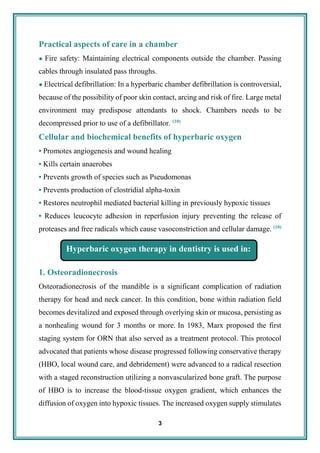
Monoplace chambers: It is transparent, made up of acrylic, can accommodate a
single patient and the patient does not require a mask. Primary advantage: Cost
and space requirements. Fig.1
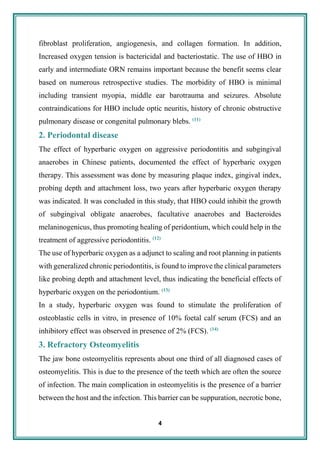
Multiplace chambers: Usually of steel (some may be made up of aluminum),
can accommodate more than two people and is pressurized with air, while the
patients breathe O2 from a tight fitting mask/circuit. Advantage: Is suitable for
critically ill patients requiring ventilation, monitoring and constant attendance.
Pressure and duration: It depends upon the indication. It ranges from 2 to 6 ATA
for 2-6 h. Decompression sickness/gas embolism may require prolonged,
continuous saturation protocols. Emergency indications for HBO therapy
generally require only 2-3 separate chamber treatments. Fig.2
Fig.2 Multiplace chambersFig.1 Monoplace chambers
3
Practical aspects of care in a chamber
● Fire safety: Maintaining electrical components outside the chamber. Passing
cables through insulated pass throughs.
● Electrical defibrillation: In a hyperbaric chamber defibrillation is controversial,
because of the possibility of poor skin contact, arcing and risk of fire. Large metal
environment may predispose attendants to shock. Chambers needs to be
decompressed prior to use of a defibrillator. (10)
Cellular and biochemical benefits of hyperbaric oxygen
• Promotes angiogenesis and wound healing
• Kills certain anaerobes
• Prevents growth of species such as Pseudomonas
• Prevents production of clostridial alpha-toxin
• Restores neutrophil mediated bacterial killing in previously hypoxic tissues
• Reduces leucocyte adhesion in reperfusion injury preventing the release of
proteases and free radicals which cause vasoconstriction and cellular damage. (10)
1. Osteoradionecrosis
Osteoradionecrosis of the mandible is a significant complication of radiation
therapy for head and neck cancer. In this condition, bone within radiation field
becomes devitalized and exposed through overlying skin or mucosa, persisting as
a nonhealing wound for 3 months or more. In 1983, Marx proposed the first
staging system for ORN that also served as a treatment protocol. This protocol
advocated that patients whose disease progressed following conservative therapy
(HBO, local wound care, and debridement) were advanced to a radical resection
with a staged reconstruction utilizing a nonvascularized bone graft. The purpose
of HBO is to increase the blood-tissue oxygen gradient, which enhances the
diffusion of oxygen into hypoxic tissues. The increased oxygen supply stimulates
Hyperbaric oxygen therapy in dentistry is used in:
4
fibroblast proliferation, angiogenesis, and collagen formation. In addition,
Increased oxygen tension is bactericidal and bacteriostatic. The use of HBO in
early and intermediate ORN remains important because the benefit seems clear
based on numerous retrospective studies. The morbidity of HBO is minimal
including transient myopia, middle ear barotrauma and seizures. Absolute
contraindications for HBO include optic neuritis, history of chronic obstructive
pulmonary disease or congenital pulmonary blebs. (11)
2. Periodontal disease
The effect of hyperbaric oxygen on aggressive periodontitis and subgingival
anaerobes in Chinese patients, documented the effect of hyperbaric oxygen
therapy. This assessment was done by measuring plaque index, gingival index,
probing depth and attachment loss, two years after hyperbaric oxygen therapy
was indicated. It was concluded in this study, that HBO could inhibit the growth
of subgingival obligate anaerobes, facultative anaerobes and Bacteroides
melaninogenicus, thus promoting healing of peridontium, which could help in the
treatment of aggressive periodontitis. (12)
The use of hyperbaric oxygen as a adjunct to scaling and root planning in patients
with generalized chronic periodontitis, is found to improve the clinical parameters
like probing depth and attachment level, thus indicating the beneficial effects of
hyperbaric oxygen on the periodontium. (13)
In a study, hyperbaric oxygen was found to stimulate the proliferation of
osteoblastic cells in vitro, in presence of 10% foetal calf serum (FCS) and an
inhibitory effect was observed in presence of 2% (FCS). (14)
3. Refractory Osteomyelitis
The jaw bone osteomyelitis represents about one third of all diagnosed cases of
osteomyelitis. This is due to the presence of the teeth which are often the source
of infection. The main complication in osteomyelitis is the presence of a barrier
between the host and the infection. This barrier can be suppuration, necrotic bone,
5
but it can limit the action of the host’s immune system. In refractory
osteomyelitis, antibiotics which are used to destroy the microorganisms in the
soft tissues around the sites of infections and surgery are used for the macroscopic
removal of necrotic bone. But hyperbaric oxygen therapy aims at the improval of
the host response and at making the environment more favourable for the action
of the inflammatory cells. In a study which was done on the treatment of chronic
refractory osteomyelitis, 11 out of 14 patients were successively treated with
hyperbaric oxygen therapy without any complications. (15)
4. Implants in irradiated bone
Dental implants offer an alternative for tooth replacement. Dental implants are
directly inserted into the bone which replaces the missing teeth. The adjacent
bone around the implant should fuse well into the implant surface by forming new
bone. But in an individual who has already undergone radiation therapy, the
implant is likely to fail, because the bone formation is compromised after
radiation. In an experimental study done on implants inserted into irradiated bone,
to assess the effects of hyperbaric oxygen therapy on the capacity of bone
formation, hyperbaric oxygen therapy was found to stimulate effective bone
formation. According to histomorphometric studies done on effects of bone
reactions on titanium implants, it was found that the woven bone was not replaced
by lamellar bone in irradiated patients. (16)
Contraindications of HBO
The various contraindications of hyperbaric oxygen therapy are:
Absolute contraindications: Untreated tension pneumothorax
Relative contraindications: Upper restrictive tract infections / Emphysema with
carbon dioxide retentions / Asymptomatic pulmonary lesions which are seen on
chest X- ray / History of thoracic or ear surgery / Uncontrolled hyperthermia /
Pregnancy / Claustrophobia / Seizure disorder. (17)
6
Complication
Though hyperbaric oxygen therapy has widespread applications, complications
in the usage do occur. In hyperbaric oxygen therapy, there are pressure
equalization problems which predominantly affect the middle ear and the nasal
sinus, which cause barotraumatic lesions. In a study which was done to analyze
the side effects of hyperbaric oxygen therapy, oxygen toxicity and ocular
disturbances were reported.
Non-emergent patients who are treated routinely with hyperbaric oxygen, with
oxygen being administered via a head hood, have a potential risk of CNS oxygen
toxicity which is three fold greater than is normally quoted. But the complications
which were observed were transient and they were limited mostly within the
duration of the treatment. (18)
Conclusion
HBO provides the most benefit in tissues with vessels which have good blood
flow. The anatomical structure of the mouth with its rich vascular beds is an
advantage to benefit from the treatment, which supports the intent to use this
therapy in dentistry. HBO proved its worth as an adjuvant therapy in multiple
dental indications. HBO application also proved its preventive worth in case of
tooth extraction at the site after irradiation. Tissue devastation after the head and
neck tumors treatment requires functional and aesthetic reconstruction. Success
of implants retention in the given site is significantly higher after HBO
application. As an adjuvant therapy, HBO proved its worth in treatment of
refractory osteomyelitis. HBO inhibits the growth of anaerobes in gingival
pockets which is probably the cause of the effect in the treatment of aggressive
periodontitis. Studies evaluating the positive effect of HBO in dentistry mostly
recommend it as an adjuvant therapy. Despite promissing results of experimental
works, the use of HBO in dentistry still has room for improvement. The effect
objectification for its more extensive use will require further studies. (19)
7
References
1. Hexdall E, Brave R, Kraft K, Siewers J. Diving deep into hyperbaric oxygen
therapy. Nursing. 2016;46:28-36.
2. Lam G, Fontaine R, Ross FL, Chiu ES. Hyperbaric oxygen therapy: exploring
the clinical evidence. Adv Skin Wound Care. 2017;30:181-190.
3. Carney AY. Hyperbaric oxygen therapy: an introduction. Crit Care Nurs Q.
2013;36:274-279.
4. Devaraj D, Srisakthi D. Hyperbaric oxygen therapy - can it be the new era in
dentistry? J Clin Diagn Res. 2014;8:263-265.
5. Vandana Mehta, Abhishek De, Balachandran C. Hyperbaric oxygen therapy.
Journal of Pakisthan Association of Dermatologists. 2009;19: 164-67.
6. AL Gill, CNA Bell. Hyperbaric oxygen therapy: its uses, mechanism of action
and outcomes. Q J Med. 2004; 97: 385-95.
7. David R Knighton, Vance D Fiegel, Tim Halverson, Susan Schneider, Tony
Brown, Carol L Wells. Oxygen as an antibiotic-The effect of inspired oxygen on
bacterial clearance. Arch Surg. 1990;125:97-100.
8. Knighton DR, Halliday B, Hunt TK. Oxygen as an antibiotic-the effect of
inspired oxygen on infection. Arch Surgery. 1984;119:199-204.
9. Leach RM, Rees PJ, Wilmshurst P. Hyperbaric oxygen therapy. BMJ
1998;317:1140-3.
10. Nalini Jain, D. Deepa. Applications of hyperbaric oxygen therapy in
dentistry: A mini review . Journal of Interdisciplinary Dentistry / Jan-Apr 2014 /
Vol-4 / Issue1
11. Jacobson AS, Buchbinder D, Hu K, Urken ML. Paradigm shifts in the
management of osteoradionecrosis of the mandible. Oral Oncol 2010;46:795-
801.
12. Tie-lou Chen, Bing Xu, Jing- Chang Liu, Shu-Guang Li, De-Yi Li, Guo
Chuan Gong, et al. Effects of hyperbaric oxygen on aggressive periodontitis and
8
subgingival anaerobes in Chinese patients. Journal of Indian Society Of
Periodontology. 2012;16:492-97.
13. Getulio R, Nogueira-Filho, Brino T Rosa, Joao R. David-Neto. Effects of
hyperbaric oxygen therapy on the treatment of severe cases of periodontitis.
UHM. 2010;37(2): 107-14.
14. Wu, Dong, Malda, Jos, Crawford, Ross W, Xiao, Yin. Effects of hyperbaric
oxygen on proliferation and differenciation of osteoblasts derived from human
alveolar bone. Connected Tissue Research. 2007; 48(4):206-13.
15. Chen ChE, Shih SHT, Fu Th, Wang JW, Wang ChJ. 2003. Hyperberic oxygen
therapy in the treatment of chronic refractory osteomyelitis. A preliminary report.
Chang Gung Medicine Journal. 2003;26:114-20.
16. Ase A Johnsson, Toshihiro Sawaii, Magnus Jacobsun, Gosta Granstrom,
Ingela Turesson. A histomorphometric study of bone reactions to titanium
implants in irradiated bone and the effect of hyperbaric oxygen treatment. The
International Journal of Oral and Maxillofacial Implants. 1999;14:699-706.
17. Lieutenent Sarah Sharkey. Current indications for hyperbaric oxygen therapy.
ADF Health. 2000;1:64-72.
18. N. Hampson, D. Atik. Central nervous system toxicity during routine
hyperbaric oxygen therapy. UHM. 2003;30(2): 147-53.
19. Martin Čelko – Juraj ČELKO. Use of hyperbaric oxygen therapy in dentistry.
University Review, Vol. 10, 2016, No. 3, p. 7-11

Hyperbaric oxygen therapy (HBOT)

  • 2.
    1 Introduction Hyperbaric oxygen therapy(HBOT) facilitates the transfer of oxygen to the tissues of the human body. By doing so, it promotes healing of wounds and minimizes the typical recovery time for patients. (1) At this juncture, strictly within dental medicine, HBOT indicates the distribution of comprehensive oxygen at pressures greater than 1.4 atmosphere absolute (ATA), often in a series of treatments. (2) This treatment requires the patient to stand within a hyperbaric chamber with pressure greater than ambient. It has many uses such as patient care, and wound care within standard medicine and dental medicine. (3) HBOT exploits numerous physiological principles of how gases and oxygen react under specific adjustments of pressure. There is a direct relationship between the concentration of oxygen in solution and the diffusion gradient. The increase in concentration of oxygen in solution results in the increase of the diffusion gradient for the delivery into deeper tissue, thus being the basis for HBOT. In HBOT, the oxygen level is amplified, which highly increases the oxygen tension in the tissues. When the treatment is concluded, the oxygen tension decreases allowing for an inundation of neutrophils. Neutrophils are a type of white blood cells which specifically aid in fighting off infection and tissue regrowth. Conclusively, the increase in dissolved oxygen generated by HBOT has potential to alter tissue responses to disease and injury. (4) Mechanism of action The effects caused by hyperbaric oxygen on the body can be divided into primary or direct effects like increased oxygen tension and diffusion in the tissue; secondary or immediate effects like vasoconstriction, angiogenesis, fibroblast proliferation and increased leukocyte oxidative killing. (5) These effects are based on the gas laws, physiological and biochemical effects of hyper oxygenation. Henry’s Law states that the amount of gas which is dissolved in a liquid or tissue is proportional to the partial pressure of that gas which is in contact with liquid
  • 3.
    2 or tissue. (6) Inhyperbaric oxygen therapy, the increased amounts of oxygen which is supplied, increases the oxygen tension in the tissues, thus explaining the effects of hyperoxia in hypoxic tissues. When the oxygen tension decreases, there is influx of neutrophils. The activated neutrophils consume enormous amount of oxygen, leading to further decrease in oxygen levels in the hypoxic tissues. Very low levels of oxygen can cause tissue injuries. Hyperbaric oxygen therapy reverses the hypoxic tissue injuries by increasing the oxygen concentration, thereby helping the neutrophils by supplying oxygen and accelerating the healing process. (7,8) Hyper oxygenation causes vasoconstriction in the normal tissues. Equipment HBO therapy is administered in a hyperbaric chamber. (9) They are of two types: Monoplace chambers: It is transparent, made up of acrylic, can accommodate a single patient and the patient does not require a mask. Primary advantage: Cost and space requirements. Fig.1 Multiplace chambers: Usually of steel (some may be made up of aluminum), can accommodate more than two people and is pressurized with air, while the patients breathe O2 from a tight fitting mask/circuit. Advantage: Is suitable for critically ill patients requiring ventilation, monitoring and constant attendance. Pressure and duration: It depends upon the indication. It ranges from 2 to 6 ATA for 2-6 h. Decompression sickness/gas embolism may require prolonged, continuous saturation protocols. Emergency indications for HBO therapy generally require only 2-3 separate chamber treatments. Fig.2 Fig.2 Multiplace chambersFig.1 Monoplace chambers
  • 4.
    3 Practical aspects ofcare in a chamber ● Fire safety: Maintaining electrical components outside the chamber. Passing cables through insulated pass throughs. ● Electrical defibrillation: In a hyperbaric chamber defibrillation is controversial, because of the possibility of poor skin contact, arcing and risk of fire. Large metal environment may predispose attendants to shock. Chambers needs to be decompressed prior to use of a defibrillator. (10) Cellular and biochemical benefits of hyperbaric oxygen • Promotes angiogenesis and wound healing • Kills certain anaerobes • Prevents growth of species such as Pseudomonas • Prevents production of clostridial alpha-toxin • Restores neutrophil mediated bacterial killing in previously hypoxic tissues • Reduces leucocyte adhesion in reperfusion injury preventing the release of proteases and free radicals which cause vasoconstriction and cellular damage. (10) 1. Osteoradionecrosis Osteoradionecrosis of the mandible is a significant complication of radiation therapy for head and neck cancer. In this condition, bone within radiation field becomes devitalized and exposed through overlying skin or mucosa, persisting as a nonhealing wound for 3 months or more. In 1983, Marx proposed the first staging system for ORN that also served as a treatment protocol. This protocol advocated that patients whose disease progressed following conservative therapy (HBO, local wound care, and debridement) were advanced to a radical resection with a staged reconstruction utilizing a nonvascularized bone graft. The purpose of HBO is to increase the blood-tissue oxygen gradient, which enhances the diffusion of oxygen into hypoxic tissues. The increased oxygen supply stimulates Hyperbaric oxygen therapy in dentistry is used in:
  • 5.
    4 fibroblast proliferation, angiogenesis,and collagen formation. In addition, Increased oxygen tension is bactericidal and bacteriostatic. The use of HBO in early and intermediate ORN remains important because the benefit seems clear based on numerous retrospective studies. The morbidity of HBO is minimal including transient myopia, middle ear barotrauma and seizures. Absolute contraindications for HBO include optic neuritis, history of chronic obstructive pulmonary disease or congenital pulmonary blebs. (11) 2. Periodontal disease The effect of hyperbaric oxygen on aggressive periodontitis and subgingival anaerobes in Chinese patients, documented the effect of hyperbaric oxygen therapy. This assessment was done by measuring plaque index, gingival index, probing depth and attachment loss, two years after hyperbaric oxygen therapy was indicated. It was concluded in this study, that HBO could inhibit the growth of subgingival obligate anaerobes, facultative anaerobes and Bacteroides melaninogenicus, thus promoting healing of peridontium, which could help in the treatment of aggressive periodontitis. (12) The use of hyperbaric oxygen as a adjunct to scaling and root planning in patients with generalized chronic periodontitis, is found to improve the clinical parameters like probing depth and attachment level, thus indicating the beneficial effects of hyperbaric oxygen on the periodontium. (13) In a study, hyperbaric oxygen was found to stimulate the proliferation of osteoblastic cells in vitro, in presence of 10% foetal calf serum (FCS) and an inhibitory effect was observed in presence of 2% (FCS). (14) 3. Refractory Osteomyelitis The jaw bone osteomyelitis represents about one third of all diagnosed cases of osteomyelitis. This is due to the presence of the teeth which are often the source of infection. The main complication in osteomyelitis is the presence of a barrier between the host and the infection. This barrier can be suppuration, necrotic bone,
  • 6.
    5 but it canlimit the action of the host’s immune system. In refractory osteomyelitis, antibiotics which are used to destroy the microorganisms in the soft tissues around the sites of infections and surgery are used for the macroscopic removal of necrotic bone. But hyperbaric oxygen therapy aims at the improval of the host response and at making the environment more favourable for the action of the inflammatory cells. In a study which was done on the treatment of chronic refractory osteomyelitis, 11 out of 14 patients were successively treated with hyperbaric oxygen therapy without any complications. (15) 4. Implants in irradiated bone Dental implants offer an alternative for tooth replacement. Dental implants are directly inserted into the bone which replaces the missing teeth. The adjacent bone around the implant should fuse well into the implant surface by forming new bone. But in an individual who has already undergone radiation therapy, the implant is likely to fail, because the bone formation is compromised after radiation. In an experimental study done on implants inserted into irradiated bone, to assess the effects of hyperbaric oxygen therapy on the capacity of bone formation, hyperbaric oxygen therapy was found to stimulate effective bone formation. According to histomorphometric studies done on effects of bone reactions on titanium implants, it was found that the woven bone was not replaced by lamellar bone in irradiated patients. (16) Contraindications of HBO The various contraindications of hyperbaric oxygen therapy are: Absolute contraindications: Untreated tension pneumothorax Relative contraindications: Upper restrictive tract infections / Emphysema with carbon dioxide retentions / Asymptomatic pulmonary lesions which are seen on chest X- ray / History of thoracic or ear surgery / Uncontrolled hyperthermia / Pregnancy / Claustrophobia / Seizure disorder. (17)
  • 7.
    6 Complication Though hyperbaric oxygentherapy has widespread applications, complications in the usage do occur. In hyperbaric oxygen therapy, there are pressure equalization problems which predominantly affect the middle ear and the nasal sinus, which cause barotraumatic lesions. In a study which was done to analyze the side effects of hyperbaric oxygen therapy, oxygen toxicity and ocular disturbances were reported. Non-emergent patients who are treated routinely with hyperbaric oxygen, with oxygen being administered via a head hood, have a potential risk of CNS oxygen toxicity which is three fold greater than is normally quoted. But the complications which were observed were transient and they were limited mostly within the duration of the treatment. (18) Conclusion HBO provides the most benefit in tissues with vessels which have good blood flow. The anatomical structure of the mouth with its rich vascular beds is an advantage to benefit from the treatment, which supports the intent to use this therapy in dentistry. HBO proved its worth as an adjuvant therapy in multiple dental indications. HBO application also proved its preventive worth in case of tooth extraction at the site after irradiation. Tissue devastation after the head and neck tumors treatment requires functional and aesthetic reconstruction. Success of implants retention in the given site is significantly higher after HBO application. As an adjuvant therapy, HBO proved its worth in treatment of refractory osteomyelitis. HBO inhibits the growth of anaerobes in gingival pockets which is probably the cause of the effect in the treatment of aggressive periodontitis. Studies evaluating the positive effect of HBO in dentistry mostly recommend it as an adjuvant therapy. Despite promissing results of experimental works, the use of HBO in dentistry still has room for improvement. The effect objectification for its more extensive use will require further studies. (19)
  • 8.
    7 References 1. Hexdall E,Brave R, Kraft K, Siewers J. Diving deep into hyperbaric oxygen therapy. Nursing. 2016;46:28-36. 2. Lam G, Fontaine R, Ross FL, Chiu ES. Hyperbaric oxygen therapy: exploring the clinical evidence. Adv Skin Wound Care. 2017;30:181-190. 3. Carney AY. Hyperbaric oxygen therapy: an introduction. Crit Care Nurs Q. 2013;36:274-279. 4. Devaraj D, Srisakthi D. Hyperbaric oxygen therapy - can it be the new era in dentistry? J Clin Diagn Res. 2014;8:263-265. 5. Vandana Mehta, Abhishek De, Balachandran C. Hyperbaric oxygen therapy. Journal of Pakisthan Association of Dermatologists. 2009;19: 164-67. 6. AL Gill, CNA Bell. Hyperbaric oxygen therapy: its uses, mechanism of action and outcomes. Q J Med. 2004; 97: 385-95. 7. David R Knighton, Vance D Fiegel, Tim Halverson, Susan Schneider, Tony Brown, Carol L Wells. Oxygen as an antibiotic-The effect of inspired oxygen on bacterial clearance. Arch Surg. 1990;125:97-100. 8. Knighton DR, Halliday B, Hunt TK. Oxygen as an antibiotic-the effect of inspired oxygen on infection. Arch Surgery. 1984;119:199-204. 9. Leach RM, Rees PJ, Wilmshurst P. Hyperbaric oxygen therapy. BMJ 1998;317:1140-3. 10. Nalini Jain, D. Deepa. Applications of hyperbaric oxygen therapy in dentistry: A mini review . Journal of Interdisciplinary Dentistry / Jan-Apr 2014 / Vol-4 / Issue1 11. Jacobson AS, Buchbinder D, Hu K, Urken ML. Paradigm shifts in the management of osteoradionecrosis of the mandible. Oral Oncol 2010;46:795- 801. 12. Tie-lou Chen, Bing Xu, Jing- Chang Liu, Shu-Guang Li, De-Yi Li, Guo Chuan Gong, et al. Effects of hyperbaric oxygen on aggressive periodontitis and
  • 9.
    8 subgingival anaerobes inChinese patients. Journal of Indian Society Of Periodontology. 2012;16:492-97. 13. Getulio R, Nogueira-Filho, Brino T Rosa, Joao R. David-Neto. Effects of hyperbaric oxygen therapy on the treatment of severe cases of periodontitis. UHM. 2010;37(2): 107-14. 14. Wu, Dong, Malda, Jos, Crawford, Ross W, Xiao, Yin. Effects of hyperbaric oxygen on proliferation and differenciation of osteoblasts derived from human alveolar bone. Connected Tissue Research. 2007; 48(4):206-13. 15. Chen ChE, Shih SHT, Fu Th, Wang JW, Wang ChJ. 2003. Hyperberic oxygen therapy in the treatment of chronic refractory osteomyelitis. A preliminary report. Chang Gung Medicine Journal. 2003;26:114-20. 16. Ase A Johnsson, Toshihiro Sawaii, Magnus Jacobsun, Gosta Granstrom, Ingela Turesson. A histomorphometric study of bone reactions to titanium implants in irradiated bone and the effect of hyperbaric oxygen treatment. The International Journal of Oral and Maxillofacial Implants. 1999;14:699-706. 17. Lieutenent Sarah Sharkey. Current indications for hyperbaric oxygen therapy. ADF Health. 2000;1:64-72. 18. N. Hampson, D. Atik. Central nervous system toxicity during routine hyperbaric oxygen therapy. UHM. 2003;30(2): 147-53. 19. Martin Čelko – Juraj ČELKO. Use of hyperbaric oxygen therapy in dentistry. University Review, Vol. 10, 2016, No. 3, p. 7-11