Hydrocarbon Traps and 
Seals
Revision 
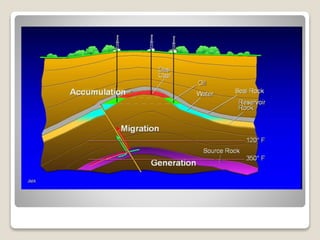
What are geological elements of petroleum 
system? 
What are geological processes of petroleum 
system? 
How organic matters is converted into 
petroleum?
• Source Rock - A rock with abundant hydrocarbon-prone organic 
matter 
• Reservoir Rock - A rock in which oil and gas accumulates: 
- Porosity - space between rock grains in which oil accumulates 
- Permeability - passage-ways between pores through 
which oil and gas moves 
• Seal Rock - A rock through which oil and gas cannot move 
effectively (such as mudstone and claystone) 
• Migration Route - Avenues in rock through which oil and gas moves from 
source rock to trap 
• Trap - The structural and stratigraphic configuration that focuses 
oil and gas into an accumulation
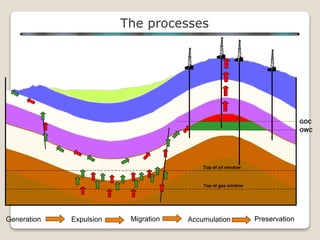
The processes 
Top of oil window 
Top of gas window 
Generation Expulsion Accumulation 
GOC 
OWC 
Migration Preservation
(modified from Tissot and Welte, 1984) 
Organic Debris 
Kerogen 
Carbon 
Initial Bitumen 
Oil and Gas 
Methane 
Oil Reservoir 
Migration 
Thermal Degradation 
Cracking 
Diagenesis 
Catagenesis 
Metagenesis 
Progressive Burial and Heating 
Schematic Representation of the Mechanism 
of Petroleum Generation and Destruction
i. Diagenesis is chemical, physical, or biological 
change undergone by a sediment after its initial 
deposition and during and after its lithification, 
exclusive of surface alteration (weathering) and 
metamorphism. These changes happen at relatively 
low temperatures and pressures and result in 
changes to the rock's original mineralogy and 
texture. There is no sharp boundary between 
diagenesis and metamorphism, but the latter occurs 
at higher temperature and pressure than the former. 
ii. Catagenesis 
Catagenesis is the cracking process which results in 
the conversion of organic kerogens into hydrocarbons
iii. Metagenesis is the last stage of maturation and 
conversion of organic matter to hydrocarbons. 
Metagenesis occurs at temperatures of 150° to 
200°C. At the end of metagenesis, methane, or 
dry gas, is evolved along with nonhydrocarbon 
gases such as CO2, N2, and H2S, as oil molecules 
are cracked into smaller gas molecules.
What is Trap 
A trap is the place where oil and gas are barred 
from further movement….(Levorsen, 1967) 
.
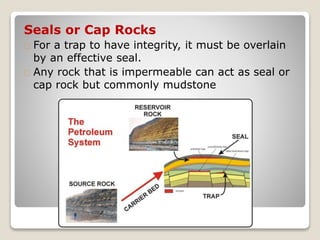
Seals or Cap Rocks 
For a trap to have integrity, it must be overlain 
by an effective seal. 
Any rock that is impermeable can act as seal or 
cap rock but commonly mudstone
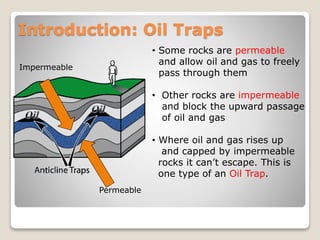
Introduction: Oil Traps 
• Some rocks are permeable 
and allow oil and gas to freely 
pass through them 
• Other rocks are impermeable 
and block the upward passage 
of oil and gas 
• Where oil and gas rises up 
and capped by impermeable 
rocks it can’t escape. This is 
one type of an Oil Trap. 
Impermeable 
Permeable
• The permeable rocks than contain oil and gas within 
the oil trap are known as the Reservoir Rock. 
• Reservoir rocks have lots of interconnected holes 
called pores. These allow them to absorb the oil and 
gas like a sponge.
Earth Science World Image Bank Image #h5innl 
This is a highly magnified picture of 
a sandy reservoir rock (water-filled 
pores are shown in blue) 
As oil migrates it fills up the pores 
(oil-filled pores shown in black)
Carbonate as Reservoir
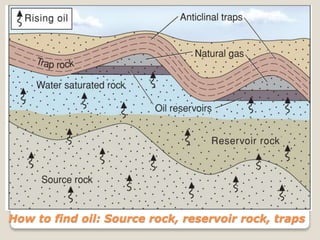
How to find oil: Source rock, reservoir rock, traps
Hydrocarbon Traps 
i. Structural traps 
Structural traps are caused by structural features. 
They are usually formed as a result of tectonics. 
ii. Stratigraphic traps 
Stratigraphic traps are usually caused by changes in 
rock quality. 
iii. Combination traps 
Combination traps that combine more than one type of 
trap are common in petroleum reservoirs. 
Other types of traps (such as hydrodynamic traps) 
are usually less common.
Structural Hydrocarbon Traps 
i. Fold 
ii. Fault 
iii. Salt Dome
Petroleum trapped in top of dome 
iii. Salt Dome 
Rocks above salt 
dome are bowed up 
Oil and gas 
trapped on 
sides of 
impermeable 
dome 
Salt flows up as a weak mass
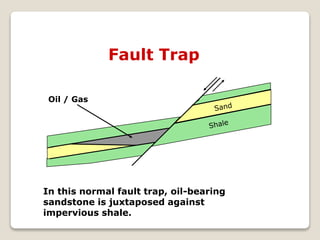
Fault Trap 
Oil / Gas 
In this normal fault trap, oil-bearing 
sandstone is juxtaposed against 
impervious shale.
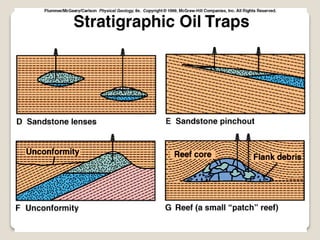
Stratigraphic Hydrocarbon Traps 
Stratigraphic hydrocarbon traps occur where 
reservoir facies pinch into impervious rock such 
as shale, or where they have been truncated by 
erosion and capped by impervious layers above 
an unconformity. 
(modified from Bjorlykke, 1989)
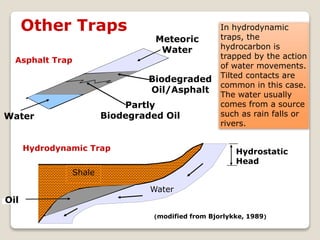
Other Traps In hydrodynamic 
Asphalt Trap 
Water 
Hydrodynamic Trap 
Meteoric 
Water 
Biodegraded 
Oil/Asphalt 
Partly 
Biodegraded Oil 
Shale 
Oil 
Water 
traps, the 
hydrocarbon is 
trapped by the action 
of water movements. 
Tilted contacts are 
common in this case. 
The water usually 
comes from a source 
such as rain falls or 
rivers. 
Hydrostatic 
Head 
(modified from Bjorlykke, 1989)
Summary
Questions?

Hydrocarbon Traps & Seals

  • 1.
  • 2.
    Revision What aregeological elements of petroleum system? What are geological processes of petroleum system? How organic matters is converted into petroleum?
  • 3.
    • Source Rock- A rock with abundant hydrocarbon-prone organic matter • Reservoir Rock - A rock in which oil and gas accumulates: - Porosity - space between rock grains in which oil accumulates - Permeability - passage-ways between pores through which oil and gas moves • Seal Rock - A rock through which oil and gas cannot move effectively (such as mudstone and claystone) • Migration Route - Avenues in rock through which oil and gas moves from source rock to trap • Trap - The structural and stratigraphic configuration that focuses oil and gas into an accumulation
  • 4.
    The processes Topof oil window Top of gas window Generation Expulsion Accumulation GOC OWC Migration Preservation
  • 5.
    (modified from Tissotand Welte, 1984) Organic Debris Kerogen Carbon Initial Bitumen Oil and Gas Methane Oil Reservoir Migration Thermal Degradation Cracking Diagenesis Catagenesis Metagenesis Progressive Burial and Heating Schematic Representation of the Mechanism of Petroleum Generation and Destruction
  • 6.
    i. Diagenesis ischemical, physical, or biological change undergone by a sediment after its initial deposition and during and after its lithification, exclusive of surface alteration (weathering) and metamorphism. These changes happen at relatively low temperatures and pressures and result in changes to the rock's original mineralogy and texture. There is no sharp boundary between diagenesis and metamorphism, but the latter occurs at higher temperature and pressure than the former. ii. Catagenesis Catagenesis is the cracking process which results in the conversion of organic kerogens into hydrocarbons
  • 7.
    iii. Metagenesis isthe last stage of maturation and conversion of organic matter to hydrocarbons. Metagenesis occurs at temperatures of 150° to 200°C. At the end of metagenesis, methane, or dry gas, is evolved along with nonhydrocarbon gases such as CO2, N2, and H2S, as oil molecules are cracked into smaller gas molecules.
  • 8.
    What is Trap A trap is the place where oil and gas are barred from further movement….(Levorsen, 1967) .
  • 9.
    Seals or CapRocks For a trap to have integrity, it must be overlain by an effective seal. Any rock that is impermeable can act as seal or cap rock but commonly mudstone
  • 10.
    Introduction: Oil Traps • Some rocks are permeable and allow oil and gas to freely pass through them • Other rocks are impermeable and block the upward passage of oil and gas • Where oil and gas rises up and capped by impermeable rocks it can’t escape. This is one type of an Oil Trap. Impermeable Permeable
  • 12.
    • The permeablerocks than contain oil and gas within the oil trap are known as the Reservoir Rock. • Reservoir rocks have lots of interconnected holes called pores. These allow them to absorb the oil and gas like a sponge.
  • 13.
    Earth Science WorldImage Bank Image #h5innl This is a highly magnified picture of a sandy reservoir rock (water-filled pores are shown in blue) As oil migrates it fills up the pores (oil-filled pores shown in black)
  • 14.
  • 19.
    How to findoil: Source rock, reservoir rock, traps
  • 20.
    Hydrocarbon Traps i.Structural traps Structural traps are caused by structural features. They are usually formed as a result of tectonics. ii. Stratigraphic traps Stratigraphic traps are usually caused by changes in rock quality. iii. Combination traps Combination traps that combine more than one type of trap are common in petroleum reservoirs. Other types of traps (such as hydrodynamic traps) are usually less common.
  • 21.
    Structural Hydrocarbon Traps i. Fold ii. Fault iii. Salt Dome
  • 22.
    Petroleum trapped intop of dome iii. Salt Dome Rocks above salt dome are bowed up Oil and gas trapped on sides of impermeable dome Salt flows up as a weak mass
  • 23.
    Fault Trap Oil/ Gas In this normal fault trap, oil-bearing sandstone is juxtaposed against impervious shale.
  • 24.
    Stratigraphic Hydrocarbon Traps Stratigraphic hydrocarbon traps occur where reservoir facies pinch into impervious rock such as shale, or where they have been truncated by erosion and capped by impervious layers above an unconformity. (modified from Bjorlykke, 1989)
  • 26.
    Other Traps Inhydrodynamic Asphalt Trap Water Hydrodynamic Trap Meteoric Water Biodegraded Oil/Asphalt Partly Biodegraded Oil Shale Oil Water traps, the hydrocarbon is trapped by the action of water movements. Tilted contacts are common in this case. The water usually comes from a source such as rain falls or rivers. Hydrostatic Head (modified from Bjorlykke, 1989)
  • 28.
  • 30.