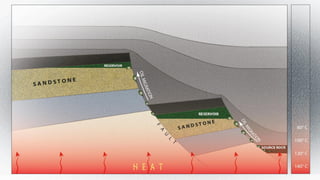
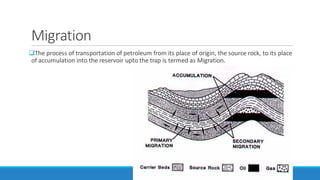
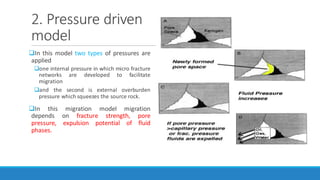
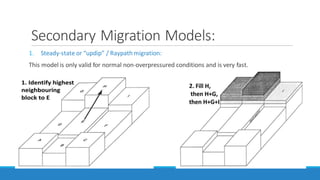
Migration of petroleum involves transporting hydrocarbons from the source rock to accumulation points within reservoirs, divided into three stages: primary, secondary, and tertiary migration. Primary migration allows hydrocarbons to move within source rocks to permeable carrier beds, influenced by expulsion models like saturation, pressure-driven, and chemical diffusion. Secondary migration involves hydrocarbons moving within carrier beds towards accumulations, whereas tertiary migration refers to the remobilization from existing accumulations, potentially altering volumes and fluid characteristics.