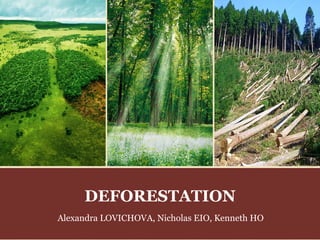
DEFORESTATION
Alexandra LOVICHOVA, Nicholas EIO, Kenneth HO
Content
1.  Introduction: Deforestation
2.  Current Situation of our Rainforests
3.  Causes of Deforestation
4.  Short & Long Term Effects of Deforestation
5.  Short & Long Term Solutions
6.  Conclusion
Introduction
1
Introduction: Deforestation
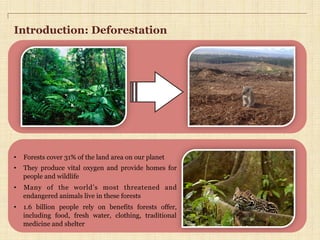
•  Forests cover 31% of the land area on our planet
•  They produce vital oxygen and provide homes for
people and wildlife
•  Many of the world’s most threatened and
endangered animals live in these forests
•  1.6 billion people rely on benefits forests offer,
including food, fresh water, clothing, traditional
medicine and shelter
Current Situation of our Rainforests
2
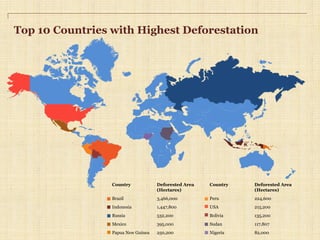
Country Deforested Area
(Hectares)
Brazil 3,466,000
Indonesia 1,447,800
Russia 532,200
Mexico 395,000
Papua New Guinea 250,200
Country Deforested Area
(Hectares)
Peru 224,600
USA 215,200
Bolivia 135,200
Sudan 117,807
Nigeria 82,000
Top 10 Countries with Highest Deforestation
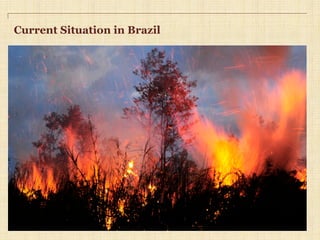
Current Situation in Brazil
h"p://www.youtube.com/watch?v=rNx51WqBBgM	
  
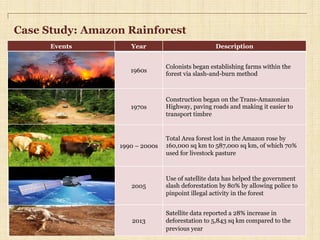
Case Study: Amazon Rainforest
Events Year Description
1960s
Colonists began establishing farms within the
forest via slash-and-burn method
1970s
Construction began on the Trans-Amazonian
Highway, paving roads and making it easier to
transport timbre
1990 – 2000s
Total Area forest lost in the Amazon rose by
160,000 sq km to 587,000 sq km, of which 70%
used for livestock pasture
2005
Use of satellite data has helped the government
slash deforestation by 80% by allowing police to
pinpoint illegal activity in the forest
2013
Satellite data reported a 28% increase in
deforestation to 5,843 sq km compared to the
previous year
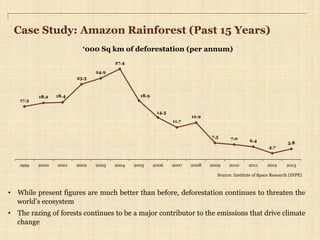
Case Study: Amazon Rainforest (Past 15 Years)
•  While present figures are much better than before, deforestation continues to threaten the
world’s ecosystem
•  The razing of forests continues to be a major contributor to the emissions that drive climate
change
17.3
18.2 18.4
23.3
24.9
27.4
18.9
14.3
11.7
12.9
7.5 7.0 6.4
4.7
5.8
1999 2000 2001 2002 2003 2004 2005 2006 2007 2008 2009 2010 2011 2012 2013
‘000 Sq km of deforestation (per annum)
Source: Institute of Space Research (INPE)
Causes of Deforestation
3
Causes of Deforestation
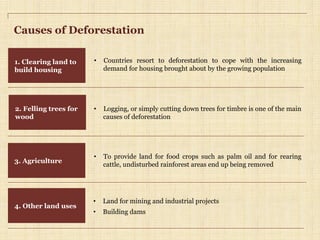
1. Clearing land to
build housing
2. Felling trees for
wood
4. Other land uses
•  Countries resort to deforestation to cope with the increasing
demand for housing brought about by the growing population
•  Logging, or simply cutting down trees for timbre is one of the main
causes of deforestation
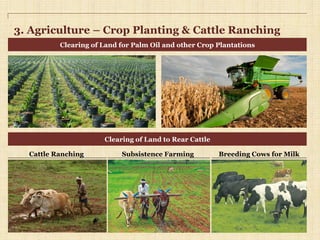
3. Agriculture
•  To provide land for food crops such as palm oil and for rearing
cattle, undisturbed rainforest areas end up being removed
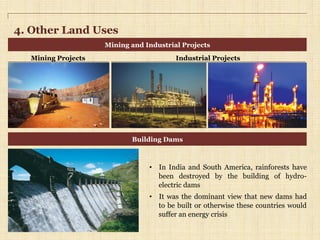
•  Land for mining and industrial projects
•  Building dams
1. Growing Demand for Housing
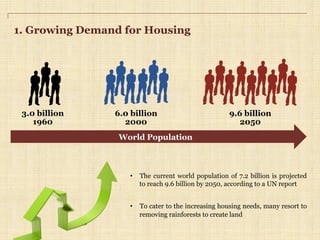
World Population
3.0 billion
1960
6.0 billion
2000
9.6 billion
2050
•  The current world population of 7.2 billion is projected
to reach 9.6 billion by 2050, according to a UN report
•  To cater to the increasing housing needs, many resort to
removing rainforests to create land
2. Logging
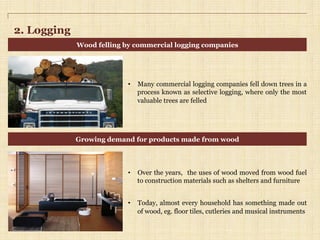
•  Many commercial logging companies fell down trees in a
process known as selective logging, where only the most
valuable trees are felled
•  Over the years, the uses of wood moved from wood fuel
to construction materials such as shelters and furniture
•  Today, almost every household has something made out
of wood, eg. floor tiles, cutleries and musical instruments
Wood felling by commercial logging companies
Growing demand for products made from wood
3. Agriculture – Crop Planting & Cattle Ranching
Clearing of Land for Palm Oil and other Crop Plantations
Clearing of Land to Rear Cattle
Subsistence Farming Breeding Cows for MilkCattle Ranching
4. Other Land Uses
Mining and Industrial Projects
Building Dams
•  In India and South America, rainforests have
been destroyed by the building of hydro-
electric dams
•  It was the dominant view that new dams had
to be built or otherwise these countries would
suffer an energy crisis
Mining Projects Industrial Projects
Effects
4
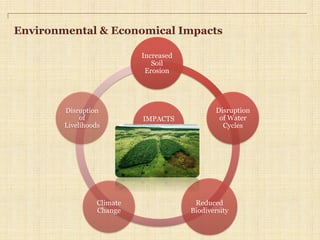
Environmental & Economical Impacts
IMPACTS
Increased
Soil
Erosion
Disruption
of Water
Cycles
Reduced
Biodiversity
Climate
Change
Disruption
of
Livelihoods
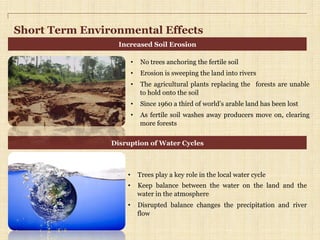
Short Term Environmental Effects
•  No trees anchoring the fertile soil
•  Erosion is sweeping the land into rivers
•  The agricultural plants replacing the forests are unable
to hold onto the soil
•  Since 1960 a third of world’s arable land has been lost
•  As fertile soil washes away producers move on, clearing
more forests
•  Trees play a key role in the local water cycle
•  Keep balance between the water on the land and the
water in the atmosphere
•  Disrupted balance changes the precipitation and river
flow
Increased Soil Erosion
Disruption of Water Cycles
Long Term Environmental Effects
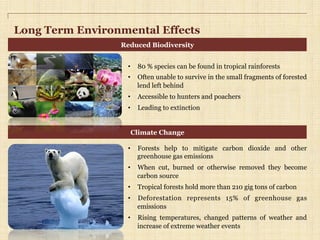
•  80 % species can be found in tropical rainforests
•  Often unable to survive in the small fragments of forested
lend left behind
•  Accessible to hunters and poachers
•  Leading to extinction
•  Forests help to mitigate carbon dioxide and other
greenhouse gas emissions
•  When cut, burned or otherwise removed they become
carbon source
•  Tropical forests hold more than 210 gig tons of carbon
•  Deforestation represents 15% of greenhouse gas
emissions
•  Rising temperatures, changed patterns of weather and
increase of extreme weather events
Reduced Biodiversity
Climate Change
Economical Effects
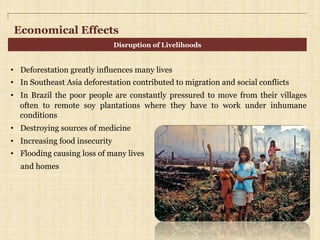
•  Deforestation greatly influences many lives
•  In Southeast Asia deforestation contributed to migration and social conflicts
•  In Brazil the poor people are constantly pressured to move from their villages
often to remote soy plantations where they have to work under inhumane
conditions
•  Destroying sources of medicine
•  Increasing food insecurity
•  Flooding causing loss of many lives
and homes
Disruption of Livelihoods
Solutions
5
Solutions
1. Corporations
2. Governments
•  If corporations have the ability to destroy the world’s rainforests,
they also have the power to help save them
•  Governments are able to enact ambitious domestic and
international forest policies that have wide-ranging effects
3. Individuals
•  As individuals, we contribute significantly to deforestation with our
lifestyle, hence we have the responsibility to keep ourselves in
check
1. Corporations
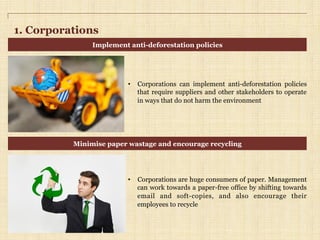
•  Corporations can implement anti-deforestation policies
that require suppliers and other stakeholders to operate
in ways that do not harm the environment
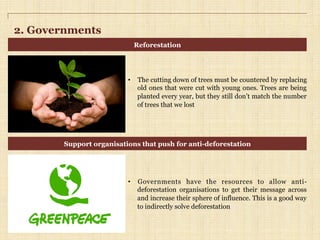
•  Corporations are huge consumers of paper. Management
can work towards a paper-free office by shifting towards
email and soft-copies, and also encourage their
employees to recycle
Implement anti-deforestation policies
Minimise paper wastage and encourage recycling
2. Governments
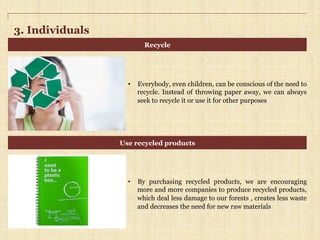
•  The cutting down of trees must be countered by replacing
old ones that were cut with young ones. Trees are being
planted every year, but they still don’t match the number
of trees that we lost
•  Governments have the resources to allow anti-
deforestation organisations to get their message across
and increase their sphere of influence. This is a good way
to indirectly solve deforestation
Reforestation
Support organisations that push for anti-deforestation
3. Individuals
“You may never know what
results come from your
action. But if you do nothing,
there will be no result.”
– Mahatma Gandhi
3. Individuals
•  Everybody, even children, can be conscious of the need to
recycle. Instead of throwing paper away, we can always
seek to recycle it or use it for other purposes
•  By purchasing recycled products, we are encouraging
more and more companies to produce recycled products,
which deal less damage to our forests , creates less waste
and decreases the need for new raw materials
Recycle
Use recycled products
3. Individuals
•  For ecological deforestation to end, paper consumption
must be drastically reduced. Opting for paperless bills,
checks and payments significantly contributes towards
mending the harmful effects of deforestation
•  Cattle grazing is one of the primary causes of
deforestation. Limit your consumption of fast food meat
and always choose to buy locally. Knowing where your
food comes from helps to combat deforestation
Go paperless
Be conscious of your food choices
3. Individuals
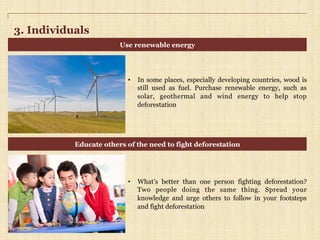
•  In some places, especially developing countries, wood is
still used as fuel. Purchase renewable energy, such as
solar, geothermal and wind energy to help stop
deforestation
•  What’s better than one person fighting deforestation?
Two people doing the same thing. Spread your
knowledge and urge others to follow in your footsteps
and fight deforestation
Use renewable energy
Educate others of the need to fight deforestation
Conclusion
6
Conclusion
THE END

Deforestation: Causes, Effects and Solutions

  • 1.
  • 2.
    Content 1.  Introduction: Deforestation 2. Current Situation of our Rainforests 3.  Causes of Deforestation 4.  Short & Long Term Effects of Deforestation 5.  Short & Long Term Solutions 6.  Conclusion
  • 3.
  • 4.
    Introduction: Deforestation •  Forestscover 31% of the land area on our planet •  They produce vital oxygen and provide homes for people and wildlife •  Many of the world’s most threatened and endangered animals live in these forests •  1.6 billion people rely on benefits forests offer, including food, fresh water, clothing, traditional medicine and shelter
  • 5.
    Current Situation ofour Rainforests 2
  • 6.
    Country Deforested Area (Hectares) Brazil3,466,000 Indonesia 1,447,800 Russia 532,200 Mexico 395,000 Papua New Guinea 250,200 Country Deforested Area (Hectares) Peru 224,600 USA 215,200 Bolivia 135,200 Sudan 117,807 Nigeria 82,000 Top 10 Countries with Highest Deforestation
  • 7.
    Current Situation inBrazil h"p://www.youtube.com/watch?v=rNx51WqBBgM  
  • 8.
    Case Study: AmazonRainforest Events Year Description 1960s Colonists began establishing farms within the forest via slash-and-burn method 1970s Construction began on the Trans-Amazonian Highway, paving roads and making it easier to transport timbre 1990 – 2000s Total Area forest lost in the Amazon rose by 160,000 sq km to 587,000 sq km, of which 70% used for livestock pasture 2005 Use of satellite data has helped the government slash deforestation by 80% by allowing police to pinpoint illegal activity in the forest 2013 Satellite data reported a 28% increase in deforestation to 5,843 sq km compared to the previous year
  • 9.
    Case Study: AmazonRainforest (Past 15 Years) •  While present figures are much better than before, deforestation continues to threaten the world’s ecosystem •  The razing of forests continues to be a major contributor to the emissions that drive climate change 17.3 18.2 18.4 23.3 24.9 27.4 18.9 14.3 11.7 12.9 7.5 7.0 6.4 4.7 5.8 1999 2000 2001 2002 2003 2004 2005 2006 2007 2008 2009 2010 2011 2012 2013 ‘000 Sq km of deforestation (per annum) Source: Institute of Space Research (INPE)
  • 10.
  • 11.
    Causes of Deforestation 1.Clearing land to build housing 2. Felling trees for wood 4. Other land uses •  Countries resort to deforestation to cope with the increasing demand for housing brought about by the growing population •  Logging, or simply cutting down trees for timbre is one of the main causes of deforestation 3. Agriculture •  To provide land for food crops such as palm oil and for rearing cattle, undisturbed rainforest areas end up being removed •  Land for mining and industrial projects •  Building dams
  • 12.
    1. Growing Demandfor Housing World Population 3.0 billion 1960 6.0 billion 2000 9.6 billion 2050 •  The current world population of 7.2 billion is projected to reach 9.6 billion by 2050, according to a UN report •  To cater to the increasing housing needs, many resort to removing rainforests to create land
  • 13.
    2. Logging •  Manycommercial logging companies fell down trees in a process known as selective logging, where only the most valuable trees are felled •  Over the years, the uses of wood moved from wood fuel to construction materials such as shelters and furniture •  Today, almost every household has something made out of wood, eg. floor tiles, cutleries and musical instruments Wood felling by commercial logging companies Growing demand for products made from wood
  • 14.
    3. Agriculture –Crop Planting & Cattle Ranching Clearing of Land for Palm Oil and other Crop Plantations Clearing of Land to Rear Cattle Subsistence Farming Breeding Cows for MilkCattle Ranching
  • 15.
    4. Other LandUses Mining and Industrial Projects Building Dams •  In India and South America, rainforests have been destroyed by the building of hydro- electric dams •  It was the dominant view that new dams had to be built or otherwise these countries would suffer an energy crisis Mining Projects Industrial Projects
  • 16.
  • 17.
    Environmental & EconomicalImpacts IMPACTS Increased Soil Erosion Disruption of Water Cycles Reduced Biodiversity Climate Change Disruption of Livelihoods
  • 18.
    Short Term EnvironmentalEffects •  No trees anchoring the fertile soil •  Erosion is sweeping the land into rivers •  The agricultural plants replacing the forests are unable to hold onto the soil •  Since 1960 a third of world’s arable land has been lost •  As fertile soil washes away producers move on, clearing more forests •  Trees play a key role in the local water cycle •  Keep balance between the water on the land and the water in the atmosphere •  Disrupted balance changes the precipitation and river flow Increased Soil Erosion Disruption of Water Cycles
  • 19.
    Long Term EnvironmentalEffects •  80 % species can be found in tropical rainforests •  Often unable to survive in the small fragments of forested lend left behind •  Accessible to hunters and poachers •  Leading to extinction •  Forests help to mitigate carbon dioxide and other greenhouse gas emissions •  When cut, burned or otherwise removed they become carbon source •  Tropical forests hold more than 210 gig tons of carbon •  Deforestation represents 15% of greenhouse gas emissions •  Rising temperatures, changed patterns of weather and increase of extreme weather events Reduced Biodiversity Climate Change
  • 20.
    Economical Effects •  Deforestationgreatly influences many lives •  In Southeast Asia deforestation contributed to migration and social conflicts •  In Brazil the poor people are constantly pressured to move from their villages often to remote soy plantations where they have to work under inhumane conditions •  Destroying sources of medicine •  Increasing food insecurity •  Flooding causing loss of many lives and homes Disruption of Livelihoods
  • 22.
  • 23.
    Solutions 1. Corporations 2. Governments • If corporations have the ability to destroy the world’s rainforests, they also have the power to help save them •  Governments are able to enact ambitious domestic and international forest policies that have wide-ranging effects 3. Individuals •  As individuals, we contribute significantly to deforestation with our lifestyle, hence we have the responsibility to keep ourselves in check
  • 24.
    1. Corporations •  Corporationscan implement anti-deforestation policies that require suppliers and other stakeholders to operate in ways that do not harm the environment •  Corporations are huge consumers of paper. Management can work towards a paper-free office by shifting towards email and soft-copies, and also encourage their employees to recycle Implement anti-deforestation policies Minimise paper wastage and encourage recycling
  • 25.
    2. Governments •  Thecutting down of trees must be countered by replacing old ones that were cut with young ones. Trees are being planted every year, but they still don’t match the number of trees that we lost •  Governments have the resources to allow anti- deforestation organisations to get their message across and increase their sphere of influence. This is a good way to indirectly solve deforestation Reforestation Support organisations that push for anti-deforestation
  • 26.
    3. Individuals “You maynever know what results come from your action. But if you do nothing, there will be no result.” – Mahatma Gandhi
  • 27.
    3. Individuals •  Everybody,even children, can be conscious of the need to recycle. Instead of throwing paper away, we can always seek to recycle it or use it for other purposes •  By purchasing recycled products, we are encouraging more and more companies to produce recycled products, which deal less damage to our forests , creates less waste and decreases the need for new raw materials Recycle Use recycled products
  • 28.
    3. Individuals •  Forecological deforestation to end, paper consumption must be drastically reduced. Opting for paperless bills, checks and payments significantly contributes towards mending the harmful effects of deforestation •  Cattle grazing is one of the primary causes of deforestation. Limit your consumption of fast food meat and always choose to buy locally. Knowing where your food comes from helps to combat deforestation Go paperless Be conscious of your food choices
  • 29.
    3. Individuals •  Insome places, especially developing countries, wood is still used as fuel. Purchase renewable energy, such as solar, geothermal and wind energy to help stop deforestation •  What’s better than one person fighting deforestation? Two people doing the same thing. Spread your knowledge and urge others to follow in your footsteps and fight deforestation Use renewable energy Educate others of the need to fight deforestation
  • 30.
  • 31.
  • 32.