Oil and Gas Traps 
All oil and gas deposits are found in structural or stratigraphic 
traps. You may have heard that oil is found underground in 
“pools,” “lakes,” or “rivers.” Maybe someone told you there 
was a “sea” or “ocean” of oil underground. This is all 
completely wrong, so don’t believe everything you hear. 
Beneath the earth's surface, oil will ooze through rocks if there 
is enough space between them, but this oil will not accumulate 
into large quantities unless something traps it in a particular 
place. There are a variety of geologic traps, which themselves 
can be broken into categories: 
 Structural trap types: anticline, fault, salt 
 Stratigraphic trap types: unconformity, lens, pinch-out 
It is important to remember that oil is not all by itself in some 
sort of underground cave, but is, instead, contained within solid 
rock - which has enough room within it to actually soak up (or 
become soaked in, however you look at it) oil. 
Structural Traps 
These traps hold oil and gas because the earth has been bent and 
deformed in some way. The trap may be a simple dome (or big 
bump), just a “crease” in the rocks, or it may be a more complex 
fault trap like the one shown below. All pore spaces in the rocks 
are filled with fluid, either water, gas, or oil. Gas, being the 
lightest, moves to the top. Oil locates right beneath the gas, and 
water stays lower. 
Once the oil and gas reach an impenetrable layer, a layer that is 
very dense or non-permeable, the movement stops. The 
impenetrable layer is called a “cap rock.”
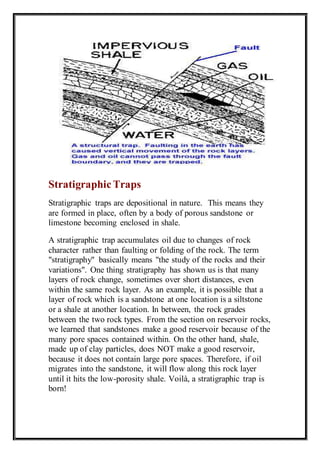
Stratigraphic Traps 
Stratigraphic traps are depositional in nature. This means they 
are formed in place, often by a body of porous sandstone or 
limestone becoming enclosed in shale. 
A stratigraphic trap accumulates oil due to changes of rock 
character rather than faulting or folding of the rock. The term 
"stratigraphy" basically means "the study of the rocks and their 
variations". One thing stratigraphy has shown us is that many 
layers of rock change, sometimes over short distances, even 
within the same rock layer. As an example, it is possible that a 
layer of rock which is a sandstone at one location is a siltstone 
or a shale at another location. In between, the rock grades 
between the two rock types. From the section on reservoir rocks, 
we learned that sandstones make a good reservoir because of the 
many pore spaces contained within. On the other hand, shale, 
made up of clay particles, does NOT make a good reservoir, 
because it does not contain large pore spaces. Therefore, if oil 
migrates into the sandstone, it will flow along this rock layer 
until it hits the low-porosity shale. Voilà, a stratigraphic trap is 
born!
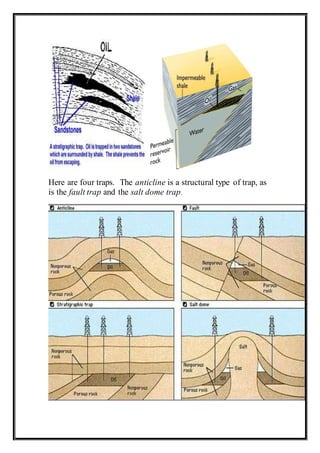
Here are four traps. The anticline is a structural type of trap, as 
is the fault trap and the salt dome trap.
The stratigraphic trap shown at the lower left is a cool one. It 
was formed when rock layers at the bottom were tilted, then 
eroded flat. Then more layers were formed horizontally on top 
of the tilted ones. The oil moved up through the tilted porous 
rock and was trapped underneath the horizontal, nonporous 
(cap) rocks. 
Another Stratigraphic Trap 
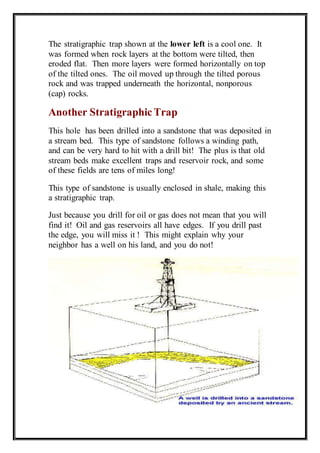
This hole has been drilled into a sandstone that was deposited in 
a stream bed. This type of sandstone follows a winding path, 
and can be very hard to hit with a drill bit! The plus is that old 
stream beds make excellent traps and reservoir rock, and some 
of these fields are tens of miles long! 
This type of sandstone is usually enclosed in shale, making this 
a stratigraphic trap. 
Just because you drill for oil or gas does not mean that you will 
find it! Oil and gas reservoirs all have edges. If you drill past 
the edge, you will miss it ! This might explain why your 
neighbor has a well on his land, and you do not!
Stratigraphic Problems When Drilling 
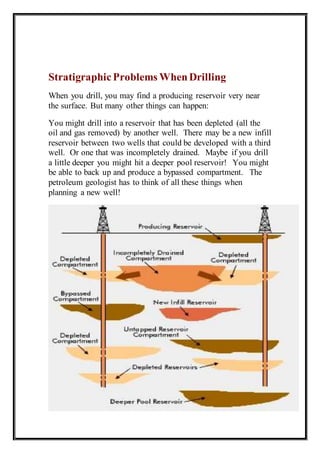
When you drill, you may find a producing reservoir very near 
the surface. But many other things can happen: 
You might drill into a reservoir that has been depleted (all the 
oil and gas removed) by another well. There may be a new infill 
reservoir between two wells that could be developed with a third 
well. Or one that was incompletely drained. Maybe if you drill 
a little deeper you might hit a deeper pool reservoir! You might 
be able to back up and produce a bypassed compartment. The 
petroleum geologist has to think of all these things when 
planning a new well!
Structural Problems When Drilling 
Finally, structures in the earth can give the PG many challenges. 
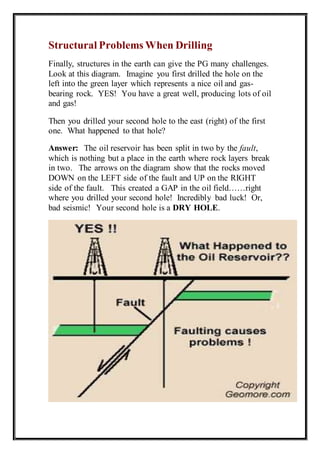
Look at this diagram. Imagine you first drilled the hole on the 
left into the green layer which represents a nice oil and gas-bearing 
rock. YES! You have a great well, producing lots of oil 
and gas! 
Then you drilled your second hole to the east (right) of the first 
one. What happened to that hole? 
Answer: The oil reservoir has been split in two by the fault, 
which is nothing but a place in the earth where rock layers break 
in two. The arrows on the diagram show that the rocks moved 
DOWN on the LEFT side of the fault and UP on the RIGHT 
side of the fault. This created a GAP in the oil field……right 
where you drilled your second hole! Incredibly bad luck! Or, 
bad seismic! Your second hole is a DRY HOLE.

Oil and gas traps

  • 1.
    Oil and GasTraps All oil and gas deposits are found in structural or stratigraphic traps. You may have heard that oil is found underground in “pools,” “lakes,” or “rivers.” Maybe someone told you there was a “sea” or “ocean” of oil underground. This is all completely wrong, so don’t believe everything you hear. Beneath the earth's surface, oil will ooze through rocks if there is enough space between them, but this oil will not accumulate into large quantities unless something traps it in a particular place. There are a variety of geologic traps, which themselves can be broken into categories:  Structural trap types: anticline, fault, salt  Stratigraphic trap types: unconformity, lens, pinch-out It is important to remember that oil is not all by itself in some sort of underground cave, but is, instead, contained within solid rock - which has enough room within it to actually soak up (or become soaked in, however you look at it) oil. Structural Traps These traps hold oil and gas because the earth has been bent and deformed in some way. The trap may be a simple dome (or big bump), just a “crease” in the rocks, or it may be a more complex fault trap like the one shown below. All pore spaces in the rocks are filled with fluid, either water, gas, or oil. Gas, being the lightest, moves to the top. Oil locates right beneath the gas, and water stays lower. Once the oil and gas reach an impenetrable layer, a layer that is very dense or non-permeable, the movement stops. The impenetrable layer is called a “cap rock.”
  • 2.
    Stratigraphic Traps Stratigraphictraps are depositional in nature. This means they are formed in place, often by a body of porous sandstone or limestone becoming enclosed in shale. A stratigraphic trap accumulates oil due to changes of rock character rather than faulting or folding of the rock. The term "stratigraphy" basically means "the study of the rocks and their variations". One thing stratigraphy has shown us is that many layers of rock change, sometimes over short distances, even within the same rock layer. As an example, it is possible that a layer of rock which is a sandstone at one location is a siltstone or a shale at another location. In between, the rock grades between the two rock types. From the section on reservoir rocks, we learned that sandstones make a good reservoir because of the many pore spaces contained within. On the other hand, shale, made up of clay particles, does NOT make a good reservoir, because it does not contain large pore spaces. Therefore, if oil migrates into the sandstone, it will flow along this rock layer until it hits the low-porosity shale. Voilà, a stratigraphic trap is born!
  • 3.
    Here are fourtraps. The anticline is a structural type of trap, as is the fault trap and the salt dome trap.
  • 4.
    The stratigraphic trapshown at the lower left is a cool one. It was formed when rock layers at the bottom were tilted, then eroded flat. Then more layers were formed horizontally on top of the tilted ones. The oil moved up through the tilted porous rock and was trapped underneath the horizontal, nonporous (cap) rocks. Another Stratigraphic Trap This hole has been drilled into a sandstone that was deposited in a stream bed. This type of sandstone follows a winding path, and can be very hard to hit with a drill bit! The plus is that old stream beds make excellent traps and reservoir rock, and some of these fields are tens of miles long! This type of sandstone is usually enclosed in shale, making this a stratigraphic trap. Just because you drill for oil or gas does not mean that you will find it! Oil and gas reservoirs all have edges. If you drill past the edge, you will miss it ! This might explain why your neighbor has a well on his land, and you do not!
  • 5.
    Stratigraphic Problems WhenDrilling When you drill, you may find a producing reservoir very near the surface. But many other things can happen: You might drill into a reservoir that has been depleted (all the oil and gas removed) by another well. There may be a new infill reservoir between two wells that could be developed with a third well. Or one that was incompletely drained. Maybe if you drill a little deeper you might hit a deeper pool reservoir! You might be able to back up and produce a bypassed compartment. The petroleum geologist has to think of all these things when planning a new well!
  • 6.
    Structural Problems WhenDrilling Finally, structures in the earth can give the PG many challenges. Look at this diagram. Imagine you first drilled the hole on the left into the green layer which represents a nice oil and gas-bearing rock. YES! You have a great well, producing lots of oil and gas! Then you drilled your second hole to the east (right) of the first one. What happened to that hole? Answer: The oil reservoir has been split in two by the fault, which is nothing but a place in the earth where rock layers break in two. The arrows on the diagram show that the rocks moved DOWN on the LEFT side of the fault and UP on the RIGHT side of the fault. This created a GAP in the oil field……right where you drilled your second hole! Incredibly bad luck! Or, bad seismic! Your second hole is a DRY HOLE.