Hydrocarbon Generation and 
Migration
What is oil and gas? Where does it 
come from?
Origin: Plankton 
cache.eb.com/eb/image?id=93510 
Plant plankton Animal plankton 
en.wikipedia.org/wiki/Image:Ceratium_hirundinella.jpg en.wikipedia.org/wiki/Image:Copepod. 
10,000 of these bugs 
would fit on a pinhead! 
• Most oil and gas starts life as microscopic plants and animals 
that live in the ocean.
Introduction 
 However, under certain conditions there may be very 
little oxygen on the sea floor. 
 This may be because the ocean is deep and stagnant and 
oxygen has not been mixed down from the surface 
waters. 
 No animal life can survive where the sea bed is 
completely lacking oxygen. Without animals to eat the 
dead plankton, the organic mush builds up on the sea 
bed.
On the sea bed 
 When plankton dies it slowly settles to the sea bed where it forms 
an organic mush. Usually there are lots of animals living on the 
sea floor that feed on this material. One important group is the 
polychaete worms. These are detritivores, which means they eat 
the dead and decay remains of other organisms 
upload.wikimedia.org/wikipedia/en/0/04/Plankton.jpg When the plankton dies it rains 
down on sea bed to form an 
organic mush 
Sea bed 
en.wikipedia.org/wiki/Image:Nerr0328.jpg 
If there are any animals on the 
sea bed these will feed on the 
organic particles
Origin: Black Shale 
upload.wikimedia.org/wikipedia/en/0/04/Plankton.jpg 
• However, if there is little or no 
oxygen in the water then animals 
can’t survive and the organic 
mush accumulates 
• Where sediment contains 
organic matter, 
it eventually forms a rock 
known as a Black Shale 
© Earth Science World Image Bank
Interpretation of Total Organic Carbon (TOC) 
(based on early oil window maturity) 
Hydrocarbon 
Generation 
Potential 
TOC in Shale 
(wt. %) 
TOC in Carbonates 
(wt. %) 
Poor 
Fair 
Good 
Very Good 
Excellent 
0.0-0.5 
0.5-1.0 
1.0-2.0 
2.0-5.0 
>5.0 
0.0-0.2 
0.2-0.5 
0.5-1.0 
1.0-2.0 
>2.0
Organic Matter in Sedimentary Rocks 
Vitrinite 
Reflected-Light Micrograph 
of Coal 
Kerogen 
Disseminated Organic Matter in 
Sedimentary Rocks That is Insoluble 
in Oxidizing Acids, Bases, and 
Organic Solvents. 
Vitrinite 
A nonfluorescent type of organic material 
in petroleum source rocks derived 
primarily from woody material. 
The reflectivity of vitrinite is one of the 
best indicators of coal rank and thermal 
maturity of petroleum source rock.
Origin: Cooking 
www.oilandgasgeology.com/oil_gas_window.jpg 
As source rock is buried, it is heated. 
Kerogen 
Gas 
Oil 
Organic matter is first changed by the 
increase in temperature into kerogen, 
which is a solid form of hydrocarbon 
Around 90°C, it is changed into a liquid 
state, which we call oil 
Around 150°C, it is changed into a gas 
A rock that has produced oil and gas in 
this way is known as a Source Rock
Schematic Representation of the Mechanism 
of Petroleum Generation and Destruction 
(modified from Tissot and Welte, 1984) 
Organic Debris 
Kerogen 
Carbon 
Initial Bitumen 
Oil and Gas 
Methane 
Oil Reservoir 
Migration 
Thermal Degradation 
Cracking 
Diagenesis 
Catagenesis 
Metagenesis 
Progressive Burial and Heating
Type of hydrocarbon 
Sweet 
• The term "sweet" originates from the fact that a low level 
of sulfur provides the oil with a mildly sweet taste and 
pleasant smell. 
• High-quality, low-sulfur crude oil is commonly used for 
processing into gasoline and is in high demand, particularly 
in the industrialized nations. 
• "Light sweet crude oil" is the most sought-after version of 
crude oil as it contains a disproportionately large fraction 
that is directly processed (fractionation) into gasoline 
(naphtha), kerosene, and high-quality diesel (gas oil).
Producers of sweet crude oil include: 
The Far East/Oceania: 
Australia 
Asia/Pacific: 
Brunei 
China 
India 
Indonesia 
Malaysia 
New Zealand 
Vietnam 
The Middle East Kurdistan 
North America: United States (Pennsylvania)
Sour 
Petroleum containing higher levels of sulfur is called sour 
crude oil. 
Sour crude oil is crude oil containing a high amount of the 
impurity sulfur (level in the oil is more than 0.5% ). 
The impurities need to be removed before this lower quality 
crude can be refined into petrol, thereby increasing the cost of 
processing - higher-priced gasoline than that made from 
sweet crude oil. 
Usually processed into heavy crude oil such as diesel and fuel 
oil rather than gasoline to reduce processing cost.
The majority of the sulfur in crude oil occurs bonded to carbon 
atoms, with a small amount occurring as elemental sulfur in 
solution and as hydrogen sulfide (H2S) gas. 
Sour oil can be toxic and corrosive, especially when the oil 
contains higher levels of hydrogen sulfide, a t low 
concentrations has the smell of rotten eggs. 
Sour crude oil needs to be stabilized by having hydrogen 
sulfide gas (H2S) removed from it before being transported by 
oil tankers for safety reasons
• Since sour crude is more common than sweet crude in the 
U.S. part of the Gulf of Mexico, Platts has come out in March 
2009 with a new sour crude benchmark (oil marker) called 
"Americas Crude Marker (ACM)". 
• Dubai Crude (and Oman Crude) both sour crude oils have 
been used as a benchmark (crude oil) oil marker for Middle 
East crude oils for some time. 
• The major producers of sour crude oil include: 
North America: Alberta (Canada), United States' portion of the 
Gulf of Mexico, and Mexico. 
South America: Venezuela, Colombia, and Ecuador. 
Middle East: Saudi Arabia, Iraq, Kuwait, Iran, Syria, and Egypt.
Generation, Migration, and Trapping 
Migration route 
Reservoir 
rock 
Seal 
Oil/water 
contact (OWC) 
Hydrocarbon 
accumulation 
in the 
reservoir rock 
Top of maturity 
Source rock 
Fault 
(impermeable) 
of Hydrocarbons
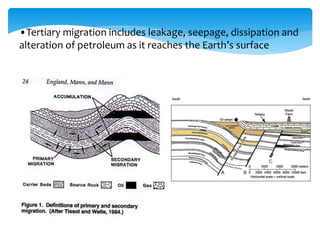
• Secondary migration is any movement in carrier rocks or 
reservoir rocks outside the source rock or movement 
through fractures within the source rock.
•Tertiary migration includes leakage, seepage, dissipation and 
alteration of petroleum as it reaches the Earth’s surface
Hydrocarbon Generation & Migration

Hydrocarbon Generation & Migration

  • 1.
  • 2.
    What is oiland gas? Where does it come from?
  • 3.
    Origin: Plankton cache.eb.com/eb/image?id=93510 Plant plankton Animal plankton en.wikipedia.org/wiki/Image:Ceratium_hirundinella.jpg en.wikipedia.org/wiki/Image:Copepod. 10,000 of these bugs would fit on a pinhead! • Most oil and gas starts life as microscopic plants and animals that live in the ocean.
  • 4.
    Introduction  However,under certain conditions there may be very little oxygen on the sea floor.  This may be because the ocean is deep and stagnant and oxygen has not been mixed down from the surface waters.  No animal life can survive where the sea bed is completely lacking oxygen. Without animals to eat the dead plankton, the organic mush builds up on the sea bed.
  • 7.
    On the seabed  When plankton dies it slowly settles to the sea bed where it forms an organic mush. Usually there are lots of animals living on the sea floor that feed on this material. One important group is the polychaete worms. These are detritivores, which means they eat the dead and decay remains of other organisms upload.wikimedia.org/wikipedia/en/0/04/Plankton.jpg When the plankton dies it rains down on sea bed to form an organic mush Sea bed en.wikipedia.org/wiki/Image:Nerr0328.jpg If there are any animals on the sea bed these will feed on the organic particles
  • 8.
    Origin: Black Shale upload.wikimedia.org/wikipedia/en/0/04/Plankton.jpg • However, if there is little or no oxygen in the water then animals can’t survive and the organic mush accumulates • Where sediment contains organic matter, it eventually forms a rock known as a Black Shale © Earth Science World Image Bank
  • 11.
    Interpretation of TotalOrganic Carbon (TOC) (based on early oil window maturity) Hydrocarbon Generation Potential TOC in Shale (wt. %) TOC in Carbonates (wt. %) Poor Fair Good Very Good Excellent 0.0-0.5 0.5-1.0 1.0-2.0 2.0-5.0 >5.0 0.0-0.2 0.2-0.5 0.5-1.0 1.0-2.0 >2.0
  • 12.
    Organic Matter inSedimentary Rocks Vitrinite Reflected-Light Micrograph of Coal Kerogen Disseminated Organic Matter in Sedimentary Rocks That is Insoluble in Oxidizing Acids, Bases, and Organic Solvents. Vitrinite A nonfluorescent type of organic material in petroleum source rocks derived primarily from woody material. The reflectivity of vitrinite is one of the best indicators of coal rank and thermal maturity of petroleum source rock.
  • 17.
    Origin: Cooking www.oilandgasgeology.com/oil_gas_window.jpg As source rock is buried, it is heated. Kerogen Gas Oil Organic matter is first changed by the increase in temperature into kerogen, which is a solid form of hydrocarbon Around 90°C, it is changed into a liquid state, which we call oil Around 150°C, it is changed into a gas A rock that has produced oil and gas in this way is known as a Source Rock
  • 18.
    Schematic Representation ofthe Mechanism of Petroleum Generation and Destruction (modified from Tissot and Welte, 1984) Organic Debris Kerogen Carbon Initial Bitumen Oil and Gas Methane Oil Reservoir Migration Thermal Degradation Cracking Diagenesis Catagenesis Metagenesis Progressive Burial and Heating
  • 19.
    Type of hydrocarbon Sweet • The term "sweet" originates from the fact that a low level of sulfur provides the oil with a mildly sweet taste and pleasant smell. • High-quality, low-sulfur crude oil is commonly used for processing into gasoline and is in high demand, particularly in the industrialized nations. • "Light sweet crude oil" is the most sought-after version of crude oil as it contains a disproportionately large fraction that is directly processed (fractionation) into gasoline (naphtha), kerosene, and high-quality diesel (gas oil).
  • 20.
    Producers of sweetcrude oil include: The Far East/Oceania: Australia Asia/Pacific: Brunei China India Indonesia Malaysia New Zealand Vietnam The Middle East Kurdistan North America: United States (Pennsylvania)
  • 21.
    Sour Petroleum containinghigher levels of sulfur is called sour crude oil. Sour crude oil is crude oil containing a high amount of the impurity sulfur (level in the oil is more than 0.5% ). The impurities need to be removed before this lower quality crude can be refined into petrol, thereby increasing the cost of processing - higher-priced gasoline than that made from sweet crude oil. Usually processed into heavy crude oil such as diesel and fuel oil rather than gasoline to reduce processing cost.
  • 22.
    The majority ofthe sulfur in crude oil occurs bonded to carbon atoms, with a small amount occurring as elemental sulfur in solution and as hydrogen sulfide (H2S) gas. Sour oil can be toxic and corrosive, especially when the oil contains higher levels of hydrogen sulfide, a t low concentrations has the smell of rotten eggs. Sour crude oil needs to be stabilized by having hydrogen sulfide gas (H2S) removed from it before being transported by oil tankers for safety reasons
  • 23.
    • Since sourcrude is more common than sweet crude in the U.S. part of the Gulf of Mexico, Platts has come out in March 2009 with a new sour crude benchmark (oil marker) called "Americas Crude Marker (ACM)". • Dubai Crude (and Oman Crude) both sour crude oils have been used as a benchmark (crude oil) oil marker for Middle East crude oils for some time. • The major producers of sour crude oil include: North America: Alberta (Canada), United States' portion of the Gulf of Mexico, and Mexico. South America: Venezuela, Colombia, and Ecuador. Middle East: Saudi Arabia, Iraq, Kuwait, Iran, Syria, and Egypt.
  • 25.
    Generation, Migration, andTrapping Migration route Reservoir rock Seal Oil/water contact (OWC) Hydrocarbon accumulation in the reservoir rock Top of maturity Source rock Fault (impermeable) of Hydrocarbons
  • 29.
    • Secondary migrationis any movement in carrier rocks or reservoir rocks outside the source rock or movement through fractures within the source rock.
  • 30.
    •Tertiary migration includesleakage, seepage, dissipation and alteration of petroleum as it reaches the Earth’s surface