1
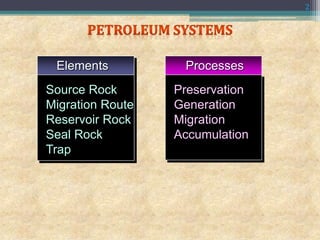
Source Rock
Migration Route
Reservoir Rock
Seal Rock
Trap
Elements
Preservation
Generation
Migration
Accumulation
Processes
2
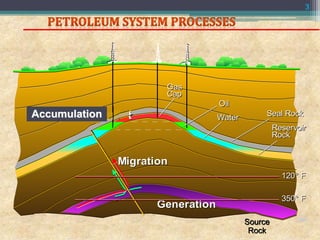
24803
Petroleum System ElementsPetroleum System Elements
120° F120° F
350° F350° F
GenerationGeneration
MigrationMigration
Seal RockSeal Rock
Reservoir
Rock
Reservoir
Rock
OilOil
WaterWater
Gas
Cap
Gas
Cap
EntrapmentEntrapmentAccumulation
Source
Rock
3
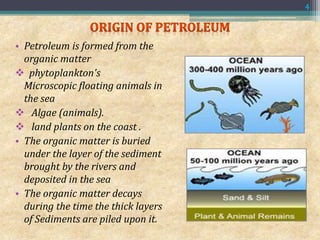
• Petroleum is formed from the
organic matter
 phytoplankton's
Microscopic floating animals in
the sea
 Algae (animals).
 land plants on the coast .
• The organic matter is buried
under the layer of the sediment
brought by the rivers and
deposited in the sea
• The organic matter decays
during the time the thick layers
of Sediments are piled upon it.
4
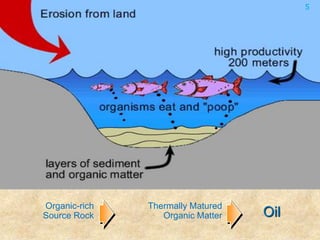
Organic-rich
Source Rock
Thermally Matured
Organic Matter Oil
5
• Sedimentary basin are large subsiding depressions filled
with thick sequence of sedimentary rocks. These depressions
result from the compression or extension of tectonic plates of
the earth.
• There are around 600 sedimentary basins in the world, only
40% are producing.
• Petroleum is found in the sedimentary basins.
• The floor of the basin is made up igneous and metamorphic
rocks and is often called “basement complex”
• Two sedimentary basins in Pakistan
• Indus basin
• Baluchistan basin
6
• Sedimentary rocks are composed of sediments. That is,
particles such as grains that are formed by the breakdown of
the preexisting rocks. Or sea shell fragment Or salts
precipitated from ocean water.
• The most common organic sedimentary rock is black shale..
• Sedimentary rocks are of two type
1. Those which have formed by deposition of granular
material brought from land to depositional basin called
Clastic Rocks.
2. Those which form because of precipitation of salts from
oversaturated saline sea water called Non- Clastic or
chemical rocks.
7
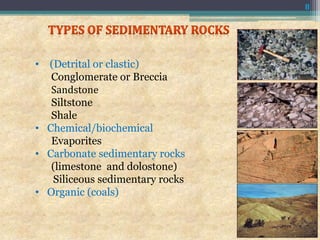
• (Detrital or clastic)
Conglomerate or Breccia
Sandstone
Siltstone
Shale
• Chemical/biochemical
Evaporites
• Carbonate sedimentary rocks
(limestone and dolostone)
Siliceous sedimentary rocks
• Organic (coals)
8
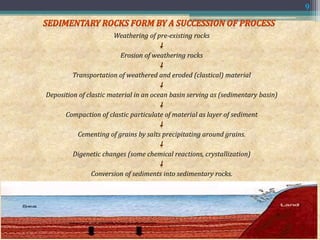
Weathering of pre-existing rocks
Erosion of weathering rocks
Transportation of weathered and eroded (clastical) material
Deposition of clastic material in an ocean basin serving as (sedimentary basin)
Compaction of clastic particulate of material as layer of sediment
Cementing of grains by salts precipitating around grains.
Digenetic changes (some chemical reactions, crystallization)
Conversion of sediments into sedimentary rocks.
9
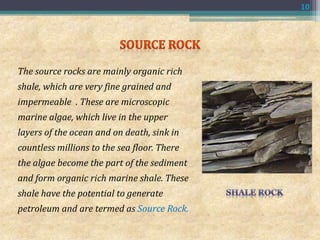
The source rocks are mainly organic rich
shale, which are very fine grained and
impermeable . These are microscopic
marine algae, which live in the upper
layers of the ocean and on death, sink in
countless millions to the sea floor. There
the algae become the part of the sediment
and form organic rich marine shale. These
shale have the potential to generate
petroleum and are termed as Source Rock.
10
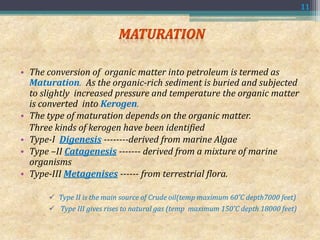
• The conversion of organic matter into petroleum is termed as
Maturation. As the organic-rich sediment is buried and subjected
to slightly increased pressure and temperature the organic matter
is converted into Kerogen.
• The type of maturation depends on the organic matter.
Three kinds of kerogen have been identified
• Type-I Digenesis --------derived from marine Algae
• Type –II Catagenesis ------- derived from a mixture of marine
organisms
• Type-III Metagenises ------ from terrestrial flora.
 Type II is the main source of Crude oil(temp maximum 60˚C depth7000 feet)
 Type III gives rises to natural gas (temp maximum 150˚C depth 18000 feet)
11
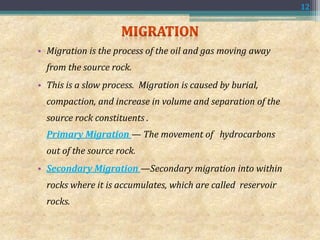
• Migration is the process of the oil and gas moving away
from the source rock.
• This is a slow process. Migration is caused by burial,
compaction, and increase in volume and separation of the
source rock constituents .
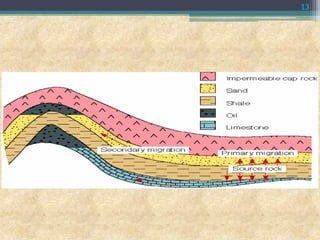
Primary Migration — The movement of hydrocarbons
out of the source rock.
• Secondary Migration —Secondary migration into within
rocks where it is accumulates, which are called reservoir
rocks.
12
13
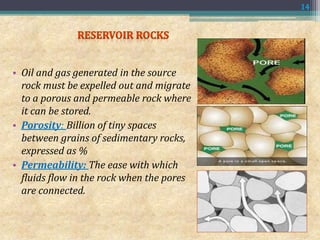
• Oil and gas generated in the source
rock must be expelled out and migrate
to a porous and permeable rock where
it can be stored.
• Porosity: Billion of tiny spaces
between grains of sedimentary rocks,
expressed as %
• Permeability: The ease with which
fluids flow in the rock when the pores
are connected.
14
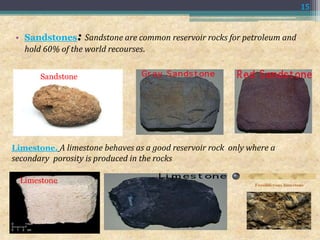
• Sandstones: Sandstone are common reservoir rocks for petroleum and
hold 60% of the world recourses.
Limestone. A limestone behaves as a good reservoir rock only where a
secondary porosity is produced in the rocks
Sandstone
Limestone
15
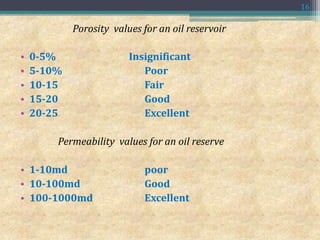
Porosity values for an oil reservoir
• 0-5% Insignificant
• 5-10% Poor
• 10-15 Fair
• 15-20 Good
• 20-25 Excellent
Permeability values for an oil reserve
• 1-10md poor
• 10-100md Good
• 100-1000md Excellent
16
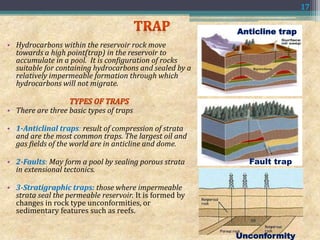
• Hydrocarbons within the reservoir rock move
towards a high point(trap) in the reservoir to
accumulate in a pool. It is configuration of rocks
suitable for containing hydrocarbons and sealed by a
relatively impermeable formation through which
hydrocarbons will not migrate.
• There are three basic types of traps
• 1-Anticlinal traps: result of compression of strata
and are the most common traps. The largest oil and
gas fields of the world are in anticline and dome.
• 2-Faults: May form a pool by sealing porous strata
in extensional tectonics.
• 3-Stratigraphic traps: those where impermeable
strata seal the permeable reservoir. It is formed by
changes in rock type unconformities, or
sedimentary features such as reefs.
Fault trap
Anticline trap
Unconformity
17
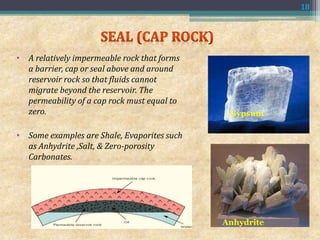
• A relatively impermeable rock that forms
a barrier, cap or seal above and around
reservoir rock so that fluids cannot
migrate beyond the reservoir. The
permeability of a cap rock must equal to
zero.
• Some examples are Shale, Evaporites such
as Anhydrite ,Salt, & Zero-porosity
Carbonates.
18
Gypsum
Anhydrite
19

PETROLEUM SYSTEM FINAL

  • 1.
  • 2.
    Source Rock Migration Route ReservoirRock Seal Rock Trap Elements Preservation Generation Migration Accumulation Processes 2
  • 3.
    24803 Petroleum System ElementsPetroleumSystem Elements 120° F120° F 350° F350° F GenerationGeneration MigrationMigration Seal RockSeal Rock Reservoir Rock Reservoir Rock OilOil WaterWater Gas Cap Gas Cap EntrapmentEntrapmentAccumulation Source Rock 3
  • 4.
    • Petroleum isformed from the organic matter  phytoplankton's Microscopic floating animals in the sea  Algae (animals).  land plants on the coast . • The organic matter is buried under the layer of the sediment brought by the rivers and deposited in the sea • The organic matter decays during the time the thick layers of Sediments are piled upon it. 4
  • 5.
  • 6.
    • Sedimentary basinare large subsiding depressions filled with thick sequence of sedimentary rocks. These depressions result from the compression or extension of tectonic plates of the earth. • There are around 600 sedimentary basins in the world, only 40% are producing. • Petroleum is found in the sedimentary basins. • The floor of the basin is made up igneous and metamorphic rocks and is often called “basement complex” • Two sedimentary basins in Pakistan • Indus basin • Baluchistan basin 6
  • 7.
    • Sedimentary rocksare composed of sediments. That is, particles such as grains that are formed by the breakdown of the preexisting rocks. Or sea shell fragment Or salts precipitated from ocean water. • The most common organic sedimentary rock is black shale.. • Sedimentary rocks are of two type 1. Those which have formed by deposition of granular material brought from land to depositional basin called Clastic Rocks. 2. Those which form because of precipitation of salts from oversaturated saline sea water called Non- Clastic or chemical rocks. 7
  • 8.
    • (Detrital orclastic) Conglomerate or Breccia Sandstone Siltstone Shale • Chemical/biochemical Evaporites • Carbonate sedimentary rocks (limestone and dolostone) Siliceous sedimentary rocks • Organic (coals) 8
  • 9.
    Weathering of pre-existingrocks Erosion of weathering rocks Transportation of weathered and eroded (clastical) material Deposition of clastic material in an ocean basin serving as (sedimentary basin) Compaction of clastic particulate of material as layer of sediment Cementing of grains by salts precipitating around grains. Digenetic changes (some chemical reactions, crystallization) Conversion of sediments into sedimentary rocks. 9
  • 10.
    The source rocksare mainly organic rich shale, which are very fine grained and impermeable . These are microscopic marine algae, which live in the upper layers of the ocean and on death, sink in countless millions to the sea floor. There the algae become the part of the sediment and form organic rich marine shale. These shale have the potential to generate petroleum and are termed as Source Rock. 10
  • 11.
    • The conversionof organic matter into petroleum is termed as Maturation. As the organic-rich sediment is buried and subjected to slightly increased pressure and temperature the organic matter is converted into Kerogen. • The type of maturation depends on the organic matter. Three kinds of kerogen have been identified • Type-I Digenesis --------derived from marine Algae • Type –II Catagenesis ------- derived from a mixture of marine organisms • Type-III Metagenises ------ from terrestrial flora.  Type II is the main source of Crude oil(temp maximum 60˚C depth7000 feet)  Type III gives rises to natural gas (temp maximum 150˚C depth 18000 feet) 11
  • 12.
    • Migration isthe process of the oil and gas moving away from the source rock. • This is a slow process. Migration is caused by burial, compaction, and increase in volume and separation of the source rock constituents . Primary Migration — The movement of hydrocarbons out of the source rock. • Secondary Migration —Secondary migration into within rocks where it is accumulates, which are called reservoir rocks. 12
  • 13.
  • 14.
    • Oil andgas generated in the source rock must be expelled out and migrate to a porous and permeable rock where it can be stored. • Porosity: Billion of tiny spaces between grains of sedimentary rocks, expressed as % • Permeability: The ease with which fluids flow in the rock when the pores are connected. 14
  • 15.
    • Sandstones: Sandstoneare common reservoir rocks for petroleum and hold 60% of the world recourses. Limestone. A limestone behaves as a good reservoir rock only where a secondary porosity is produced in the rocks Sandstone Limestone 15
  • 16.
    Porosity values foran oil reservoir • 0-5% Insignificant • 5-10% Poor • 10-15 Fair • 15-20 Good • 20-25 Excellent Permeability values for an oil reserve • 1-10md poor • 10-100md Good • 100-1000md Excellent 16
  • 17.
    • Hydrocarbons withinthe reservoir rock move towards a high point(trap) in the reservoir to accumulate in a pool. It is configuration of rocks suitable for containing hydrocarbons and sealed by a relatively impermeable formation through which hydrocarbons will not migrate. • There are three basic types of traps • 1-Anticlinal traps: result of compression of strata and are the most common traps. The largest oil and gas fields of the world are in anticline and dome. • 2-Faults: May form a pool by sealing porous strata in extensional tectonics. • 3-Stratigraphic traps: those where impermeable strata seal the permeable reservoir. It is formed by changes in rock type unconformities, or sedimentary features such as reefs. Fault trap Anticline trap Unconformity 17
  • 18.
    • A relativelyimpermeable rock that forms a barrier, cap or seal above and around reservoir rock so that fluids cannot migrate beyond the reservoir. The permeability of a cap rock must equal to zero. • Some examples are Shale, Evaporites such as Anhydrite ,Salt, & Zero-porosity Carbonates. 18 Gypsum Anhydrite
  • 19.