Understanding source rocks
Source rock attributes
3 features characterize source
rocks:
• Organic richness
• Kerogen type
• Thermal maturity
Organic richness and type of
kerogen is a function of
depositional setting; whilst
tectonic history determines
maturity
0.2 0.3 0.4 0.5 0.6 0.7 0.8 0.9 1.0 1.3 2.0 3.0
What is a source rock (SR)
• ‘A source rock is a (fine grained) rock that is
capable of generating or that has generated
movable quantities of hydrocarbons’ (Law,
1999)
• A source may be termed potential source
rock- if it hasn’t been sufficiently cooked
(immature); active source rock if it’s is
currently generating (early, mid or late
mature); spent if it is over mature or lacks
OM to continue generating
• Effective source rock which contains organic
matter and is presently generating and/or
expelling hydrocarbons to form commercial
accumulations.
• Relic effective source An effective source
rock which has ceased generating and
expelling hydrocarbons carbons due to a
thermal cooling event such as uplift or
erosion before exhausting its organic matter
supply.
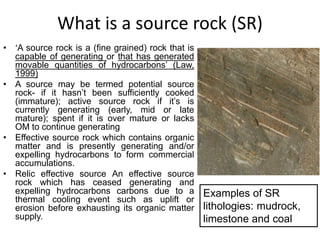
Examples of SR
lithologies: mudrock,
limestone and coal
Organic richness
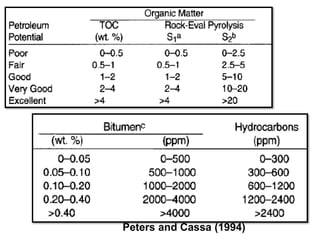
• This is the percentage or quantity of organic carbon (TOC) in a
rock, which includes both kerogen (insoluble) and bitumen
(soluble) (Peters and Cassa, 1994)
• It represents the amount of carbon, oxygen and hydrogen atoms
are available for hydrocarbon generation (Kennedy et al., 2012)
• As earlier said, this attribute is a function of conditions prevalent
during deposition of source material
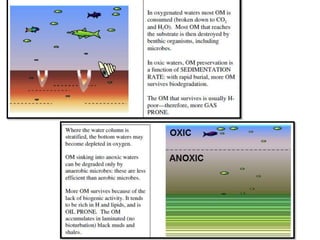
• Generally, depositional conditions that favour accumulation of OM
are low energy, reducing dysoxic – anoxic conditions
• Deserts (< 0.05% OM); Abyssal Ocean Plains (< 0.1% OM); High
Energy Coasts (0.2–0.5% OM); Low Energy Coasts (0.5–5% OM); Distal
Floodplains and Deltas (0.5 – > 10% OM); Silled Basins, Enclosed Seas
(< 2 – > 10% OM); Epeiric Seas (< 1 - > 10%); Lakes, Coastal Lagoons (<
1 - > 10%); Coastal Swamps (10 – 100%)
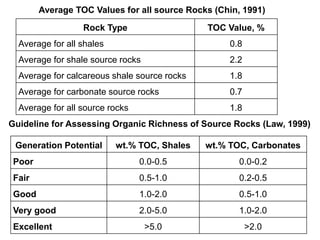
Rock Type TOC Value, %
Average for all shales 0.8
Average for shale source rocks 2.2
Average for calcareous shale source rocks 1.8
Average for carbonate source rocks 0.7
Average for all source rocks 1.8
Average TOC Values for all source Rocks (Chin, 1991)
Generation Potential wt.% TOC, Shales wt.% TOC, Carbonates
Poor 0.0-0.5 0.0-0.2
Fair 0.5-1.0 0.2-0.5
Good 1.0-2.0 0.5-1.0
Very good 2.0-5.0 1.0-2.0
Excellent >5.0 >2.0
Guideline for Assessing Organic Richness of Source Rocks (Law, 1999)
Determination of organic richness
Tissot and Welte
(1984)
TOC is not
measured directly,
but can be
calculated via the
formula below:
%TOC =
[0.082(S1 + S2) +
S4]/10
Law (1999)
Peak Measured parameter Comment
S1 (mgHC/g
rock)
Free hydrocarbons
present in sample
before analysis
Akin to residual hydrocarbon
phase
S2 (mgHC/g
rock)
Volume of hydrocarbons
formed during thermal
Pyrolysis of the sample
Used to estimate the remaining
hydrocarbon generating
potential of the sample
S3 (mgCO2/g
rock)
The CO2 yield during
thermal breakdown of
kerogen
Most prevalent in calcareous
source rocks
S4 (mg carbon/g
rock)
The residual carbon
content of sample
Residual carbon content of
sample has little or no potential
to generate hydrocarbons due
to lack of hydrogen and
chemical structure of the
molecule
Peters and Cassa (1994)
LECO Method
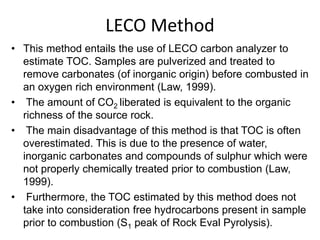
• This method entails the use of LECO carbon analyzer to
estimate TOC. Samples are pulverized and treated to
remove carbonates (of inorganic origin) before combusted in
an oxygen rich environment (Law, 1999).
• The amount of CO2 liberated is equivalent to the organic
richness of the source rock.
• The main disadvantage of this method is that TOC is often
overestimated. This is due to the presence of water,
inorganic carbonates and compounds of sulphur which were
not properly chemically treated prior to combustion (Law,
1999).
• Furthermore, the TOC estimated by this method does not
take into consideration free hydrocarbons present in sample
prior to combustion (S1 peak of Rock Eval Pyrolysis).
• Kerogen is a portion of the organic richness in a
sedimentary rock (Peters and Cassa, 1994; Tissot and
Welte, 1984; Durand, 1980).
• It is a macro-molecular complex with a polymer-like
structure (organic compound) that is insoluble in non-
oxidising acids, alkaline solvents or organic solvents
• which can yield hydrocarbon when subjected to
increased temperature and pressure.
• It forms from the diagenetic modification of organic
precursors (Carbohydrates, Proteins and Lipids) from
organic materials like algae, miospore, etc at a depth
of a few hundred metres and a temperature range of
about 500C to 600C.
SOURCE QUALITY/KEROGEN TYPING
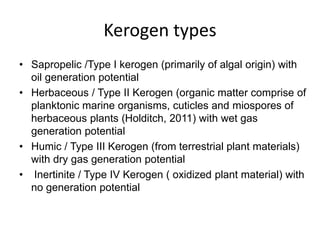
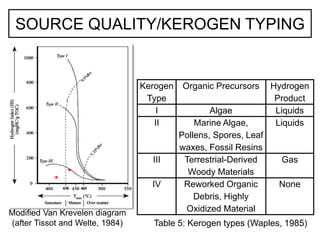
Kerogen types
• Sapropelic /Type I kerogen (primarily of algal origin) with
oil generation potential
• Herbaceous / Type II Kerogen (organic matter comprise of
planktonic marine organisms, cuticles and miospores of
herbaceous plants (Holditch, 2011) with wet gas
generation potential
• Humic / Type III Kerogen (from terrestrial plant materials)
with dry gas generation potential
• Inertinite / Type IV Kerogen ( oxidized plant material) with
no generation potential
SOURCE QUALITY/KEROGEN TYPING
Kerogen
Type
Organic Precursors Hydrogen
Product
I Algae Liquids
II Marine Algae,
Pollens, Spores, Leaf
waxes, Fossil Resins
Liquids
III Terrestrial-Derived
Woody Materials
Gas
IV Reworked Organic
Debris, Highly
Oxidized Material
None
Table 5: Kerogen types (Waples, 1985)
Modified Van Krevelen diagram
(after Tissot and Welte, 1984)
Kerogen analysis Via HI
HI = S2 (mg/g)/%TOC * 100
OI = S3 (mg/g)/%TOC × 100
Kerogen analysis Via modified van krevelen
diagram
Modified Van Krevelen
diagram (after Tissot and
Welte, 1984)
HI = S2 (mg/g)/%TOC *
100
OI = S3 (mg/g)/%TOC ×
100
Palynofacies assemblage
AUCHI (Mag.: X40)
SOBE (Mag.: X40)
IKABIGBO (Mag.: X40)
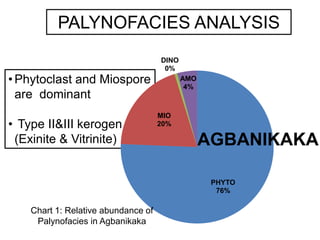
• Phytoclast and Miospore
are dominant
• Type II&III kerogen
(Exinite & Vitrinite)
PHYTO
76%
MIO
20%
DINO
0%
AMO
4%
AGBANIKAKA
PALYNOFACIES ANALYSIS
Chart 1: Relative abundance of
Palynofacies in Agbanikaka
• Phytoclast and Miospore
are dominant
• Type II&III kerogen
(Exinite and Vitrinite)
PALYNOFACIES ANALYSIS
PHYTO
55%
MIO
43%
DINO
1%
AMO
1%
AUCHI
Chart 2: Relative abundance of
Palynofacies in Auchi
• Phytoclast predominates
• Mainly of Type III
kerogen (Vitrinite)
PALYNOFACIES ANALYSIS
PHYTO
95%
MIO
5%
DINO
0%
AMO
0%
IKABIGBO
Chart 3: Relative
abundance of Palynofacies
in Ikabigbo
• Phytoclast predominates
• Mainly of Type III
kerogen (Vitrinite)
PALYNOFACIES ANALYSIS
PHYTO
87%
MIO
12%
DINO
1%
AMO
0%
SOBE
Chart 4: Relative
abundance of
Palynofacies in Sobe
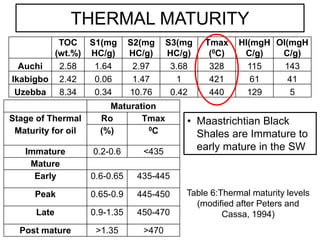
THERMAL MATURITY
TOC
(wt.%)
S1(mg
HC/g)
S2(mg
HC/g)
S3(mg
HC/g)
Tmax
(0C)
HI(mgH
C/g)
OI(mgH
C/g)
Auchi 2.58 1.64 2.97 3.68 328 115 143
Ikabigbo 2.42 0.06 1.47 1 421 61 41
Uzebba 8.34 0.34 10.76 0.42 440 129 5
Maturation
Stage of Thermal
Maturity for oil
Ro Tmax
(%) 0C
Immature 0.2-0.6 <435
Mature
Early 0.6-0.65 435-445
Peak 0.65-0.9 445-450
Late 0.9-1.35 450-470
Post mature >1.35 >470
• Maastrichtian Black
Shales are Immature to
early mature in the SW
Table 6:Thermal maturity levels
(modified after Peters and
Cassa, 1994)
THERMAL MATURITY (SCI)
R0 SCI Tmax Generalized HC Zone
0.40 4.0 420 Immature
0.50 5.0 435 Immature
0.60 6.0 440 Oil
0.80 7.4 450 Oil
1.00 8.1 460 Oil
1.20 8.3 465 Oil &wet gas
1.35 8.5 470 Wet gas
1.50 8.7 480 Wet
2.00 9.2 500 Methane
Table 7:Generalized
correlation of different
maturity indices (Waples,
1985)
Chart 5: Spore colour index chart (modified from Pearson, 1984)
AUCHI
Plate 1:Miospores identified in Auchi
Black shales
Magnification: X40
SCI <5
 Immature
SOBE
Plate 2:Miospores identified in
Sobe Black shales
Magnification: X40
SCI <5
 Immature
AGBANIKAKA
Plate 3:Miospores identified
in Agbanikaka Black shales
Magnification: X40
SCI <5
 Immature
IKABIGBO
Plate 4:Miospores identified in
Ikabigbo Black shales
Magnification: X40
SCI <5
 Immature

Understanding source rocks

  • 1.
  • 2.
    Source rock attributes 3features characterize source rocks: • Organic richness • Kerogen type • Thermal maturity Organic richness and type of kerogen is a function of depositional setting; whilst tectonic history determines maturity 0.2 0.3 0.4 0.5 0.6 0.7 0.8 0.9 1.0 1.3 2.0 3.0
  • 3.
    What is asource rock (SR) • ‘A source rock is a (fine grained) rock that is capable of generating or that has generated movable quantities of hydrocarbons’ (Law, 1999) • A source may be termed potential source rock- if it hasn’t been sufficiently cooked (immature); active source rock if it’s is currently generating (early, mid or late mature); spent if it is over mature or lacks OM to continue generating • Effective source rock which contains organic matter and is presently generating and/or expelling hydrocarbons to form commercial accumulations. • Relic effective source An effective source rock which has ceased generating and expelling hydrocarbons carbons due to a thermal cooling event such as uplift or erosion before exhausting its organic matter supply. Examples of SR lithologies: mudrock, limestone and coal
  • 4.
    Organic richness • Thisis the percentage or quantity of organic carbon (TOC) in a rock, which includes both kerogen (insoluble) and bitumen (soluble) (Peters and Cassa, 1994) • It represents the amount of carbon, oxygen and hydrogen atoms are available for hydrocarbon generation (Kennedy et al., 2012) • As earlier said, this attribute is a function of conditions prevalent during deposition of source material • Generally, depositional conditions that favour accumulation of OM are low energy, reducing dysoxic – anoxic conditions • Deserts (< 0.05% OM); Abyssal Ocean Plains (< 0.1% OM); High Energy Coasts (0.2–0.5% OM); Low Energy Coasts (0.5–5% OM); Distal Floodplains and Deltas (0.5 – > 10% OM); Silled Basins, Enclosed Seas (< 2 – > 10% OM); Epeiric Seas (< 1 - > 10%); Lakes, Coastal Lagoons (< 1 - > 10%); Coastal Swamps (10 – 100%)
  • 7.
    Rock Type TOCValue, % Average for all shales 0.8 Average for shale source rocks 2.2 Average for calcareous shale source rocks 1.8 Average for carbonate source rocks 0.7 Average for all source rocks 1.8 Average TOC Values for all source Rocks (Chin, 1991) Generation Potential wt.% TOC, Shales wt.% TOC, Carbonates Poor 0.0-0.5 0.0-0.2 Fair 0.5-1.0 0.2-0.5 Good 1.0-2.0 0.5-1.0 Very good 2.0-5.0 1.0-2.0 Excellent >5.0 >2.0 Guideline for Assessing Organic Richness of Source Rocks (Law, 1999)
  • 8.
    Determination of organicrichness Tissot and Welte (1984) TOC is not measured directly, but can be calculated via the formula below: %TOC = [0.082(S1 + S2) + S4]/10
  • 9.
    Law (1999) Peak Measuredparameter Comment S1 (mgHC/g rock) Free hydrocarbons present in sample before analysis Akin to residual hydrocarbon phase S2 (mgHC/g rock) Volume of hydrocarbons formed during thermal Pyrolysis of the sample Used to estimate the remaining hydrocarbon generating potential of the sample S3 (mgCO2/g rock) The CO2 yield during thermal breakdown of kerogen Most prevalent in calcareous source rocks S4 (mg carbon/g rock) The residual carbon content of sample Residual carbon content of sample has little or no potential to generate hydrocarbons due to lack of hydrogen and chemical structure of the molecule
  • 10.
  • 11.
    LECO Method • Thismethod entails the use of LECO carbon analyzer to estimate TOC. Samples are pulverized and treated to remove carbonates (of inorganic origin) before combusted in an oxygen rich environment (Law, 1999). • The amount of CO2 liberated is equivalent to the organic richness of the source rock. • The main disadvantage of this method is that TOC is often overestimated. This is due to the presence of water, inorganic carbonates and compounds of sulphur which were not properly chemically treated prior to combustion (Law, 1999). • Furthermore, the TOC estimated by this method does not take into consideration free hydrocarbons present in sample prior to combustion (S1 peak of Rock Eval Pyrolysis).
  • 12.
    • Kerogen isa portion of the organic richness in a sedimentary rock (Peters and Cassa, 1994; Tissot and Welte, 1984; Durand, 1980). • It is a macro-molecular complex with a polymer-like structure (organic compound) that is insoluble in non- oxidising acids, alkaline solvents or organic solvents • which can yield hydrocarbon when subjected to increased temperature and pressure. • It forms from the diagenetic modification of organic precursors (Carbohydrates, Proteins and Lipids) from organic materials like algae, miospore, etc at a depth of a few hundred metres and a temperature range of about 500C to 600C. SOURCE QUALITY/KEROGEN TYPING
  • 13.
    Kerogen types • Sapropelic/Type I kerogen (primarily of algal origin) with oil generation potential • Herbaceous / Type II Kerogen (organic matter comprise of planktonic marine organisms, cuticles and miospores of herbaceous plants (Holditch, 2011) with wet gas generation potential • Humic / Type III Kerogen (from terrestrial plant materials) with dry gas generation potential • Inertinite / Type IV Kerogen ( oxidized plant material) with no generation potential
  • 14.
    SOURCE QUALITY/KEROGEN TYPING Kerogen Type OrganicPrecursors Hydrogen Product I Algae Liquids II Marine Algae, Pollens, Spores, Leaf waxes, Fossil Resins Liquids III Terrestrial-Derived Woody Materials Gas IV Reworked Organic Debris, Highly Oxidized Material None Table 5: Kerogen types (Waples, 1985) Modified Van Krevelen diagram (after Tissot and Welte, 1984)
  • 15.
    Kerogen analysis ViaHI HI = S2 (mg/g)/%TOC * 100 OI = S3 (mg/g)/%TOC × 100
  • 16.
    Kerogen analysis Viamodified van krevelen diagram Modified Van Krevelen diagram (after Tissot and Welte, 1984) HI = S2 (mg/g)/%TOC * 100 OI = S3 (mg/g)/%TOC × 100
  • 17.
    Palynofacies assemblage AUCHI (Mag.:X40) SOBE (Mag.: X40) IKABIGBO (Mag.: X40)
  • 18.
    • Phytoclast andMiospore are dominant • Type II&III kerogen (Exinite & Vitrinite) PHYTO 76% MIO 20% DINO 0% AMO 4% AGBANIKAKA PALYNOFACIES ANALYSIS Chart 1: Relative abundance of Palynofacies in Agbanikaka
  • 19.
    • Phytoclast andMiospore are dominant • Type II&III kerogen (Exinite and Vitrinite) PALYNOFACIES ANALYSIS PHYTO 55% MIO 43% DINO 1% AMO 1% AUCHI Chart 2: Relative abundance of Palynofacies in Auchi
  • 20.
    • Phytoclast predominates •Mainly of Type III kerogen (Vitrinite) PALYNOFACIES ANALYSIS PHYTO 95% MIO 5% DINO 0% AMO 0% IKABIGBO Chart 3: Relative abundance of Palynofacies in Ikabigbo
  • 21.
    • Phytoclast predominates •Mainly of Type III kerogen (Vitrinite) PALYNOFACIES ANALYSIS PHYTO 87% MIO 12% DINO 1% AMO 0% SOBE Chart 4: Relative abundance of Palynofacies in Sobe
  • 22.
    THERMAL MATURITY TOC (wt.%) S1(mg HC/g) S2(mg HC/g) S3(mg HC/g) Tmax (0C) HI(mgH C/g) OI(mgH C/g) Auchi 2.581.64 2.97 3.68 328 115 143 Ikabigbo 2.42 0.06 1.47 1 421 61 41 Uzebba 8.34 0.34 10.76 0.42 440 129 5 Maturation Stage of Thermal Maturity for oil Ro Tmax (%) 0C Immature 0.2-0.6 <435 Mature Early 0.6-0.65 435-445 Peak 0.65-0.9 445-450 Late 0.9-1.35 450-470 Post mature >1.35 >470 • Maastrichtian Black Shales are Immature to early mature in the SW Table 6:Thermal maturity levels (modified after Peters and Cassa, 1994)
  • 23.
    THERMAL MATURITY (SCI) R0SCI Tmax Generalized HC Zone 0.40 4.0 420 Immature 0.50 5.0 435 Immature 0.60 6.0 440 Oil 0.80 7.4 450 Oil 1.00 8.1 460 Oil 1.20 8.3 465 Oil &wet gas 1.35 8.5 470 Wet gas 1.50 8.7 480 Wet 2.00 9.2 500 Methane Table 7:Generalized correlation of different maturity indices (Waples, 1985) Chart 5: Spore colour index chart (modified from Pearson, 1984)
  • 24.
    AUCHI Plate 1:Miospores identifiedin Auchi Black shales Magnification: X40 SCI <5  Immature
  • 25.
    SOBE Plate 2:Miospores identifiedin Sobe Black shales Magnification: X40 SCI <5  Immature
  • 26.
    AGBANIKAKA Plate 3:Miospores identified inAgbanikaka Black shales Magnification: X40 SCI <5  Immature
  • 27.
    IKABIGBO Plate 4:Miospores identifiedin Ikabigbo Black shales Magnification: X40 SCI <5  Immature