Reservoir Rock and
Fluid Properties
Subject
Hussein Suad Hussein hussein.hussein@soran.edu.iq
 References:
- Abhijit Y. Dandekar , Petroleum Reservoir Rock and
Fluid properties, Second Edition.
- Petroleum Rock and Fluid Properties Laboratory
manual, 2003.
Lec.1
Introduction
Three keywords that describe the title of this
course
 The term “petroleum” is a combination of two
different words, “petra” meaning rock and “oleum”
meaning oil, “rock oil” also is used to describe
petroleum since the oil resides in the rock.
 petroleum may refer to hydrocarbons (compounds of
carbon and hydrogen) in both the gaseous and liquid
states
 They are found in nature in raw or unrefined (hence
the word crude oil) forms and are separated into
different fractions to produce a variety of
transportation fuels (natural gas, gasoline, diesel,
kerosene, aviation fuel, lube oils, etc.) and
petrochemical products (polymers, plastics, etc.).
 The term “reservoir” in general terms means a pool or
an accumulation of petroleum in porous rock
formations buried several feet underground or
subsurface.
 The term “fluid” generally means anything that flows
from point A (subsurface location) to B (surface
location)
 The petroleum reservoir rock together with fluids
makes up a system, which has a certain areal extent
and depth and exists at given pressure and
temperature conditions, which is explored and
exploited commercially for production of petroleum.
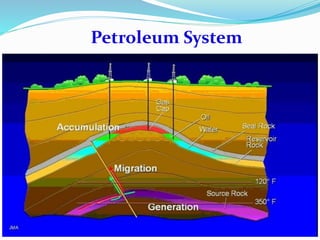
Petroleum System
Source Rock
Migration Route
Reservoir Rock
Seal Rock
Trap
Generation
Migration
Accumulation
Preservation
Elements Processes
1. Source Rocks
 The rock that contains the organic material, kerogen,
which eventually converted into petroleum, is called a
source rock.
Add heat and pressure by burying it (Maturation)
2. Transform organic matter
 The kerogen is converted to crude oil and natural gas
through three different processes, namely,
 Diagenesis ( >150 F) , (100-1000 m) { }
 Catagenesis ( 150 F-300 F) , (1000-4000 m) { liquid HC}
 Metagenesis (300 F-400 F) , (>4000 m) {dry gas}
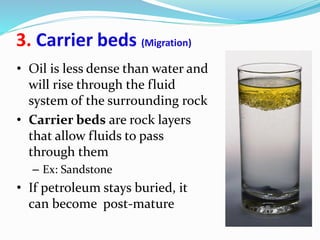
3. Carrier beds (Migration)
• Oil is less dense than water and
will rise through the fluid
system of the surrounding rock
• Carrier beds are rock layers
that allow fluids to pass
through them
– Ex: Sandstone
• If petroleum stays buried, it
can become post-mature
Primary Migration
 Mature hydrocarbons first have to migrate out of the
source rock.
Primary Migration Mechanism:
 Migration by diffusion.
 Migration by molecular solution in water.
 Migration along micro fractures in the source
rock.
Secondary Migration
 The process in which hydrocarbons move along
a porous and permeable layer to its final
accumulation is called secondary migration.
 it is almost entirely governed by buoyancy
forces.
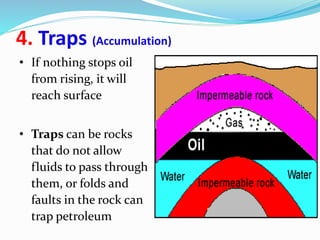
4. Traps (Accumulation)
• If nothing stops oil
from rising, it will
reach surface
• Traps can be rocks
that do not allow
fluids to pass through
them, or folds and
faults in the rock can
trap petroleum
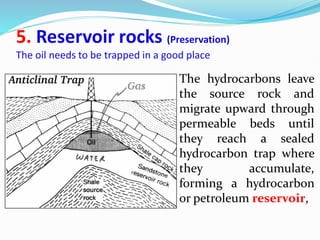
5. Reservoir rocks (Preservation)
The oil needs to be trapped in a good place
The hydrocarbons leave
the source rock and
migrate upward through
permeable beds until
they reach a sealed
hydrocarbon trap where
they accumulate,
forming a hydrocarbon
or petroleum reservoir,
6. Proper timing
• Timing between accumulation of organic
material, petroleum maturation,
migration, and trap formation is vital
Petroleum System
Typical Characteristics of Petroleum Reservoirs
 Depth: have an important implications in that the
temperature and pressure are influenced by depth.
 for shallower petroleum reservoirs, the temperatures
and pressures are relatively low and vice versa for
deeper reservoirs.
 Areal extend and thickness of the oil column:
 physical and chemical properties of the hydrocarbons
 Porosity
 Permeabilty
 The reservoir rocks that contain oil and gas accumulations
are broadly sandstones and carbonates.
 About 10% of the petroleum occurrences are found in
fractured shales and igneous and metamorphic rocks.
UNCONVENTIONAL OIL AND GAS RESOURCES
 In the past, given the technical challenges, lack of
economic viability, and the presence of easy-to-produce
conventional oil and gas, the unconventional resources
were largely ignored.
 In the current times, given the rapidly climbing energy
demands, given the technological advances made by the
petroleum industry.
Unconventional resources typically include
 Coal bed methane (CBM gas), which is methane in coal
seams;
 Tight sands gas (hydrocarbon gas in tight ultralow-
permeability formations);
 Shale gas (gas in very-low-permeability shales);
 Methane hydrates (methane trapped in crystal structure of
water);
 Heavy oil (high-viscosity and high-density oil);
 Shale oil (kerogen);
 Tar sands (containing bitumen which has extremely high
viscosities).

lec 1-Introduction.pdf

  • 1.
    Reservoir Rock and FluidProperties Subject Hussein Suad Hussein hussein.hussein@soran.edu.iq
  • 2.
     References: - AbhijitY. Dandekar , Petroleum Reservoir Rock and Fluid properties, Second Edition. - Petroleum Rock and Fluid Properties Laboratory manual, 2003.
  • 3.
  • 4.
    Three keywords thatdescribe the title of this course  The term “petroleum” is a combination of two different words, “petra” meaning rock and “oleum” meaning oil, “rock oil” also is used to describe petroleum since the oil resides in the rock.  petroleum may refer to hydrocarbons (compounds of carbon and hydrogen) in both the gaseous and liquid states
  • 5.
     They arefound in nature in raw or unrefined (hence the word crude oil) forms and are separated into different fractions to produce a variety of transportation fuels (natural gas, gasoline, diesel, kerosene, aviation fuel, lube oils, etc.) and petrochemical products (polymers, plastics, etc.).
  • 6.
     The term“reservoir” in general terms means a pool or an accumulation of petroleum in porous rock formations buried several feet underground or subsurface.  The term “fluid” generally means anything that flows from point A (subsurface location) to B (surface location)
  • 7.
     The petroleumreservoir rock together with fluids makes up a system, which has a certain areal extent and depth and exists at given pressure and temperature conditions, which is explored and exploited commercially for production of petroleum.
  • 8.
    Petroleum System Source Rock MigrationRoute Reservoir Rock Seal Rock Trap Generation Migration Accumulation Preservation Elements Processes
  • 9.
    1. Source Rocks The rock that contains the organic material, kerogen, which eventually converted into petroleum, is called a source rock.
  • 10.
    Add heat andpressure by burying it (Maturation) 2. Transform organic matter  The kerogen is converted to crude oil and natural gas through three different processes, namely,  Diagenesis ( >150 F) , (100-1000 m) { }  Catagenesis ( 150 F-300 F) , (1000-4000 m) { liquid HC}  Metagenesis (300 F-400 F) , (>4000 m) {dry gas}
  • 11.
    3. Carrier beds(Migration) • Oil is less dense than water and will rise through the fluid system of the surrounding rock • Carrier beds are rock layers that allow fluids to pass through them – Ex: Sandstone • If petroleum stays buried, it can become post-mature
  • 12.
    Primary Migration  Maturehydrocarbons first have to migrate out of the source rock. Primary Migration Mechanism:  Migration by diffusion.  Migration by molecular solution in water.  Migration along micro fractures in the source rock.
  • 13.
    Secondary Migration  Theprocess in which hydrocarbons move along a porous and permeable layer to its final accumulation is called secondary migration.  it is almost entirely governed by buoyancy forces.
  • 14.
    4. Traps (Accumulation) •If nothing stops oil from rising, it will reach surface • Traps can be rocks that do not allow fluids to pass through them, or folds and faults in the rock can trap petroleum
  • 15.
    5. Reservoir rocks(Preservation) The oil needs to be trapped in a good place The hydrocarbons leave the source rock and migrate upward through permeable beds until they reach a sealed hydrocarbon trap where they accumulate, forming a hydrocarbon or petroleum reservoir,
  • 16.
    6. Proper timing •Timing between accumulation of organic material, petroleum maturation, migration, and trap formation is vital
  • 17.
  • 18.
    Typical Characteristics ofPetroleum Reservoirs  Depth: have an important implications in that the temperature and pressure are influenced by depth.  for shallower petroleum reservoirs, the temperatures and pressures are relatively low and vice versa for deeper reservoirs.
  • 19.
     Areal extendand thickness of the oil column:  physical and chemical properties of the hydrocarbons  Porosity  Permeabilty
  • 20.
     The reservoirrocks that contain oil and gas accumulations are broadly sandstones and carbonates.  About 10% of the petroleum occurrences are found in fractured shales and igneous and metamorphic rocks.
  • 22.
    UNCONVENTIONAL OIL ANDGAS RESOURCES  In the past, given the technical challenges, lack of economic viability, and the presence of easy-to-produce conventional oil and gas, the unconventional resources were largely ignored.  In the current times, given the rapidly climbing energy demands, given the technological advances made by the petroleum industry.
  • 23.
    Unconventional resources typicallyinclude  Coal bed methane (CBM gas), which is methane in coal seams;  Tight sands gas (hydrocarbon gas in tight ultralow- permeability formations);  Shale gas (gas in very-low-permeability shales);  Methane hydrates (methane trapped in crystal structure of water);  Heavy oil (high-viscosity and high-density oil);  Shale oil (kerogen);  Tar sands (containing bitumen which has extremely high viscosities).