Presented by:
Aleena Sadiq
Anam Mustafa
Anma Riaz
Amna Khalid
Ideas are only true reality, the only
thing worth knowing.
Rejection of the physical reality.
“Idealism holds ultimate reality is
spiritualism.”
D.M.Dutta-
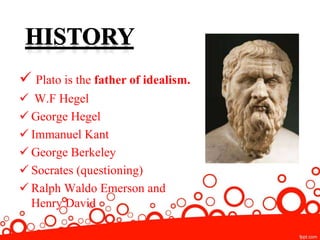
 Plato is the father of idealism.
 W.F Hegel
 George Hegel
 Immanuel Kant
 George Berkeley
 Socrates (questioning)
 Ralph Waldo Emerson and
Henry David
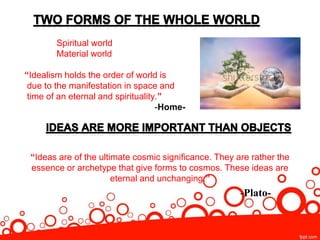
 Two forms of the whole world
 Ideas are more important than objects
 Importance of man over nature
 Faith in spiritual values
 Importance of personality development
 Full support of principles of unity in
diversity.
Spiritual world
Material world
“Idealism holds the order of world is
due to the manifestation in space and
time of an eternal and spirituality.”
-Home-
“Ideas are of the ultimate cosmic significance. They are rather the
essence or archetype that give forms to cosmos. These ideas are
eternal and unchanging.”
-Plato-
“The spiritual or cultural environment of man’s own
making, it is a product of man’s creative activity.”
-R.R.Rusk-
“Goodness, truth and beauty are seen to be absolute
each existing in its own rights and entirely desirable
in itself.”
-J.S Ross-
“Thus the Grandeur and worth of human life at its best are
emphasis the idealism. Human personality is of supreme value and
constitutes the noblest work of the God.”
-J.S Ross-
“An idealistic philosophy of education , than , is an account of man
finding himself as an integral part of universe mind.”
-H.N Home-
• Self-realization or Exhalation of Personality
• To ensure Spiritual Development
• To cultivate Truth, Beauty and Goodness
• Conservation, Promotion and Transmission of cultural
Heritage
• Conversion of Inborn Nature into Spiritual Nature
• Preparation of Holy Life
• Development of Intelligence and Rationality
“The aims of education specially associated
with idealism is the exhalation of personality,
or self-realization, the making actual or real
the highest potentialities of the self.”
-J.S. Ross-
“Education must enable mankind through its
culture to enter more and more fully into the
spiritual realm and also enlarge the boundaries
of the spiritual realm.” -RUSK-
Truth
Beauty
Goodness
To Develop
Cultural,
Social
Artistic Values Of Human Life
To sublimate the inborn raw instincts of the
child into spiritual qualities.
“The object of education is the
realization of a faithful, pure,
inviolable and hence holy life.”
Froebel-
“In all things there reigns an eternal law this all-
pervading energetic, self-conscious and hence eternal
unity. This unity is GOD. Education should lead and
guide man to face with nature and unity and GOD.”
FROEBEL from-Education of Man-
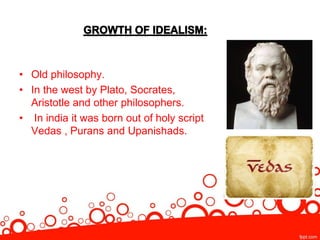
• Old philosophy.
• In the west by Plato, Socrates,
Aristotle and other philosophers.
• In india it was born out of holy script
Vedas , Purans and Upanishads.
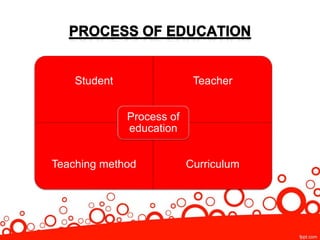
Student Teacher
Teaching method Curriculum
Process of
education
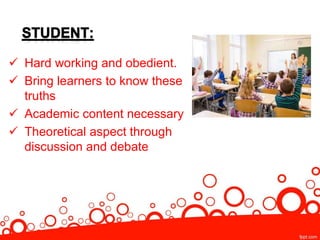
 Hard working and obedient.
 Bring learners to know these
truths
 Academic content necessary
 Theoretical aspect through
discussion and debate
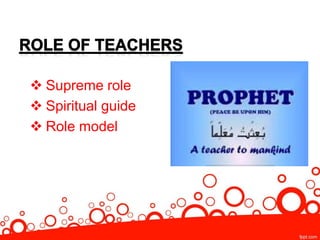
 Supreme role
 Spiritual guide
 Role model
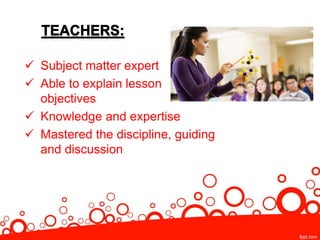
 Subject matter expert
 Able to explain lesson
objectives
 Knowledge and expertise
 Mastered the discipline, guiding
and discussion
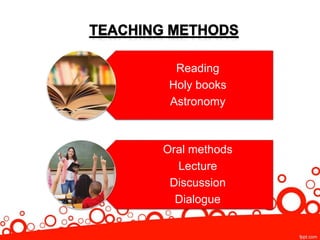
Reading
Holy books
Astronomy
Oral methods
Lecture
Discussion
Dialogue
 Humanistic subjects
 Religious studies
 Spiritual studies
 Literature
 History
 Fine arts
 Curriculum developed
according to Ideals and
eternal values
 Emphasis inner discipline
 Moral and Religious instruction
 Restraint on freedom
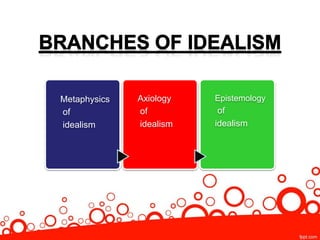
Metaphysics
of
idealism
Axiology
of
idealism
Epistemology
of
idealism
 The self is the primary reality of individual
experience
 Ultimate reality is self
 Ultimate reality maybe one or many
 The individual self has all the freedom
 Values are real existents.
 Evil is not real existent.
 The values of human life are what they are
largely because there are individual persons to
possess and enjoy them
 The individual person can realize value by
actively relating parts and wholes
 The ultimate knowledge is the knowledge on spirituality
 Idealism and critical realism are like in their treatment of
perception to some extent
 Some idealists support direct experience of the self
 Surrounding world is important to experience the self
 Reality to be a logically unified total system, a Universal
mind
 Absolutists-search of truth-
true ideas
 Rationalists-search for truth
is rational process
 Subjectivists-strive for self
realization
 Character development
 Wisdom,
 Moral conviction,
 Good will,
 Loyalty
Muhammad and Islamic thought
Judaism and Christianity
Alexander the Great
Idealism in education

Idealism in education

  • 1.
    Presented by: Aleena Sadiq AnamMustafa Anma Riaz Amna Khalid
  • 2.
    Ideas are onlytrue reality, the only thing worth knowing. Rejection of the physical reality. “Idealism holds ultimate reality is spiritualism.” D.M.Dutta-
  • 3.
     Plato isthe father of idealism.  W.F Hegel  George Hegel  Immanuel Kant  George Berkeley  Socrates (questioning)  Ralph Waldo Emerson and Henry David
  • 4.
     Two formsof the whole world  Ideas are more important than objects  Importance of man over nature  Faith in spiritual values  Importance of personality development  Full support of principles of unity in diversity.
  • 5.
    Spiritual world Material world “Idealismholds the order of world is due to the manifestation in space and time of an eternal and spirituality.” -Home- “Ideas are of the ultimate cosmic significance. They are rather the essence or archetype that give forms to cosmos. These ideas are eternal and unchanging.” -Plato-
  • 6.
    “The spiritual orcultural environment of man’s own making, it is a product of man’s creative activity.” -R.R.Rusk- “Goodness, truth and beauty are seen to be absolute each existing in its own rights and entirely desirable in itself.” -J.S Ross-
  • 7.
    “Thus the Grandeurand worth of human life at its best are emphasis the idealism. Human personality is of supreme value and constitutes the noblest work of the God.” -J.S Ross- “An idealistic philosophy of education , than , is an account of man finding himself as an integral part of universe mind.” -H.N Home-
  • 8.
    • Self-realization orExhalation of Personality • To ensure Spiritual Development • To cultivate Truth, Beauty and Goodness • Conservation, Promotion and Transmission of cultural Heritage • Conversion of Inborn Nature into Spiritual Nature • Preparation of Holy Life • Development of Intelligence and Rationality
  • 9.
    “The aims ofeducation specially associated with idealism is the exhalation of personality, or self-realization, the making actual or real the highest potentialities of the self.” -J.S. Ross- “Education must enable mankind through its culture to enter more and more fully into the spiritual realm and also enlarge the boundaries of the spiritual realm.” -RUSK-
  • 10.
  • 11.
    To sublimate theinborn raw instincts of the child into spiritual qualities. “The object of education is the realization of a faithful, pure, inviolable and hence holy life.” Froebel-
  • 12.
    “In all thingsthere reigns an eternal law this all- pervading energetic, self-conscious and hence eternal unity. This unity is GOD. Education should lead and guide man to face with nature and unity and GOD.” FROEBEL from-Education of Man-
  • 13.
    • Old philosophy. •In the west by Plato, Socrates, Aristotle and other philosophers. • In india it was born out of holy script Vedas , Purans and Upanishads.
  • 14.
    Student Teacher Teaching methodCurriculum Process of education
  • 15.
     Hard workingand obedient.  Bring learners to know these truths  Academic content necessary  Theoretical aspect through discussion and debate
  • 16.
     Supreme role Spiritual guide  Role model
  • 17.
     Subject matterexpert  Able to explain lesson objectives  Knowledge and expertise  Mastered the discipline, guiding and discussion
  • 18.
  • 19.
     Humanistic subjects Religious studies  Spiritual studies  Literature  History  Fine arts  Curriculum developed according to Ideals and eternal values
  • 20.
     Emphasis innerdiscipline  Moral and Religious instruction  Restraint on freedom
  • 21.
  • 22.
     The selfis the primary reality of individual experience  Ultimate reality is self  Ultimate reality maybe one or many  The individual self has all the freedom
  • 23.
     Values arereal existents.  Evil is not real existent.  The values of human life are what they are largely because there are individual persons to possess and enjoy them  The individual person can realize value by actively relating parts and wholes
  • 24.
     The ultimateknowledge is the knowledge on spirituality  Idealism and critical realism are like in their treatment of perception to some extent  Some idealists support direct experience of the self  Surrounding world is important to experience the self  Reality to be a logically unified total system, a Universal mind
  • 25.
     Absolutists-search oftruth- true ideas  Rationalists-search for truth is rational process  Subjectivists-strive for self realization  Character development  Wisdom,  Moral conviction,  Good will,  Loyalty
  • 26.
    Muhammad and Islamicthought Judaism and Christianity Alexander the Great