Etymological meaning of Philosophy: The term ‘philosophy’ has been
derived from the Greek words – ‘Philos’ and ‘Sophia’.
‘Philos’ means ‘love’
‘Sophia’ means ‘wisdom’
Thus etymologically speaking, philosophy is
‘love of wisdom’
Fichte’s view: “Philosophy is the science of knowledge.”
Kant’s view: “Philosophy is the science and criticism of cognition.”
S. Radhakrishnan’s view: “Philosophy is a logical enquiry into the
nature of reality.”
Coleridge’s view: “Philosophy is the Science of Sciences.”
PHILOSOPHY IS A WAY OF LIFE: Every man is a born metaphysician and all
human beings live in accordance with their philosophy of life, their
conception of world.
PHILOSOPHY IS A SEARCH FOR TRUTH : It is search for reality and truth.
PHILOSOPHY IS WHAT COMES OUT OF HUMAN EXPERIENCE: Different
persons have different philosophies. Certain philosophies are product of
circumstances, times and human experiences.
IT IS OF ANALYTICAL NATURE : Human beings seek to discover an ultimate
principle on the first cause of the source of all existence.
SYNTHETIC NATURE Philosophy is an effort to combine into an integrated
form of all knowledge and experiences: The nature of philosophy is to
synthesise man’s total experience in the form of knowledge. It is through
the process of philosophical synthesis that a man is able to give meaning to
his very existence. The quest for new dimensions continue unending.
PHILOSOPHICAL PROBLMES ARE GENERAL PROBLEMS: General questions like
what is good, what is life, space, time, knowledge or death?
BEGINNING OF PHILOSOPHY : The philosophy of Vedas began in wonder.
Philosophy of Budh began in discontentment with the miserable world. When
man was struck with wonder at the natural phenomenon in life and was filled
with discontentment at the existing order of things, it is the beginning of the
philosophy.
IT IS MOTHER OF ALL SCIENCES: In the process of scientific progress, philosophy
is always found at the apex. It always transcends science and goes further.
COMPREHENSIVE SCIENCE- CRITICAL AND SYNTHETIC: The synthetic aspect of
philosophy is known as speculative aspect because the philosopher has to take
resources to speculation in his philosophical synthesis. It involves speculation
and not merely putting together of bits of knowledge. The critical philosophy is
discursive and it critically examines the postulates and conclusions of different
sciences.
PHILOSOPHY AND COMMONSENSE : Life is impossible without common sense.
Commonsense is required in activities of daily life. Common sense is narrow and
philosophy is comprehensive. Commonsense is concerned with particular
questions. Philosophy and common sense are mutually complimentary.
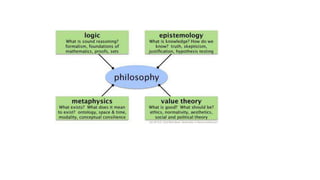
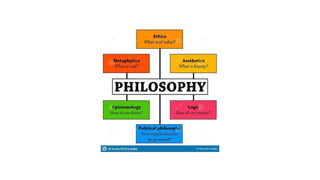
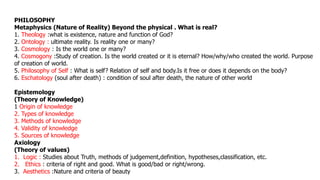
PHILOSOPHY
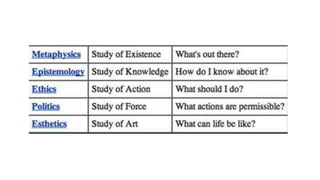
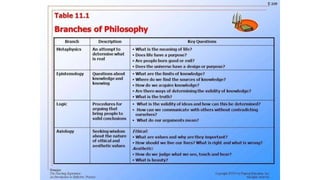
Metaphysics (Nature of Reality) Beyond the physical . What is real?
1. Theology :what is existence, nature and function of God?
2. Ontology : ultimate reality. Is reality one or many?
3. Cosmology : Is the world one or many?
4. Cosmogony :Study of creation. Is the world created or it is eternal? How/why/who created the world. Purpose
of creation of world.
5. Philosophy of Self : What is self? Relation of self and body.Is it free or does it depends on the body?
6. Eschatology (soul after death) : condition of soul after death, the nature of other world
Epistemology
(Theory of Knowledge)
1 Origin of knowledge
2. Types of knowledge
3. Methods of knowledge
4. Validity of knowledge
5. Sources of knowledge
Axiology
(Theory of values)
1. Logic : Studies about Truth, methods of judgement,definition, hypotheses,classification, etc.
2. Ethics : criteria of right and good. What is good/bad or right/wrong.
3. Aesthetics :Nature and criteria of beauty
Nandra, I.S. & Kaur, P. (2015) Philosophical Perspectives in Education.
Twenty first Century Publications, Patiala

Philosophy.pptx

  • 2.
    Etymological meaning ofPhilosophy: The term ‘philosophy’ has been derived from the Greek words – ‘Philos’ and ‘Sophia’. ‘Philos’ means ‘love’ ‘Sophia’ means ‘wisdom’ Thus etymologically speaking, philosophy is ‘love of wisdom’ Fichte’s view: “Philosophy is the science of knowledge.” Kant’s view: “Philosophy is the science and criticism of cognition.” S. Radhakrishnan’s view: “Philosophy is a logical enquiry into the nature of reality.” Coleridge’s view: “Philosophy is the Science of Sciences.”
  • 3.
    PHILOSOPHY IS AWAY OF LIFE: Every man is a born metaphysician and all human beings live in accordance with their philosophy of life, their conception of world. PHILOSOPHY IS A SEARCH FOR TRUTH : It is search for reality and truth. PHILOSOPHY IS WHAT COMES OUT OF HUMAN EXPERIENCE: Different persons have different philosophies. Certain philosophies are product of circumstances, times and human experiences. IT IS OF ANALYTICAL NATURE : Human beings seek to discover an ultimate principle on the first cause of the source of all existence. SYNTHETIC NATURE Philosophy is an effort to combine into an integrated form of all knowledge and experiences: The nature of philosophy is to synthesise man’s total experience in the form of knowledge. It is through the process of philosophical synthesis that a man is able to give meaning to his very existence. The quest for new dimensions continue unending.
  • 4.
    PHILOSOPHICAL PROBLMES AREGENERAL PROBLEMS: General questions like what is good, what is life, space, time, knowledge or death? BEGINNING OF PHILOSOPHY : The philosophy of Vedas began in wonder. Philosophy of Budh began in discontentment with the miserable world. When man was struck with wonder at the natural phenomenon in life and was filled with discontentment at the existing order of things, it is the beginning of the philosophy. IT IS MOTHER OF ALL SCIENCES: In the process of scientific progress, philosophy is always found at the apex. It always transcends science and goes further. COMPREHENSIVE SCIENCE- CRITICAL AND SYNTHETIC: The synthetic aspect of philosophy is known as speculative aspect because the philosopher has to take resources to speculation in his philosophical synthesis. It involves speculation and not merely putting together of bits of knowledge. The critical philosophy is discursive and it critically examines the postulates and conclusions of different sciences. PHILOSOPHY AND COMMONSENSE : Life is impossible without common sense. Commonsense is required in activities of daily life. Common sense is narrow and philosophy is comprehensive. Commonsense is concerned with particular questions. Philosophy and common sense are mutually complimentary.
  • 8.
    PHILOSOPHY Metaphysics (Nature ofReality) Beyond the physical . What is real? 1. Theology :what is existence, nature and function of God? 2. Ontology : ultimate reality. Is reality one or many? 3. Cosmology : Is the world one or many? 4. Cosmogony :Study of creation. Is the world created or it is eternal? How/why/who created the world. Purpose of creation of world. 5. Philosophy of Self : What is self? Relation of self and body.Is it free or does it depends on the body? 6. Eschatology (soul after death) : condition of soul after death, the nature of other world Epistemology (Theory of Knowledge) 1 Origin of knowledge 2. Types of knowledge 3. Methods of knowledge 4. Validity of knowledge 5. Sources of knowledge Axiology (Theory of values) 1. Logic : Studies about Truth, methods of judgement,definition, hypotheses,classification, etc. 2. Ethics : criteria of right and good. What is good/bad or right/wrong. 3. Aesthetics :Nature and criteria of beauty
  • 10.
    Nandra, I.S. &Kaur, P. (2015) Philosophical Perspectives in Education. Twenty first Century Publications, Patiala