Bone Tumours
Bone Tumours
• The term bone tumour encompass benign and
malignant neoplasms, reactive focal
abnormalities, metabolic abnormalities, and
miscellaneous “tumorlike” conditions
Bone Tumours
… can be divided into primary and secondary.
Primary bone tumors are rare
and malignant primary bone tumors (except
myeloma and lymphoma) constitute only 0.2%
of all malignancies in adults and 5% in
children.
Primary Bone Tumours
• Predominant occurrence in the first 3 decades of
life
• Relatively specific radiographic presentations
• Benign tumors are more common than malignant
ones (hamartomas eg. Osteochondroma)
• Some primary bone tumors are difficult to classify
as benign or malignant
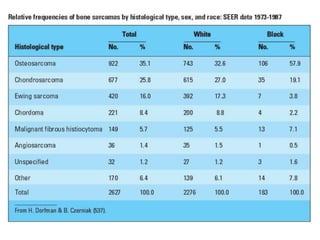
• Among primary malignant neoplasms,
osteosarcoma and multiple myeloma have the
highest incidence, followed by chondrosarcoma
and Ewing's sarcoma.
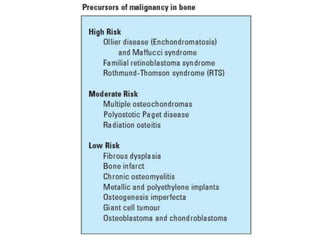
Secondary Bone Tumours
Can be further subdivided into:
• Metastatic tumors
• Tumors resulting from contiguous spread of
adjacent soft tissue neoplasms
• Tumors representing malignant
transformation of the pre-existing benign
lesions
Precursors
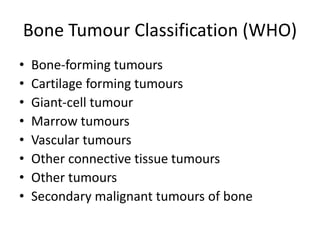
Bone Tumour Classification (WHO)
• Bone-forming tumours
• Cartilage forming tumours
• Giant-cell tumour
• Marrow tumours
• Vascular tumours
• Other connective tissue tumours
• Other tumours
• Secondary malignant tumours of bone
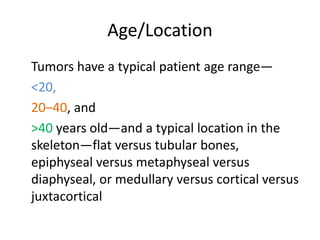
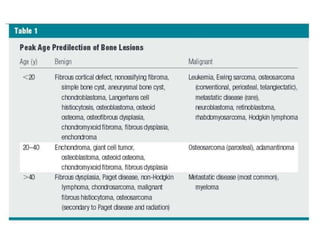
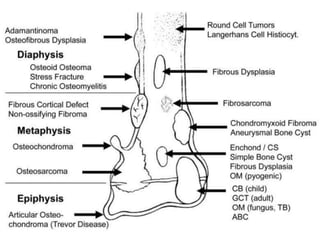
Age/Location
Tumors have a typical patient age range—
<20,
20–40, and
>40 years old—and a typical location in the
skeleton—flat versus tubular bones,
epiphyseal versus metaphyseal versus
diaphyseal, or medullary versus cortical versus
juxtacortical
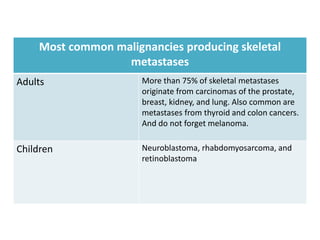
Most common malignancies producing skeletal
metastases
Adults More than 75% of skeletal metastases
originate from carcinomas of the prostate,
breast, kidney, and lung. Also common are
metastases from thyroid and colon cancers.
And do not forget melanoma.
Children Neuroblastoma, rhabdomyosarcoma, and
retinoblastoma
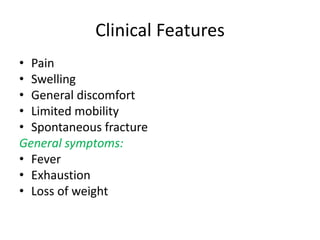
Clinical Features
• Pain
• Swelling
• General discomfort
• Limited mobility
• Spontaneous fracture
General symptoms:
• Fever
• Exhaustion
• Loss of weight
Pain
• Tearing neuralgia-like pain (may also be interpreted as
"rheumatic pain“)
• Initially may occur intermittently and only at rest
• Might subsequently become more intense:
– disturb sleep at night
– spread into the adjacent joint
– frequently misinterpreted as arthritis or as a post-traumatic
phenomenon
• Further intensification of pain is experienced as a persistent and
piercing pain
• Becomes excruciating and intolerable, requiring opiate
treatment
• In case of pressure on nerve trunks or nerve plexuses, the
patient may experience radiating pain
• When the tumour is located in the spine causes radicular or
spinal compression symptoms with paralysis
Pain
May be a symptom of:
• Growing lesions (locally aggressive lesions eg.
aggressive osteoblastoma and GCT, and
malignant tumors)
• Pathologic fracture complicating either benign
or malignant tumor
• Significant local tissue reaction to the tumor
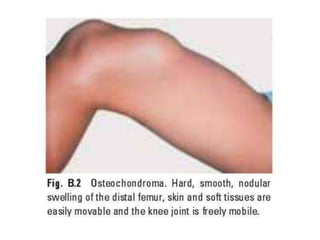
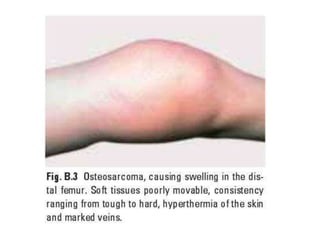
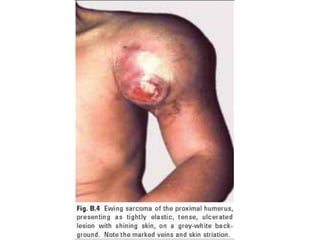
Swelling
• Very long duration, no additional complaints
• Only observed if there is an extraosseous part of
the tumour or the bone is expanded by the
tumourous process
• In malignant tumours, swelling develops more
rapidly
• Consistency is important e.g. hard, coarse, tightly
elastic or soft
• May cause skin changes (tensed shining skin with
prominent veins, livid colouring, hyperthermia,
striation of the skin and eventually, ulceration)
• Mobility of the skin
Limited mobility
• In cases of lesions close to the joint
• In tumours such as OB, CB, GCT and all types
of sarcomas
• Occasionally it is not the tumour but reactive
synovitis in the joint, especially in CB
Diagnosis
• Clinical examination
• Imaging
• Laboratory investigations
• Biopsy
Imaging
• Radiography
• CT scan
• MRI
• Radio nuclide bone scan
• Arteriogram
Radiography
Usually the first imaging technique for a
suspected bone lesion since it is inexpensive
and easily obtainable. It is also the best for
assessment of general radiological features of
the tumor.
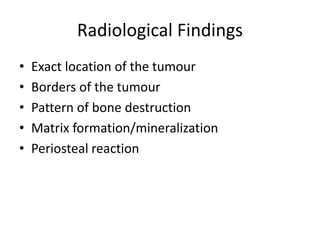
Radiological Findings
• Exact location of the tumour
• Borders of the tumour
• Pattern of bone destruction
• Matrix formation/mineralization
• Periosteal reaction
Geographic Pattern
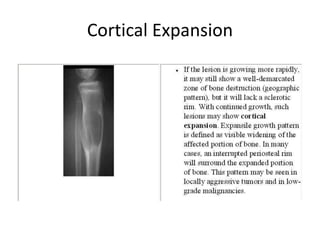
Cortical Expansion
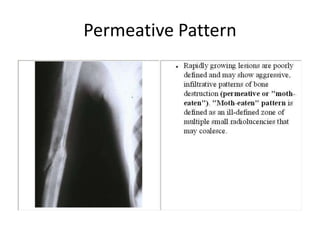
Permeative Pattern
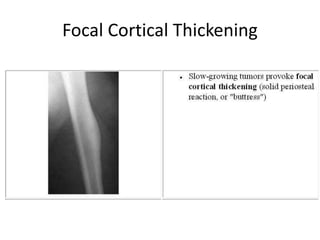
Focal Cortical Thickening
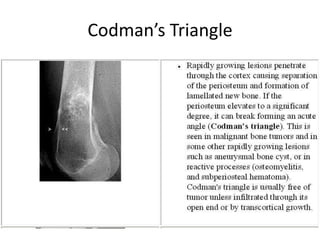
Codman’s Triangle
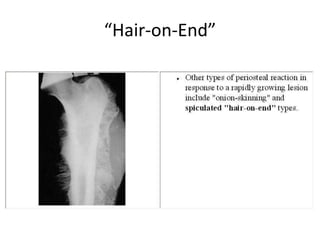
“Hair-on-End”
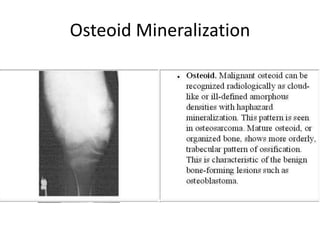
Osteoid Mineralization
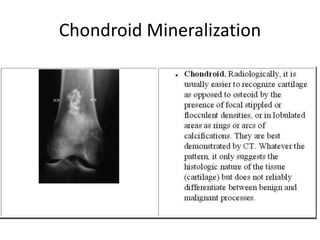
Chondroid Mineralization
CT
Method of choice when plain film assessment
is difficult owing to the nature of the lesion
(eg., permeative pattern of destruction) or
anatomic site (eg., sacrum). In addition, CT is
the best technique in assessment of matrix
mineralization, cortical detail, and detection of
the cystic and fatty lesions.
MRI
• Local Staging
• It is superior to CT in the definition of
medullary and extracortical spread and of the
relationship of the tumor to critical
neurovascular structures. However, remember
that the MRI appearances of the majority of
bone tumors are totally non-specific.
Radionuclide Bone Scanning
• For pre biopsy staging
• Dissemination of tumour
• Silent secondaries and skip lesions
Arteriogram
• Planning limb sparing surgery
• Therapeutic embolization
• To assess vascularity of tumour
Bone Scintigraphy
Highly sensitive but relatively non-specific
technique. Its main role is in detection of
suspected metastases in the whole skeleton. It
may also be helpful in the detection of osteoid
osteomas ("double density sign" is present in
about 50% of cases and is highly suggestive of
this tumor).
Laboratory Findings
• Hb %
• ESR
• ↑Alkaline Phosphatase
• Serum electrophoretic pattern
• Bence-Jones protein
• ↑Acid Phosphatase
Biopsy
• Closed biopsy
FNAC
Needle biopsy
• Open biopsy
Incisional biopsy
Excisional biopsy
Important Histologic Features to
Consider
• Pattern of growth (eg., sheets of cells vs. lobular
architecture)
• Cytologic characteristics of the cells
• Presence of necrosis and/or hemorrhage and/or
cystic change
• Matrix production
• Relationship between the lesional tissue and the
surrounding bone (eg., sharp border vs.
infiltrative growth)
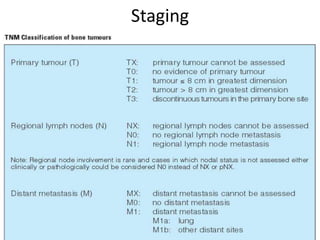
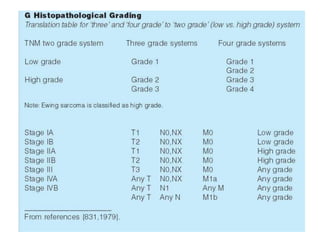
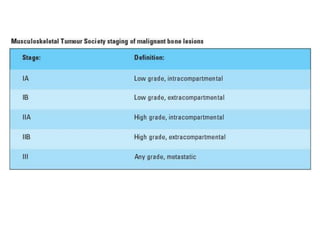
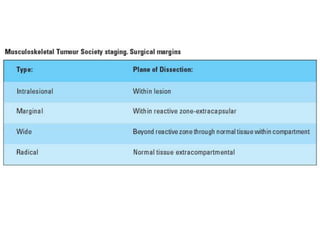
Staging
Management
• Radiotherapy/chemotherapy
(adjuvant/neoadjuvant)
• Medication
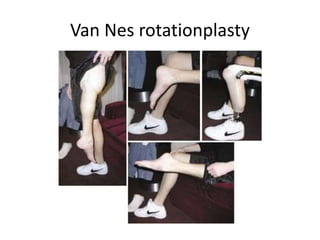
• Ablative surgeries (amputation, limb sparing
surgery, bone graft, artificial bone,
rotationplasty)
Management
• Benign, asymptomatic lesions
Excisional biopsy or curettage
• Benign, symptomatic or enlarging lesions
Biopsy confirmation followed by marginal
resection or curettage (cystic lesions)
Van Nes rotationplasty

Bone tumours

  • 1.
  • 2.
    Bone Tumours • Theterm bone tumour encompass benign and malignant neoplasms, reactive focal abnormalities, metabolic abnormalities, and miscellaneous “tumorlike” conditions
  • 3.
    Bone Tumours … canbe divided into primary and secondary. Primary bone tumors are rare and malignant primary bone tumors (except myeloma and lymphoma) constitute only 0.2% of all malignancies in adults and 5% in children.
  • 4.
    Primary Bone Tumours •Predominant occurrence in the first 3 decades of life • Relatively specific radiographic presentations • Benign tumors are more common than malignant ones (hamartomas eg. Osteochondroma) • Some primary bone tumors are difficult to classify as benign or malignant • Among primary malignant neoplasms, osteosarcoma and multiple myeloma have the highest incidence, followed by chondrosarcoma and Ewing's sarcoma.
  • 5.
    Secondary Bone Tumours Canbe further subdivided into: • Metastatic tumors • Tumors resulting from contiguous spread of adjacent soft tissue neoplasms • Tumors representing malignant transformation of the pre-existing benign lesions
  • 6.
  • 8.
    Bone Tumour Classification(WHO) • Bone-forming tumours • Cartilage forming tumours • Giant-cell tumour • Marrow tumours • Vascular tumours • Other connective tissue tumours • Other tumours • Secondary malignant tumours of bone
  • 9.
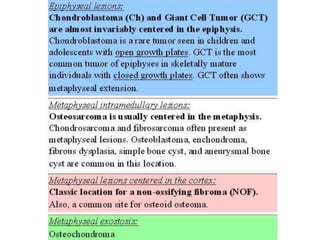
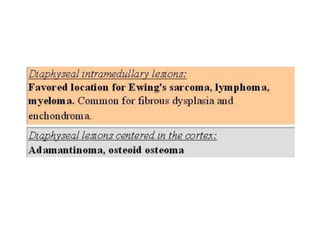
    Age/Location Tumors have atypical patient age range— <20, 20–40, and >40 years old—and a typical location in the skeleton—flat versus tubular bones, epiphyseal versus metaphyseal versus diaphyseal, or medullary versus cortical versus juxtacortical
  • 11.
    Most common malignanciesproducing skeletal metastases Adults More than 75% of skeletal metastases originate from carcinomas of the prostate, breast, kidney, and lung. Also common are metastases from thyroid and colon cancers. And do not forget melanoma. Children Neuroblastoma, rhabdomyosarcoma, and retinoblastoma
  • 17.
    Clinical Features • Pain •Swelling • General discomfort • Limited mobility • Spontaneous fracture General symptoms: • Fever • Exhaustion • Loss of weight
  • 21.
    Pain • Tearing neuralgia-likepain (may also be interpreted as "rheumatic pain“) • Initially may occur intermittently and only at rest • Might subsequently become more intense: – disturb sleep at night – spread into the adjacent joint – frequently misinterpreted as arthritis or as a post-traumatic phenomenon • Further intensification of pain is experienced as a persistent and piercing pain • Becomes excruciating and intolerable, requiring opiate treatment • In case of pressure on nerve trunks or nerve plexuses, the patient may experience radiating pain • When the tumour is located in the spine causes radicular or spinal compression symptoms with paralysis
  • 22.
    Pain May be asymptom of: • Growing lesions (locally aggressive lesions eg. aggressive osteoblastoma and GCT, and malignant tumors) • Pathologic fracture complicating either benign or malignant tumor • Significant local tissue reaction to the tumor
  • 23.
    Swelling • Very longduration, no additional complaints • Only observed if there is an extraosseous part of the tumour or the bone is expanded by the tumourous process • In malignant tumours, swelling develops more rapidly • Consistency is important e.g. hard, coarse, tightly elastic or soft • May cause skin changes (tensed shining skin with prominent veins, livid colouring, hyperthermia, striation of the skin and eventually, ulceration) • Mobility of the skin
  • 24.
    Limited mobility • Incases of lesions close to the joint • In tumours such as OB, CB, GCT and all types of sarcomas • Occasionally it is not the tumour but reactive synovitis in the joint, especially in CB
  • 25.
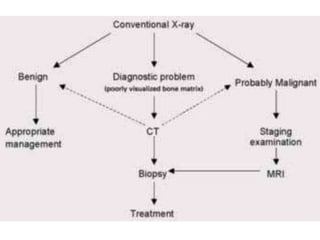
    Diagnosis • Clinical examination •Imaging • Laboratory investigations • Biopsy
  • 27.
    Imaging • Radiography • CTscan • MRI • Radio nuclide bone scan • Arteriogram
  • 28.
    Radiography Usually the firstimaging technique for a suspected bone lesion since it is inexpensive and easily obtainable. It is also the best for assessment of general radiological features of the tumor.
  • 29.
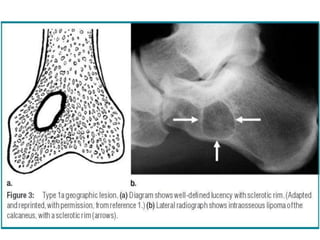
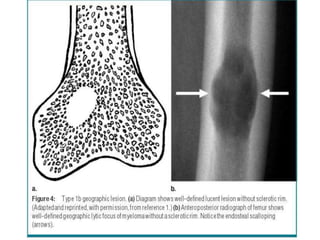
    Radiological Findings • Exactlocation of the tumour • Borders of the tumour • Pattern of bone destruction • Matrix formation/mineralization • Periosteal reaction
  • 31.
  • 32.
  • 33.
  • 34.
  • 35.
  • 36.
  • 37.
  • 38.
  • 39.
    CT Method of choicewhen plain film assessment is difficult owing to the nature of the lesion (eg., permeative pattern of destruction) or anatomic site (eg., sacrum). In addition, CT is the best technique in assessment of matrix mineralization, cortical detail, and detection of the cystic and fatty lesions.
  • 40.
    MRI • Local Staging •It is superior to CT in the definition of medullary and extracortical spread and of the relationship of the tumor to critical neurovascular structures. However, remember that the MRI appearances of the majority of bone tumors are totally non-specific.
  • 41.
    Radionuclide Bone Scanning •For pre biopsy staging • Dissemination of tumour • Silent secondaries and skip lesions
  • 42.
    Arteriogram • Planning limbsparing surgery • Therapeutic embolization • To assess vascularity of tumour
  • 43.
    Bone Scintigraphy Highly sensitivebut relatively non-specific technique. Its main role is in detection of suspected metastases in the whole skeleton. It may also be helpful in the detection of osteoid osteomas ("double density sign" is present in about 50% of cases and is highly suggestive of this tumor).
  • 44.
    Laboratory Findings • Hb% • ESR • ↑Alkaline Phosphatase • Serum electrophoretic pattern • Bence-Jones protein • ↑Acid Phosphatase
  • 45.
    Biopsy • Closed biopsy FNAC Needlebiopsy • Open biopsy Incisional biopsy Excisional biopsy
  • 46.
    Important Histologic Featuresto Consider • Pattern of growth (eg., sheets of cells vs. lobular architecture) • Cytologic characteristics of the cells • Presence of necrosis and/or hemorrhage and/or cystic change • Matrix production • Relationship between the lesional tissue and the surrounding bone (eg., sharp border vs. infiltrative growth)
  • 47.
  • 51.
    Management • Radiotherapy/chemotherapy (adjuvant/neoadjuvant) • Medication •Ablative surgeries (amputation, limb sparing surgery, bone graft, artificial bone, rotationplasty)
  • 52.
    Management • Benign, asymptomaticlesions Excisional biopsy or curettage • Benign, symptomatic or enlarging lesions Biopsy confirmation followed by marginal resection or curettage (cystic lesions)
  • 53.

Editor's Notes

  • #5 Primary osteosarcoma and Ewing's sarcoma are tumors of children and young adults. Occurrence of chondrosarcomas in children or Ewing's sarcoma in middle-aged patients is extremely unusual. In individuals older than 40 years, the commonest form of skeletal malignancy is metastatic cancer. Of the primary bone tumors in this age group, multiple myeloma and chondrosarcoma are most commonly encountered. Osteosarcomas in this age group are often secondary malignancies, which develop at the the sites of bone damage. Giant cell tumor, a locally aggressive lesion, almost exclusively occurs in skeletally mature patients, 20 to 50 years of age, with closed epiphyses. It is practically never seen in children or patients older than 60 years.