Downloaded 24 times

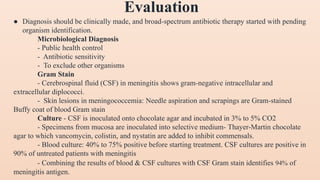
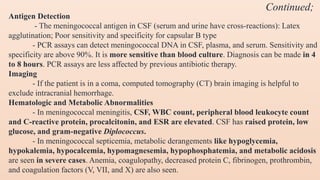
![Antimicrobial Agents
- Third-generation cephalosporin-ceftriaxone or cefotaxime are used for
initial therapy.
Continued disease:
• Ceftriaxone (80 mg/kg per day in 1 to 2 divided doses intravenously [IV])
• Cefotaxime (200 mg/kg per day in 3 to4 divided doses IV)
• Penicillin G (50 mg/kg every 4 to 6 hours IV)
• Chloramphenicol (100 mg/kg/day in 4 divided doses, orally or IV)
• Meropenem for those with severe allergies
- The recommended duration of therapy is 7 days for both meningitis and
meningococcemia.
Treatment / Management](https://image.slidesharecdn.com/meningococcalinfection-rivin-210618060223/85/Meningococcal-infection-11-320.jpg)
![1. https://www.ncbi.nlm.nih.gov/books/NBK534849/
2. Batista RS, Gomes AP, Dutra Gazineo JL, Balbino Miguel PS, Santana LA, Oliveira L, Geller M.
Meningococcal disease, a clinical and epidemiological review. Asian Pac J Trop Med. 2017 Nov;10(11):1019-
1029. [PubMed]
3. Harrison LH. Epidemiological profile of meningococcal disease in the United States. Clin. Infect. Dis. 2010
Mar 01;50 Suppl 2:S37-44. [PMC free article] [PubMed]
4. Dass Hazarika R, Deka NM, Khyriem AB, Lyngdoh WV, Barman H, Duwarah SG, Jain P, Borthakur D.
Invasive meningococcal infection: analysis of 110 cases from a tertiary care centre in North East India. Indian J
Pediatr. 2013 May;80(5):359-64. [PMC free article] [PubMed]
5. Törös B, Thulin Hedberg S, Jacobsson S, Fredlund H, Olcén P, Mölling P. Surveillance of invasive Neisseria
meningitidis with a serogroup Y update, Sweden 2010 to 2012. Euro Surveill. 2014 Oct 23;19(42) [PubMed]
6. Coureuil M, Join-Lambert O, Lécuyer H, Bourdoulous S, Marullo S, Nassif X. Pathogenesis of
meningococcemia. Cold Spring Harb Perspect Med. 2013 Jun 01;3(6) [PMC free article] [PubMed]
7. Dwilow R, Fanella S. Invasive meningococcal disease in the 21st century—an update for the clinician. Curr
Neurol Neurosci Rep. 2015 Mar;15(3):2. [PubMed]
8. Halperin SA, Bettinger JA, Greenwood B, Harrison LH, Jelfs J, Ladhani SN, McIntyre P, Ramsay ME,
Sáfadi MA. The changing and dynamic epidemiology of meningococcal disease. Vaccine. 2012 May 30;30
Suppl 2:B26-36. [PubMed]
References](https://image.slidesharecdn.com/meningococcalinfection-rivin-210618060223/85/Meningococcal-infection-19-320.jpg)

1. Meningococcal infection, caused by Neisseria meningitidis, manifests as meningitis or septicemia. It is a serious and life-threatening disease, especially in children. 2. N. meningitidis is a gram-negative coccus that colonizes the nasopharynx initially before invading the bloodstream and meninges. Virulence factors like capsular polysaccharides and pili aid in invasion and evading the immune system. 3. Diagnosis involves identifying the organism from blood or CSF cultures. Treatment involves antibiotics like ceftriaxone or penicillin. Outcomes range from full recovery to death, with purpura fulminans carrying the


