HSPA/HSDPA
   (Beyond 3G)


   PRESENTED BY-
  Manish Srivastava
HSPA - Introduction
High Speed Packet Access (HSPA) is an amalgamation of two mobile
telephony protocols, High Speed Downlink Packet Access (HSDPA) and
High Speed Uplink Packet Access (HSUPA), that extends and improves
the performance of existing 3G mobile telecommunication networks
utilizing the WCDMA protocols.


  HSPA evolution first introduced downlink counterpart called HSDPA in
  Release 5.

  Uplink evolution followed later in Release 6 by the name of HSUPA.

  HSPA was originally designed for non-real time traffic with high
  transmission rate requirements.
FEATURES-
HSPA improves the end-user experience by:

• increasing peak data rates to 14 Mbit/s in the downlink and 5.8 Mbit/s in
the uplink

• reducing latency

• providing up to five times more system capacity in the downlink and up
to twice as much system capacity in the uplink, reducing the production
cost per bit

• link adaptation in downlink
TECHNOLOGIES USED-
Shared-channel transmission, which results in efficient use of available
code and power resources in WCDMA.
A shorter Transmission Time Interval (TTI) , which reduces round-trip
time and improves the tracking of fast channel variations.
Link adaptation, which maximizes channel usage and enables the base
station to operate at close to maximum cell power.
Fast scheduling, which provides users with the most suitable channel
conditions.
Fast retransmission and soft-combining, which further increase the
capacity.
16QAM and 64QAM , which yields higher bit-rates.
MIMO, which exploits antenna diversity to provide further
improvements in bit-rates and system capacity.
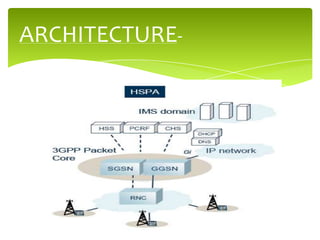
ARCHITECTURE-
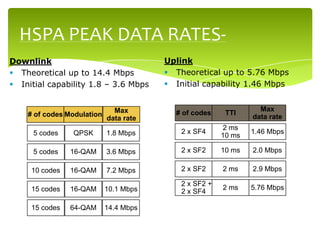
HSPA PEAK DATA RATES-
Downlink                                Uplink
 Theoretical up to 14.4 Mbps            Theoretical up to 5.76 Mbps
 Initial capability 1.8 – 3.6 Mbps      Initial capability 1.46 Mbps


                              Max                                 Max
    # of codes Modulation                 # of codes     TTI
                            data rate                           data rate
                                                         2 ms
     5 codes    QPSK        1.8 Mbps        2 x SF4             1.46 Mbps
                                                        10 ms

     5 codes    16-QAM      3.6 Mbps        2 x SF2     10 ms   2.0 Mbps

     10 codes   16-QAM      7.2 Mbps        2 x SF2     2 ms    2.9 Mbps

                                            2 x SF2 +
     15 codes   16-QAM      10.1 Mbps                   2 ms    5.76 Mbps
                                            2 x SF4

     15 codes   64-QAM      14.4 Mbps
HSDPA
 In WCDMA 3GPP Release 5, HSDPA adds a new transport channel to
  WCDMA– the High Speed Downlink Shared Channel (HS-DSCH) – which
  provides enhanced support for high-performance packet data
  applications in the downlink.

 The improved downlink provides up to 14 Mbit/s with significantly
  reduced latency. Current devices support 7.2 Mbps throughput.

 In order to support HSDPA features with minimal impact on the existing
  radio interface protocol architecture, a new MAC sub-layer, MAC-hs,
  has been introduced. It enables a functional split to be retained
  between layers and nodes from WCDMA 3GPP Releases 99 and 4.
HSDPA CHANNELS
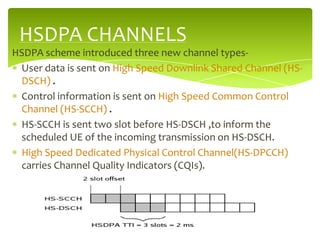
HSDPA scheme introduced three new channel types-
 User data is sent on High Speed Downlink Shared Channel (HS-
 DSCH) .
 Control information is sent on High Speed Common Control
 Channel (HS-SCCH) .
 HS-SCCH is sent two slot before HS-DSCH ,to inform the
 scheduled UE of the incoming transmission on HS-DSCH.
 High Speed Dedicated Physical Control Channel(HS-DPCCH)
 carries Channel Quality Indicators (CQIs).
Key Features-

 Shared Channel and Multi-Code Transmission
 Higher-order modulation
 Short Transmission Time Interval (TTI)
 Fast link adaptation
 Fast scheduling
 Fast Hybrid Automatic Repeat reQuest (ARQ)
Fig: HS-DSCH code and time structures
ADVANTAGES OF HSDPA-
 The network can employ data schedulers that give higher priority to
 real-time applications.
 Employs shorter frame length, thus it can react faster to problems in
 the radio channel.
 Provides shorter delays, which enables new applications, such as
 interactive networked games.
 It is best for applications with highly variable bandwidth
 requirements.


DISADVANTAGES-
 Not suitable for applications with low band-width requirements, such
 as voice.
HSDPA Capability-
HSPA+ (Second Phase of HSDPA)
The second phase of HSDPA is specified in the 3GPP release7.

Provides smooth inter-networking between HSPA and LTE, thereby
facilitating the operation of both technologies.

Higher-order modulation can be supported in both uplink
(16QAM) and downlink (64QAM).

16QAM modulation enables peak data rates of 12 Mbit/s in the uplink,
while 64QAM modulation enables peak data rates of 21 Mbit/s in the
downlink.

It introduces antenna array technologies such as beamforming and
Multiple-input multiple-output communications (MIMO).
HSPA/HSPA+(One Tunnel Architecture)
DUAL CELL HSDPA
Part of 3GPP Release 8.

Allows a user to connect to two cells at once, thereby theoretically
doubling the connection speeds for the user.

 Can support up to 28 Mbit/s and 42 Mbit/s with a single 5 MHz carrier
in Rel7 (MIMO with 16QAM) and Rel8 (64-QAM + MIMO).

While in Release 8 DC-HSPDA can only operate on adjacent carriers,
Release 9 also allows that the paired cells can operate on two
different frequency bands.
THANK YOU!

Hspa and hsdpa

  • 1.
    HSPA/HSDPA (Beyond 3G) PRESENTED BY- Manish Srivastava
  • 2.
    HSPA - Introduction HighSpeed Packet Access (HSPA) is an amalgamation of two mobile telephony protocols, High Speed Downlink Packet Access (HSDPA) and High Speed Uplink Packet Access (HSUPA), that extends and improves the performance of existing 3G mobile telecommunication networks utilizing the WCDMA protocols. HSPA evolution first introduced downlink counterpart called HSDPA in Release 5. Uplink evolution followed later in Release 6 by the name of HSUPA. HSPA was originally designed for non-real time traffic with high transmission rate requirements.
  • 3.
    FEATURES- HSPA improves theend-user experience by: • increasing peak data rates to 14 Mbit/s in the downlink and 5.8 Mbit/s in the uplink • reducing latency • providing up to five times more system capacity in the downlink and up to twice as much system capacity in the uplink, reducing the production cost per bit • link adaptation in downlink
  • 4.
    TECHNOLOGIES USED- Shared-channel transmission,which results in efficient use of available code and power resources in WCDMA. A shorter Transmission Time Interval (TTI) , which reduces round-trip time and improves the tracking of fast channel variations. Link adaptation, which maximizes channel usage and enables the base station to operate at close to maximum cell power. Fast scheduling, which provides users with the most suitable channel conditions. Fast retransmission and soft-combining, which further increase the capacity. 16QAM and 64QAM , which yields higher bit-rates. MIMO, which exploits antenna diversity to provide further improvements in bit-rates and system capacity.
  • 5.
  • 6.
    HSPA PEAK DATARATES- Downlink Uplink  Theoretical up to 14.4 Mbps  Theoretical up to 5.76 Mbps  Initial capability 1.8 – 3.6 Mbps  Initial capability 1.46 Mbps Max Max # of codes Modulation # of codes TTI data rate data rate 2 ms 5 codes QPSK 1.8 Mbps 2 x SF4 1.46 Mbps 10 ms 5 codes 16-QAM 3.6 Mbps 2 x SF2 10 ms 2.0 Mbps 10 codes 16-QAM 7.2 Mbps 2 x SF2 2 ms 2.9 Mbps 2 x SF2 + 15 codes 16-QAM 10.1 Mbps 2 ms 5.76 Mbps 2 x SF4 15 codes 64-QAM 14.4 Mbps
  • 7.
    HSDPA  In WCDMA3GPP Release 5, HSDPA adds a new transport channel to WCDMA– the High Speed Downlink Shared Channel (HS-DSCH) – which provides enhanced support for high-performance packet data applications in the downlink.  The improved downlink provides up to 14 Mbit/s with significantly reduced latency. Current devices support 7.2 Mbps throughput.  In order to support HSDPA features with minimal impact on the existing radio interface protocol architecture, a new MAC sub-layer, MAC-hs, has been introduced. It enables a functional split to be retained between layers and nodes from WCDMA 3GPP Releases 99 and 4.
  • 8.
    HSDPA CHANNELS HSDPA schemeintroduced three new channel types- User data is sent on High Speed Downlink Shared Channel (HS- DSCH) . Control information is sent on High Speed Common Control Channel (HS-SCCH) . HS-SCCH is sent two slot before HS-DSCH ,to inform the scheduled UE of the incoming transmission on HS-DSCH. High Speed Dedicated Physical Control Channel(HS-DPCCH) carries Channel Quality Indicators (CQIs).
  • 9.
    Key Features- SharedChannel and Multi-Code Transmission Higher-order modulation Short Transmission Time Interval (TTI) Fast link adaptation Fast scheduling Fast Hybrid Automatic Repeat reQuest (ARQ)
  • 10.
    Fig: HS-DSCH codeand time structures
  • 11.
    ADVANTAGES OF HSDPA- The network can employ data schedulers that give higher priority to real-time applications. Employs shorter frame length, thus it can react faster to problems in the radio channel. Provides shorter delays, which enables new applications, such as interactive networked games. It is best for applications with highly variable bandwidth requirements. DISADVANTAGES- Not suitable for applications with low band-width requirements, such as voice.
  • 12.
  • 13.
    HSPA+ (Second Phaseof HSDPA) The second phase of HSDPA is specified in the 3GPP release7. Provides smooth inter-networking between HSPA and LTE, thereby facilitating the operation of both technologies. Higher-order modulation can be supported in both uplink (16QAM) and downlink (64QAM). 16QAM modulation enables peak data rates of 12 Mbit/s in the uplink, while 64QAM modulation enables peak data rates of 21 Mbit/s in the downlink. It introduces antenna array technologies such as beamforming and Multiple-input multiple-output communications (MIMO).
  • 14.
  • 15.
    DUAL CELL HSDPA Partof 3GPP Release 8. Allows a user to connect to two cells at once, thereby theoretically doubling the connection speeds for the user. Can support up to 28 Mbit/s and 42 Mbit/s with a single 5 MHz carrier in Rel7 (MIMO with 16QAM) and Rel8 (64-QAM + MIMO). While in Release 8 DC-HSPDA can only operate on adjacent carriers, Release 9 also allows that the paired cells can operate on two different frequency bands.
  • 16.