CONTROL & USER PLANE,
MOBILITY & CONNECTION
    MANAGEMENT

     Presented By:
   Manish Srivastava
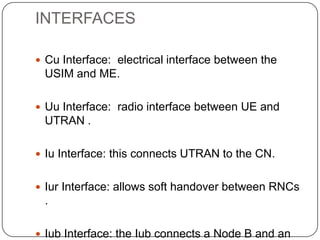
INTERFACES

 Cu Interface: electrical interface between the
 USIM and ME.

 Uu Interface: radio interface between UE and
 UTRAN .

 Iu Interface: this connects UTRAN to the CN.


 Iur Interface: allows soft handover between RNCs
 .

 Iub Interface: the Iub connects a Node B and an
GENERAL ARCHITECTURE

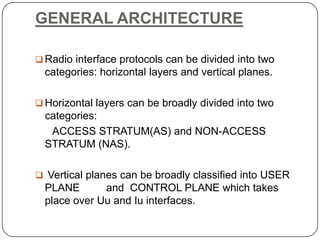
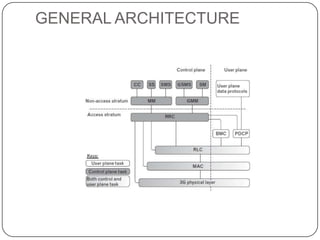
 Radio interface protocols can be divided into two
  categories: horizontal layers and vertical planes.

 Horizontal layers can be broadly divided into two
  categories:
   ACCESS STRATUM(AS) and NON-ACCESS
  STRATUM (NAS).

 Vertical planes can be broadly classified into USER
  PLANE       and CONTROL PLANE which takes
  place over Uu and Iu interfaces.
GENERAL ARCHITECTURE
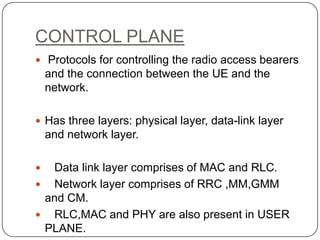
CONTROL PLANE
 Protocols for controlling the radio access bearers
    and the connection between the UE and the
    network.

 Has three layers: physical layer, data-link layer
    and network layer.

 Data link layer comprises of MAC and RLC.
 Network layer comprises of RRC ,MM,GMM
 and CM.
 RLC,MAC and PHY are also present in USER
 PLANE.
USER PLANE
 U-plane is responsible for the transfer of user
 data, such as voice or application data through
 the access stratum.

 It consists of Applications ,CN protocols and RAN
 protocols.

 CN comprises of Data Protocols such as
 IP,PPP,OSP and others.

 RAN comprises of PDCP,BMC,RLC,MAC and
 PHY.
MOBILITY MANAGEMENT
Mobility management allows mobile phones to
work by tracking where the subscribers are,
allowing calls, SMS and other mobile phone
services to be delivered to them.

  Functions:
• Location management
• Network registration
• Security function
MM PROCEDURES
COMMON PROCEDURES:
The common procedures basically include:
  • TMSI reallocation procedure.
  • Authentication procedure.
  • Identification procedure.
  •Information procedure.
SPECIFIC PROCEDURE:
  • Normal location updating procedure;
  • Periodic updating procedure;
  • IMSI attach procedure.
CONNECTION MANAGEMENT PROCEDURES:
 Establish,
 Maintain
 release
   MM connection between the mobile station and
  the network over which an entity of the upper CM
  layer can exchange information with its peer.
LOCATION UPDATE
 The cells broadcast their cell identities.


 The MS periodically listens to the broadcast cell
  identity, and compares it with the cell identity stored
  in the MS’s buffer.

 If the comparison indicates that the location has
  been changed, then the MS sends the location
  update message to the network.

 It takes place either when MS detects when location
  has been changed or periodically.
CONNECTION MANAGEMENT


 Connection management (CM) sub layer consists
of
 Call control
 Supplementary services
 Short message service
 Session management
 GPRS SMS
Call Control
 Call-establishment procedures
    A call can be either a mobile-originated call (MOC) or
a
   mobile terminated call (MTC).
 Call-clearing procedures
   It can be initiated either by the UE or by the network.
 Call-information-phase procedures
    Informs the user about call-related events, such as
user
     suspension or resume
 Miscellaneous procedures
    include in-band tones and announcements, status
inquiry, and call
    reestablishment.
Supplementary Services
 value-added services that may or may not be
  provided by the network operator
 advice of charge (AoC), call forwarding (CF),
  and call waiting (CW) supplementary services
 services belong to the NAS
Short Message Service
 non-real-time service
 a store and-forward service in which messages
 can be stored on the SMSC an delivered when
 the destination UE is available.
Session Management
 protocol is to support packet data protocol(PDP)
  context handling of the user terminal.
 communicating entities do need to know about the
  characteristics of the data to be transferred, it is
  performed by the PDP context-activation procedure
GPRS Short Message Service
 protocol task handles the SMS service while the UE is
  attached to the PS CN
THANK YOU….!!!!!!

Control plane

  • 1.
    CONTROL & USERPLANE, MOBILITY & CONNECTION MANAGEMENT Presented By: Manish Srivastava
  • 2.
    INTERFACES  Cu Interface:electrical interface between the USIM and ME.  Uu Interface: radio interface between UE and UTRAN .  Iu Interface: this connects UTRAN to the CN.  Iur Interface: allows soft handover between RNCs .  Iub Interface: the Iub connects a Node B and an
  • 4.
    GENERAL ARCHITECTURE  Radiointerface protocols can be divided into two categories: horizontal layers and vertical planes.  Horizontal layers can be broadly divided into two categories: ACCESS STRATUM(AS) and NON-ACCESS STRATUM (NAS).  Vertical planes can be broadly classified into USER PLANE and CONTROL PLANE which takes place over Uu and Iu interfaces.
  • 5.
  • 6.
    CONTROL PLANE  Protocolsfor controlling the radio access bearers and the connection between the UE and the network.  Has three layers: physical layer, data-link layer and network layer.  Data link layer comprises of MAC and RLC.  Network layer comprises of RRC ,MM,GMM and CM.  RLC,MAC and PHY are also present in USER PLANE.
  • 8.
    USER PLANE  U-planeis responsible for the transfer of user data, such as voice or application data through the access stratum.  It consists of Applications ,CN protocols and RAN protocols.  CN comprises of Data Protocols such as IP,PPP,OSP and others.  RAN comprises of PDCP,BMC,RLC,MAC and PHY.
  • 10.
    MOBILITY MANAGEMENT Mobility managementallows mobile phones to work by tracking where the subscribers are, allowing calls, SMS and other mobile phone services to be delivered to them. Functions: • Location management • Network registration • Security function
  • 11.
    MM PROCEDURES COMMON PROCEDURES: Thecommon procedures basically include: • TMSI reallocation procedure. • Authentication procedure. • Identification procedure. •Information procedure. SPECIFIC PROCEDURE: • Normal location updating procedure; • Periodic updating procedure; • IMSI attach procedure.
  • 12.
    CONNECTION MANAGEMENT PROCEDURES: Establish,  Maintain  release MM connection between the mobile station and the network over which an entity of the upper CM layer can exchange information with its peer.
  • 14.
    LOCATION UPDATE  Thecells broadcast their cell identities.  The MS periodically listens to the broadcast cell identity, and compares it with the cell identity stored in the MS’s buffer.  If the comparison indicates that the location has been changed, then the MS sends the location update message to the network.  It takes place either when MS detects when location has been changed or periodically.
  • 15.
    CONNECTION MANAGEMENT Connectionmanagement (CM) sub layer consists of  Call control  Supplementary services  Short message service  Session management  GPRS SMS
  • 16.
    Call Control  Call-establishmentprocedures A call can be either a mobile-originated call (MOC) or a mobile terminated call (MTC).  Call-clearing procedures It can be initiated either by the UE or by the network.  Call-information-phase procedures Informs the user about call-related events, such as user suspension or resume  Miscellaneous procedures include in-band tones and announcements, status inquiry, and call reestablishment.
  • 17.
    Supplementary Services  value-addedservices that may or may not be provided by the network operator  advice of charge (AoC), call forwarding (CF), and call waiting (CW) supplementary services  services belong to the NAS Short Message Service  non-real-time service  a store and-forward service in which messages can be stored on the SMSC an delivered when the destination UE is available.
  • 18.
    Session Management  protocolis to support packet data protocol(PDP) context handling of the user terminal.  communicating entities do need to know about the characteristics of the data to be transferred, it is performed by the PDP context-activation procedure GPRS Short Message Service  protocol task handles the SMS service while the UE is attached to the PS CN
  • 19.