Mobile communications: present and future (Part- II) Dr. Abhaya Sumanasena MSc PhD CEng MIET MIEEE 22 January 2009 Dr. Abhaya Sumanasena
Introduction to  HSDPA Dr. Abhaya Sumanasena
What is HSDPA ? Dr. Abhaya Sumanasena
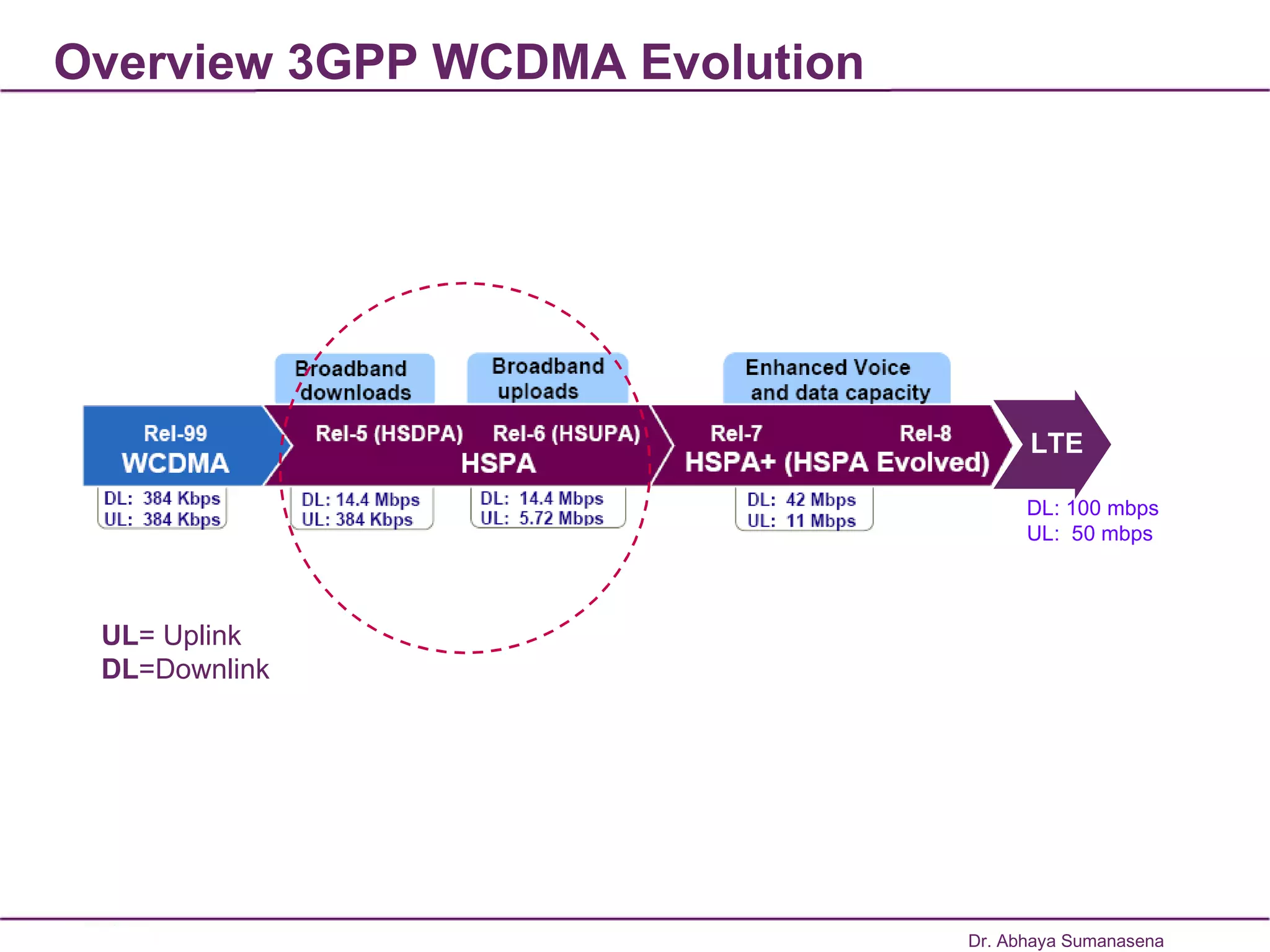
Overview 3GPP WCDMA Evolution UL = Uplink DL =Downlink DL: 100 mbps UL:  50 mbps LTE Dr. Abhaya Sumanasena
HSDPA HSDPA services provide users with a "broadband experience" today on mobile HSDPA delivers a 5-fold increase in downlink data speeds. It increases spectrum efficiency by using adaptive modulation and coding HSDPA is a most cost effective way to provide high-speed broadband access to both rural communities and the developing world [GSMA] HSDPA users can roam up to 55 countries [GSMA] Deployed in many frequency bands ( 850, 900,1700, 1800, 1900 and 2100 MHz)  Leverages the existing 3G assets Spectrum Subscriber base Network infrastructure (sites, radio, core network, transmission) Operation and Management system and staff Subscriber management systems (authentication, billing) Dr. Abhaya Sumanasena
Some Basics Dr. Abhaya Sumanasena
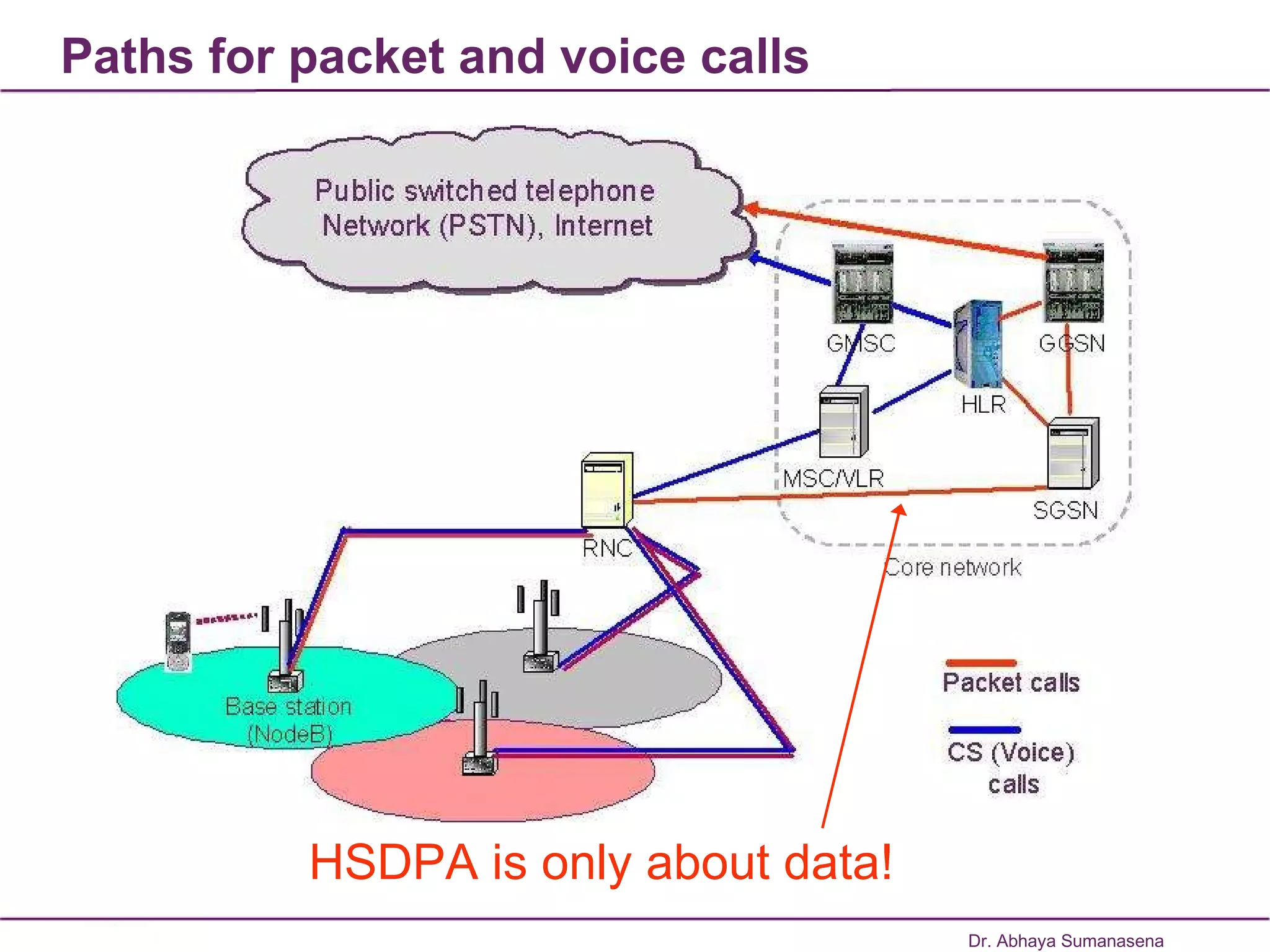
Paths for packet and voice calls Dr. Abhaya Sumanasena HSDPA is only about data!
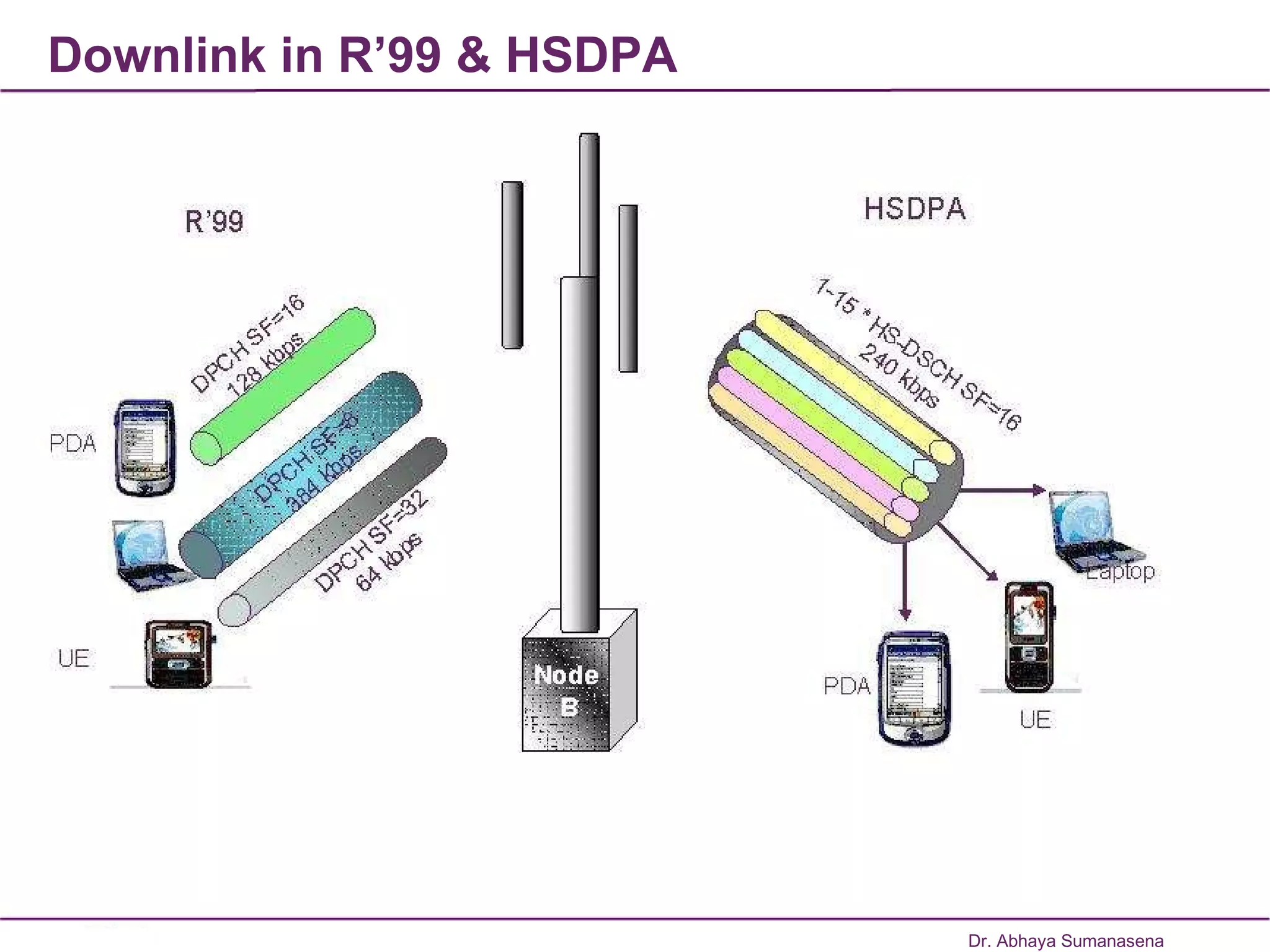
Downlink in R’99 & HSDPA Dr. Abhaya Sumanasena
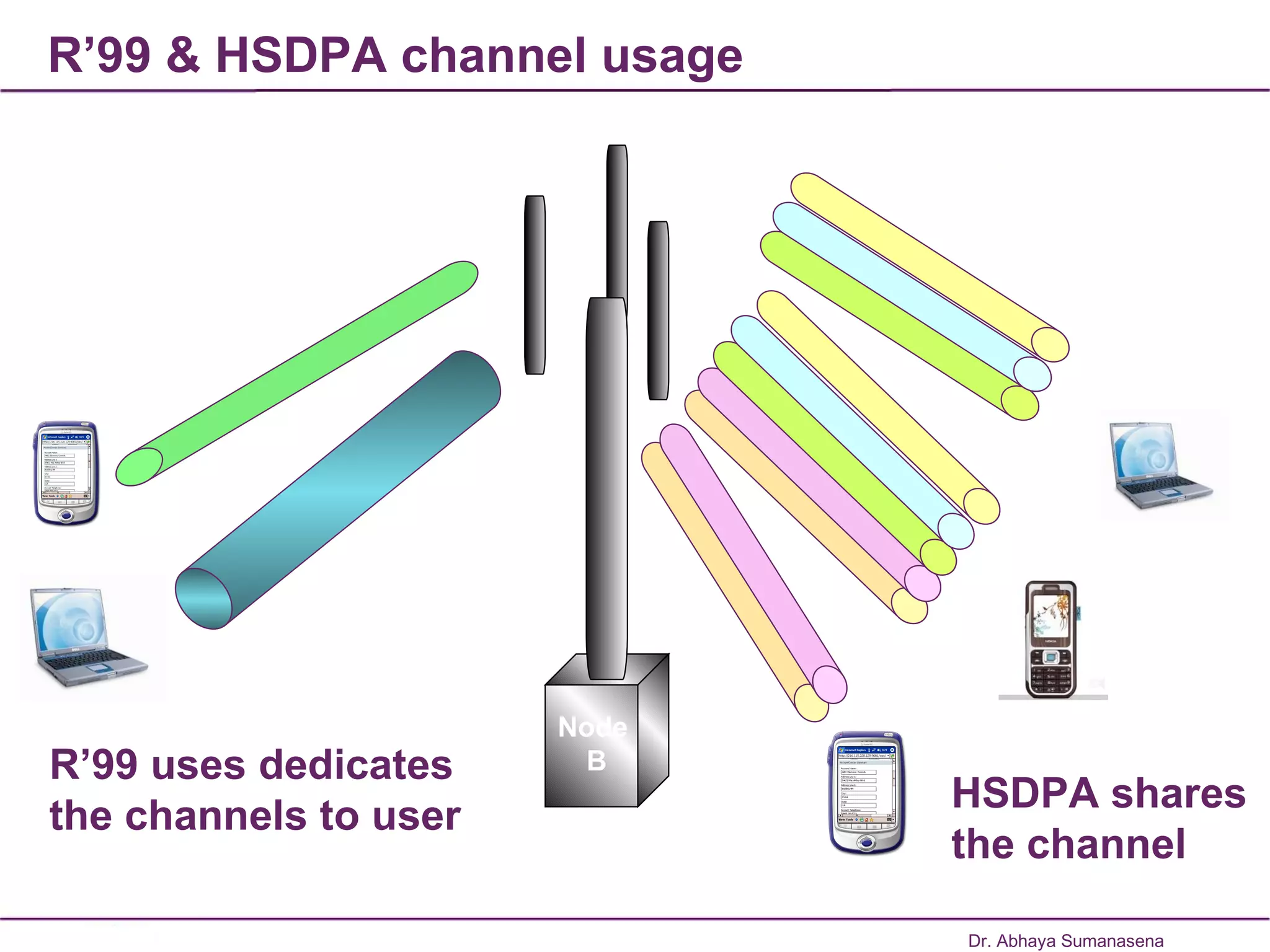
R’99 & HSDPA channel usage R’99 uses dedicates  the channels to user Node  B Dr. Abhaya Sumanasena HSDPA shares  the channel
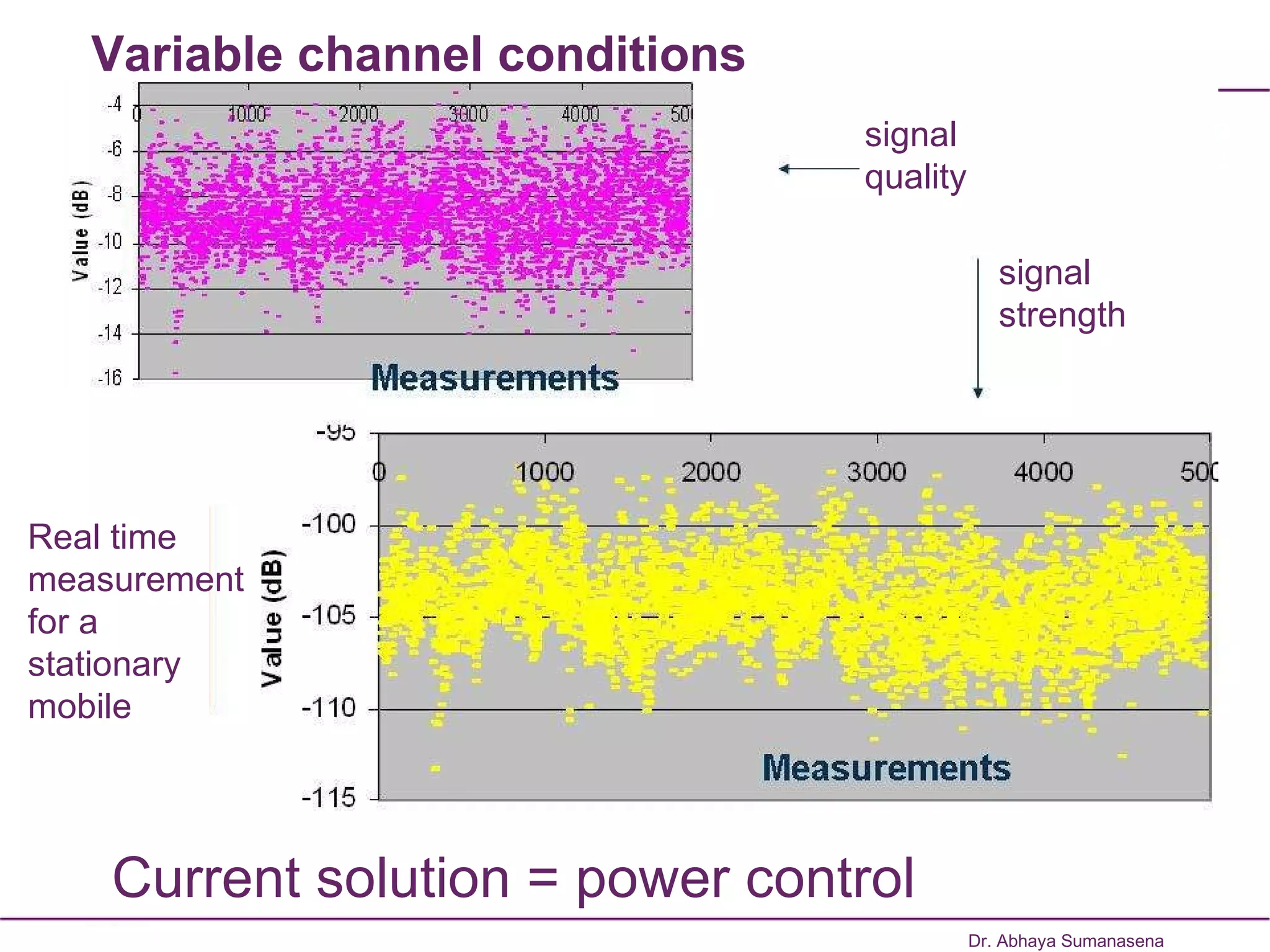
Dr. Abhaya Sumanasena ≈  SR signal  strength Variable channel conditions signal  quality Real time  measurement  for a  stationary  mobile Current solution = power control
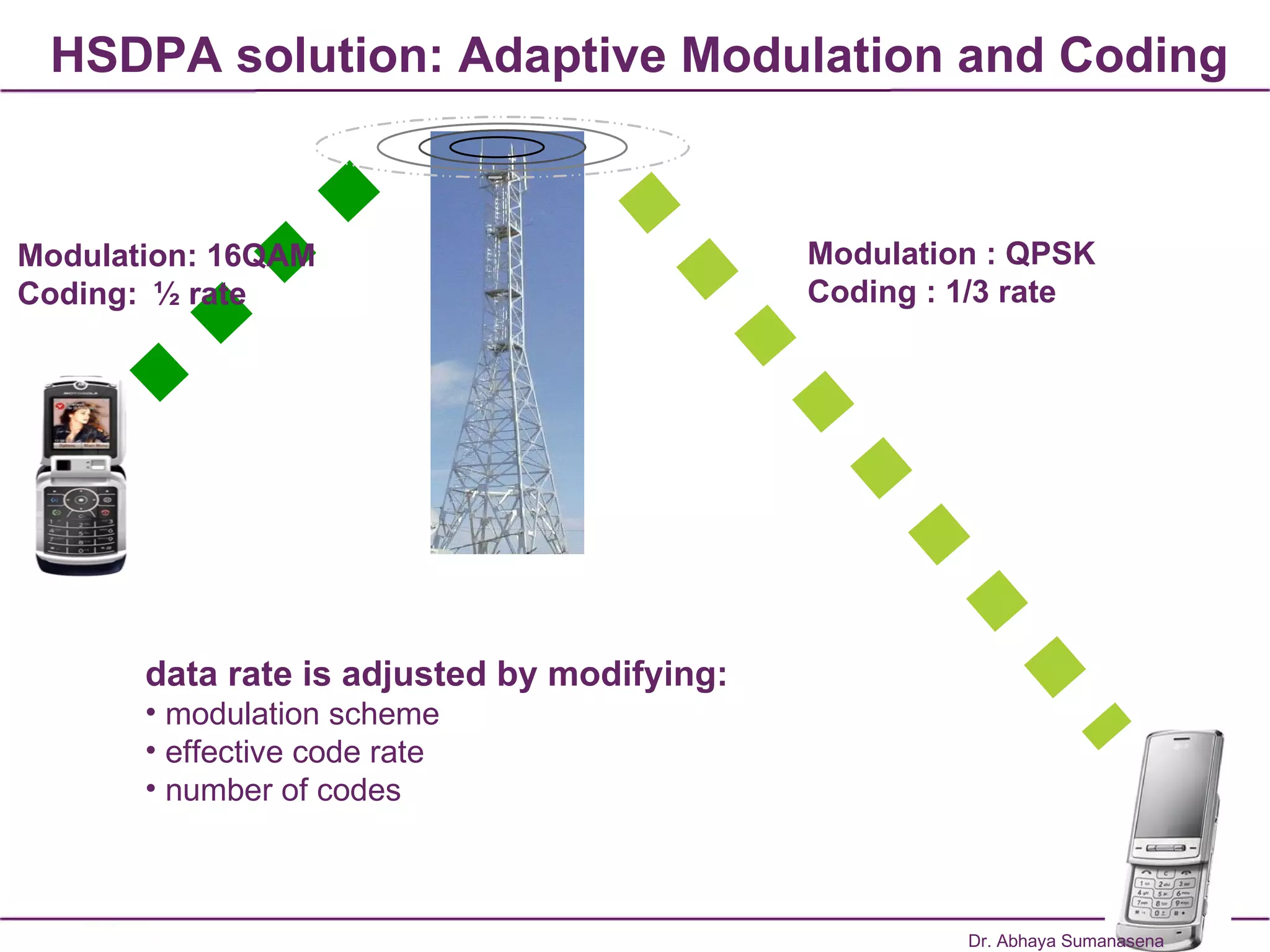
HSDPA solution: Adaptive Modulation and Coding data rate is adjusted by modifying: modulation scheme effective code rate number of codes Modulation: 16QAM Coding:  ½ rate Modulation : QPSK  Coding : 1/3 rate Dr. Abhaya Sumanasena
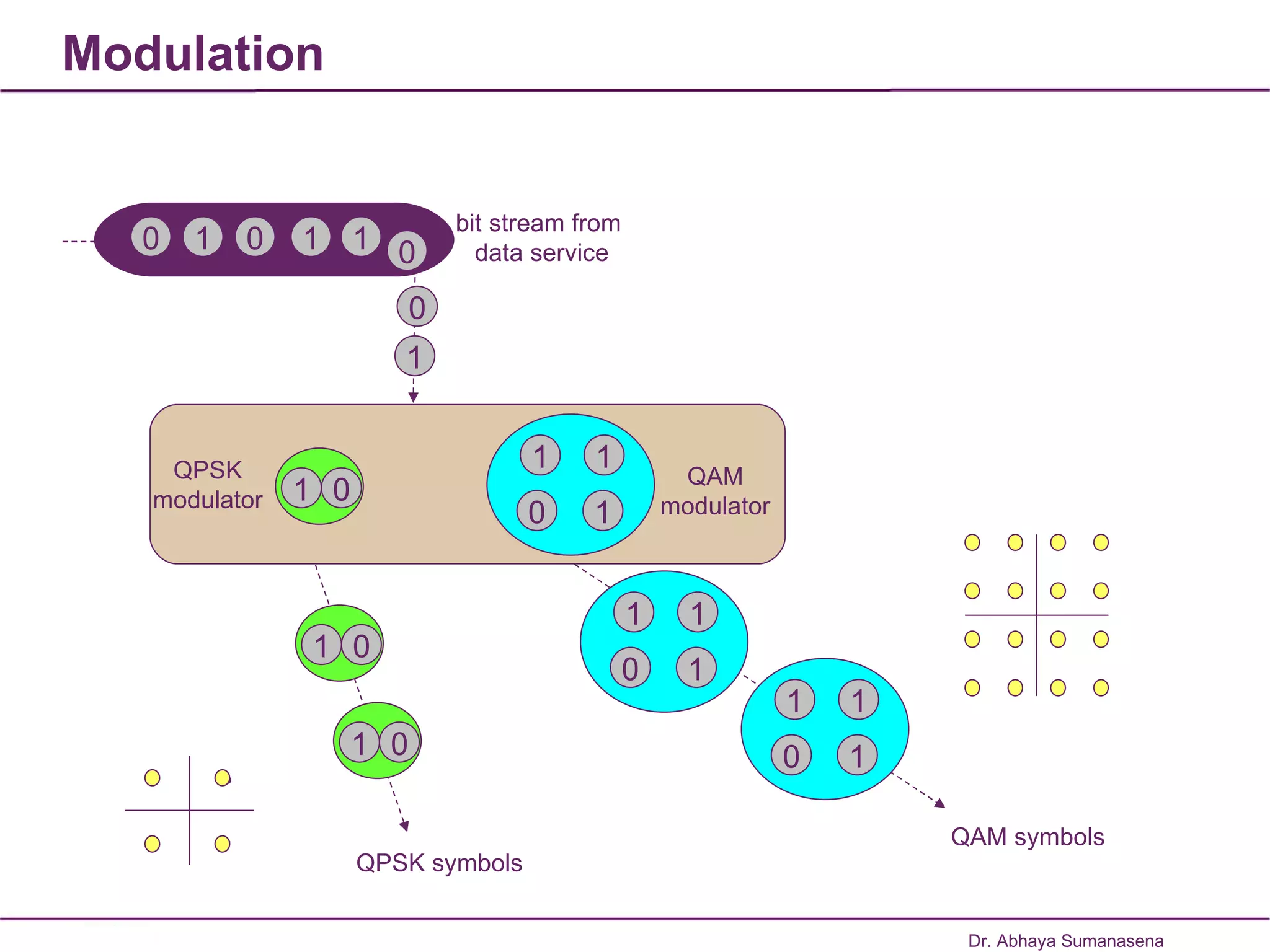
Modulation 0 1 0 1 1 0 0 1 QPSK modulator QAM modulator QAM symbols QPSK symbols bit stream from  data service Dr. Abhaya Sumanasena 1 0 1 1 0 1 1 1 0 1 1 1 0 1 1 0 1 0
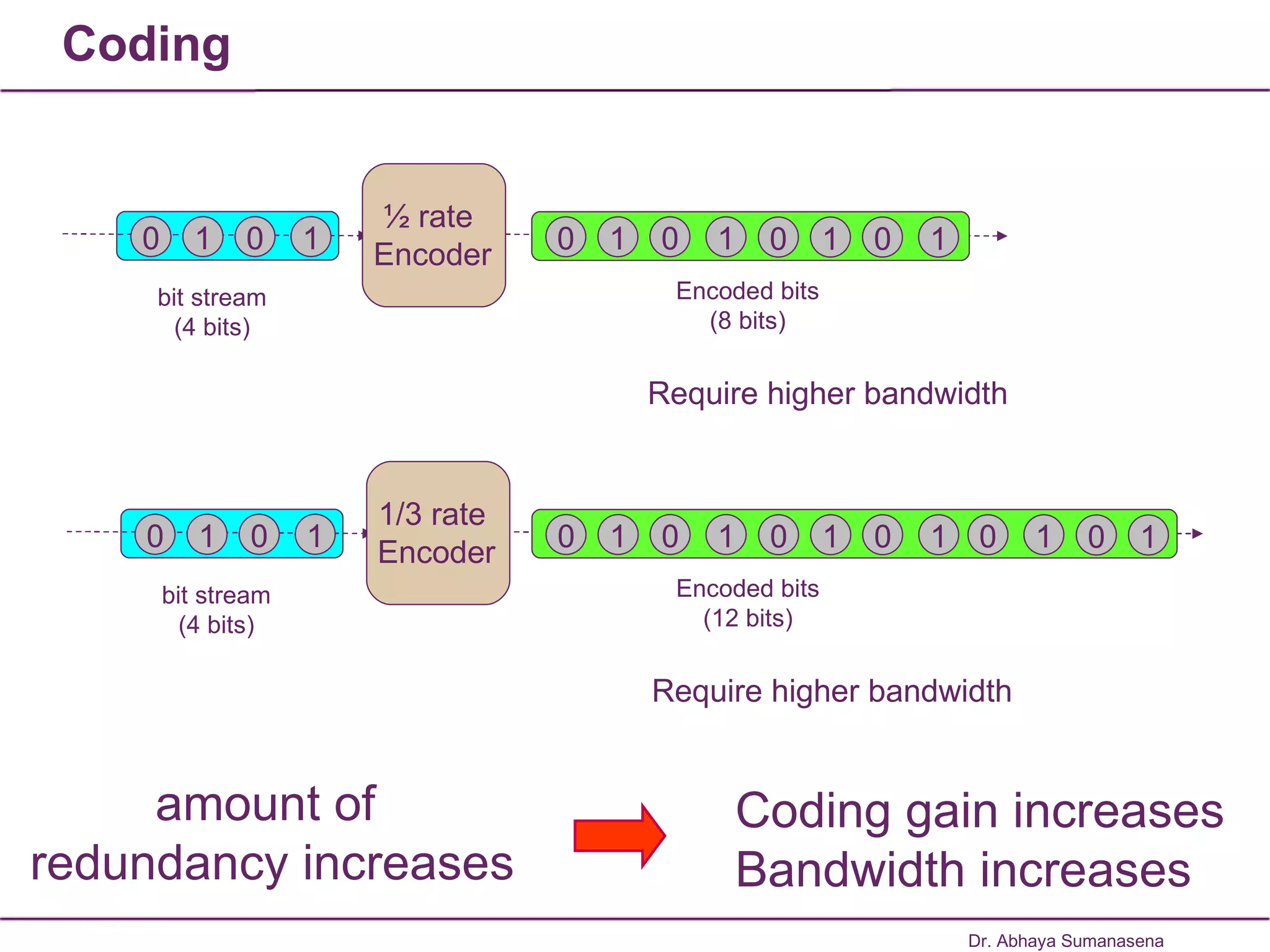
Coding 0 1 0 1 bit stream (4 bits) ½ rate  Encoder 0 1 0 1 0 1 0 1 Encoded bits (8 bits) Require higher bandwidth 0 1 0 1 bit stream (4 bits) 1/3 rate  Encoder 0 1 0 1 0 1 0 1 Encoded bits (12 bits) Require higher bandwidth 0 1 0 1 amount of  redundancy increases Coding gain increases Bandwidth increases Dr. Abhaya Sumanasena
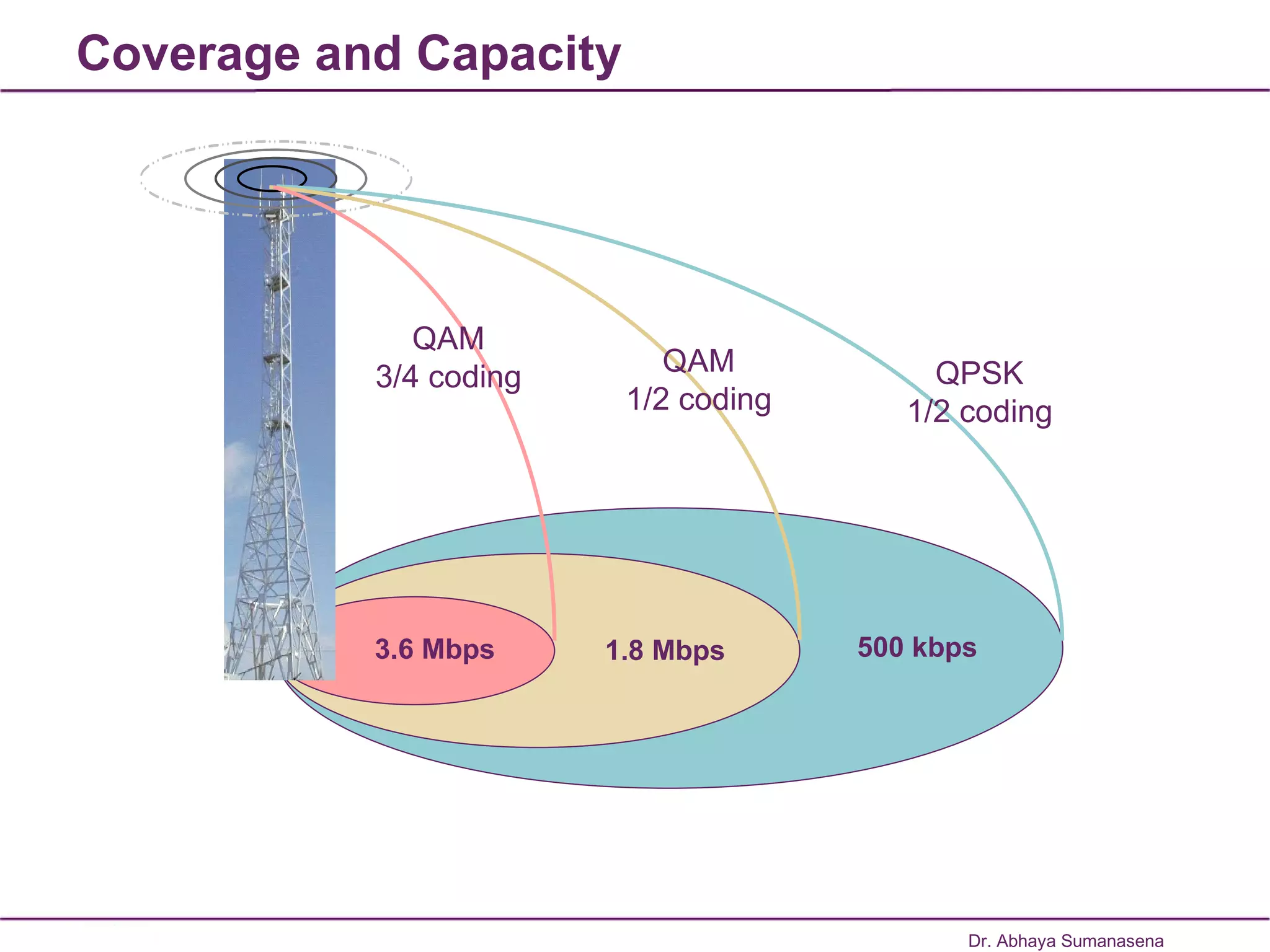
Coverage and Capacity 3.6 Mbps 1.8 Mbps 500 kbps QAM 3/4 coding QAM 1/2 coding QPSK 1/2 coding Dr. Abhaya Sumanasena
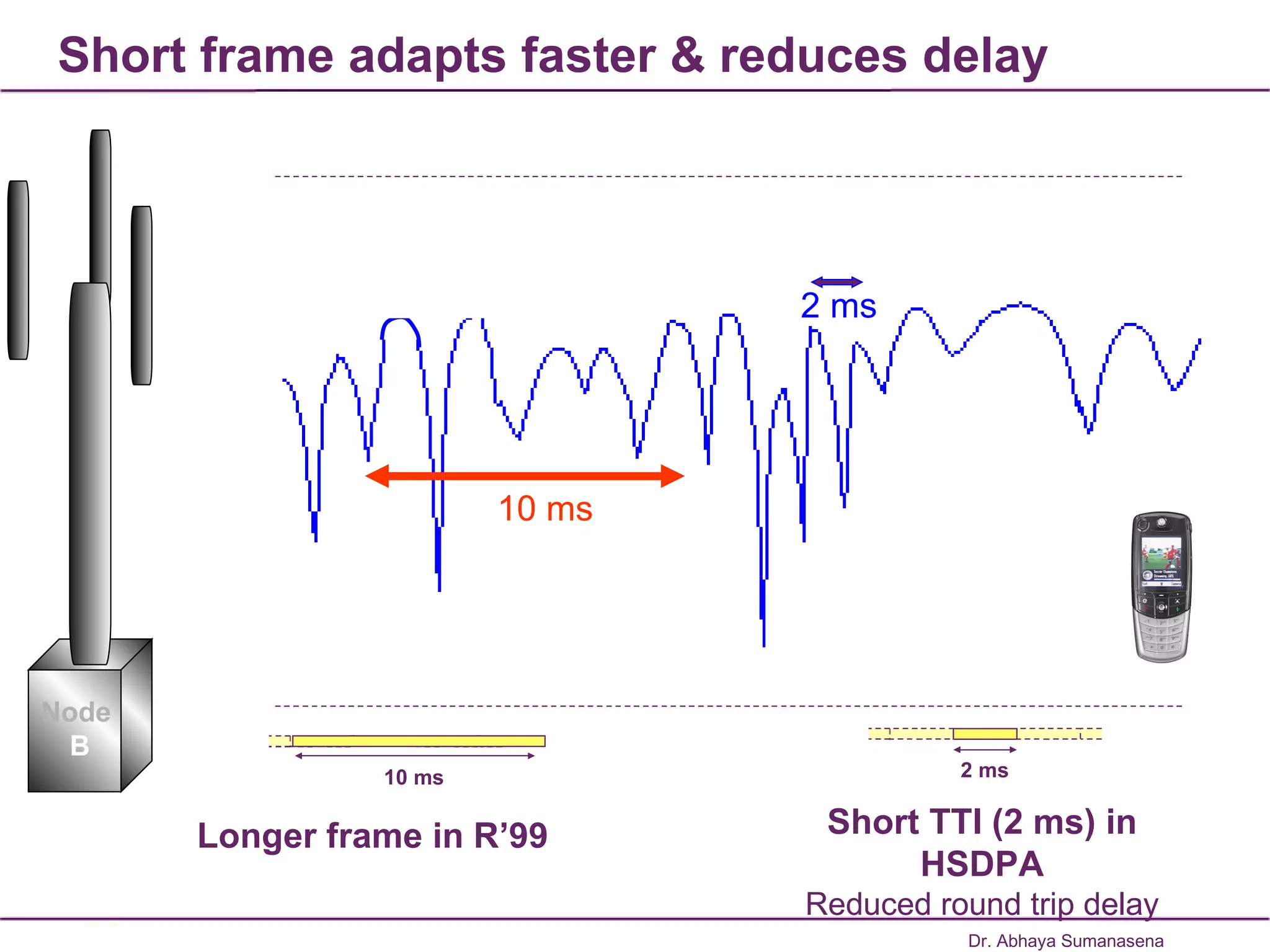
Short frame adapts faster & reduces delay 10 ms 10 ms Longer frame in R’99 Dr. Abhaya Sumanasena Node  B 2 ms 2 ms Short TTI (2 ms) in HSDPA Reduced round trip delay
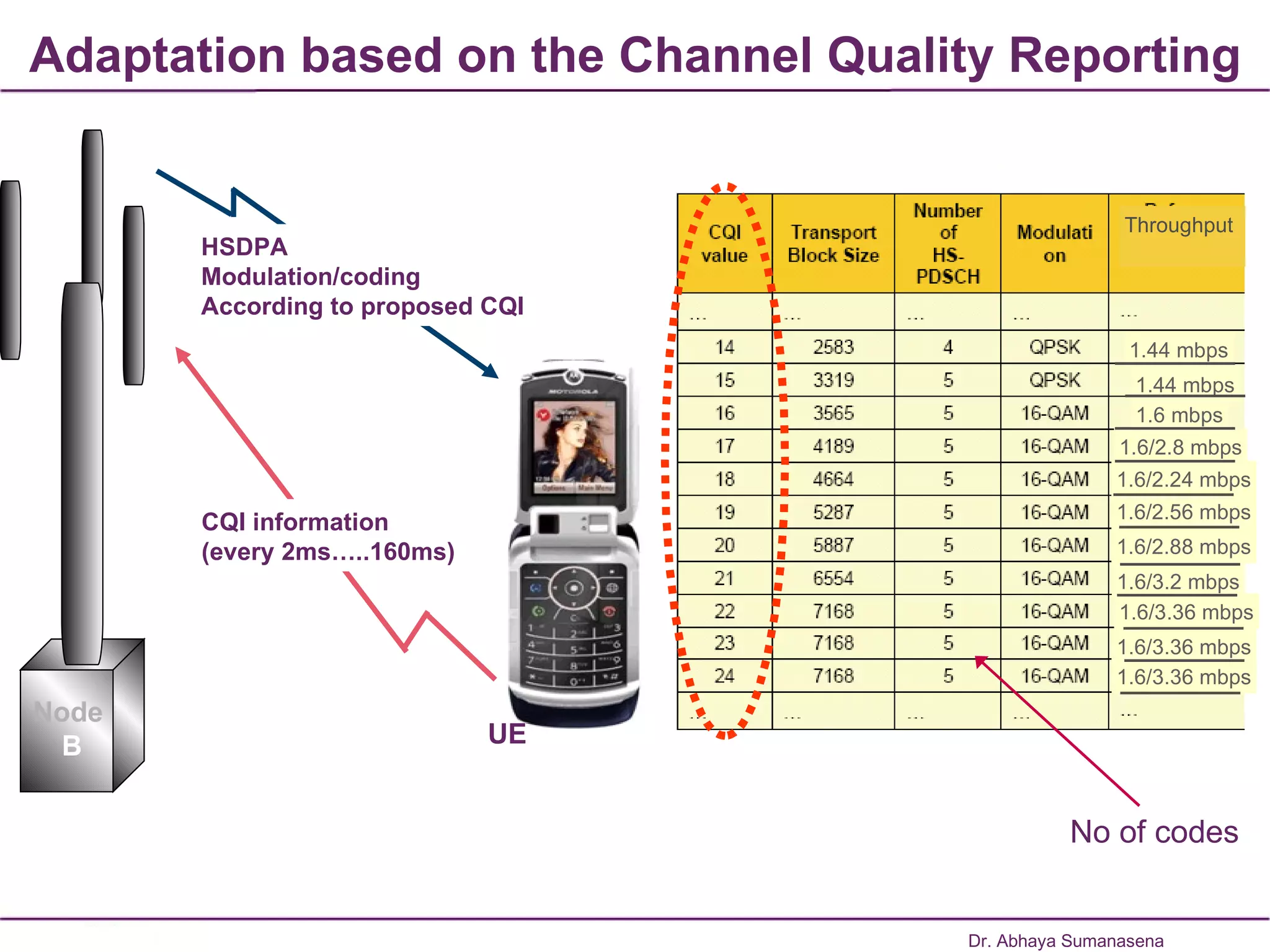
Adaptation based on the Channel Quality Reporting HSDPA Modulation/coding  According to proposed CQI CQI information  (every 2ms…..160ms) UE No of codes 1.44 mbps 1.44 mbps 1.6 mbps 1.6/2.8 mbps 1.6/2.24 mbps 1.6/2.56 mbps 1.6/2.88 mbps 1.6/3.2 mbps 1.6/3.36 mbps 1.6/3.36 mbps 1.6/3.36 mbps Throughput Dr. Abhaya Sumanasena Node  B
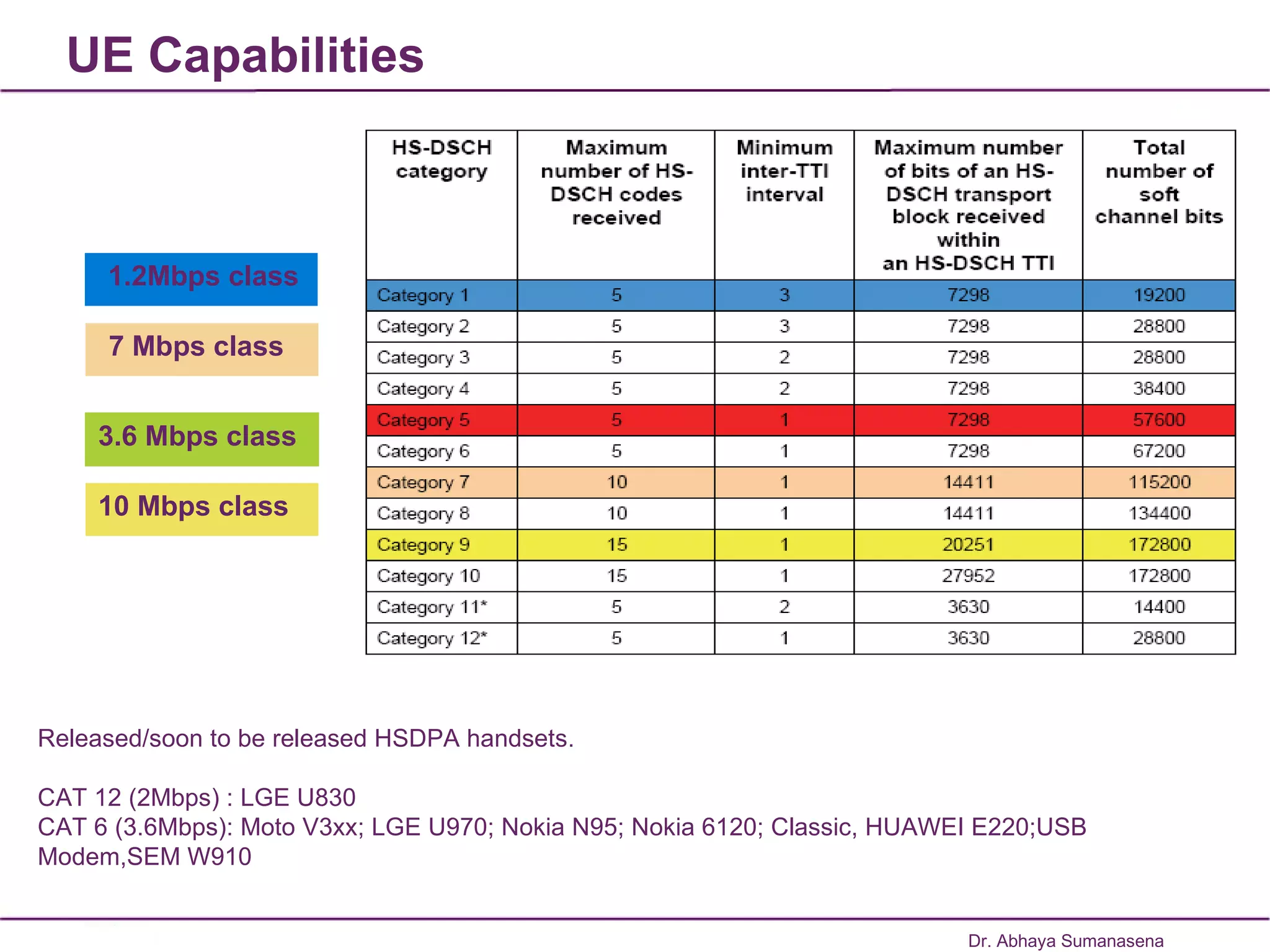
UE Capabilities   1.2Mbps class 7 Mbps class 3.6 Mbps class 10 Mbps class Released/soon to be released HSDPA handsets.   CAT 12 (2Mbps) : LGE U830 CAT 6 (3.6Mbps): Moto V3xx; LGE U970; Nokia N95; Nokia 6120; Classic, HUAWEI E220;USB  Modem,SEM W910 Dr. Abhaya Sumanasena
What do the operators have to do ? Dr. Abhaya Sumanasena
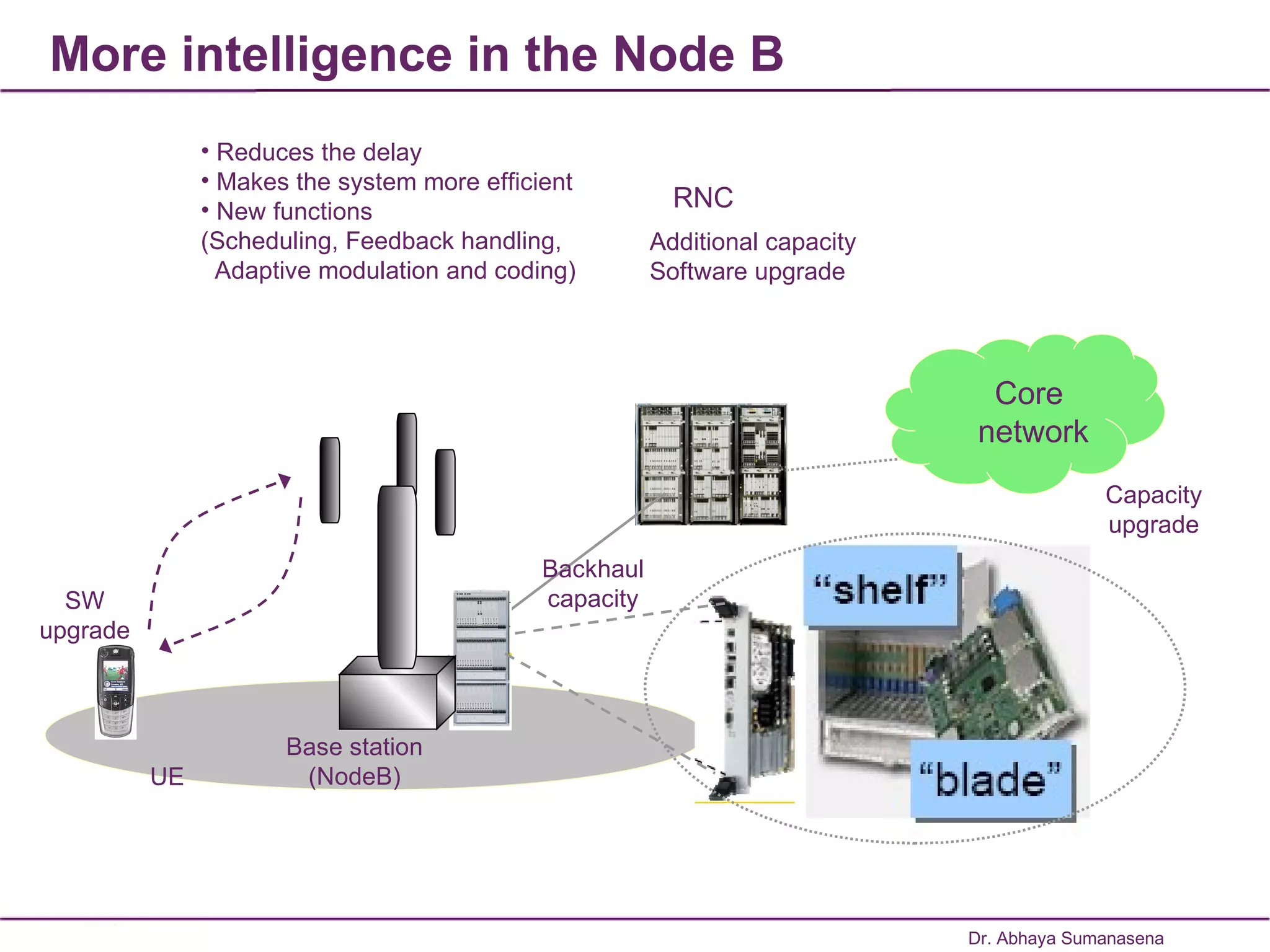
More intelligence in the Node B Dr. Abhaya Sumanasena RNC Reduces the delay Makes the system more efficient New functions  (Scheduling, Feedback handling,  Adaptive modulation and coding) Additional capacity Software upgrade Core   network Base station (NodeB) UE SW upgrade Backhaul capacity Capacity upgrade
What is there for the user ? Dr. Abhaya Sumanasena
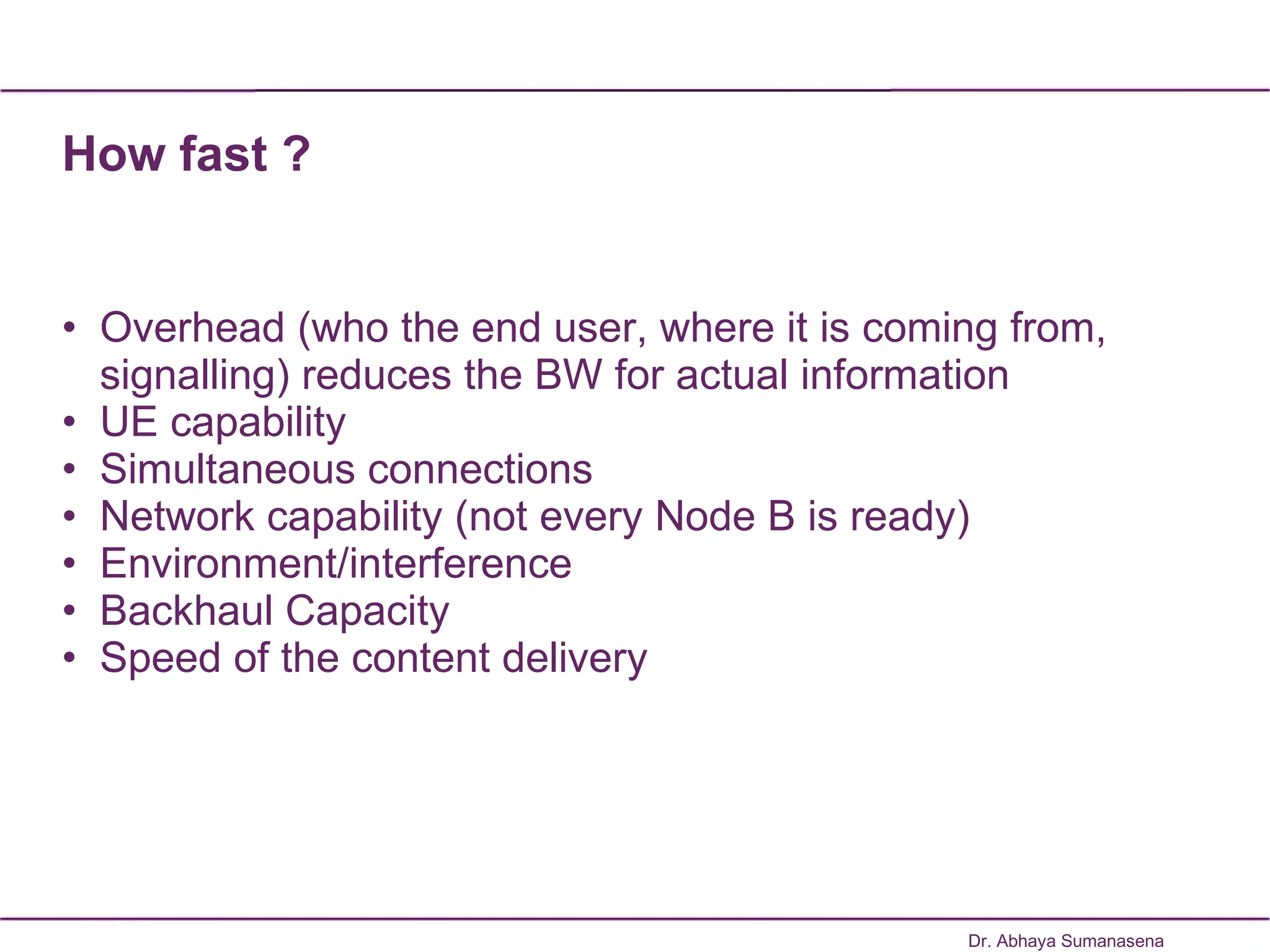
How fast ? Overhead (who the end user, where it is coming from, signalling) reduces the BW for actual information UE capability Simultaneous connections Network capability (not every Node B is ready) Environment/interference Backhaul Capacity  Speed of the content delivery Dr. Abhaya Sumanasena
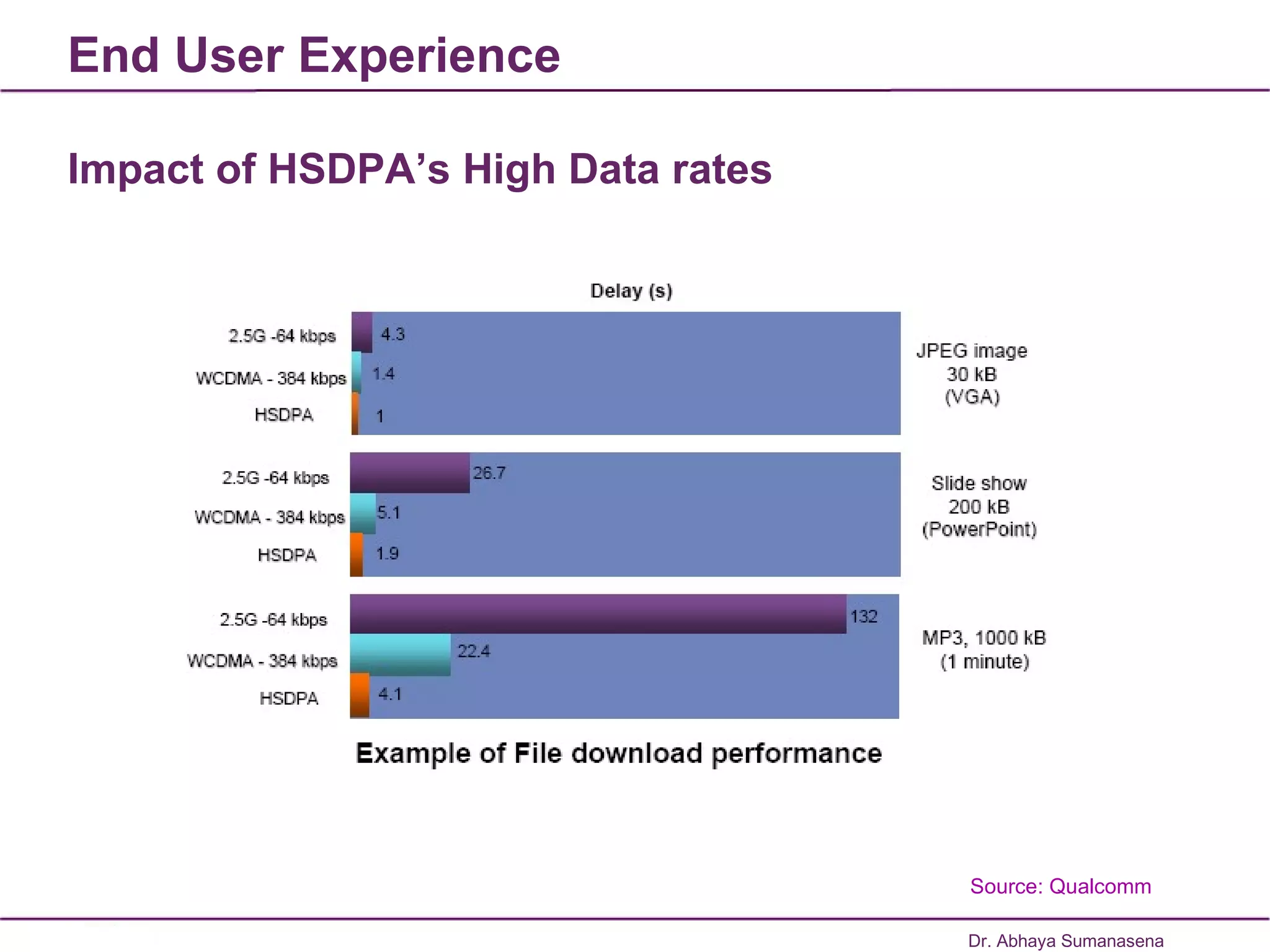
End User Experience Impact of HSDPA’s High Data rates Source: Qualcomm Dr. Abhaya Sumanasena
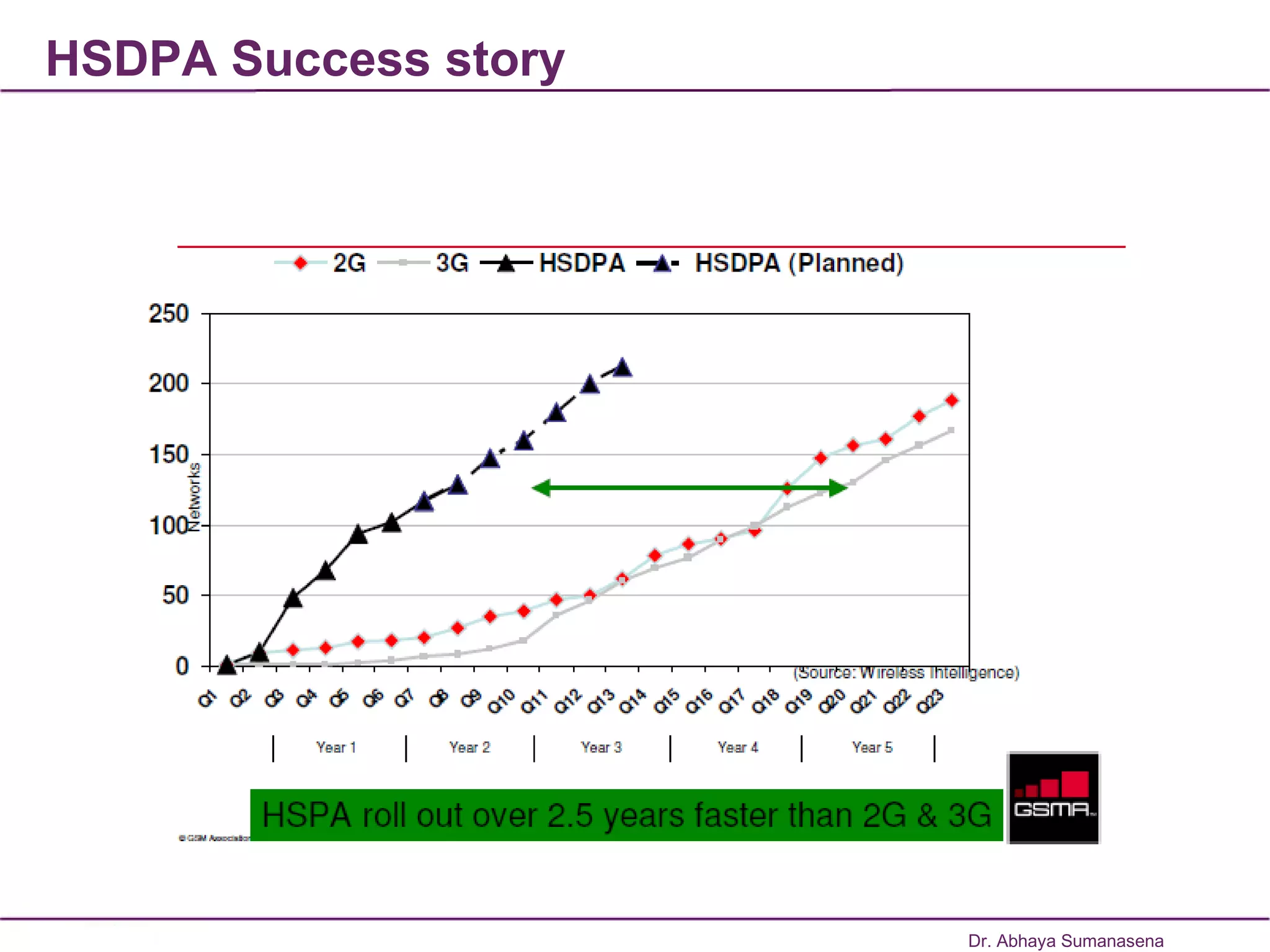
HSDPA Success story Dr. Abhaya Sumanasena
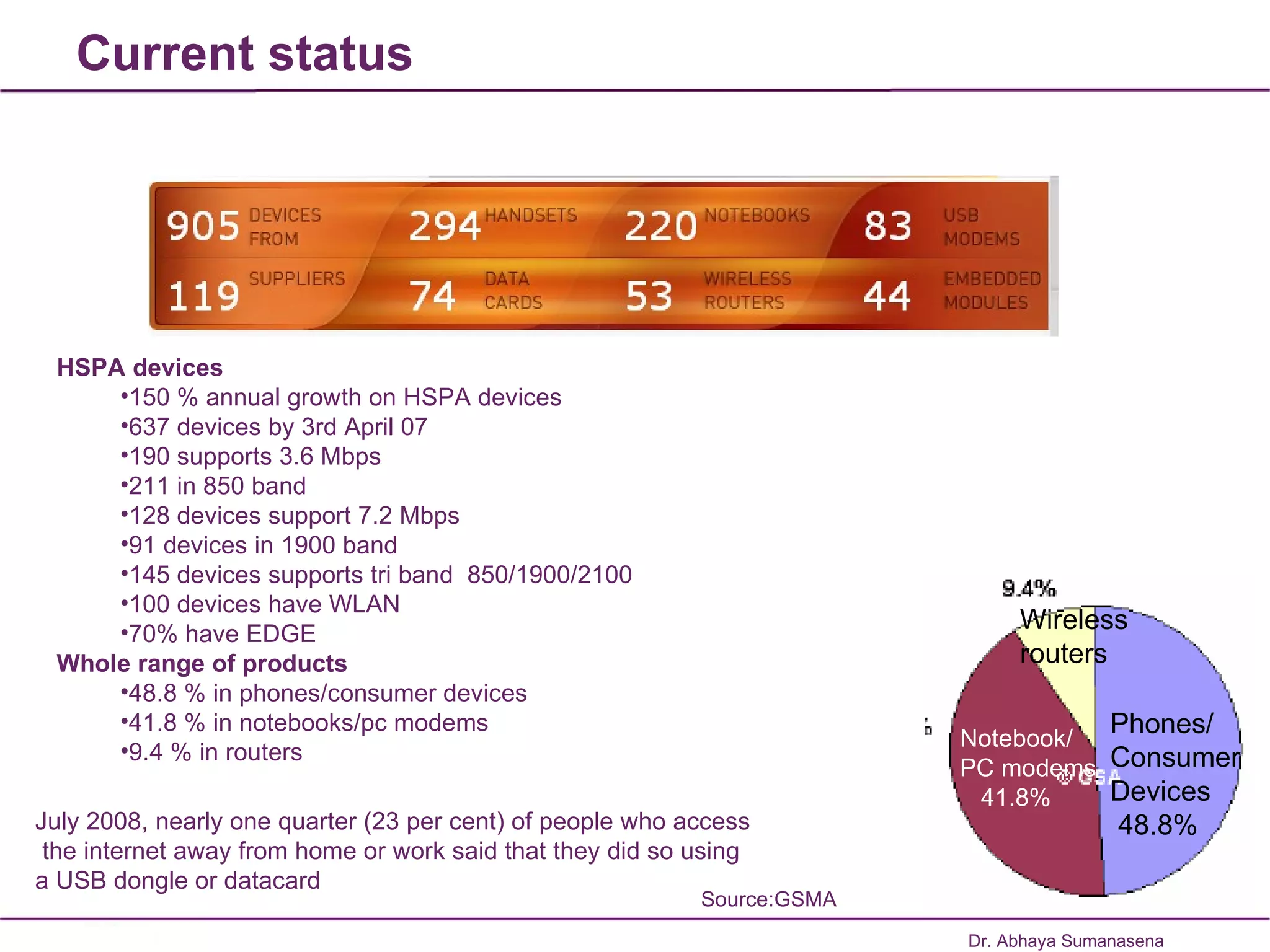
Source:GSMA Current status Notebook/ PC modems 41.8% Wireless routers Phones/ Consumer  Devices 48.8% Dr. Abhaya Sumanasena July 2008, nearly one quarter (23 per cent) of people who access the internet away from home or work said that they did so using  a USB dongle or datacard  HSPA devices 150 % annual growth on HSPA devices  637 devices by 3rd April 07 190 supports 3.6 Mbps 211 in 850 band 128 devices support 7.2 Mbps 91 devices in 1900 band 145 devices supports tri band  850/1900/2100 100 devices have WLAN 70% have EDGE  Whole range of products 48.8 % in phones/consumer devices 41.8 % in notebooks/pc modems 9.4 % in routers
Future Directions Dr. Abhaya Sumanasena
LTE What is LTE:  The next step in the evolution of 3GPP ( Rel-8 ) radio interfaces to deliver “global mobile  broadband”.  LTE is more about what user likes to have, about convenience and user experience  much about broadband and not about voice. Voice is not the driving force for LTE Main services provided by LTE: messaging, internet surfing, VoIP  Performance Targets Significantly improved spectrum efficiency and cell edge bitrate whilst maintaining same site locations DL target 3-4 times and UL target 2-3 times greater than HSDPA Release 6 Reduced CAPEX and OPEX (simple architecture, maximum reuse) resulting in low cost per bit Soft handover no longer required and circuit-switched connectivity no longer supported MIMO raises the number of users/cell  by a factor of 10 compared to UMTS Current status of development The specifications were approved in September and December 2007. The work on the Layer 1 was closed in March 2008 and open work on core specifications is planned to be finished in 2008.  NTT DoCoMo and Varizone announced LTE deployments in 2100 MHz and 700 MHz bands by 2010 Capabilities Likely LTE deployment scenarios   [source: 3gpp] Data rates 2x20 MHz UL: 50 Mbps (peak)/ 20 Mbps (av) DL: 160 Mbps (peak) Latency 10 ms Spectral efficiency Data: DL/UL 2.14/0.9 bps/Hz/cell  Voice: DL/UL 45-55 users/MHz/cell Spectrum  IMT-2000 bands Bandwidth 1.4, 3, 5,10,15, 20 MHz User Experience 2-5 Mbps, better cell edge performance at lower cost
Regulatory aspects Dr. Abhaya Sumanasena
Principal duty under the Communications Act to further the interests of consumers, where appropriate by promoting competition Principal spectrum related duty to secure optimal use of the spectrum and competition between providers Three ways to manage the spectrum: Command & control . An approach whereby the regulator determines what the spectrum can be used for and who should own it. Changes can only be made with the approval of the regulator. In 2004, this approach was used for over 90% of the spectrum. Market forces . Under this approach flexible licenses are provided which allow the licence holder to change the use they put the spectrum to and to sell their licences to others (“liberalisation” and “trading”, respectively). Licence exempt . Often termed unlicensed or “spectrum commons”, this approach allows anyone to use the spectrum without a licence as long as their equipment conforms to certain restrictions, normally relatively low transmit power levels. In 2004 around 6% of the spectrum was licence exempt, including the highly successful 2.4GHz band used for WiFi and BlueTooth. Regulatory aspects
Thank you! (please send your feedback abhaya@theiet.org) Dr. Abhaya Sumanasena

Abhaya 4 Slintec Jan08 Part2

  • 1.
    Mobile communications: presentand future (Part- II) Dr. Abhaya Sumanasena MSc PhD CEng MIET MIEEE 22 January 2009 Dr. Abhaya Sumanasena
  • 2.
    Introduction to HSDPA Dr. Abhaya Sumanasena
  • 3.
    What is HSDPA? Dr. Abhaya Sumanasena
  • 4.
    Overview 3GPP WCDMAEvolution UL = Uplink DL =Downlink DL: 100 mbps UL: 50 mbps LTE Dr. Abhaya Sumanasena
  • 5.
    HSDPA HSDPA servicesprovide users with a "broadband experience" today on mobile HSDPA delivers a 5-fold increase in downlink data speeds. It increases spectrum efficiency by using adaptive modulation and coding HSDPA is a most cost effective way to provide high-speed broadband access to both rural communities and the developing world [GSMA] HSDPA users can roam up to 55 countries [GSMA] Deployed in many frequency bands ( 850, 900,1700, 1800, 1900 and 2100 MHz) Leverages the existing 3G assets Spectrum Subscriber base Network infrastructure (sites, radio, core network, transmission) Operation and Management system and staff Subscriber management systems (authentication, billing) Dr. Abhaya Sumanasena
  • 6.
    Some Basics Dr.Abhaya Sumanasena
  • 7.
    Paths for packetand voice calls Dr. Abhaya Sumanasena HSDPA is only about data!
  • 8.
    Downlink in R’99& HSDPA Dr. Abhaya Sumanasena
  • 9.
    R’99 & HSDPAchannel usage R’99 uses dedicates the channels to user Node B Dr. Abhaya Sumanasena HSDPA shares the channel
  • 10.
    Dr. Abhaya Sumanasena≈ SR signal strength Variable channel conditions signal quality Real time measurement for a stationary mobile Current solution = power control
  • 11.
    HSDPA solution: AdaptiveModulation and Coding data rate is adjusted by modifying: modulation scheme effective code rate number of codes Modulation: 16QAM Coding: ½ rate Modulation : QPSK Coding : 1/3 rate Dr. Abhaya Sumanasena
  • 12.
    Modulation 0 10 1 1 0 0 1 QPSK modulator QAM modulator QAM symbols QPSK symbols bit stream from data service Dr. Abhaya Sumanasena 1 0 1 1 0 1 1 1 0 1 1 1 0 1 1 0 1 0
  • 13.
    Coding 0 10 1 bit stream (4 bits) ½ rate Encoder 0 1 0 1 0 1 0 1 Encoded bits (8 bits) Require higher bandwidth 0 1 0 1 bit stream (4 bits) 1/3 rate Encoder 0 1 0 1 0 1 0 1 Encoded bits (12 bits) Require higher bandwidth 0 1 0 1 amount of redundancy increases Coding gain increases Bandwidth increases Dr. Abhaya Sumanasena
  • 14.
    Coverage and Capacity3.6 Mbps 1.8 Mbps 500 kbps QAM 3/4 coding QAM 1/2 coding QPSK 1/2 coding Dr. Abhaya Sumanasena
  • 15.
    Short frame adaptsfaster & reduces delay 10 ms 10 ms Longer frame in R’99 Dr. Abhaya Sumanasena Node B 2 ms 2 ms Short TTI (2 ms) in HSDPA Reduced round trip delay
  • 16.
    Adaptation based onthe Channel Quality Reporting HSDPA Modulation/coding According to proposed CQI CQI information (every 2ms…..160ms) UE No of codes 1.44 mbps 1.44 mbps 1.6 mbps 1.6/2.8 mbps 1.6/2.24 mbps 1.6/2.56 mbps 1.6/2.88 mbps 1.6/3.2 mbps 1.6/3.36 mbps 1.6/3.36 mbps 1.6/3.36 mbps Throughput Dr. Abhaya Sumanasena Node B
  • 17.
    UE Capabilities 1.2Mbps class 7 Mbps class 3.6 Mbps class 10 Mbps class Released/soon to be released HSDPA handsets.   CAT 12 (2Mbps) : LGE U830 CAT 6 (3.6Mbps): Moto V3xx; LGE U970; Nokia N95; Nokia 6120; Classic, HUAWEI E220;USB Modem,SEM W910 Dr. Abhaya Sumanasena
  • 18.
    What do theoperators have to do ? Dr. Abhaya Sumanasena
  • 19.
    More intelligence inthe Node B Dr. Abhaya Sumanasena RNC Reduces the delay Makes the system more efficient New functions (Scheduling, Feedback handling, Adaptive modulation and coding) Additional capacity Software upgrade Core network Base station (NodeB) UE SW upgrade Backhaul capacity Capacity upgrade
  • 20.
    What is therefor the user ? Dr. Abhaya Sumanasena
  • 21.
    How fast ?Overhead (who the end user, where it is coming from, signalling) reduces the BW for actual information UE capability Simultaneous connections Network capability (not every Node B is ready) Environment/interference Backhaul Capacity Speed of the content delivery Dr. Abhaya Sumanasena
  • 22.
    End User ExperienceImpact of HSDPA’s High Data rates Source: Qualcomm Dr. Abhaya Sumanasena
  • 23.
    HSDPA Success storyDr. Abhaya Sumanasena
  • 24.
    Source:GSMA Current statusNotebook/ PC modems 41.8% Wireless routers Phones/ Consumer Devices 48.8% Dr. Abhaya Sumanasena July 2008, nearly one quarter (23 per cent) of people who access the internet away from home or work said that they did so using a USB dongle or datacard HSPA devices 150 % annual growth on HSPA devices 637 devices by 3rd April 07 190 supports 3.6 Mbps 211 in 850 band 128 devices support 7.2 Mbps 91 devices in 1900 band 145 devices supports tri band 850/1900/2100 100 devices have WLAN 70% have EDGE Whole range of products 48.8 % in phones/consumer devices 41.8 % in notebooks/pc modems 9.4 % in routers
  • 25.
    Future Directions Dr.Abhaya Sumanasena
  • 26.
    LTE What isLTE: The next step in the evolution of 3GPP ( Rel-8 ) radio interfaces to deliver “global mobile broadband”. LTE is more about what user likes to have, about convenience and user experience much about broadband and not about voice. Voice is not the driving force for LTE Main services provided by LTE: messaging, internet surfing, VoIP Performance Targets Significantly improved spectrum efficiency and cell edge bitrate whilst maintaining same site locations DL target 3-4 times and UL target 2-3 times greater than HSDPA Release 6 Reduced CAPEX and OPEX (simple architecture, maximum reuse) resulting in low cost per bit Soft handover no longer required and circuit-switched connectivity no longer supported MIMO raises the number of users/cell by a factor of 10 compared to UMTS Current status of development The specifications were approved in September and December 2007. The work on the Layer 1 was closed in March 2008 and open work on core specifications is planned to be finished in 2008. NTT DoCoMo and Varizone announced LTE deployments in 2100 MHz and 700 MHz bands by 2010 Capabilities Likely LTE deployment scenarios [source: 3gpp] Data rates 2x20 MHz UL: 50 Mbps (peak)/ 20 Mbps (av) DL: 160 Mbps (peak) Latency 10 ms Spectral efficiency Data: DL/UL 2.14/0.9 bps/Hz/cell Voice: DL/UL 45-55 users/MHz/cell Spectrum IMT-2000 bands Bandwidth 1.4, 3, 5,10,15, 20 MHz User Experience 2-5 Mbps, better cell edge performance at lower cost
  • 27.
    Regulatory aspects Dr.Abhaya Sumanasena
  • 28.
    Principal duty underthe Communications Act to further the interests of consumers, where appropriate by promoting competition Principal spectrum related duty to secure optimal use of the spectrum and competition between providers Three ways to manage the spectrum: Command & control . An approach whereby the regulator determines what the spectrum can be used for and who should own it. Changes can only be made with the approval of the regulator. In 2004, this approach was used for over 90% of the spectrum. Market forces . Under this approach flexible licenses are provided which allow the licence holder to change the use they put the spectrum to and to sell their licences to others (“liberalisation” and “trading”, respectively). Licence exempt . Often termed unlicensed or “spectrum commons”, this approach allows anyone to use the spectrum without a licence as long as their equipment conforms to certain restrictions, normally relatively low transmit power levels. In 2004 around 6% of the spectrum was licence exempt, including the highly successful 2.4GHz band used for WiFi and BlueTooth. Regulatory aspects
  • 29.
    Thank you! (pleasesend your feedback abhaya@theiet.org) Dr. Abhaya Sumanasena

Editor's Notes

  • #5 HSDPA is a part of well defined roadmap supported by the majority of mobile phone operators (WCDMA downlink evolution HSDPA – High Speed Downlink Packet Access) 3G in 2001 HSPA in 2005
  • #6 is part of 3GPP/UTRAN-FDD Release 5 WCDMA specifications.
  • #11 Link budget R’99 solution power control -4 to -14= 10 times
  • #12 Adaptation of tx parameters to radio conditions and UE capability Link adaptation every TTI 2ms
  • #13 Converts coded bits to channel compatible symbols Key Characteristics Sensitivity Bandwidth efficiency Envelope characteristics Complexity Power Efficiency QPSK > 4 Modulation phases for the carrier 16 QAM > 16 phase/amplitude combinations for the carrier
  • #14 Ch Coding Adds redundancy Detect and correct the errors when Txed over the air interface
  • #17 Fast scheduling based on CQI UE reported value how much data the UE can receive with a BLER of 10% A UE is a member of one of 12 categories, as a function of its hardware capabilities. Each category represents different values of the following parameters: 􀁺 Number of simultaneous HS-PDSCH codes (5, 10, or 15) 􀁺 Maximum transport block size 􀁺 Inter-TTI interval – minimum time between consecutive assignments. 􀁺 Incremental redundancy buffer size – used to soft-combine symbols from retransmissions.
  • #20 All Release’99 transport channels presented earlier in this document are terminated at the RNC. Hence, the retransmission procedure for the packet data is located in the serving RNC, which also handles the connection for the particular user to the core network. With the introduction of HS-DSCH, additional intelligence in the form of an HSDPA Medium Access Control (MAC) layer is installed in the Node B. This way, retransmissions can be controlled directly by the Node B, leading to faster retransmission and thus shorter delay with packet data operation when retransmissions are needed. With HSDPA, the Iub interface between Node B and RNC requires a flow control mechanism to ensure that Node B buffers are used properly and that there is no data loss due to Node B buffer overflow. Although there is a new MAC functionality added in the Node B, the RNC still retains the Release’99/Release 4 functionalities of the Radio Link Control (RLC), such as taking care of the retransmission in case the HS-DSCH transmission from the Node N would fail after, for instance, exceeding the maximum number of physical layer retransmissions. The key functionality of the new Node B MAC functionality (MAC-hs) is to handle the Automatic Repeat Request (ARQ) functionality and scheduling as well as priority handling. Ciphering is done in any case in the RLC layer to ensure that the ciphering mask stays identical for each retransmission to enable physical layer combining of retransmissions. Similar to Node B a new MAC entity, MAC-hs is added in the UE architecture. The functionality of the MAC-hs is same as on the Node B side. The Node B scheduler is responsible for deciding how to allocate the available HSDPA channels and transmit power among users. The standard puts no requirements on this algorithm, leaving it entirely implementation dependent. Some possible schemes: 􀁺 Round Robin – Each user is allocated the channel in a fixed rotation. The scheme could be simple, or modified to account for CQI and/or user priorities. 􀁺 Proportional Fair – Each user sees a throughput proportional to the peak rate that its link can sustain.
  • #25 3 has already completed a rollout to give more than 95 per cent of the UK's population access to 3.6Mb/s HSDPA. It hopes to raise that speed to 7.2Mb/s by 2010 – the same time that the big cities get 14.4Mb/s HSDPA and 5.7Mb/s HSUPA
  • #26 HSPA soon will reach its limits due to the spectrum efficiency Revenue and traffic is no longer coupled. traffic increases (revenue per MB goes down but Data revenues MEUR increases) In the past coverage and capacity and devices. In the future: economy and cost HSPA+ gives peak rates only for a small part of the cell.
  • #27 Modems IMT-Advanced- concept from the ITU for mobile communication systems with capabilities which go further than that of IMT-2000 ITU-R has invited submission of candidate Radio Interface Technologies (RITs) for IMT-Advanced. Gbps
  • #29 As market economics have been more widely used across other areas of our economy there has been increasing interest in utilising a market in radio spectrum to deliver greater economic benefits reforms introduced in the UK in the last few years in the form of spectrum trading Radio spectrum =properties to land – both a finite resources, with some areas that are highly desirable and as a result congested, and others that are less so. Imagine, then, that you could only buy your house from the Government, that you had to return it after 20 years and that you had no rights to sell it to anyone else, to rent it, or to change it in any manner. Regulators have been on a journey to liberalise spectrum management for many years.