Presented by:
Manish Srivastava
   Widely used in 90’s-2000
   allows multiple users on a single channel.
   Supports voice as well as data.
   radio signals on 2G networks are digital,
    which can be compressed and multiplexed
    easily.
   2G technologies can be divided into TDMA-
    based and CDMA-based standards depending
    on the type of multiplexing used.
   Speed 9.6 Kbps .
   Carrier frequency is of 200 KHz.
   Used in 2001-2004
   In addition to circuit switched data, packet
    switched data was also implemented.
   Enhanced multimedia and streaming video are
    possible.
   Supports web browsing
   2.5G is General Packet Radio Service (GPRS),
    which is evolution from GSM.
   GPRS could provide data rates from 56 Kbps up to
    115 Kbps.
    It can be used for services such as wireless
    application protocol (WAP) access, Multimedia
    Messaging Service (MMS), and for Internet
    communication services such as email and World
    Wide Web access.
   carrier frequency is same as that of 2G.
   Came into picture during 2004-2005.
   High speed (2Mbps) and increased bandwidth (2GHz).
   Carrier frequency is 5 MHz.
   3G networks offer greater security than their 2G
    predecessors because 3G networks permit validation
    measures when communicating with other devices. 
   This technology is much more flexible as it can support 5
    major radio technologies that operate under CDMA, TDMA
    and FDMA. CDMA accounts for IMT-DS (direct speed), IMT-MC
    (multi carrier). TDMA holds for IMT-TC (time code), IMT-SC
    (single carrier).
   Applications of 3G are: Mobile TV, Video on Demand, Video
    Conferencing, Location-based services and Global Positioning
    System(GPS)
   Drawback of 3G is that it is simply not available in certain
    regions.
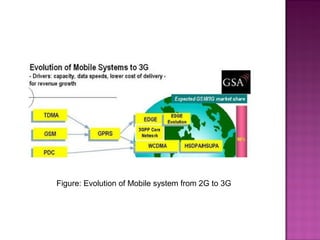
Figure: Evolution of Mobile system from 2G to 3G
   LTE is a standard for wireless communication of
    high-speed data for mobile phones and data
    terminals.
   Supports at least 200 active data clients in every
    5 MHz cell.
   It is based on the GSM/EDGE and UMTS/HSPA
    network technologies, increasing the capacity
    and speed using new modulation techniques.
   Ability to manage fast moving mobiles and
    supports MBSFN (Multicast Broadcast Single
    Frequency Network).
   It can deliver services such as Mobile TV
   Formally submitted as a candidate 4G system to
    ITU-T in late 2009, was approved into ITU,
    International Telecommunications Union, IMT-
    Advanced and was finalized by 3GPP in March
    2011.
   Data rate is 2Gbps.
   It targets faster switching between power states
    and improved performance at the cell edge.
   Improves the capacity and coverage, and ensures
    user fairness.
   Also introduces multicarrier to be able to use
    ultra wide bandwidth, up to 100 MHz of
    spectrum supporting very high data rates.
Comparison between 2g, 2.5g, 3g, lte and lte a

Comparison between 2g, 2.5g, 3g, lte and lte a

  • 1.
  • 2.
    Widely used in 90’s-2000  allows multiple users on a single channel.  Supports voice as well as data.  radio signals on 2G networks are digital, which can be compressed and multiplexed easily.  2G technologies can be divided into TDMA- based and CDMA-based standards depending on the type of multiplexing used.  Speed 9.6 Kbps .  Carrier frequency is of 200 KHz.
  • 3.
    Used in 2001-2004  In addition to circuit switched data, packet switched data was also implemented.  Enhanced multimedia and streaming video are possible.  Supports web browsing  2.5G is General Packet Radio Service (GPRS), which is evolution from GSM.  GPRS could provide data rates from 56 Kbps up to 115 Kbps.  It can be used for services such as wireless application protocol (WAP) access, Multimedia Messaging Service (MMS), and for Internet communication services such as email and World Wide Web access.  carrier frequency is same as that of 2G.
  • 4.
    Came into picture during 2004-2005.  High speed (2Mbps) and increased bandwidth (2GHz).  Carrier frequency is 5 MHz.  3G networks offer greater security than their 2G predecessors because 3G networks permit validation measures when communicating with other devices.   This technology is much more flexible as it can support 5 major radio technologies that operate under CDMA, TDMA and FDMA. CDMA accounts for IMT-DS (direct speed), IMT-MC (multi carrier). TDMA holds for IMT-TC (time code), IMT-SC (single carrier).  Applications of 3G are: Mobile TV, Video on Demand, Video Conferencing, Location-based services and Global Positioning System(GPS)  Drawback of 3G is that it is simply not available in certain regions.
  • 5.
    Figure: Evolution ofMobile system from 2G to 3G
  • 6.
    LTE is a standard for wireless communication of high-speed data for mobile phones and data terminals.  Supports at least 200 active data clients in every 5 MHz cell.  It is based on the GSM/EDGE and UMTS/HSPA network technologies, increasing the capacity and speed using new modulation techniques.  Ability to manage fast moving mobiles and supports MBSFN (Multicast Broadcast Single Frequency Network).  It can deliver services such as Mobile TV
  • 7.
    Formally submitted as a candidate 4G system to ITU-T in late 2009, was approved into ITU, International Telecommunications Union, IMT- Advanced and was finalized by 3GPP in March 2011.  Data rate is 2Gbps.  It targets faster switching between power states and improved performance at the cell edge.  Improves the capacity and coverage, and ensures user fairness.  Also introduces multicarrier to be able to use ultra wide bandwidth, up to 100 MHz of spectrum supporting very high data rates.