TELEMETRY, TRACKING
COMMAND & MONITORING
Presented by:
Alpana A. Ingale
Roll no 8108
CONTENT
1. INTRODUCTION
2. TTC & M BLOCK DIAGRAM
3. TTC & M FUNCTIONS
4. TTC & M BACKUP SYSTEM
5. TELEMETRY SYSTEM
6. MONITORING SYSTEM
7. TRACKING SYSTEM
8. COMMAND SYSTEM
9. COMMANDS USED
10. REFERENCES
TELEMETRY, TRACKING COMMAND
& MONITORING
INTRODUCTION
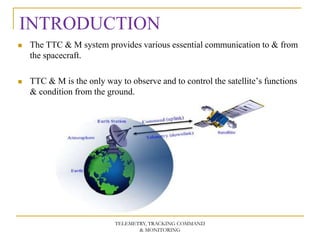
 The TTC & M system provides various essential communication to & from
the spacecraft.
 TTC & M is the only way to observe and to control the satellite’s functions
& condition from the ground.
TELEMETRY, TRACKING COMMAND
& MONITORING
TTC & M BLOCK DIAGRAM
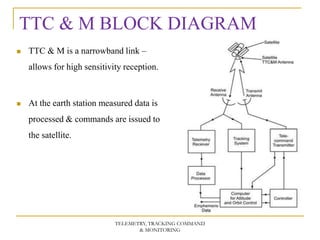
 TTC & M is a narrowband link –
allows for high sensitivity reception.
 At the earth station measured data is
processed & commands are issued to
the satellite.
TELEMETRY, TRACKING COMMAND
& MONITORING
TTC & M FUNCTIONS
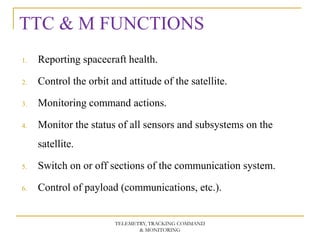
1. Reporting spacecraft health.
2. Control the orbit and attitude of the satellite.
3. Monitoring command actions.
4. Monitor the status of all sensors and subsystems on the
satellite.
5. Switch on or off sections of the communication system.
6. Control of payload (communications, etc.).
TELEMETRY, TRACKING COMMAND
& MONITORING
TTC & M BACKUP SYSTEM
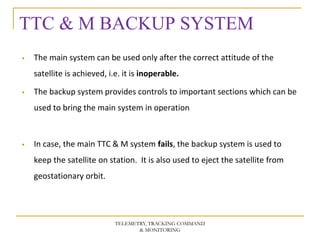
 The main system can be used only after the correct attitude of the
satellite is achieved, i.e. it is inoperable.
 The backup system provides controls to important sections which can be
used to bring the main system in operation
 In case, the main TTC & M system fails, the backup system is used to
keep the satellite on station. It is also used to eject the satellite from
geostationary orbit.
TELEMETRY, TRACKING COMMAND
& MONITORING
TELEMETRY SYSTEM
 Telemetry : The telemetry system sends data received from sensors on the
satellite to monitor the satellite’s health, via telemetry link to the
controlling earth station.
 Telemetry data are usually digitized and transmitted as phase shift keying
of a low-power telemetry carrier using time division techniques.
 A low data rate (downlink bit rates up to 8 Mbps) is normally used to
allow the receiver at the earth station to have a narrow BW & thus maintain
a high carrier to noise ratio.
 The sensor data and the status of each subsystem, can be reported back to
the earth by the telemetry system.
TELEMETRY, TRACKING COMMAND
& MONITORING
MONITORING SYSTEM
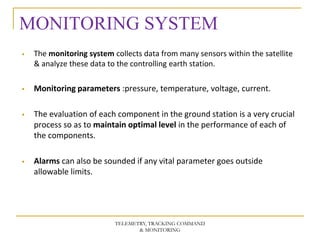
 The monitoring system collects data from many sensors within the satellite
& analyze these data to the controlling earth station.
 Monitoring parameters :pressure, temperature, voltage, current.
 The evaluation of each component in the ground station is a very crucial
process so as to maintain optimal level in the performance of each of
the components.
 Alarms can also be sounded if any vital parameter goes outside
allowable limits.
TELEMETRY, TRACKING COMMAND
& MONITORING
MONITORING SYSTEM - CONT’D
 Attitude maintenance sighting devices are monitored via telemetry link.
 In failure case the satellite points in the wrong direction. The faulty unit
must then be disconnected and a spare brought in, via the command
system, or some other means of controlling attitude devised.
 These comparisons are done to take corrective or preventive action
whenever required to prevent failure or delays in the mission timelines.
 Parameters measured: AGC & BER [2]
AGC: It is the plot between time and power. It helps us to determine the
satellite anomalies.
BER: The figure of merit for a digital radio link is its Bit Error Rate
TELEMETRY, TRACKING COMMAND
& MONITORING
TRACKING SYSTEM
 Tracking : The tracking system at the earth station provides information
on the range, elevation, and azimuth of the satellite needed in computing
orbital elements.
 Ranging measurements Ranging tones.
 The earth station controlling the satellite can observe the Doppler shift of
the telemetry carrier or beacon transmitter carrier to determine the rate at
which range is changing.
TELEMETRY, TRACKING COMMAND
& MONITORING
TRACKING SYSTEM – CONT’D
 One of the technique to determine the current position of an orbit is
by integrating the data obtained by velocity and acceleration sensors.
 Triangulation method is used to determine the position of a satellite
when a sufficient number of earth stations with adequate separation are
observing it.
TELEMETRY, TRACKING COMMAND
& MONITORING
COMMAND SYSTEM
 During launch sequence
 Switch on power
 Deploy antennas and solar panels
 Point antennas to desired location
 In orbit
 Maintain spacecraft thermal balance
 Control payload, thrusters, etc.
 Encryption of commands and responses is used to provide security in the
command system, so that the risk of satellite malfunction due to erroneous
commands is minimized.
 The command and telemetry links can operate in the same frequency band (6
& 4GHz) but they are usually separated from the communication system.
TELEMETRY, TRACKING COMMAND
& MONITORING
COMMANDS USED
UNIX:
 The monitor supplies commands for managing satellite files ( cat, cd,
chmod, chsize, cp, create, df, ls, mv, pwd, rm, quit ).
 For communicating with the host ( hcu ), and for executing application
programs ( exec ).
 An additional command ( help ) gives a synopsis of all the satellite
commands.
 Satellite utility programs include makefsys, diskcp, garead, and boot.
TELEMETRY, TRACKING COMMAND
& MONITORING
COMMANDS USED – CONT’D
Useful Commands for Satellite CCRMA:
 https://ccrma.stanford.edu/wiki/Useful_Commands_for_Satellite_CCRMA
Useful Commands for Satellite Nv:
 https://www.cisco.com/c/en/us/td/docs/routers/asr9000/software/asr9k_r4-
3/interfaces/command/reference/b_interfaces_cr43xasr9k/b_interfaces_cr43
xasr9k_chapter_01110.pdf
TELEMETRY, TRACKING COMMAND
& MONITORING
REFERENCES
[1] Satellite communication by T Pratt, C.Bostian & J.Allnutt, Wiley.
[2] Chaithra. N, Akhil.V “Telemetry, Tracking, Command and Monitoring
on Ground Station Parameters for Satellites” by, IJAEEE Journal, vol
no.5, issue no.6, 2016.
TELEMETRY, TRACKING COMMAND
& MONITORING
TELEMETRY, TRACKING COMMAND
& MONITORING

TELEMETRY, TRACKING COMMAND & MONITORING

  • 1.
    TELEMETRY, TRACKING COMMAND &MONITORING Presented by: Alpana A. Ingale Roll no 8108
  • 2.
    CONTENT 1. INTRODUCTION 2. TTC& M BLOCK DIAGRAM 3. TTC & M FUNCTIONS 4. TTC & M BACKUP SYSTEM 5. TELEMETRY SYSTEM 6. MONITORING SYSTEM 7. TRACKING SYSTEM 8. COMMAND SYSTEM 9. COMMANDS USED 10. REFERENCES TELEMETRY, TRACKING COMMAND & MONITORING
  • 3.
    INTRODUCTION  The TTC& M system provides various essential communication to & from the spacecraft.  TTC & M is the only way to observe and to control the satellite’s functions & condition from the ground. TELEMETRY, TRACKING COMMAND & MONITORING
  • 4.
    TTC & MBLOCK DIAGRAM  TTC & M is a narrowband link – allows for high sensitivity reception.  At the earth station measured data is processed & commands are issued to the satellite. TELEMETRY, TRACKING COMMAND & MONITORING
  • 5.
    TTC & MFUNCTIONS 1. Reporting spacecraft health. 2. Control the orbit and attitude of the satellite. 3. Monitoring command actions. 4. Monitor the status of all sensors and subsystems on the satellite. 5. Switch on or off sections of the communication system. 6. Control of payload (communications, etc.). TELEMETRY, TRACKING COMMAND & MONITORING
  • 6.
    TTC & MBACKUP SYSTEM  The main system can be used only after the correct attitude of the satellite is achieved, i.e. it is inoperable.  The backup system provides controls to important sections which can be used to bring the main system in operation  In case, the main TTC & M system fails, the backup system is used to keep the satellite on station. It is also used to eject the satellite from geostationary orbit. TELEMETRY, TRACKING COMMAND & MONITORING
  • 7.
    TELEMETRY SYSTEM  Telemetry: The telemetry system sends data received from sensors on the satellite to monitor the satellite’s health, via telemetry link to the controlling earth station.  Telemetry data are usually digitized and transmitted as phase shift keying of a low-power telemetry carrier using time division techniques.  A low data rate (downlink bit rates up to 8 Mbps) is normally used to allow the receiver at the earth station to have a narrow BW & thus maintain a high carrier to noise ratio.  The sensor data and the status of each subsystem, can be reported back to the earth by the telemetry system. TELEMETRY, TRACKING COMMAND & MONITORING
  • 8.
    MONITORING SYSTEM  Themonitoring system collects data from many sensors within the satellite & analyze these data to the controlling earth station.  Monitoring parameters :pressure, temperature, voltage, current.  The evaluation of each component in the ground station is a very crucial process so as to maintain optimal level in the performance of each of the components.  Alarms can also be sounded if any vital parameter goes outside allowable limits. TELEMETRY, TRACKING COMMAND & MONITORING
  • 9.
    MONITORING SYSTEM -CONT’D  Attitude maintenance sighting devices are monitored via telemetry link.  In failure case the satellite points in the wrong direction. The faulty unit must then be disconnected and a spare brought in, via the command system, or some other means of controlling attitude devised.  These comparisons are done to take corrective or preventive action whenever required to prevent failure or delays in the mission timelines.  Parameters measured: AGC & BER [2] AGC: It is the plot between time and power. It helps us to determine the satellite anomalies. BER: The figure of merit for a digital radio link is its Bit Error Rate TELEMETRY, TRACKING COMMAND & MONITORING
  • 10.
    TRACKING SYSTEM  Tracking: The tracking system at the earth station provides information on the range, elevation, and azimuth of the satellite needed in computing orbital elements.  Ranging measurements Ranging tones.  The earth station controlling the satellite can observe the Doppler shift of the telemetry carrier or beacon transmitter carrier to determine the rate at which range is changing. TELEMETRY, TRACKING COMMAND & MONITORING
  • 11.
    TRACKING SYSTEM –CONT’D  One of the technique to determine the current position of an orbit is by integrating the data obtained by velocity and acceleration sensors.  Triangulation method is used to determine the position of a satellite when a sufficient number of earth stations with adequate separation are observing it. TELEMETRY, TRACKING COMMAND & MONITORING
  • 12.
    COMMAND SYSTEM  Duringlaunch sequence  Switch on power  Deploy antennas and solar panels  Point antennas to desired location  In orbit  Maintain spacecraft thermal balance  Control payload, thrusters, etc.  Encryption of commands and responses is used to provide security in the command system, so that the risk of satellite malfunction due to erroneous commands is minimized.  The command and telemetry links can operate in the same frequency band (6 & 4GHz) but they are usually separated from the communication system. TELEMETRY, TRACKING COMMAND & MONITORING
  • 13.
    COMMANDS USED UNIX:  Themonitor supplies commands for managing satellite files ( cat, cd, chmod, chsize, cp, create, df, ls, mv, pwd, rm, quit ).  For communicating with the host ( hcu ), and for executing application programs ( exec ).  An additional command ( help ) gives a synopsis of all the satellite commands.  Satellite utility programs include makefsys, diskcp, garead, and boot. TELEMETRY, TRACKING COMMAND & MONITORING
  • 14.
    COMMANDS USED –CONT’D Useful Commands for Satellite CCRMA:  https://ccrma.stanford.edu/wiki/Useful_Commands_for_Satellite_CCRMA Useful Commands for Satellite Nv:  https://www.cisco.com/c/en/us/td/docs/routers/asr9000/software/asr9k_r4- 3/interfaces/command/reference/b_interfaces_cr43xasr9k/b_interfaces_cr43 xasr9k_chapter_01110.pdf TELEMETRY, TRACKING COMMAND & MONITORING
  • 15.
    REFERENCES [1] Satellite communicationby T Pratt, C.Bostian & J.Allnutt, Wiley. [2] Chaithra. N, Akhil.V “Telemetry, Tracking, Command and Monitoring on Ground Station Parameters for Satellites” by, IJAEEE Journal, vol no.5, issue no.6, 2016. TELEMETRY, TRACKING COMMAND & MONITORING
  • 16.