
Developing Research Protocols
Dr.Sandeep Singh Jadon
G.R.Medical College,Gwalior,M.P.
Learning Objectives
❖Definition of Research
❖What is Clinical Research Protocol
❖Why Protocol is required
❖Parts of Protocol
❖What is protocol violation
Definition of Research
Research is a systematic collection, analysis and
interpretation of data to answer a certain question or
solve a problem.
What is Clinical Research Protocol
A research protocol is a formal written record that
one
prepares BEFORE research fieldwork is undertaken.
Why a Protocol
 To clarify the research question
 To compile existing knowledge
 To formulate a hypothesis and objectives
 To decide about a study design
 To clarify ethical considerations
 To apply for funding
Parts of Protocol
1) Study Title
• Should be concise and descriptive.
• Must be informative and catchy.
• The hypothesis to be studied can be included.
2) Introduction
• Problem statements
• Background
• Rationale
• Aims and objectives of the study
3) Methodology
• Research design
• Data sources
• Sampling procedures – size and technique
• Data gathering instruments to include validity
testing and pilot study
• Procedures
• Data analysis
• Ethical considerations
4) Study time frames and budget
5)References
6)Appendices
Ethical framework for Health
Research
• Any research involving human participants should
follow international standards of ethics.
• Indian national standards are not less exacting and
Indian ethical guidelines are on par with
international guidelines.
• Ethics review is also expected in situations involving
no risk when available data are used or minimal risk
such as when only questions are asked, no samples/
other specimens are collected
Indian Council of Medical Research
introduced Ethical Guidelines for
Research on Human Participants
NATIONAL GUIDELINES
2000, ICMR
guidelines
All institutions in the country which carry
out any form of biomedical research
involving human beings should follow these
guidelines in letter and spirit to protect
safety and well being of all individuals.
2006, Revised
ICMR
guidelines
There are
several other
national
guidelines
available
Genome Policy and Genetic Research
[2000], Indian GCP [2001], Amendment of
Drugs and Cosmetics Act [2002], Assisted
Reproductive Technology [2005], Stem Cell
Research and Bio-banking [2006]
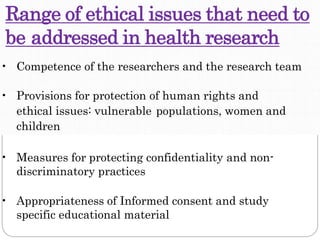
Range of ethical issues that need to
be addressed in health research
• Competence of the researchers and the research team
• Provisions for protection of human rights and
ethical issues: vulnerable populations, women and
children
• Measures for protecting confidentiality and non-
discriminatory practices
• Appropriateness of Informed consent and study
specific educational material
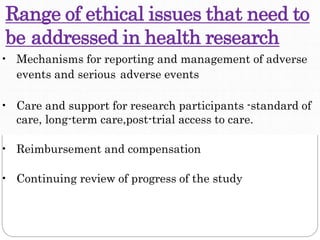
Range of ethical issues that need to
be addressed in health research
• Mechanisms for reporting and management of adverse
events and serious adverse events
• Care and support for research participants -standard of
care, long-term care,post-trial access to care.
• Reimbursement and compensation
• Continuing review of progress of the study
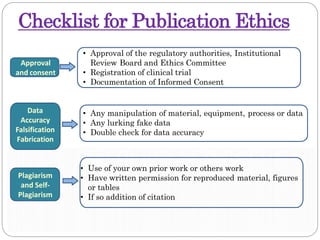
Checklist for Publication Ethics
Approval
and consent
Plagiarism
and Self-
Plagiarism
• Approval of the regulatory authorities, Institutional
Review Board and Ethics Committee
• Registration of clinical trial
• Documentation of Informed Consent
Data
Accuracy
Falsification
Fabrication
• Any manipulation of material, equipment, process or data
• Any lurking fake data
• Double check for data accuracy
• Use of your own prior work or others work
• Have written permission for reproduced material, figures
or tables
• If so addition of citation
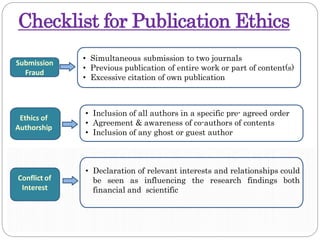
Checklist for Publication Ethics
Submission
Fraud
Ethics of
Authorship
Conflict of
Interest
• Simultaneous submission to two journals
• Previous publication of entire work or part of content(s)
• Excessive citation of own publication
• Inclusion of all authors in a specific pre- agreed order
• Agreement & awareness of co-authors of contents
• Inclusion of any ghost or guest author
• Declaration of relevant interests and relationships could
be seen as influencing the research findings both
financial and scientific
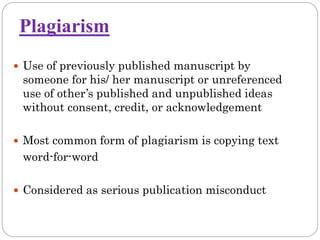
Plagiarism
 Use of previously published manuscript by
someone for his/ her manuscript or unreferenced
use of other’s published and unpublished ideas
without consent, credit, or acknowledgement
 Most common form of plagiarism is copying text
word-for-word
 Considered as serious publication misconduct
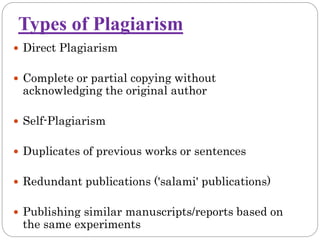
Types of Plagiarism
 Direct Plagiarism
 Complete or partial copying without
acknowledging the original author
 Self-Plagiarism
 Duplicates of previous works or sentences
 Redundant publications ('salami' publications)
 Publishing similar manuscripts/reports based on
the same experiments
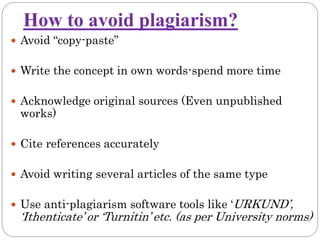
How to avoid plagiarism?
 Avoid “copy-paste”
 Write the concept in own words-spend more time
 Acknowledge original sources (Even unpublished
works)
 Cite references accurately
 Avoid writing several articles of the same type
 Use anti-plagiarism software tools like ‘URKUND’,
‘Ithenticate’ or ‘Turnitin’ etc. (as per University norms)
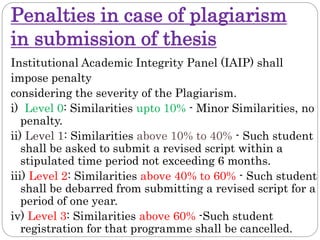
Penalties in case of plagiarism
in submission of thesis
Institutional Academic Integrity Panel (IAIP) shall
impose penalty
considering the severity of the Plagiarism.
i) Level 0: Similarities upto 10% - Minor Similarities, no
penalty.
ii) Level 1: Similarities above 10% to 40% - Such student
shall be asked to submit a revised script within a
stipulated time period not exceeding 6 months.
iii) Level 2: Similarities above 40% to 60% - Such student
shall be debarred from submitting a revised script for a
period of one year.
iv) Level 3: Similarities above 60% -Such student
registration for that programme shall be cancelled.
research protocol By Sandeep.pptx

research protocol By Sandeep.pptx

  • 1.
    Developing Research Protocols Dr.SandeepSingh Jadon G.R.Medical College,Gwalior,M.P.
  • 2.
    Learning Objectives ❖Definition ofResearch ❖What is Clinical Research Protocol ❖Why Protocol is required ❖Parts of Protocol ❖What is protocol violation
  • 3.
    Definition of Research Researchis a systematic collection, analysis and interpretation of data to answer a certain question or solve a problem. What is Clinical Research Protocol A research protocol is a formal written record that one prepares BEFORE research fieldwork is undertaken.
  • 4.
    Why a Protocol To clarify the research question  To compile existing knowledge  To formulate a hypothesis and objectives  To decide about a study design  To clarify ethical considerations  To apply for funding
  • 5.
    Parts of Protocol 1)Study Title • Should be concise and descriptive. • Must be informative and catchy. • The hypothesis to be studied can be included. 2) Introduction • Problem statements • Background • Rationale • Aims and objectives of the study
  • 6.
    3) Methodology • Researchdesign • Data sources • Sampling procedures – size and technique • Data gathering instruments to include validity testing and pilot study • Procedures • Data analysis • Ethical considerations 4) Study time frames and budget 5)References 6)Appendices
  • 7.
    Ethical framework forHealth Research • Any research involving human participants should follow international standards of ethics. • Indian national standards are not less exacting and Indian ethical guidelines are on par with international guidelines. • Ethics review is also expected in situations involving no risk when available data are used or minimal risk such as when only questions are asked, no samples/ other specimens are collected
  • 8.
    Indian Council ofMedical Research introduced Ethical Guidelines for Research on Human Participants NATIONAL GUIDELINES 2000, ICMR guidelines All institutions in the country which carry out any form of biomedical research involving human beings should follow these guidelines in letter and spirit to protect safety and well being of all individuals. 2006, Revised ICMR guidelines There are several other national guidelines available Genome Policy and Genetic Research [2000], Indian GCP [2001], Amendment of Drugs and Cosmetics Act [2002], Assisted Reproductive Technology [2005], Stem Cell Research and Bio-banking [2006]
  • 9.
    Range of ethicalissues that need to be addressed in health research • Competence of the researchers and the research team • Provisions for protection of human rights and ethical issues: vulnerable populations, women and children • Measures for protecting confidentiality and non- discriminatory practices • Appropriateness of Informed consent and study specific educational material
  • 10.
    Range of ethicalissues that need to be addressed in health research • Mechanisms for reporting and management of adverse events and serious adverse events • Care and support for research participants -standard of care, long-term care,post-trial access to care. • Reimbursement and compensation • Continuing review of progress of the study
  • 11.
    Checklist for PublicationEthics Approval and consent Plagiarism and Self- Plagiarism • Approval of the regulatory authorities, Institutional Review Board and Ethics Committee • Registration of clinical trial • Documentation of Informed Consent Data Accuracy Falsification Fabrication • Any manipulation of material, equipment, process or data • Any lurking fake data • Double check for data accuracy • Use of your own prior work or others work • Have written permission for reproduced material, figures or tables • If so addition of citation
  • 12.
    Checklist for PublicationEthics Submission Fraud Ethics of Authorship Conflict of Interest • Simultaneous submission to two journals • Previous publication of entire work or part of content(s) • Excessive citation of own publication • Inclusion of all authors in a specific pre- agreed order • Agreement & awareness of co-authors of contents • Inclusion of any ghost or guest author • Declaration of relevant interests and relationships could be seen as influencing the research findings both financial and scientific
  • 13.
    Plagiarism  Use ofpreviously published manuscript by someone for his/ her manuscript or unreferenced use of other’s published and unpublished ideas without consent, credit, or acknowledgement  Most common form of plagiarism is copying text word-for-word  Considered as serious publication misconduct
  • 14.
    Types of Plagiarism Direct Plagiarism  Complete or partial copying without acknowledging the original author  Self-Plagiarism  Duplicates of previous works or sentences  Redundant publications ('salami' publications)  Publishing similar manuscripts/reports based on the same experiments
  • 15.
    How to avoidplagiarism?  Avoid “copy-paste”  Write the concept in own words-spend more time  Acknowledge original sources (Even unpublished works)  Cite references accurately  Avoid writing several articles of the same type  Use anti-plagiarism software tools like ‘URKUND’, ‘Ithenticate’ or ‘Turnitin’ etc. (as per University norms)
  • 16.
    Penalties in caseof plagiarism in submission of thesis Institutional Academic Integrity Panel (IAIP) shall impose penalty considering the severity of the Plagiarism. i) Level 0: Similarities upto 10% - Minor Similarities, no penalty. ii) Level 1: Similarities above 10% to 40% - Such student shall be asked to submit a revised script within a stipulated time period not exceeding 6 months. iii) Level 2: Similarities above 40% to 60% - Such student shall be debarred from submitting a revised script for a period of one year. iv) Level 3: Similarities above 60% -Such student registration for that programme shall be cancelled.