

HOW TO WRITE A RESEARCH
SYNOPSIS
Asif Nawaz
Mhill Microbiology
Aust
INTRODUCTION
• Synopsis is the gist of your planned project submitted for
approval from competent authorities. It gives a panoramic
view of your research for quick analysis by the reviewers.
Thus, a protocol or a synopsis forms an integral part of a
research project or a thesis. Many universities have made it
mandatory for the postgraduate degree student to prepare a
thesis as a part of their postgraduate training.
A good knowledge about how a protocol or a synopsis is
written is imperative to all people involved in medical
research.
MEANING OF SYNOPSIS
• Literally, protocol :
(Greek word, protokollon - first page)
means a format procedure for carrying out a
scientific research.
>Synopsis:
(Greek word, sun - together, opsis - seeing)
means brief summary of something.
>Frequently, both the terms are used as
synonyms but the term 'synopsis' is used more
often.
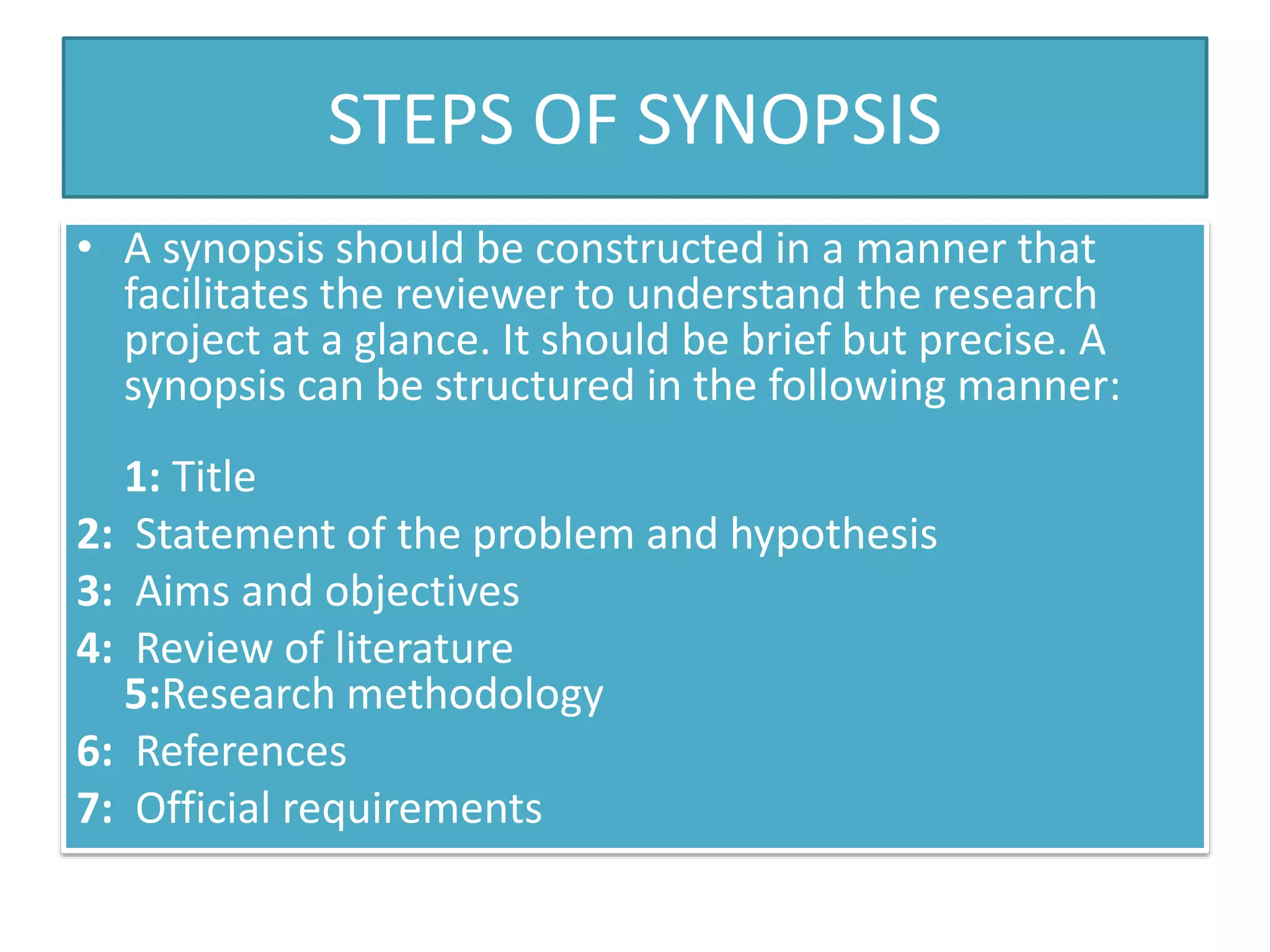
STEPS OF SYNOPSIS
• A synopsis should be constructed in a manner that
facilitates the reviewer to understand the research
project at a glance. It should be brief but precise. A
synopsis can be structured in the following manner:
1: Title
2: Statement of the problem and hypothesis
3: Aims and objectives
4: Review of literature
5:Research methodology
6: References
7: Official requirements
TITLE
• The title of the research project should be brief but
informative.
>Sensationalization of the title is best avoided.
>It should neither be too short nor too long.
>Any name of the institution, the number of cases to be
studied should not be included.
>The hypothesis to be studied can be included.
Example:
Fine needle aspiration, as a diagnostic tool for papulonodular
skin lesions". This is an acceptable, informative, and precise
title. It states the hypothesis correctly.
CONTENTS PAGE
• Enlist all the contents of the synopsis with
page number.
INTRODUCTION
• A brief description (1-3 pages) to introduce
the area of the proposed research work.
HYPOTHESIS
• The problem being studied should be mentioned in precise and
clear terms.
1: Understanding the problem aids the researcher in constructing
the research proposal.
2: It also allows the person to formulate the hypothesis.
3: The problem under study should be relevant to the present.
4: A brief account of its utility at the local or national level has to
be discussed
5: The present status of the problem and the necessity for taking
up the study needs to be mentioned.
6: Hypothesis can be formulated by understanding the problem,
reviewing the literature on it, and considering other factors.
7: A researcher can state the problem and the hypothesis in about
200 words .
AIMS AND OBJECTIVES
• All research projects should have objectives
and aims and every effort should be made to
achieve them.
.The objectives and aims should be only a few
(2-3).
.They must pertain to the study problem.
.Usages of terms like "first study", "the only
study", etc. should be avoided.
MATERIALS AND METHODS
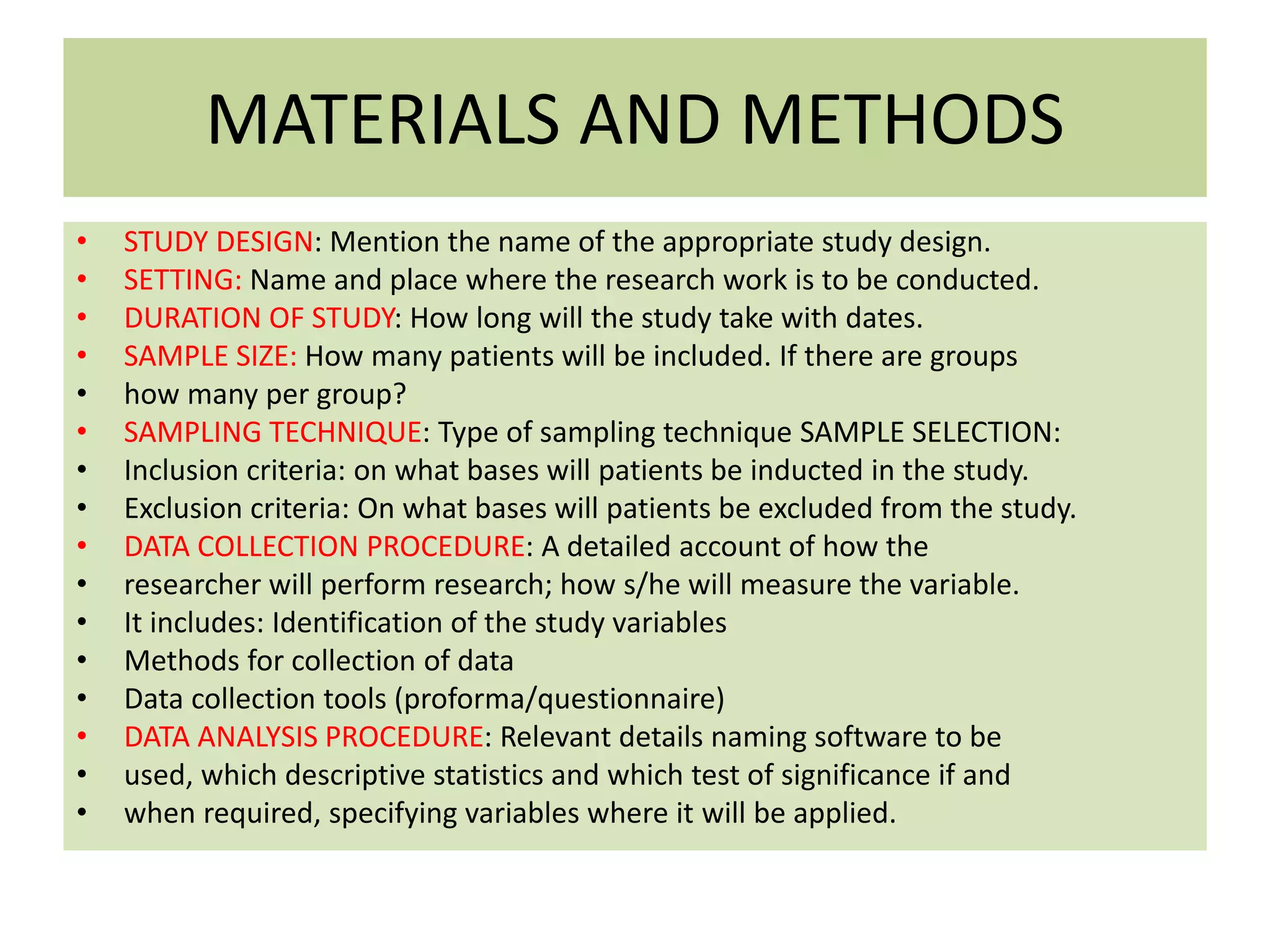
• STUDY DESIGN: Mention the name of the appropriate study design.
• SETTING: Name and place where the research work is to be conducted.
• DURATION OF STUDY: How long will the study take with dates.
• SAMPLE SIZE: How many patients will be included. If there are groups
• how many per group?
• SAMPLING TECHNIQUE: Type of sampling technique SAMPLE SELECTION:
• Inclusion criteria: on what bases will patients be inducted in the study.
• Exclusion criteria: On what bases will patients be excluded from the study.
• DATA COLLECTION PROCEDURE: A detailed account of how the
• researcher will perform research; how s/he will measure the variable.
• It includes: Identification of the study variables
• Methods for collection of data
• Data collection tools (proforma/questionnaire)
• DATA ANALYSIS PROCEDURE: Relevant details naming software to be
• used, which descriptive statistics and which test of significance if and
• when required, specifying variables where it will be applied.
REVIEW OF LITERATURE
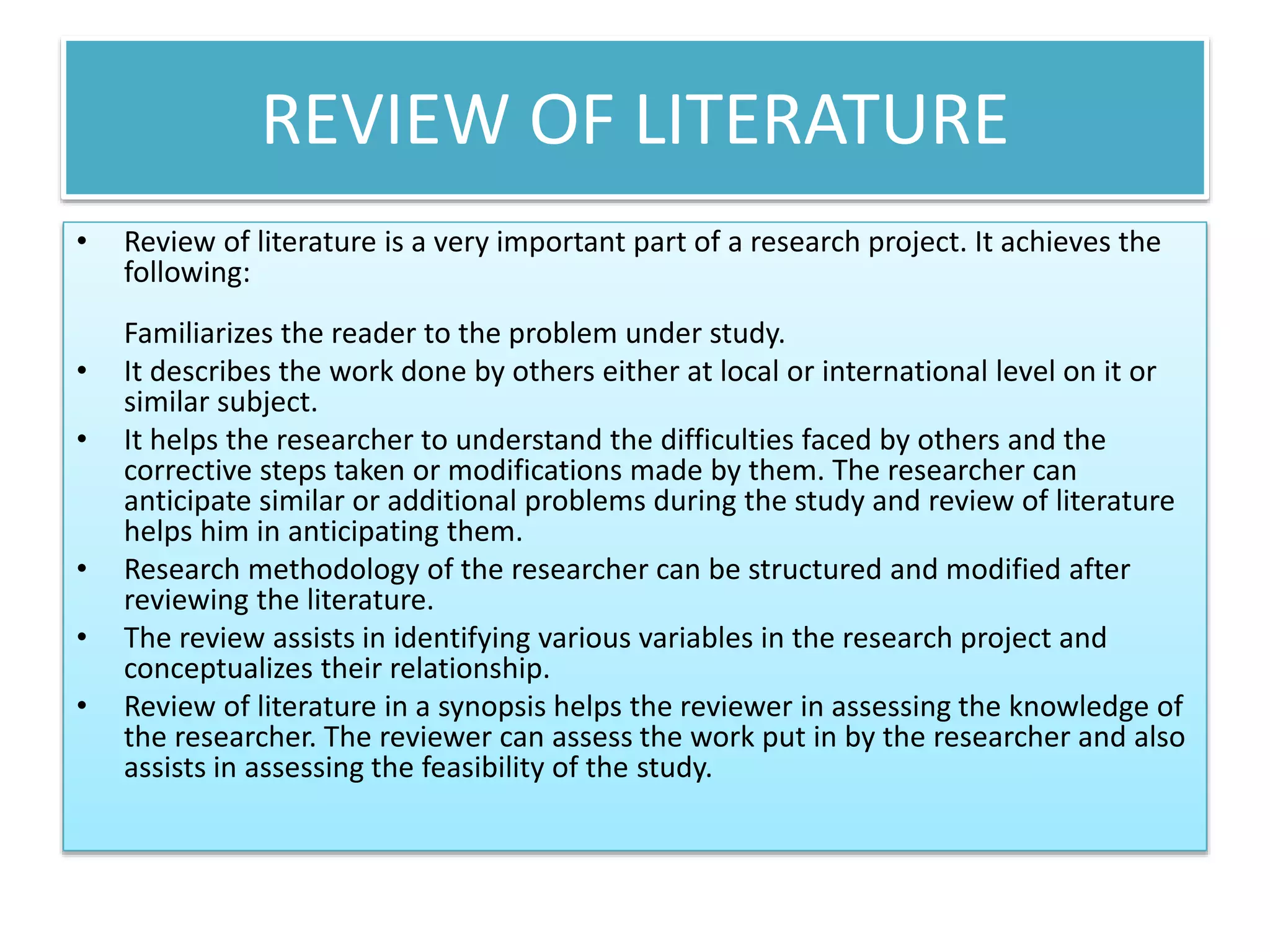
• Review of literature is a very important part of a research project. It achieves the
following:
Familiarizes the reader to the problem under study.
• It describes the work done by others either at local or international level on it or
similar subject.
• It helps the researcher to understand the difficulties faced by others and the
corrective steps taken or modifications made by them. The researcher can
anticipate similar or additional problems during the study and review of literature
helps him in anticipating them.
• Research methodology of the researcher can be structured and modified after
reviewing the literature.
• The review assists in identifying various variables in the research project and
conceptualizes their relationship.
• Review of literature in a synopsis helps the reviewer in assessing the knowledge of
the researcher. The reviewer can assess the work put in by the researcher and also
assists in assessing the feasibility of the study.
RESEARCH METHODOLOGY
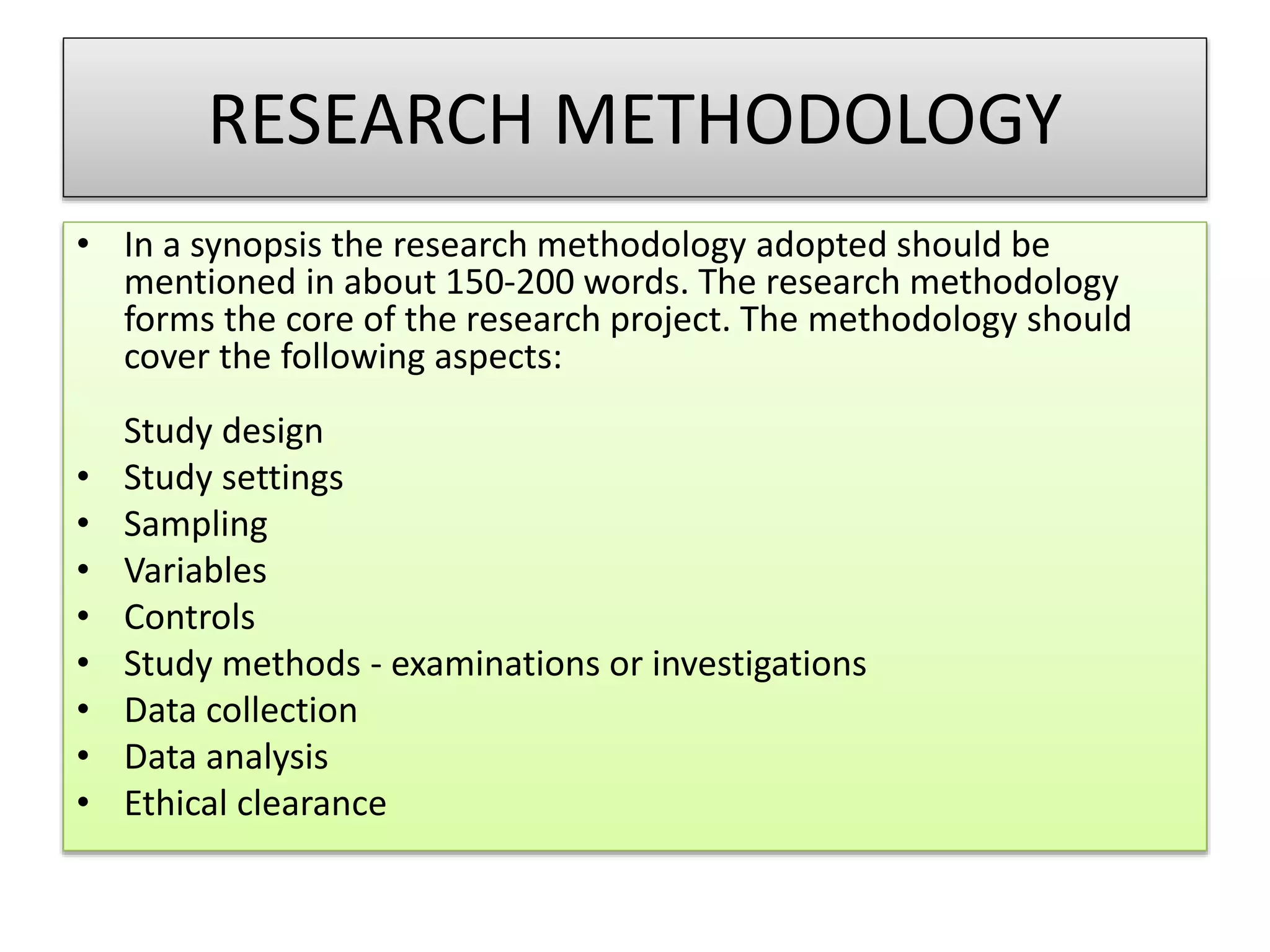
• In a synopsis the research methodology adopted should be
mentioned in about 150-200 words. The research methodology
forms the core of the research project. The methodology should
cover the following aspects:
Study design
• Study settings
• Sampling
• Variables
• Controls
• Study methods - examinations or investigations
• Data collection
• Data analysis
• Ethical clearance
REFRENCES
. Synopsis should contain at the end a list of
references, and a bibliography if required.
. These should be written (single spaced) on a
standard pattern (see pattern) and
alphabetically arranged ( A to Z ).
OFFICIAL REQUIREMENTS
• A synopsis is incomplete if it does not contain the
following information:
.Name of the researcher and designation
• Name and designation of the guide
• Name and designation of head of
departmentinstitution
• Name of the institution
• Signatures of all with official seal
CONCLUSION
• Synopsis writing is an important step in a research
project.
>A good synopsis will give maximum information in
minimum words.
>A well-conceived synopsis will go a long way in
convincing the reviewer about the ability of the
researcher to conduct the project.
.In cases of need for financial assistance, the request
will be considered favorably.
.Thus, all research workers should make efforts to
prepare a well-structured synopsis.
REFRENCES:
1: www.cpsp.edu.pk › files › rtmc › synopsis
2: www.buitms.edu.pk › office › research ›
Synopsis_MS...
3: www.ijdvl.com › article
• 4: www.researchgate.net › publication ›
279917593_Resear...
• 5: nairaproject.com › blog › how-to-write-a-
research-pape...
How to write a research synopsis

How to write a research synopsis

  • 1.
    HOW TO WRITEA RESEARCH SYNOPSIS Asif Nawaz Mhill Microbiology Aust
  • 2.
    INTRODUCTION • Synopsis isthe gist of your planned project submitted for approval from competent authorities. It gives a panoramic view of your research for quick analysis by the reviewers. Thus, a protocol or a synopsis forms an integral part of a research project or a thesis. Many universities have made it mandatory for the postgraduate degree student to prepare a thesis as a part of their postgraduate training. A good knowledge about how a protocol or a synopsis is written is imperative to all people involved in medical research.
  • 3.
    MEANING OF SYNOPSIS •Literally, protocol : (Greek word, protokollon - first page) means a format procedure for carrying out a scientific research. >Synopsis: (Greek word, sun - together, opsis - seeing) means brief summary of something. >Frequently, both the terms are used as synonyms but the term 'synopsis' is used more often.
  • 4.
    STEPS OF SYNOPSIS •A synopsis should be constructed in a manner that facilitates the reviewer to understand the research project at a glance. It should be brief but precise. A synopsis can be structured in the following manner: 1: Title 2: Statement of the problem and hypothesis 3: Aims and objectives 4: Review of literature 5:Research methodology 6: References 7: Official requirements
  • 5.
    TITLE • The titleof the research project should be brief but informative. >Sensationalization of the title is best avoided. >It should neither be too short nor too long. >Any name of the institution, the number of cases to be studied should not be included. >The hypothesis to be studied can be included. Example: Fine needle aspiration, as a diagnostic tool for papulonodular skin lesions". This is an acceptable, informative, and precise title. It states the hypothesis correctly.
  • 6.
    CONTENTS PAGE • Enlistall the contents of the synopsis with page number.
  • 7.
    INTRODUCTION • A briefdescription (1-3 pages) to introduce the area of the proposed research work.
  • 8.
    HYPOTHESIS • The problembeing studied should be mentioned in precise and clear terms. 1: Understanding the problem aids the researcher in constructing the research proposal. 2: It also allows the person to formulate the hypothesis. 3: The problem under study should be relevant to the present. 4: A brief account of its utility at the local or national level has to be discussed 5: The present status of the problem and the necessity for taking up the study needs to be mentioned. 6: Hypothesis can be formulated by understanding the problem, reviewing the literature on it, and considering other factors. 7: A researcher can state the problem and the hypothesis in about 200 words .
  • 9.
    AIMS AND OBJECTIVES •All research projects should have objectives and aims and every effort should be made to achieve them. .The objectives and aims should be only a few (2-3). .They must pertain to the study problem. .Usages of terms like "first study", "the only study", etc. should be avoided.
  • 10.
    MATERIALS AND METHODS •STUDY DESIGN: Mention the name of the appropriate study design. • SETTING: Name and place where the research work is to be conducted. • DURATION OF STUDY: How long will the study take with dates. • SAMPLE SIZE: How many patients will be included. If there are groups • how many per group? • SAMPLING TECHNIQUE: Type of sampling technique SAMPLE SELECTION: • Inclusion criteria: on what bases will patients be inducted in the study. • Exclusion criteria: On what bases will patients be excluded from the study. • DATA COLLECTION PROCEDURE: A detailed account of how the • researcher will perform research; how s/he will measure the variable. • It includes: Identification of the study variables • Methods for collection of data • Data collection tools (proforma/questionnaire) • DATA ANALYSIS PROCEDURE: Relevant details naming software to be • used, which descriptive statistics and which test of significance if and • when required, specifying variables where it will be applied.
  • 11.
    REVIEW OF LITERATURE •Review of literature is a very important part of a research project. It achieves the following: Familiarizes the reader to the problem under study. • It describes the work done by others either at local or international level on it or similar subject. • It helps the researcher to understand the difficulties faced by others and the corrective steps taken or modifications made by them. The researcher can anticipate similar or additional problems during the study and review of literature helps him in anticipating them. • Research methodology of the researcher can be structured and modified after reviewing the literature. • The review assists in identifying various variables in the research project and conceptualizes their relationship. • Review of literature in a synopsis helps the reviewer in assessing the knowledge of the researcher. The reviewer can assess the work put in by the researcher and also assists in assessing the feasibility of the study.
  • 12.
    RESEARCH METHODOLOGY • Ina synopsis the research methodology adopted should be mentioned in about 150-200 words. The research methodology forms the core of the research project. The methodology should cover the following aspects: Study design • Study settings • Sampling • Variables • Controls • Study methods - examinations or investigations • Data collection • Data analysis • Ethical clearance
  • 13.
    REFRENCES . Synopsis shouldcontain at the end a list of references, and a bibliography if required. . These should be written (single spaced) on a standard pattern (see pattern) and alphabetically arranged ( A to Z ).
  • 14.
    OFFICIAL REQUIREMENTS • Asynopsis is incomplete if it does not contain the following information: .Name of the researcher and designation • Name and designation of the guide • Name and designation of head of departmentinstitution • Name of the institution • Signatures of all with official seal
  • 15.
    CONCLUSION • Synopsis writingis an important step in a research project. >A good synopsis will give maximum information in minimum words. >A well-conceived synopsis will go a long way in convincing the reviewer about the ability of the researcher to conduct the project. .In cases of need for financial assistance, the request will be considered favorably. .Thus, all research workers should make efforts to prepare a well-structured synopsis.
  • 16.
    REFRENCES: 1: www.cpsp.edu.pk ›files › rtmc › synopsis 2: www.buitms.edu.pk › office › research › Synopsis_MS... 3: www.ijdvl.com › article • 4: www.researchgate.net › publication › 279917593_Resear... • 5: nairaproject.com › blog › how-to-write-a- research-pape...