Simple guidelines to do a
postgraduate research project
By Dr. Manori Gamage
Senior Lecturer
Department of Paediatrics
University of Sri Jayewardenepura.
Importance 0f a Research project during
Postgraduate training
It makes you to
• Learn basic research theory and techniques
• Understand how to do a literature search and a review
• Explore an area of interest
• Learn how to appraising everyday problems critically
• Acquire skills to communicate scientific research as verbal or written
presentations
Making a start on your project
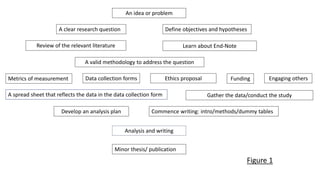
• There are many steps as shown in figure 1
• Order is not necessarily fixed
• Choose the relevant steps according to the research type
• Additional tools are necessary to find and manipulate information
• Literature search through PubMed or Medline
• Analysis programmes like Microsoft Excel SPSS
An idea or problem
A clear research question Define objectives and hypotheses
Review of the relevant literature Learn about End-Note
A valid methodology to address the question
Metrics of measurement Data collection forms Ethics proposal Funding Engaging others
A spread sheet that reflects the data in the data collection form Gather the data/conduct the study
Develop an analysis plan Commence writing: intro/methods/dummy tables
Analysis and writing
Minor thesis/ publication
Figure 1
Choosing a research topic
• It starts with an
• idea that interests you
• A problem that you have noticed
• It should be feasible to finish between 6-12 months
• Get the assistance of your supervisors
• Identify a clear research question
• Choose a practical method
A clear research question
Most important component!!!
• Should be keeping with the interested theme
• Carefully selected with help of the supervisor
• Objective
• Answerable using the research method
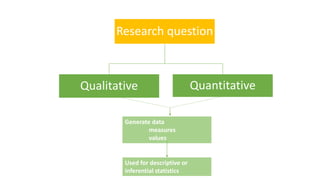
Research question
Qualitative Quantitative
Generate data
measures
values
Used for descriptive or
inferential statistics
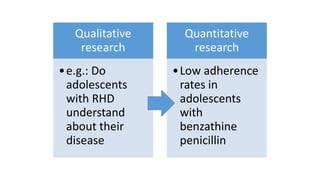
Qualitative
research
•e.g.: Do
adolescents
with RHD
understand
about their
disease
Quantitative
research
•Low adherence
rates in
adolescents
with
benzathine
penicillin
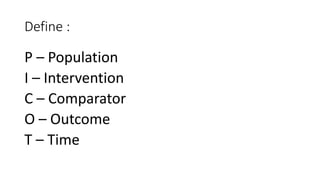
Define :
P – Population
I – Intervention
C – Comparator
O – Outcome
T – Time
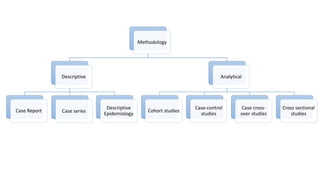
Methodology
Descriptive
Case Report Case series
Descriptive
Epidemiology
Analytical
Cohort studies
Case-control
studies
Case cross-
over studies
Cross sectional
studies
Study Design
• Depends on the research type
• Prevalence of the condition
• Short/Long term outcome
• Duration allocated for research
Plan data analysis
• Get to it before making the data collection tools
• Design data collection tools to answer specific research questions
• Include necessary questions in the most appropriate format
• Think and come to terms on statistical tests with the help of supervisors
• Design the database
• Easy to enter data
• Analyzable
• Reflects answers to research questions
• Start entering data to database early
• In quantitative research
• Be consistent with metrics
• Identify numerator and denominator
Ethics and Funding
• It is an enabler of good research in patient’s interest
• Mandatory for publication in a peer reviewed journal
• It is not usually required in systematic review of previous researches
• As a good doctor and a paediatrician, a researcher should adhere to ethical
principles
• Consent
• Autonomy
• Human dignity
• Confidentiality
• Non- maleficence
• Beneficence
• Justice
• Scientific integrity
Time management
• Do not leave project writing till the end
• Work steadily over the allocated time
• Start thesis writing early
• Expand the work that has been done on compiling the research
proposal
• Store all related data in a separate folder
• Refer back again if the data collection tool, database and thesis
provides answers to principal and supplementary research questions
• Balance your clinical and research training
• Keep yourself motivated and interested
Relationship with the supervisor
• Meet them regularly
• Keep them involved
• Seek help to solve any problem encountered during research
• Provide them with progress reports
Documents and backup
• Write one master document which can be used for initial proposal
• Expand it to form your thesis
• There can be multiple documents
• Abstratct
• Proposal
• Final report/ thesis
• Journal article
• Avoid ‘version confusion’ by keeping master document so that all
versions get updated at once
• Clearly label and date
• Ensure all agree on a system of version control
• Put date and initials of the person last edited the document
• Store all documents in a separate folder
• Back up all documents
• Either in a flash drive
• Or in a cloud storage e.g.: Google Drive, Dropbox
• Cloud storage enable sharing
• Flash drive should be protected by viruses
Writing style
• For the proposal ; use future tense
• In the thesis/report ; use past tense
• Language should be concise and clear
• A thesis should be written in a way that people without specific
knowledge can understand
Writing style
• For the proposal ; use future tense
• In the thesis/report ; use past tense
• Language should be concise and clear
• A thesis should be written in a way that people without specific
knowledge can understand
Thesis Structure
• There are many structures
• Can write with following components as chapters or subheadings of
one document
• Abstract
• Introduction
• Literature review
• Methodology
• Results
• Discussion
• Conclusions and recommendations
• references
Thesis Order and length
• No fixed order
• It could be anything from 4000-20000 words
• Can differ from the course that’s taken
• But its not the length that indicates the quality
Avoid plagiarism
• It is important that a thesis is writer’s/researcher’s own work
• Plagiarism is a form of cheating and is not accepted
• Can avoid this if everything that is written is writer’s own work
• Avoid copy-and-pasting
• Many universities use programmes like “Turnitin” and “Grammarly”
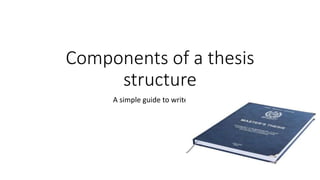
Components of a thesis
structure
A simple guide to write them
Abstract
• A very brief one page overview of the whole thesis
• 250-300 words
• In one to two sentences describe
⁻ Introduction
⁻ Method
⁻ Results
⁻ conclusions
Introduction
• 3-4 paragraph account
• Start with why it is an important topic to research
• Give contextual information on why the study was done
• Highlight the burden of the condition and its importance to the
specialty
• Point out if the topic was well studied or neglected
• Identify gaps
• State objectives and research questions
Literature review
• It is a summary of existing knowledge on the topic
• Relevant, concise and informative
• Should be focused on general and specific objectives
• State the search engines e.g.: PubMed, Google Scholar and key words
• Write from general to specific areas
• Instead of summarizing each individual research, tey to catagorise them
into themes and write
• If the literature on the subject is scanty, state it and point out the gaps
• Cite the references
Methodology
• It consist of how the study was done
• A researcher should be able to conduct the same research and
reproduce same/different results after reading the methodology
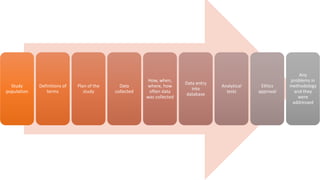
Study
population
Definitions of
terms
Plan of the
study
Data
collected
How, when,
where, how
often data
was collected
Data entry
into
database
Analytical
tests
Ethics
approval
Any
problems in
methodology
and they
were
addressed
Results
• Can be presented as narrative, tables, graphs and figures
• Results should be logical and organized
• Results should not be duplicated in each medium of presentation
• All the results should not be written as a narrative to prevent it being
too long and tedious
Only write the important results as a narrative
• Each table, figure or graph must be referenced in narration at the
appropriate place
• Results can be planned and written before the study is complete
using ‘dummy tables’
• There is no limit to number of tables
• In tables and the narrative include numbers and confidence intervals
together with percentages
• Accurately do the descriptive epidemiology using means, medians,
percentages, ranges, IQRs and confidence intervals
• Not all tables need a P value and not all P values <0.05 are significant
Avoid using P values to report minor post hoc results
• Describe the findings clearly, concisely in plain language
• Divide it to subheadings
• Give more importance to specific research question
Discussion
• It is an interpretation of the results
• Should refer to primary objectives and research questions and state
whether they have been achieved
• Organize discussion into thematic paragraphs/subheadings
• Allocate the first paragraph to restate main results in plain language
• Then compare and contrast the results with pre existing knowledge
• Beware not to duplicate the literature review
• Use appropriate language to show that you are scientifically open
• Avoid using unnecessary categorical or certain language
• Discuss the limitations of the study
• Identify biases and confounds
• Do not highlight post hoc P values
• Avoid making excuses
• Make sure no new results has been entered
Conclusions/Recommendations
• Should be brief
• State main findings related to main research question
• State if main objectives has been achieved
• State lessons learnt from study and how it should be applied
• Give recommendations
• Change of practice
• New policies
• Raised awareness
• State need for further research
References
• Any important fact stated in research should have a reference
• Applies usually to introduction, literature review and discussion
• Refer from original research paper
• Find the full article to make sure it implies the same p-oint yo6u’re
making
• Best way to cite references as numbers
• Use standard referencing methods
• E.g.: Harvard Referencing standard
• Applications like EndNote, Zotero, Mendelay
Thank You!

Simple guidelines to do a postgraduate research project slide share

  • 1.
    Simple guidelines todo a postgraduate research project By Dr. Manori Gamage Senior Lecturer Department of Paediatrics University of Sri Jayewardenepura.
  • 2.
    Importance 0f aResearch project during Postgraduate training It makes you to • Learn basic research theory and techniques • Understand how to do a literature search and a review • Explore an area of interest • Learn how to appraising everyday problems critically • Acquire skills to communicate scientific research as verbal or written presentations
  • 3.
    Making a starton your project • There are many steps as shown in figure 1 • Order is not necessarily fixed • Choose the relevant steps according to the research type • Additional tools are necessary to find and manipulate information • Literature search through PubMed or Medline • Analysis programmes like Microsoft Excel SPSS
  • 4.
    An idea orproblem A clear research question Define objectives and hypotheses Review of the relevant literature Learn about End-Note A valid methodology to address the question Metrics of measurement Data collection forms Ethics proposal Funding Engaging others A spread sheet that reflects the data in the data collection form Gather the data/conduct the study Develop an analysis plan Commence writing: intro/methods/dummy tables Analysis and writing Minor thesis/ publication Figure 1
  • 5.
    Choosing a researchtopic • It starts with an • idea that interests you • A problem that you have noticed • It should be feasible to finish between 6-12 months • Get the assistance of your supervisors • Identify a clear research question • Choose a practical method
  • 6.
    A clear researchquestion Most important component!!! • Should be keeping with the interested theme • Carefully selected with help of the supervisor • Objective • Answerable using the research method
  • 7.
    Research question Qualitative Quantitative Generatedata measures values Used for descriptive or inferential statistics
  • 8.
    Qualitative research •e.g.: Do adolescents with RHD understand abouttheir disease Quantitative research •Low adherence rates in adolescents with benzathine penicillin
  • 9.
    Define : P –Population I – Intervention C – Comparator O – Outcome T – Time
  • 10.
    Methodology Descriptive Case Report Caseseries Descriptive Epidemiology Analytical Cohort studies Case-control studies Case cross- over studies Cross sectional studies
  • 11.
    Study Design • Dependson the research type • Prevalence of the condition • Short/Long term outcome • Duration allocated for research
  • 12.
    Plan data analysis •Get to it before making the data collection tools • Design data collection tools to answer specific research questions • Include necessary questions in the most appropriate format • Think and come to terms on statistical tests with the help of supervisors • Design the database • Easy to enter data • Analyzable • Reflects answers to research questions • Start entering data to database early • In quantitative research • Be consistent with metrics • Identify numerator and denominator
  • 13.
    Ethics and Funding •It is an enabler of good research in patient’s interest • Mandatory for publication in a peer reviewed journal • It is not usually required in systematic review of previous researches • As a good doctor and a paediatrician, a researcher should adhere to ethical principles • Consent • Autonomy • Human dignity • Confidentiality • Non- maleficence • Beneficence • Justice • Scientific integrity
  • 14.
    Time management • Donot leave project writing till the end • Work steadily over the allocated time • Start thesis writing early • Expand the work that has been done on compiling the research proposal • Store all related data in a separate folder • Refer back again if the data collection tool, database and thesis provides answers to principal and supplementary research questions • Balance your clinical and research training • Keep yourself motivated and interested
  • 15.
    Relationship with thesupervisor • Meet them regularly • Keep them involved • Seek help to solve any problem encountered during research • Provide them with progress reports
  • 16.
    Documents and backup •Write one master document which can be used for initial proposal • Expand it to form your thesis • There can be multiple documents • Abstratct • Proposal • Final report/ thesis • Journal article • Avoid ‘version confusion’ by keeping master document so that all versions get updated at once • Clearly label and date
  • 17.
    • Ensure allagree on a system of version control • Put date and initials of the person last edited the document • Store all documents in a separate folder • Back up all documents • Either in a flash drive • Or in a cloud storage e.g.: Google Drive, Dropbox • Cloud storage enable sharing • Flash drive should be protected by viruses
  • 18.
    Writing style • Forthe proposal ; use future tense • In the thesis/report ; use past tense • Language should be concise and clear • A thesis should be written in a way that people without specific knowledge can understand
  • 19.
    Writing style • Forthe proposal ; use future tense • In the thesis/report ; use past tense • Language should be concise and clear • A thesis should be written in a way that people without specific knowledge can understand
  • 20.
    Thesis Structure • Thereare many structures • Can write with following components as chapters or subheadings of one document • Abstract • Introduction • Literature review • Methodology • Results • Discussion • Conclusions and recommendations • references
  • 21.
    Thesis Order andlength • No fixed order • It could be anything from 4000-20000 words • Can differ from the course that’s taken • But its not the length that indicates the quality
  • 22.
    Avoid plagiarism • Itis important that a thesis is writer’s/researcher’s own work • Plagiarism is a form of cheating and is not accepted • Can avoid this if everything that is written is writer’s own work • Avoid copy-and-pasting • Many universities use programmes like “Turnitin” and “Grammarly”
  • 23.
    Components of athesis structure A simple guide to write them
  • 24.
    Abstract • A verybrief one page overview of the whole thesis • 250-300 words • In one to two sentences describe ⁻ Introduction ⁻ Method ⁻ Results ⁻ conclusions
  • 25.
    Introduction • 3-4 paragraphaccount • Start with why it is an important topic to research • Give contextual information on why the study was done • Highlight the burden of the condition and its importance to the specialty • Point out if the topic was well studied or neglected • Identify gaps • State objectives and research questions
  • 26.
    Literature review • Itis a summary of existing knowledge on the topic • Relevant, concise and informative • Should be focused on general and specific objectives • State the search engines e.g.: PubMed, Google Scholar and key words • Write from general to specific areas • Instead of summarizing each individual research, tey to catagorise them into themes and write • If the literature on the subject is scanty, state it and point out the gaps • Cite the references
  • 27.
    Methodology • It consistof how the study was done • A researcher should be able to conduct the same research and reproduce same/different results after reading the methodology
  • 28.
    Study population Definitions of terms Plan ofthe study Data collected How, when, where, how often data was collected Data entry into database Analytical tests Ethics approval Any problems in methodology and they were addressed
  • 29.
    Results • Can bepresented as narrative, tables, graphs and figures • Results should be logical and organized • Results should not be duplicated in each medium of presentation • All the results should not be written as a narrative to prevent it being too long and tedious Only write the important results as a narrative • Each table, figure or graph must be referenced in narration at the appropriate place • Results can be planned and written before the study is complete using ‘dummy tables’
  • 30.
    • There isno limit to number of tables • In tables and the narrative include numbers and confidence intervals together with percentages • Accurately do the descriptive epidemiology using means, medians, percentages, ranges, IQRs and confidence intervals • Not all tables need a P value and not all P values <0.05 are significant Avoid using P values to report minor post hoc results • Describe the findings clearly, concisely in plain language • Divide it to subheadings • Give more importance to specific research question
  • 31.
    Discussion • It isan interpretation of the results • Should refer to primary objectives and research questions and state whether they have been achieved • Organize discussion into thematic paragraphs/subheadings • Allocate the first paragraph to restate main results in plain language • Then compare and contrast the results with pre existing knowledge • Beware not to duplicate the literature review
  • 32.
    • Use appropriatelanguage to show that you are scientifically open • Avoid using unnecessary categorical or certain language • Discuss the limitations of the study • Identify biases and confounds • Do not highlight post hoc P values • Avoid making excuses • Make sure no new results has been entered
  • 33.
    Conclusions/Recommendations • Should bebrief • State main findings related to main research question • State if main objectives has been achieved • State lessons learnt from study and how it should be applied • Give recommendations • Change of practice • New policies • Raised awareness • State need for further research
  • 34.
    References • Any importantfact stated in research should have a reference • Applies usually to introduction, literature review and discussion • Refer from original research paper • Find the full article to make sure it implies the same p-oint yo6u’re making • Best way to cite references as numbers • Use standard referencing methods • E.g.: Harvard Referencing standard • Applications like EndNote, Zotero, Mendelay
  • 35.