An illustrative guide
for reviewing/
writing a manuscript
Mohammed Esawie, MD, MSc(c)
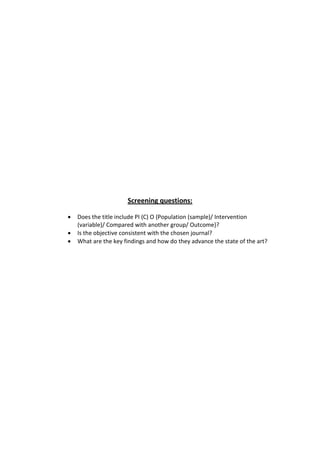
Screening questions:
 Does the title include PI (C) O {Population (sample)/ Intervention
(variable)/ Compared with another group/ Outcome}?
 Is the objective consistent with the chosen journal?
 What are the key findings and how do they advance the state of the art?
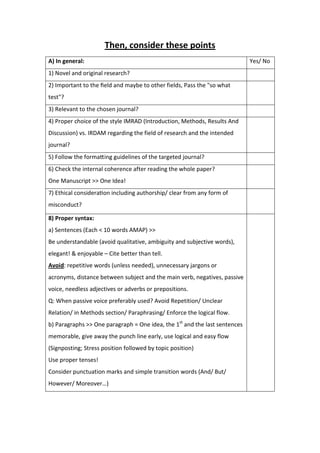
Then, consider these points
A) In general: Yes/ No
1) Novel and original research?
2) Important to the field and maybe to other fields, Pass the "so what
test"?
3) Relevant to the chosen journal?
4) Proper choice of the style IMRAD (Introduction, Methods, Results And
Discussion) vs. IRDAM regarding the field of research and the intended
journal?
5) Follow the forma ing guidelines of the targeted journal?
6) Check the internal coherence after reading the whole paper?
One Manuscript >> One Idea!
7) Ethical considera on including authorship/ clear from any form of
misconduct?
8) Proper syntax:
a) Sentences (Each < 10 words AMAP) >>
Be understandable (avoid qualitative, ambiguity and subjective words),
elegant! & enjoyable – Cite better than tell.
Avoid: repetitive words (unless needed), unnecessary jargons or
acronyms, distance between subject and the main verb, negatives, passive
voice, needless adjectives or adverbs or prepositions.
Q: When passive voice preferably used? Avoid Repetition/ Unclear
Relation/ in Methods section/ Paraphrasing/ Enforce the logical flow.
b) Paragraphs >> One paragraph = One idea, the 1st
and the last sentences
memorable, give away the punch line early, use logical and easy flow
(Signposting; Stress position followed by topic position)
Use proper tenses!
Consider punctuation marks and simple transition words (And/ But/
However/ Moreover…)
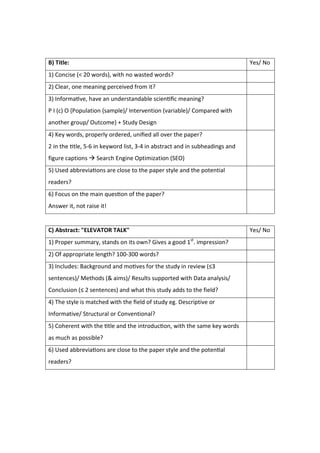
B) Title: Yes/ No
1) Concise (< 20 words), with no wasted words?
2) Clear, one meaning perceived from it?
3) Informa ve, have an understandable scien fic meaning?
P I (c) O {Population (sample)/ Intervention (variable)/ Compared with
another group/ Outcome} + Study Design
4) Key words, properly ordered, unified all over the paper?
2 in the tle, 5-6 in keyword list, 3-4 in abstract and in subheadings and
figure captions  Search Engine Optimization (SEO)
5) Used abbrevia ons are close to the paper style and the potential
readers?
6) Focus on the main ques on of the paper?
Answer it, not raise it!
C) Abstract: "ELEVATOR TALK" Yes/ No
1) Proper summary, stands on its own? Gives a good 1st
. impression?
2) Of appropriate length? 100-300 words?
3) Includes: Background and mo ves for the study in review (≤3
sentences)/ Methods (& aims)/ Results supported with Data analysis/
Conclusion (≤ 2 sentences) and what this study adds to the field?
4) The style is matched with the field of study eg. Descriptive or
Informative/ Structural or Conventional?
5) Coherent with the tle and the introduc on, with the same key words
as much as possible?
6) Used abbrevia ons are close to the paper style and the poten al
readers?
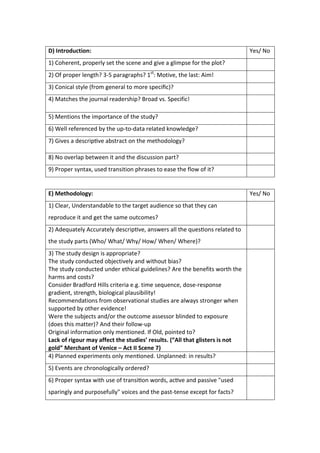
D) Introduction: Yes/ No
1) Coherent, properly set the scene and give a glimpse for the plot?
2) Of proper length? 3-5 paragraphs? 1st
: Motive, the last: Aim!
3) Conical style (from general to more specific)?
4) Matches the journal readership? Broad vs. Specific!
5) Mentions the importance of the study?
6) Well referenced by the up-to-data related knowledge?
7) Gives a descrip ve abstract on the methodology?
8) No overlap between it and the discussion part?
9) Proper syntax, used transition phrases to ease the flow of it?
E) Methodology: Yes/ No
1) Clear, Understandable to the target audience so that they can
reproduce it and get the same outcomes?
2) Adequately Accurately descrip ve, answers all the ques ons related to
the study parts (Who/ What/ Why/ How/ When/ Where)?
3) The study design is appropriate?
The study conducted objectively and without bias?
The study conducted under ethical guidelines? Are the benefits worth the
harms and costs?
Consider Bradford Hills criteria e.g. time sequence, dose-response
gradient, strength, biological plausibility!
Recommendations from observational studies are always stronger when
supported by other evidence!
Were the subjects and/or the outcome assessor blinded to exposure
(does this matter)? And their follow-up
Original information only mentioned. If Old, pointed to?
Lack of rigour may affect the studies’ results. (“All that glisters is not
gold” Merchant of Venice – Act II Scene 7)
4) Planned experiments only men oned. Unplanned: in results?
5) Events are chronologically ordered?
6) Proper syntax with use of transi on words, ac ve and passive "used
sparingly and purposefully" voices and the past-tense except for facts?
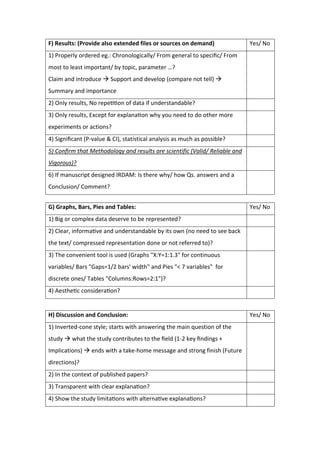
F) Results: (Provide also extended files or sources on demand) Yes/ No
1) Properly ordered eg.: Chronologically/ From general to specific/ From
most to least important/ by topic, parameter …?
Claim and introduce  Support and develop (compare not tell) 
Summary and importance
2) Only results, No repe on of data if understandable?
3) Only results, Except for explana on why you need to do other more
experiments or actions?
4) Significant (P-value & CI), statistical analysis as much as possible?
5) Confirm that Methodology and results are scientific (Valid/ Reliable and
Vigorous)?
6) If manuscript designed IRDAM: Is there why/ how Qs. answers and a
Conclusion/ Comment?
G) Graphs, Bars, Pies and Tables: Yes/ No
1) Big or complex data deserve to be represented?
2) Clear, informa ve and understandable by its own (no need to see back
the text/ compressed representation done or not referred to)?
3) The convenient tool is used (Graphs "X:Y=1:1.3" for continuous
variables/ Bars "Gaps=1/2 bars' width" and Pies "< 7 variables" for
discrete ones/ Tables "Columns:Rows=2:1")?
4) Aesthe c considera on?
H) Discussion and Conclusion: Yes/ No
1) Inverted-cone style; starts with answering the main question of the
study  what the study contributes to the field (1-2 key findings +
Implications)  ends with a take-home message and strong finish (Future
directions)?
2) In the context of published papers?
3) Transparent with clear explana on?
4) Show the study limita ons with alterna ve explana ons?
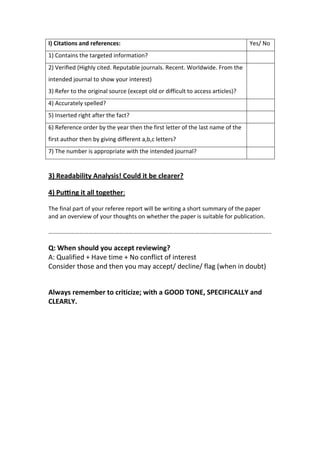
I) Citations and references: Yes/ No
1) Contains the targeted information?
2) Verified (Highly cited. Reputable journals. Recent. Worldwide. From the
intended journal to show your interest)
3) Refer to the original source (except old or difficult to access articles)?
4) Accurately spelled?
5) Inserted right after the fact?
6) Reference order by the year then the first letter of the last name of the
first author then by giving different a,b,c letters?
7) The number is appropriate with the intended journal?
3) Readability Analysis! Could it be clearer?
4) Pu ng it all together:
The final part of your referee report will be writing a short summary of the paper
and an overview of your thoughts on whether the paper is suitable for publication.
…………………………………………………………………………………………………………………………………...
Q: When should you accept reviewing?
A: Qualified + Have time + No conflict of interest
Consider those and then you may accept/ decline/ flag (when in doubt)
Always remember to criticize; with a GOOD TONE, SPECIFICALLY and
CLEARLY.
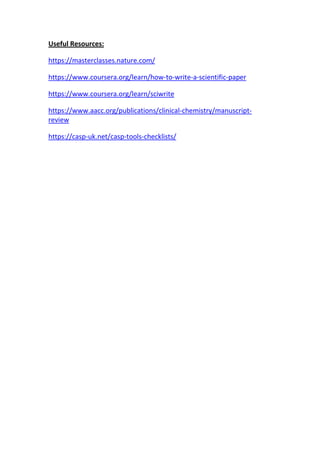
Useful Resources:
https://masterclasses.nature.com/
https://www.coursera.org/learn/how-to-write-a-scientific-paper
https://www.coursera.org/learn/sciwrite
https://www.aacc.org/publications/clinical-chemistry/manuscript-
review
https://casp-uk.net/casp-tools-checklists/

A checklist for reviewing a paper

  • 1.
    An illustrative guide forreviewing/ writing a manuscript Mohammed Esawie, MD, MSc(c)
  • 2.
    Screening questions:  Doesthe title include PI (C) O {Population (sample)/ Intervention (variable)/ Compared with another group/ Outcome}?  Is the objective consistent with the chosen journal?  What are the key findings and how do they advance the state of the art?
  • 3.
    Then, consider thesepoints A) In general: Yes/ No 1) Novel and original research? 2) Important to the field and maybe to other fields, Pass the "so what test"? 3) Relevant to the chosen journal? 4) Proper choice of the style IMRAD (Introduction, Methods, Results And Discussion) vs. IRDAM regarding the field of research and the intended journal? 5) Follow the forma ing guidelines of the targeted journal? 6) Check the internal coherence after reading the whole paper? One Manuscript >> One Idea! 7) Ethical considera on including authorship/ clear from any form of misconduct? 8) Proper syntax: a) Sentences (Each < 10 words AMAP) >> Be understandable (avoid qualitative, ambiguity and subjective words), elegant! & enjoyable – Cite better than tell. Avoid: repetitive words (unless needed), unnecessary jargons or acronyms, distance between subject and the main verb, negatives, passive voice, needless adjectives or adverbs or prepositions. Q: When passive voice preferably used? Avoid Repetition/ Unclear Relation/ in Methods section/ Paraphrasing/ Enforce the logical flow. b) Paragraphs >> One paragraph = One idea, the 1st and the last sentences memorable, give away the punch line early, use logical and easy flow (Signposting; Stress position followed by topic position) Use proper tenses! Consider punctuation marks and simple transition words (And/ But/ However/ Moreover…)
  • 4.
    B) Title: Yes/No 1) Concise (< 20 words), with no wasted words? 2) Clear, one meaning perceived from it? 3) Informa ve, have an understandable scien fic meaning? P I (c) O {Population (sample)/ Intervention (variable)/ Compared with another group/ Outcome} + Study Design 4) Key words, properly ordered, unified all over the paper? 2 in the tle, 5-6 in keyword list, 3-4 in abstract and in subheadings and figure captions  Search Engine Optimization (SEO) 5) Used abbrevia ons are close to the paper style and the potential readers? 6) Focus on the main ques on of the paper? Answer it, not raise it! C) Abstract: "ELEVATOR TALK" Yes/ No 1) Proper summary, stands on its own? Gives a good 1st . impression? 2) Of appropriate length? 100-300 words? 3) Includes: Background and mo ves for the study in review (≤3 sentences)/ Methods (& aims)/ Results supported with Data analysis/ Conclusion (≤ 2 sentences) and what this study adds to the field? 4) The style is matched with the field of study eg. Descriptive or Informative/ Structural or Conventional? 5) Coherent with the tle and the introduc on, with the same key words as much as possible? 6) Used abbrevia ons are close to the paper style and the poten al readers?
  • 5.
    D) Introduction: Yes/No 1) Coherent, properly set the scene and give a glimpse for the plot? 2) Of proper length? 3-5 paragraphs? 1st : Motive, the last: Aim! 3) Conical style (from general to more specific)? 4) Matches the journal readership? Broad vs. Specific! 5) Mentions the importance of the study? 6) Well referenced by the up-to-data related knowledge? 7) Gives a descrip ve abstract on the methodology? 8) No overlap between it and the discussion part? 9) Proper syntax, used transition phrases to ease the flow of it? E) Methodology: Yes/ No 1) Clear, Understandable to the target audience so that they can reproduce it and get the same outcomes? 2) Adequately Accurately descrip ve, answers all the ques ons related to the study parts (Who/ What/ Why/ How/ When/ Where)? 3) The study design is appropriate? The study conducted objectively and without bias? The study conducted under ethical guidelines? Are the benefits worth the harms and costs? Consider Bradford Hills criteria e.g. time sequence, dose-response gradient, strength, biological plausibility! Recommendations from observational studies are always stronger when supported by other evidence! Were the subjects and/or the outcome assessor blinded to exposure (does this matter)? And their follow-up Original information only mentioned. If Old, pointed to? Lack of rigour may affect the studies’ results. (“All that glisters is not gold” Merchant of Venice – Act II Scene 7) 4) Planned experiments only men oned. Unplanned: in results? 5) Events are chronologically ordered? 6) Proper syntax with use of transi on words, ac ve and passive "used sparingly and purposefully" voices and the past-tense except for facts?
  • 6.
    F) Results: (Providealso extended files or sources on demand) Yes/ No 1) Properly ordered eg.: Chronologically/ From general to specific/ From most to least important/ by topic, parameter …? Claim and introduce  Support and develop (compare not tell)  Summary and importance 2) Only results, No repe on of data if understandable? 3) Only results, Except for explana on why you need to do other more experiments or actions? 4) Significant (P-value & CI), statistical analysis as much as possible? 5) Confirm that Methodology and results are scientific (Valid/ Reliable and Vigorous)? 6) If manuscript designed IRDAM: Is there why/ how Qs. answers and a Conclusion/ Comment? G) Graphs, Bars, Pies and Tables: Yes/ No 1) Big or complex data deserve to be represented? 2) Clear, informa ve and understandable by its own (no need to see back the text/ compressed representation done or not referred to)? 3) The convenient tool is used (Graphs "X:Y=1:1.3" for continuous variables/ Bars "Gaps=1/2 bars' width" and Pies "< 7 variables" for discrete ones/ Tables "Columns:Rows=2:1")? 4) Aesthe c considera on? H) Discussion and Conclusion: Yes/ No 1) Inverted-cone style; starts with answering the main question of the study  what the study contributes to the field (1-2 key findings + Implications)  ends with a take-home message and strong finish (Future directions)? 2) In the context of published papers? 3) Transparent with clear explana on? 4) Show the study limita ons with alterna ve explana ons?
  • 7.
    I) Citations andreferences: Yes/ No 1) Contains the targeted information? 2) Verified (Highly cited. Reputable journals. Recent. Worldwide. From the intended journal to show your interest) 3) Refer to the original source (except old or difficult to access articles)? 4) Accurately spelled? 5) Inserted right after the fact? 6) Reference order by the year then the first letter of the last name of the first author then by giving different a,b,c letters? 7) The number is appropriate with the intended journal? 3) Readability Analysis! Could it be clearer? 4) Pu ng it all together: The final part of your referee report will be writing a short summary of the paper and an overview of your thoughts on whether the paper is suitable for publication. …………………………………………………………………………………………………………………………………... Q: When should you accept reviewing? A: Qualified + Have time + No conflict of interest Consider those and then you may accept/ decline/ flag (when in doubt) Always remember to criticize; with a GOOD TONE, SPECIFICALLY and CLEARLY.
  • 8.