Writing a Research Paper
Dr. Noman Ali Ghazanfar
SR UROLOGY
SIMS / SHL
Objectives of this Presentation
• How to write an Article / Research Paper ??
• Structure of a research article ….
• Terminologies associated with research …..
• How to Cite / How to find References in a research?.....
• Creating a Google Scholar Profile / How to Use Google Scholar ….
• Role of Chatgpt in Research / Plagiarism / Similarity index / Paraphrasing
• Brief look at Case Report structure and Clinical Audit
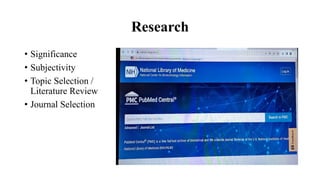
Research
• Significance
• Subjectivity
• Topic Selection /
Literature Review
• Journal Selection
Article Submission/ Types of Journals
• PubMed Indexed Journals
• Peer Reviewed Journals ( 2 Internal + 2 External Reviewers )
• Avoid Predatory Journal
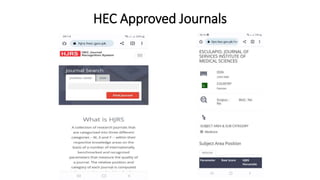
• Look for Impact Factor , ISSN / Cross Ref , Google scholar , Scopus ,
HEC approved
• X / Y / Z / W category
HEC Approved Journals
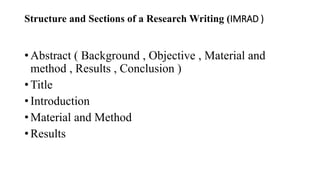
Structure and Sections of a Research Writing (IMRAD )
• Abstract ( Background , Objective , Material and
method , Results , Conclusion )
• Title
• Introduction
• Material and Method
• Results
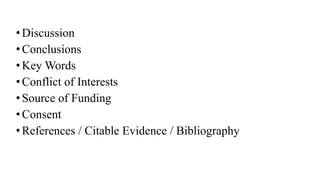
• Discussion
• Conclusions
• Key Words
• Conflict of Interests
• Source of Funding
• Consent
• References / Citable Evidence / Bibliography
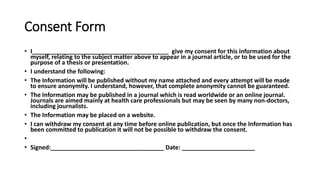
Consent Form
• I_________________________________________ give my consent for this information about
myself, relating to the subject matter above to appear in a journal article, or to be used for the
purpose of a thesis or presentation.
• I understand the following:
• The Information will be published without my name attached and every attempt will be made
to ensure anonymity. I understand, however, that complete anonymity cannot be guaranteed.
• The Information may be published in a journal which is read worldwide or an online journal.
Journals are aimed mainly at health care professionals but may be seen by many non-doctors,
including journalists.
• The Information may be placed on a website.
• I can withdraw my consent at any time before online publication, but once the Information has
been committed to publication it will not be possible to withdraw the consent.
•
• Signed:__________________________________ Date: ______________________
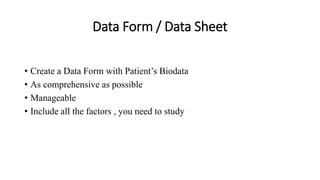
Data Form / Data Sheet
• Create a Data Form with Patient’s Biodata
• As comprehensive as possible
• Manageable
• Include all the factors , you need to study
Abstract
• Summary / Quick Look / Attraction point / Quintessential Marketing Tool
• 250 – 300 words
• May be the Only visible part at some places
• Background ( Briefly describe significance of study in 2 sentences or 3)
• Objective ( The purpose of study )
• Material and method ( Main inclusion criteria , study group and intervention or
parameters used )
• Results
• Conclusion
Title
• Reflective / Appropriate
• Word Count ( 14 )
• Easily searchable keywords on PubMed or Medline
• Should Get more Citations and Reads
• Should include the main factor or disease studied
• Should include the population studied
• Can include design of Study
Introduction
• Should Generate Curiosity to read More
• Significance of Your study
• What are you intending to achieve with it ?
• What’s New in it ?
• Explain the Utility of your work
• Suitably balance between being very obvious and avoid unnecessary details .
• 7 – 10 References
Introduction
• Typically Contains 3 Paragraphs
• 1st Indicating : Background of disease , Disease Burden , Prevalence ,
indicating how Significant your work is ….
• 2nd is Literature on the subject : Worldwide , General beliefs …
• 3rd is Local work / Studies in Pakistan on the subject
• Always end with thus there is need to study …. Thus indicating the
purpose of this study …
Material and Method
• Mention Type of Study
• Where was the work done
• Period of your research
• Explain in details what Parameters you are using
• Explain your Data Collection Process
Material and Method
• Should Include Statistical Analysis of your Variable e.g. Age , with
means and standard Deviation
• Level of significance and software Used
• Justification of sample size
• Take Help from Biostatistician where Stuck
Material and Method
• Explain all the Variables upon which you can base your results
• Contains Inclusion and Exclusion Criteria ***
• Do not contains References / Citable Evidence
• Mention of Gadgets and Tools ( Biochemical , Radiological , Clinical )
• Mention briefly that consent was obtained from Ethical committee
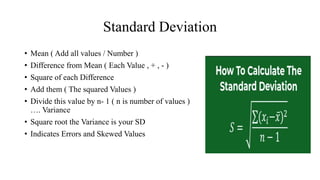
Standard Deviation
• Mean ( Add all values / Number )
• Difference from Mean ( Each Value , + , - )
• Square of each Difference
• Add them ( The squared Values )
• Divide this value by n- 1 ( n is number of values )
…. Variance
• Square root the Variance is your SD
• Indicates Errors and Skewed Values
Results
• Do not contains References
• Do not contains Commentary or Discussion
• Simply mention values and your results
• No need to repeat material and method
• Do not use the phrases as … surprisingly , interestingly etc.
• Can use both text / tables and figures …. / Pie charts / Data Summary
• Data if numerical will be with Standard Deviations
Discussion
• Starts with brief recap of main finding of your study
• But in Recap do not repeat your results , just rephrase in a way that shows the core
of your results / trend
• Compare your results with similar credible studies conducted worldwide ( With
References )
• Should include 7- 10 References
• Do criticize the other studies , to elevate your study but be diplomatic
Discussion
• Force your reader to believe this is not “ Just another Paper’’ but a significant
progress in literature
• Mention Your Shortcomings / Criticize your on work with promise to rectify in
future research work
• Again Typically Contains 3 paragraphs
• 1st …. Rephrasing of results
• 2nd …. Worldwide Comparison with similar Study
• 3rd …. Comparison or mention of local work in the same domain + Self analysis
and mention of shortcomings with promise to future work …..
Discussion
Conclusion
•In two or three Sentences , conclude
your study or work done on basis of your
results and evidence that you have
presented ….
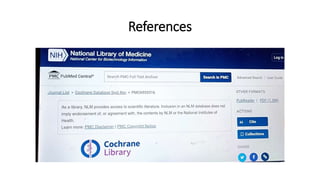
References
References
• Can be up to 20
• Widely accepted facts , need not to be referenced
• Equally distributed in Introduction and Discussion
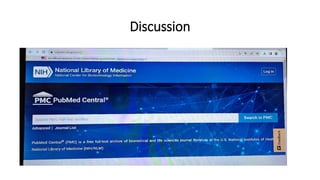
• Source : PubMed / Medline / Google Scholar
• Use Open access / Public articles on PubMed to avoid future Trouble
or Copyright issues
References
• DOI ( Digital Object Identifier ) ….. CrossRef.org ( Using Metasearch )
• URL
• Apart from articles … published books and tables from books can also
be referenced , but should be properly cited
• Follow Your journal guidelines for styling of references
References
• Can be written as Superscript BPH 2 , Superscript with Brackets (9) , Plain Brackets
[ 9 ]
• MLA ( Modern Language Association ) system Humanities and Arts
• APA (American Psychological Association ) Education and Psychology
• Harvard system
• Vancouver Style ( Medicine and Health Sciences ) / NLM ( National Library of
Medicine ) / Author-Number System / AMA ( American Medical Association )
• MHRA ( Modern Humanities Research Association ) System
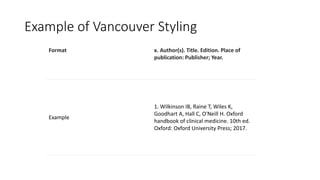
Example of Vancouver Styling
Format x. Author(s). Title. Edition. Place of
publication: Publisher; Year.
Example
1. Wilkinson IB, Raine T, Wiles K,
Goodhart A, Hall C, O'Neill H. Oxford
handbook of clinical medicine. 10th ed.
Oxford: Oxford University Press; 2017.
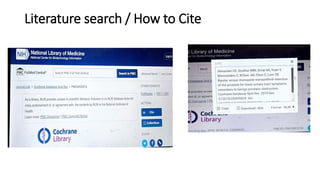
Literature search / How to Cite
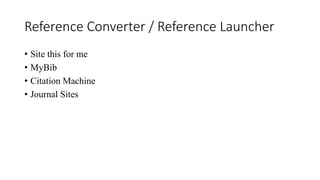
Reference Converter / Reference Launcher
• Site this for me
• MyBib
• Citation Machine
• Journal Sites
Conflict of Interest / Source of Funding
• A conflict of interest is anything that interferes with,
or could reasonably be perceived as interfering with,
the full and objective presentation, commissioning,
peer review, editorial decision-making, or publication
of research or non-research articles submitted to AIP
Publishing Journals.
EXAMPLES of Conflict of Interest
•Comparison of Efficacy And Safety Between
Tamsulosin And Ureterorenoscopy For 1.5
cm Mid Ureteric STONE
•Source of Funding : CCL Pharma /
Get Pharma /….
•Might be getting a grant or payment
Example of Conflict of Interest
• Research Articles on COVID Vaccines ….sponsored by
Pfizer
• Most Famous example in year 2020 : Relation of
vitamin D levels with morbidity and mortality related
to Coronavirus
Example
• Relationship /employee of the editorial Board / Work of same
organization
• It’s a Reader’s Right to Know the statement for conflict of
interest and Source of Funding
Key words / MeSH (Medical Subject
Headings)
• Use Commonly used PubMed friendly Key words to get for Citations
and Reads….
• Easily Discoverable …..
Adjuvants
• Title Page ( Name and Titles of Authors , Word count, Number of Figures and
Tables )
• Declaration Form ( Undertaking with name of Authors and Signatures )
• Covering Letter ( Letter to editor stating significance of research and request for
Publication)
• Check - List
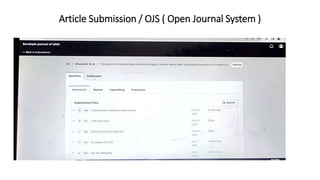
Article Submission / OJS ( Open Journal System )
Google Scholar
Google Scholar Profile
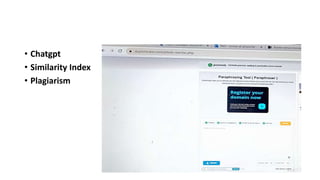
• Chatgpt
• Similarity Index
• Plagiarism
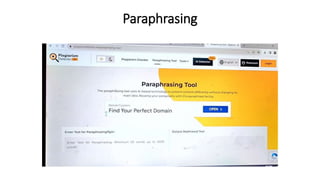
Paraphrasing
Case Reports
• Title
• Abstract
• Introduction
• Case Presentation
• Discussion
• Conclusion
• Consent / Conflict of Interest / Source of funding
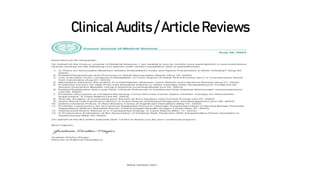
Clinical Audits / Article Reviews
Writing a Research Paper.pptx

Writing a Research Paper.pptx

  • 1.
    Writing a ResearchPaper Dr. Noman Ali Ghazanfar SR UROLOGY SIMS / SHL
  • 2.
    Objectives of thisPresentation • How to write an Article / Research Paper ?? • Structure of a research article …. • Terminologies associated with research ….. • How to Cite / How to find References in a research?..... • Creating a Google Scholar Profile / How to Use Google Scholar …. • Role of Chatgpt in Research / Plagiarism / Similarity index / Paraphrasing • Brief look at Case Report structure and Clinical Audit
  • 4.
    Research • Significance • Subjectivity •Topic Selection / Literature Review • Journal Selection
  • 5.
    Article Submission/ Typesof Journals • PubMed Indexed Journals • Peer Reviewed Journals ( 2 Internal + 2 External Reviewers ) • Avoid Predatory Journal • Look for Impact Factor , ISSN / Cross Ref , Google scholar , Scopus , HEC approved • X / Y / Z / W category
  • 6.
  • 7.
    Structure and Sectionsof a Research Writing (IMRAD ) • Abstract ( Background , Objective , Material and method , Results , Conclusion ) • Title • Introduction • Material and Method • Results
  • 8.
    • Discussion • Conclusions •Key Words • Conflict of Interests • Source of Funding • Consent • References / Citable Evidence / Bibliography
  • 9.
    Consent Form • I_________________________________________give my consent for this information about myself, relating to the subject matter above to appear in a journal article, or to be used for the purpose of a thesis or presentation. • I understand the following: • The Information will be published without my name attached and every attempt will be made to ensure anonymity. I understand, however, that complete anonymity cannot be guaranteed. • The Information may be published in a journal which is read worldwide or an online journal. Journals are aimed mainly at health care professionals but may be seen by many non-doctors, including journalists. • The Information may be placed on a website. • I can withdraw my consent at any time before online publication, but once the Information has been committed to publication it will not be possible to withdraw the consent. • • Signed:__________________________________ Date: ______________________
  • 10.
    Data Form /Data Sheet • Create a Data Form with Patient’s Biodata • As comprehensive as possible • Manageable • Include all the factors , you need to study
  • 11.
    Abstract • Summary /Quick Look / Attraction point / Quintessential Marketing Tool • 250 – 300 words • May be the Only visible part at some places • Background ( Briefly describe significance of study in 2 sentences or 3) • Objective ( The purpose of study ) • Material and method ( Main inclusion criteria , study group and intervention or parameters used ) • Results • Conclusion
  • 12.
    Title • Reflective /Appropriate • Word Count ( 14 ) • Easily searchable keywords on PubMed or Medline • Should Get more Citations and Reads • Should include the main factor or disease studied • Should include the population studied • Can include design of Study
  • 13.
    Introduction • Should GenerateCuriosity to read More • Significance of Your study • What are you intending to achieve with it ? • What’s New in it ? • Explain the Utility of your work • Suitably balance between being very obvious and avoid unnecessary details . • 7 – 10 References
  • 14.
    Introduction • Typically Contains3 Paragraphs • 1st Indicating : Background of disease , Disease Burden , Prevalence , indicating how Significant your work is …. • 2nd is Literature on the subject : Worldwide , General beliefs … • 3rd is Local work / Studies in Pakistan on the subject • Always end with thus there is need to study …. Thus indicating the purpose of this study …
  • 15.
    Material and Method •Mention Type of Study • Where was the work done • Period of your research • Explain in details what Parameters you are using • Explain your Data Collection Process
  • 16.
    Material and Method •Should Include Statistical Analysis of your Variable e.g. Age , with means and standard Deviation • Level of significance and software Used • Justification of sample size • Take Help from Biostatistician where Stuck
  • 17.
    Material and Method •Explain all the Variables upon which you can base your results • Contains Inclusion and Exclusion Criteria *** • Do not contains References / Citable Evidence • Mention of Gadgets and Tools ( Biochemical , Radiological , Clinical ) • Mention briefly that consent was obtained from Ethical committee
  • 18.
    Standard Deviation • Mean( Add all values / Number ) • Difference from Mean ( Each Value , + , - ) • Square of each Difference • Add them ( The squared Values ) • Divide this value by n- 1 ( n is number of values ) …. Variance • Square root the Variance is your SD • Indicates Errors and Skewed Values
  • 19.
    Results • Do notcontains References • Do not contains Commentary or Discussion • Simply mention values and your results • No need to repeat material and method • Do not use the phrases as … surprisingly , interestingly etc. • Can use both text / tables and figures …. / Pie charts / Data Summary • Data if numerical will be with Standard Deviations
  • 20.
    Discussion • Starts withbrief recap of main finding of your study • But in Recap do not repeat your results , just rephrase in a way that shows the core of your results / trend • Compare your results with similar credible studies conducted worldwide ( With References ) • Should include 7- 10 References • Do criticize the other studies , to elevate your study but be diplomatic
  • 21.
    Discussion • Force yourreader to believe this is not “ Just another Paper’’ but a significant progress in literature • Mention Your Shortcomings / Criticize your on work with promise to rectify in future research work • Again Typically Contains 3 paragraphs • 1st …. Rephrasing of results • 2nd …. Worldwide Comparison with similar Study • 3rd …. Comparison or mention of local work in the same domain + Self analysis and mention of shortcomings with promise to future work …..
  • 22.
  • 23.
    Conclusion •In two orthree Sentences , conclude your study or work done on basis of your results and evidence that you have presented ….
  • 24.
  • 25.
    References • Can beup to 20 • Widely accepted facts , need not to be referenced • Equally distributed in Introduction and Discussion • Source : PubMed / Medline / Google Scholar • Use Open access / Public articles on PubMed to avoid future Trouble or Copyright issues
  • 26.
    References • DOI (Digital Object Identifier ) ….. CrossRef.org ( Using Metasearch ) • URL • Apart from articles … published books and tables from books can also be referenced , but should be properly cited • Follow Your journal guidelines for styling of references
  • 27.
    References • Can bewritten as Superscript BPH 2 , Superscript with Brackets (9) , Plain Brackets [ 9 ] • MLA ( Modern Language Association ) system Humanities and Arts • APA (American Psychological Association ) Education and Psychology • Harvard system • Vancouver Style ( Medicine and Health Sciences ) / NLM ( National Library of Medicine ) / Author-Number System / AMA ( American Medical Association ) • MHRA ( Modern Humanities Research Association ) System
  • 28.
    Example of VancouverStyling Format x. Author(s). Title. Edition. Place of publication: Publisher; Year. Example 1. Wilkinson IB, Raine T, Wiles K, Goodhart A, Hall C, O'Neill H. Oxford handbook of clinical medicine. 10th ed. Oxford: Oxford University Press; 2017.
  • 29.
  • 30.
    Reference Converter /Reference Launcher • Site this for me • MyBib • Citation Machine • Journal Sites
  • 32.
    Conflict of Interest/ Source of Funding • A conflict of interest is anything that interferes with, or could reasonably be perceived as interfering with, the full and objective presentation, commissioning, peer review, editorial decision-making, or publication of research or non-research articles submitted to AIP Publishing Journals.
  • 33.
    EXAMPLES of Conflictof Interest •Comparison of Efficacy And Safety Between Tamsulosin And Ureterorenoscopy For 1.5 cm Mid Ureteric STONE
  • 34.
    •Source of Funding: CCL Pharma / Get Pharma /…. •Might be getting a grant or payment
  • 35.
    Example of Conflictof Interest • Research Articles on COVID Vaccines ….sponsored by Pfizer • Most Famous example in year 2020 : Relation of vitamin D levels with morbidity and mortality related to Coronavirus
  • 36.
    Example • Relationship /employeeof the editorial Board / Work of same organization • It’s a Reader’s Right to Know the statement for conflict of interest and Source of Funding
  • 37.
    Key words /MeSH (Medical Subject Headings) • Use Commonly used PubMed friendly Key words to get for Citations and Reads…. • Easily Discoverable …..
  • 38.
    Adjuvants • Title Page( Name and Titles of Authors , Word count, Number of Figures and Tables ) • Declaration Form ( Undertaking with name of Authors and Signatures ) • Covering Letter ( Letter to editor stating significance of research and request for Publication) • Check - List
  • 39.
    Article Submission /OJS ( Open Journal System )
  • 40.
  • 41.
  • 42.
    • Chatgpt • SimilarityIndex • Plagiarism
  • 43.
  • 44.
    Case Reports • Title •Abstract • Introduction • Case Presentation • Discussion • Conclusion • Consent / Conflict of Interest / Source of funding
  • 45.
    Clinical Audits /Article Reviews