Chapter 2
Dr. saroj suwal
 What is medical literature search
 Why search
 For whom search
 Steps in searching
 Quality searching
an activity that uses professional methods
for medical research papers retrieval, report
and other data to improve medicine research
and practice.
Literature search:
Right path to the right
reference
 For writing thesis,review ,jornals ,reports etc
 For working as a research assistant
 For finding funding proposal or grant application
 For academic work as a faculty member
 For working as a professional researcher
 Searching the literature is an essential component
of the scholarly research process
 to conduct a quality literature search  crucial for
academic study and professional development
 to create and publish secondary analysis on a specific
topic,
 for analysis of original research,
 to be able to locate the best evidence to answer
clinical questions
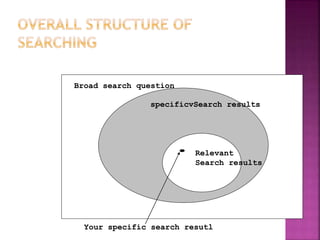
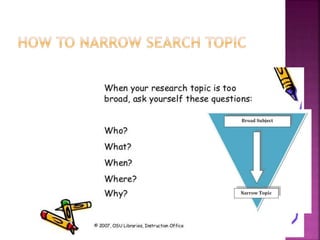
Broad search question
specificvSearch results
Relevant
Search results
Your specific search resutl
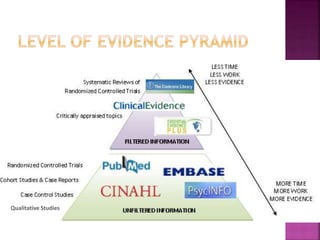
Qualitative Studies
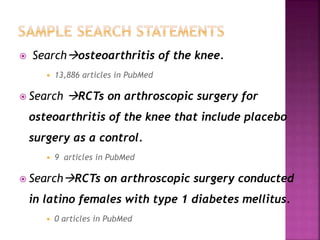
 Searchosteoarthritis of the knee.
 13,886 articles in PubMed
 Search RCTs on arthroscopic surgery for
osteoarthritis of the knee that include placebo
surgery as a control.
 9 articles in PubMed
 SearchRCTs on arthroscopic surgery conducted
in latino females with type 1 diabetes mellitus.
 0 articles in PubMed
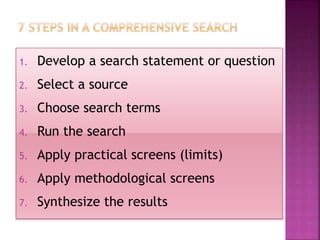
1. Develop a search statement or question
2. Select a source
3. Choose search terms
4. Run the search
5. Apply practical screens (limits)
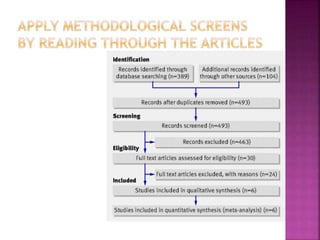
6. Apply methodological screens
7. Synthesize the results
WHY?
 To guide your review
 To provide you with keywords for your search
 To give your research precision
1. Developing search questions
“FINER”
F= Feasible
I= Interesting
N= Novel
E= Ethical
R= Relevant
Broad:
• What is the prevalence of hypertension in patients with diabetes mellitus?
Narrow:
• Does ambulatory BP readings improve detection rates for hypertension in
patients with type 1 diabetes mellitus?
Very Narrow:
• What are the attitudes of general practitioners in south china to the use of
ambulatory BP readings for patients with type 1 diabetes mellitus?
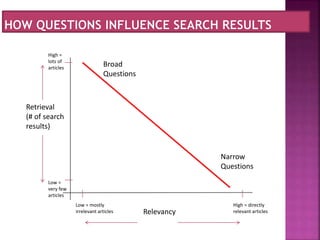
Relevancy
Retrieval
(# of search
results)
Broad
Questions
Narrow
Questions
High =
lots of
articles
Low =
very few
articles
High = directly
relevant articles
Low = mostly
irrelevant articles
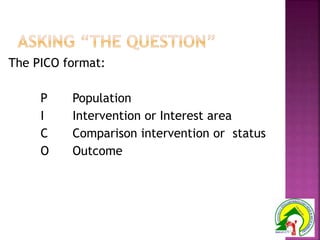
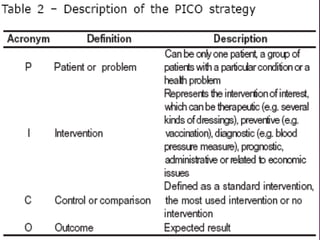
The PICO format:
P Population
I Intervention or Interest area
C Comparison intervention or status
O Outcome
 Internet Websites, search engines, news & alert services
 The Library
 Look through the list of journals and browse the text books on
the shelves to find relevant ones
 Digital Libraries
 Need to use keyword searches to identify relevant articles
 Newspaper and magazines
 Text books, Guidelines, Factsheets, Databases,
Reports
Primary Source-original
journals
Secondary Source –review
articles
Tertiary Source-text books
Web Sites
 can be very good for finding quality information
including primary sources, statistical information
and many more
 rigorously evaluate each site for quality and
responsibility
 Because anyone can post a Web page, regardless of
their expertise or intentions.
 Use keyword searches in Google (which indexes PDF and
PostScript academic publications)
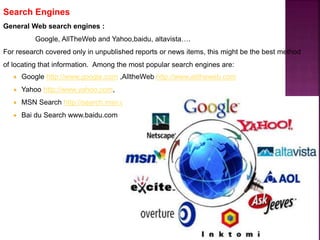
Search Engines
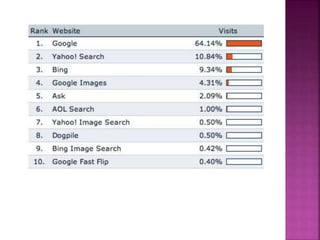
General Web search engines :
Google, AllTheWeb and Yahoo,baidu, altavista….
For research covered only in unpublished reports or news items, this might be the best method
of locating that information. Among the most popular search engines are:
 Google http://www.google.com ,AlltheWeb http://www.alltheweb.com
 Yahoo http://www.yahoo.com,
 MSN Search http://search.msn.com
 Bai du Search www.baidu.com
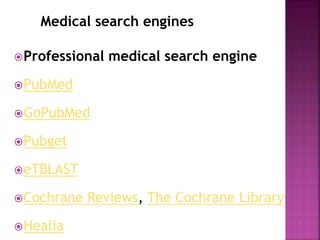
Professional medical search engine
PubMed
GoPubMed
Pubget
eTBLAST
Cochrane Reviews, The Cochrane Library
Healia
Medical search engines
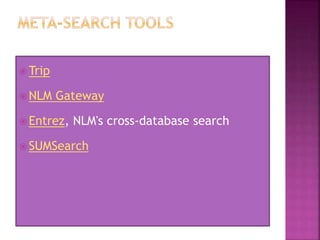
 Trip
 NLM Gateway
 Entrez, NLM's cross-database search
 SUMSearch
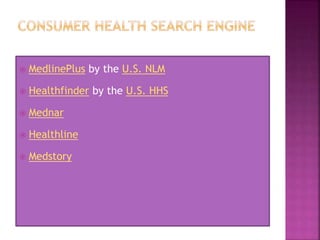
 MedlinePlus by the U.S. NLM
 Healthfinder by the U.S. HHS
 Mednar
 Healthline
 Medstory
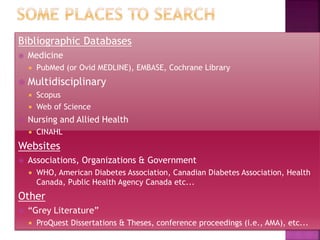
Bibliographic Databases
 Medicine
 PubMed (or Ovid MEDLINE), EMBASE, Cochrane Library
 Multidisciplinary
 Scopus
 Web of Science
 Nursing and Allied Health
 CINAHL
Websites
 Associations, Organizations & Government
 WHO, American Diabetes Association, Canadian Diabetes Association, Health
Canada, Public Health Agency Canada etc...
Other
 “Grey Literature”
 ProQuest Dissertations & Theses, conference proceedings (i.e., AMA), etc...
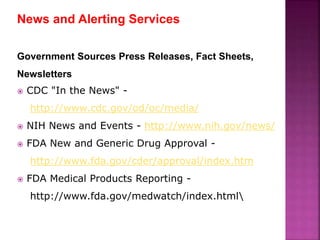
News and Alerting Services
Government Sources Press Releases, Fact Sheets,
Newsletters
 CDC "In the News" -
http://www.cdc.gov/od/oc/media/
 NIH News and Events - http://www.nih.gov/news/
 FDA New and Generic Drug Approval -
http://www.fda.gov/cder/approval/index.htm
 FDA Medical Products Reporting -
http://www.fda.gov/medwatch/index.html
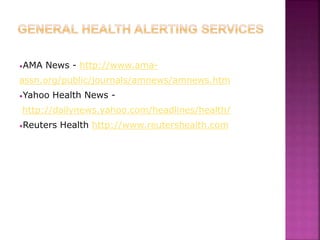
•AMA News - http://www.ama-
assn.org/public/journals/amnews/amnews.htm
•Yahoo Health News -
http://dailynews.yahoo.com/headlines/health/
•Reuters Health http://www.reutershealth.com
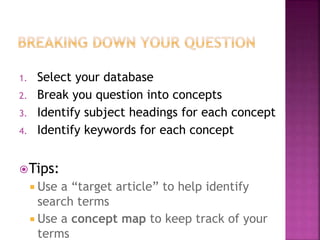
1. Select your database
2. Break you question into concepts
3. Identify subject headings for each concept
4. Identify keywords for each concept
Tips:
 Use a “target article” to help identify
search terms
 Use a concept map to keep track of your
terms
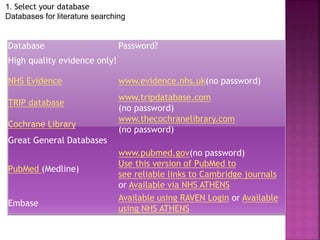
Database Password?
High quality evidence only!
NHS Evidence www.evidence.nhs.uk(no password)
TRIP database
www.tripdatabase.com
(no password)
Cochrane Library
www.thecochranelibrary.com
(no password)
Great General Databases
PubMed (Medline)
www.pubmed.gov(no password)
Use this version of PubMed to
see reliable links to Cambridge journals
or Available via NHS ATHENS
Embase
Available using RAVEN Login or Available
using NHS ATHENS
1. Select your database
Databases for literature searching
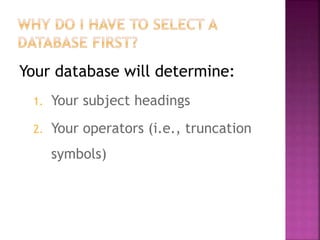
Your database will determine:
1. Your subject headings
2. Your operators (i.e., truncation
symbols)
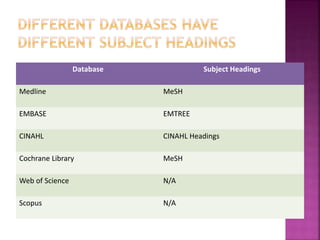
Database Subject Headings
Medline MeSH
EMBASE EMTREE
CINAHL CINAHL Headings
Cochrane Library MeSH
Web of Science N/A
Scopus N/A
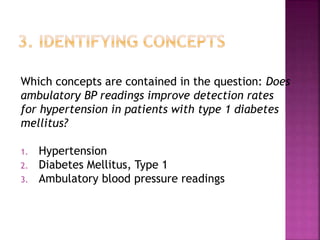
Which concepts are contained in the question: Does
ambulatory BP readings improve detection rates
for hypertension in patients with type 1 diabetes
mellitus?
1. Hypertension
2. Diabetes Mellitus, Type 1
3. Ambulatory blood pressure readings
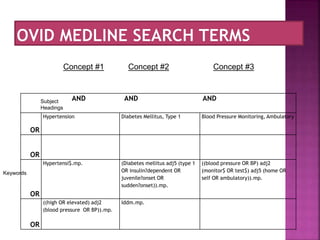
Concept #1 Concept #2 Concept #3
Subject
Headings
Keywords
AND AND AND
OR
Hypertension Diabetes Mellitus, Type 1 Blood Pressure Monitoring, Ambulatory
OR
OR
Hypertensi$.mp. (Diabetes mellitus adj5 (type 1
OR insulin?dependent OR
juvenile?onset OR
sudden?onset)).mp.
((blood pressure OR BP) adj2
(monitor$ OR test$) adj5 (home OR
self OR ambulatory)).mp.
OR
((high OR elevated) adj2
(blood pressure OR BP)).mp.
Iddm.mp.
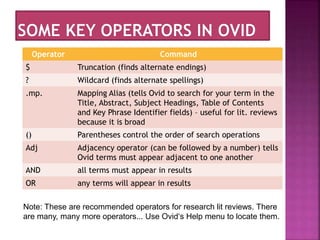
Operator Command
$ Truncation (finds alternate endings)
? Wildcard (finds alternate spellings)
.mp. Mapping Alias (tells Ovid to search for your term in the
Title, Abstract, Subject Headings, Table of Contents
and Key Phrase Identifier fields) – useful for lit. reviews
because it is broad
() Parentheses control the order of search operations
Adj Adjacency operator (can be followed by a number) tells
Ovid terms must appear adjacent to one another
AND all terms must appear in results
OR any terms will appear in results
Note: These are recommended operators for research lit reviews. There
are many, many more operators... Use Ovid‘s Help menu to locate them.
 Concept(titles , objectives)
 Searching using criterias and parameters
 Screening
 Synthesizing the results
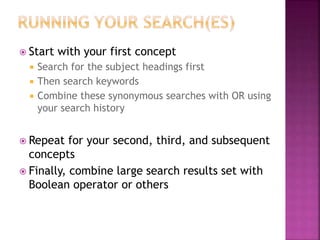
 Start with your first concept
 Search for the subject headings first
 Then search keywords
 Combine these synonymous searches with OR using
your search history
 Repeat for your second, third, and subsequent
concepts
 Finally, combine large search results set with
Boolean operator or others
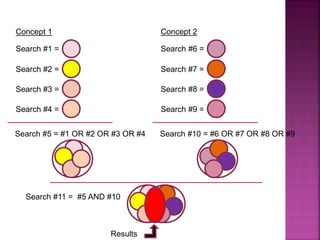
Search #2 =
Search #3 =
Search #4 =
Search #5 = #1 OR #2 OR #3 OR #4
Search #1 =
Concept 1
Search #6 =
Search #7 =
Search #8 =
Search #9 =
Concept 2
Search #10 = #6 OR #7 OR #8 OR #9
Search #11 = #5 AND #10
Results
 Two kinds: practical and methodological
1. practical screening criteria
 Is to identify a broad range of potentially
useful studies
2. methodological screening Criteria
 is to identify the best available studies
1. Date of publication
 only studies conducted between 2005 and 2010
2. Participants of subjects
 only children 6 to 12 years of age
3. Publication language
 only materials written in English
4. Research design and methods
 The clinical trials, studies
some questions to ask
 Is the study’s research design internally & externally
valid?
 Are the data sources used in the study reliable & valid?
 Are the analytical methods appropriate? (p value,
cooreation, regression, hypothesis etc)
 Are the results meaningful in practical & statistical
terms?*
*Fink, A. (2005). Conducting Research Literature Reviews. London: Sage.
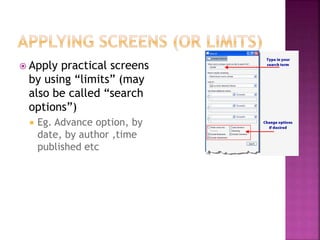
 Apply practical screens
by using “limits” (may
also be called “search
options”)
 Eg. Advance option, by
date, by author ,time
published etc
 Locate the reference lists for selected
articles*
 Identify new articles that have cited your
articles*
 Identify key journals and “hand search” their
issues
 Test your search strategy by checking to see
if a few “target articles” appear in the
results
* Use Web of Science or Scopus or else
 Export search results from each database or
website into a citation manager (i.e.,
RefWorks)
 Remove duplicates
 Remove inappropriate studies by applying
methodological screens
 What conclusions did these studies reach?
 Which studies agreed/disagreed with the consensus?
 Consider using a synthesis matrix:
www.ncsu.edu/tutorial_center/writespeak/download
/Synthesis.pdf
1. Describe current knowledge about your research
topic
2. Support the need for and significance of new
research
3. Explain research findings
4. Describe the quality of a body of research*
*Fink, A. (2005). Conducting Research Literature Reviews. London: Sage.
 Thanks

medical literature search process

  • 1.
  • 2.
     What ismedical literature search  Why search  For whom search  Steps in searching  Quality searching
  • 3.
    an activity thatuses professional methods for medical research papers retrieval, report and other data to improve medicine research and practice.
  • 4.
    Literature search: Right pathto the right reference
  • 5.
     For writingthesis,review ,jornals ,reports etc  For working as a research assistant  For finding funding proposal or grant application  For academic work as a faculty member  For working as a professional researcher
  • 6.
     Searching theliterature is an essential component of the scholarly research process  to conduct a quality literature search  crucial for academic study and professional development  to create and publish secondary analysis on a specific topic,  for analysis of original research,  to be able to locate the best evidence to answer clinical questions
  • 7.
    Broad search question specificvSearchresults Relevant Search results Your specific search resutl
  • 8.
  • 9.
     Searchosteoarthritis ofthe knee.  13,886 articles in PubMed  Search RCTs on arthroscopic surgery for osteoarthritis of the knee that include placebo surgery as a control.  9 articles in PubMed  SearchRCTs on arthroscopic surgery conducted in latino females with type 1 diabetes mellitus.  0 articles in PubMed
  • 10.
    1. Develop asearch statement or question 2. Select a source 3. Choose search terms 4. Run the search 5. Apply practical screens (limits) 6. Apply methodological screens 7. Synthesize the results
  • 11.
    WHY?  To guideyour review  To provide you with keywords for your search  To give your research precision 1. Developing search questions
  • 13.
    “FINER” F= Feasible I= Interesting N=Novel E= Ethical R= Relevant
  • 14.
    Broad: • What isthe prevalence of hypertension in patients with diabetes mellitus? Narrow: • Does ambulatory BP readings improve detection rates for hypertension in patients with type 1 diabetes mellitus? Very Narrow: • What are the attitudes of general practitioners in south china to the use of ambulatory BP readings for patients with type 1 diabetes mellitus?
  • 15.
    Relevancy Retrieval (# of search results) Broad Questions Narrow Questions High= lots of articles Low = very few articles High = directly relevant articles Low = mostly irrelevant articles
  • 17.
    The PICO format: PPopulation I Intervention or Interest area C Comparison intervention or status O Outcome
  • 19.
     Internet Websites,search engines, news & alert services  The Library  Look through the list of journals and browse the text books on the shelves to find relevant ones  Digital Libraries  Need to use keyword searches to identify relevant articles  Newspaper and magazines  Text books, Guidelines, Factsheets, Databases, Reports
  • 20.
    Primary Source-original journals Secondary Source–review articles Tertiary Source-text books
  • 21.
    Web Sites  canbe very good for finding quality information including primary sources, statistical information and many more  rigorously evaluate each site for quality and responsibility  Because anyone can post a Web page, regardless of their expertise or intentions.  Use keyword searches in Google (which indexes PDF and PostScript academic publications)
  • 22.
    Search Engines General Websearch engines : Google, AllTheWeb and Yahoo,baidu, altavista…. For research covered only in unpublished reports or news items, this might be the best method of locating that information. Among the most popular search engines are:  Google http://www.google.com ,AlltheWeb http://www.alltheweb.com  Yahoo http://www.yahoo.com,  MSN Search http://search.msn.com  Bai du Search www.baidu.com
  • 24.
    Professional medical searchengine PubMed GoPubMed Pubget eTBLAST Cochrane Reviews, The Cochrane Library Healia Medical search engines
  • 25.
     Trip  NLMGateway  Entrez, NLM's cross-database search  SUMSearch
  • 26.
     MedlinePlus bythe U.S. NLM  Healthfinder by the U.S. HHS  Mednar  Healthline  Medstory
  • 27.
    Bibliographic Databases  Medicine PubMed (or Ovid MEDLINE), EMBASE, Cochrane Library  Multidisciplinary  Scopus  Web of Science  Nursing and Allied Health  CINAHL Websites  Associations, Organizations & Government  WHO, American Diabetes Association, Canadian Diabetes Association, Health Canada, Public Health Agency Canada etc... Other  “Grey Literature”  ProQuest Dissertations & Theses, conference proceedings (i.e., AMA), etc...
  • 28.
    News and AlertingServices Government Sources Press Releases, Fact Sheets, Newsletters  CDC "In the News" - http://www.cdc.gov/od/oc/media/  NIH News and Events - http://www.nih.gov/news/  FDA New and Generic Drug Approval - http://www.fda.gov/cder/approval/index.htm  FDA Medical Products Reporting - http://www.fda.gov/medwatch/index.html
  • 30.
    •AMA News -http://www.ama- assn.org/public/journals/amnews/amnews.htm •Yahoo Health News - http://dailynews.yahoo.com/headlines/health/ •Reuters Health http://www.reutershealth.com
  • 32.
    1. Select yourdatabase 2. Break you question into concepts 3. Identify subject headings for each concept 4. Identify keywords for each concept Tips:  Use a “target article” to help identify search terms  Use a concept map to keep track of your terms
  • 33.
    Database Password? High qualityevidence only! NHS Evidence www.evidence.nhs.uk(no password) TRIP database www.tripdatabase.com (no password) Cochrane Library www.thecochranelibrary.com (no password) Great General Databases PubMed (Medline) www.pubmed.gov(no password) Use this version of PubMed to see reliable links to Cambridge journals or Available via NHS ATHENS Embase Available using RAVEN Login or Available using NHS ATHENS 1. Select your database Databases for literature searching
  • 34.
    Your database willdetermine: 1. Your subject headings 2. Your operators (i.e., truncation symbols)
  • 35.
    Database Subject Headings MedlineMeSH EMBASE EMTREE CINAHL CINAHL Headings Cochrane Library MeSH Web of Science N/A Scopus N/A
  • 36.
    Which concepts arecontained in the question: Does ambulatory BP readings improve detection rates for hypertension in patients with type 1 diabetes mellitus? 1. Hypertension 2. Diabetes Mellitus, Type 1 3. Ambulatory blood pressure readings
  • 37.
    Concept #1 Concept#2 Concept #3 Subject Headings Keywords AND AND AND OR Hypertension Diabetes Mellitus, Type 1 Blood Pressure Monitoring, Ambulatory OR OR Hypertensi$.mp. (Diabetes mellitus adj5 (type 1 OR insulin?dependent OR juvenile?onset OR sudden?onset)).mp. ((blood pressure OR BP) adj2 (monitor$ OR test$) adj5 (home OR self OR ambulatory)).mp. OR ((high OR elevated) adj2 (blood pressure OR BP)).mp. Iddm.mp.
  • 38.
    Operator Command $ Truncation(finds alternate endings) ? Wildcard (finds alternate spellings) .mp. Mapping Alias (tells Ovid to search for your term in the Title, Abstract, Subject Headings, Table of Contents and Key Phrase Identifier fields) – useful for lit. reviews because it is broad () Parentheses control the order of search operations Adj Adjacency operator (can be followed by a number) tells Ovid terms must appear adjacent to one another AND all terms must appear in results OR any terms will appear in results Note: These are recommended operators for research lit reviews. There are many, many more operators... Use Ovid‘s Help menu to locate them.
  • 39.
     Concept(titles ,objectives)  Searching using criterias and parameters  Screening  Synthesizing the results
  • 40.
     Start withyour first concept  Search for the subject headings first  Then search keywords  Combine these synonymous searches with OR using your search history  Repeat for your second, third, and subsequent concepts  Finally, combine large search results set with Boolean operator or others
  • 41.
    Search #2 = Search#3 = Search #4 = Search #5 = #1 OR #2 OR #3 OR #4 Search #1 = Concept 1 Search #6 = Search #7 = Search #8 = Search #9 = Concept 2 Search #10 = #6 OR #7 OR #8 OR #9 Search #11 = #5 AND #10 Results
  • 43.
     Two kinds:practical and methodological 1. practical screening criteria  Is to identify a broad range of potentially useful studies 2. methodological screening Criteria  is to identify the best available studies
  • 44.
    1. Date ofpublication  only studies conducted between 2005 and 2010 2. Participants of subjects  only children 6 to 12 years of age 3. Publication language  only materials written in English 4. Research design and methods  The clinical trials, studies
  • 45.
    some questions toask  Is the study’s research design internally & externally valid?  Are the data sources used in the study reliable & valid?  Are the analytical methods appropriate? (p value, cooreation, regression, hypothesis etc)  Are the results meaningful in practical & statistical terms?* *Fink, A. (2005). Conducting Research Literature Reviews. London: Sage.
  • 46.
     Apply practicalscreens by using “limits” (may also be called “search options”)  Eg. Advance option, by date, by author ,time published etc
  • 48.
     Locate thereference lists for selected articles*  Identify new articles that have cited your articles*  Identify key journals and “hand search” their issues  Test your search strategy by checking to see if a few “target articles” appear in the results * Use Web of Science or Scopus or else
  • 49.
     Export searchresults from each database or website into a citation manager (i.e., RefWorks)  Remove duplicates  Remove inappropriate studies by applying methodological screens
  • 51.
     What conclusionsdid these studies reach?  Which studies agreed/disagreed with the consensus?  Consider using a synthesis matrix: www.ncsu.edu/tutorial_center/writespeak/download /Synthesis.pdf
  • 52.
    1. Describe currentknowledge about your research topic 2. Support the need for and significance of new research 3. Explain research findings 4. Describe the quality of a body of research* *Fink, A. (2005). Conducting Research Literature Reviews. London: Sage.
  • 53.