PROTEIN STRUCTURE PREDICTION
Presented by – Siddika Arif Attar
M.SC BIOTECHNOLOGY
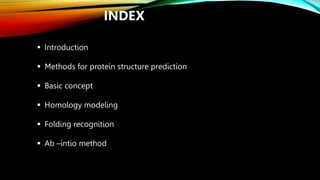
 Introduction
 Methods for protein structure prediction
 Basic concept
 Homology modeling
 Folding recognition
 Ab –intio method
INDEX
Introduction :
protein structure prediction-
protein structure prediction is the inference of the 3-D structure of protein
From its amino acid.
i.e. The predicton of its secondory & tertiory structure from primary structure.
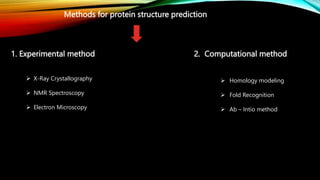
Methods for protein structure prediction
1. Experimental method 2. Computational method
 X-Ray Crystallography
 NMR Spectroscopy
 Electron Microscopy
 Homology modeling
 Fold Recognition
 Ab – Intio method
Basic concept
1. Homology modeling
 Knowledge based modeling.
 Based on sequence similarity with a protein.
 For which a structure has been predicted .
Steps in homology modeling
1. Target recognition :
 Search related protein sequence in any strucrural database.
 FASTA &BLAST from EMBL-EBI & NCBI can be used ‘
2. Template selection :
 Slection on the basis of higher similarity ,close- subfamily phylogenetic tree & purpose
of modeling
3. Alignment sequence :
 The sequence similarity is too high then global alignment used.
 The best alignment methods are Cludtal X ,MUSCLE, T-Coffe & MAFFT .
4. Model Building :
 Use MODELLER of model building i.e. Max Mod , PY Mod , PRIMO.
5. Model Evaluation :
 Accuracy of the model depend upon its sequence identity with the template.
Fig .Homology Modeling
2. Folding recognition
Two Algorithms :
 Pairwise energy based method [ threading]
 Profile based method [fold recognition]
1. Pairwise energy based method :
 Searach for structural fold database by using energy based criteria.
 Using a dynamic programming & heuristic approaches .
 Calculate energy for raw model .
 Lowest energy fold is the best model .
2. Profile based method
 A profile is constructed for related protein structure
 Generated by superimposition if structures to expose corresponding residues.
 Similarity depend upon the secondary structure ,polarity, hydrophobicity.
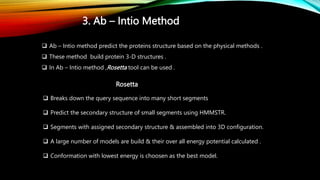
3. Ab – Intio Method
 Ab – Intio method predict the proteins structure based on the physical methods .
 These method build protein 3-D structures .
 In Ab – Intio method ,Rosetta tool can be used .
Rosetta
 Breaks down the query sequence into many short segments
 Predict the secondary structure of small segments using HMMSTR.
 Segments with assigned secondary structure & assembled into 3D configuration.
 A large number of models are build & their over all energy potential calculated .
 Conformation with lowest energy is choosen as the best model.
THANK YOU !

protein structure prediction.pptx

  • 1.
    PROTEIN STRUCTURE PREDICTION Presentedby – Siddika Arif Attar M.SC BIOTECHNOLOGY
  • 2.
     Introduction  Methodsfor protein structure prediction  Basic concept  Homology modeling  Folding recognition  Ab –intio method INDEX
  • 3.
    Introduction : protein structureprediction- protein structure prediction is the inference of the 3-D structure of protein From its amino acid. i.e. The predicton of its secondory & tertiory structure from primary structure.
  • 4.
    Methods for proteinstructure prediction 1. Experimental method 2. Computational method  X-Ray Crystallography  NMR Spectroscopy  Electron Microscopy  Homology modeling  Fold Recognition  Ab – Intio method
  • 5.
  • 6.
    1. Homology modeling Knowledge based modeling.  Based on sequence similarity with a protein.  For which a structure has been predicted .
  • 7.
    Steps in homologymodeling 1. Target recognition :  Search related protein sequence in any strucrural database.  FASTA &BLAST from EMBL-EBI & NCBI can be used ‘ 2. Template selection :  Slection on the basis of higher similarity ,close- subfamily phylogenetic tree & purpose of modeling 3. Alignment sequence :  The sequence similarity is too high then global alignment used.  The best alignment methods are Cludtal X ,MUSCLE, T-Coffe & MAFFT .
  • 8.
    4. Model Building:  Use MODELLER of model building i.e. Max Mod , PY Mod , PRIMO. 5. Model Evaluation :  Accuracy of the model depend upon its sequence identity with the template. Fig .Homology Modeling
  • 9.
    2. Folding recognition TwoAlgorithms :  Pairwise energy based method [ threading]  Profile based method [fold recognition] 1. Pairwise energy based method :  Searach for structural fold database by using energy based criteria.  Using a dynamic programming & heuristic approaches .  Calculate energy for raw model .  Lowest energy fold is the best model .
  • 10.
    2. Profile basedmethod  A profile is constructed for related protein structure  Generated by superimposition if structures to expose corresponding residues.  Similarity depend upon the secondary structure ,polarity, hydrophobicity.
  • 11.
    3. Ab –Intio Method  Ab – Intio method predict the proteins structure based on the physical methods .  These method build protein 3-D structures .  In Ab – Intio method ,Rosetta tool can be used . Rosetta  Breaks down the query sequence into many short segments  Predict the secondary structure of small segments using HMMSTR.  Segments with assigned secondary structure & assembled into 3D configuration.  A large number of models are build & their over all energy potential calculated .  Conformation with lowest energy is choosen as the best model.
  • 12.