ANATOMYANATOMYByDr. THAAER MOHAMMED DAHER ALSAADM.B.Ch.B.(MBBS)           F.I.B.M.S.(Ph.D.)SPECIALIST IN GENERAL SURGERYSENIOR          LECTURERIMS       MSU
ARM AND HUMERUSPectoral region
Pectoral regionTopographical Anatomy MIDAXILLARY LINEan imaginary vertical line passing through the middle of the axilla.used as a surface landmark for descriptive purposes.MIDCLAVICULAR LINE /(milk line)an imaginary vertical line passing through the midshaft of the clavicleused as a surface landmark for descriptive purposes.
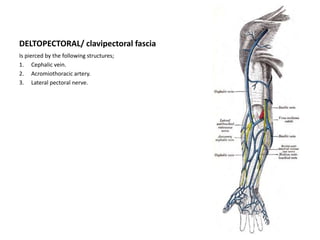
DELTOPECTORAL/ clavipectoral fasciaIs pierced by the following structures;Cephalic vein.Acromiothoracic artery.Lateral pectoral nerve.
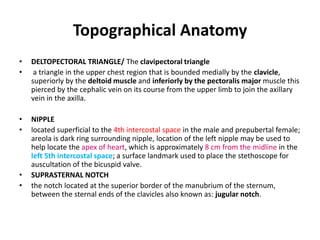
DELTOPECTORAL TRIANGLE/ The clavipectoral triangle a triangle in the upper chest region that is bounded medially by the clavicle,    superiorly by the deltoid muscle and inferiorly by the pectoralis major muscle this pierced by the cephalic vein on its course from the upper limb to join the axillary vein in the axilla.NIPPLElocated superficial to the 4th intercostal space in the male and prepubertal female; areola is dark ring surrounding nipple, location of the left nipple may be used to help locate the apex of heart, which is approximately 8 cm from the midline in the left 5th intercostal space; a surface landmark used to place the stethoscope for auscultation of the bicuspid valve.SUPRASTERNAL NOTCHthe notch located at the superior border of the manubrium of the sternum, between the sternal ends of the clavicles also known as: jugular notch.Topographical Anatomy
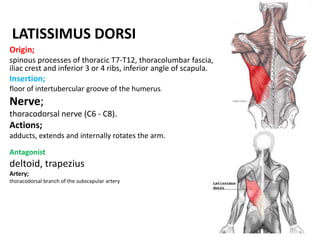
LATISSIMUS DORSIOrigin;spinous processes of thoracic T7-T12, thoracolumbar fascia, iliac crest and inferior 3 or 4 ribs, inferior angle of scapula.Insertion;floor of intertubercular groove of the humerus.Nerve;thoracodorsal nerve (C6 - C8).Actions;adducts, extends and internally rotates the arm.Antagonistdeltoid, trapeziusArtery;thoracodorsal branch of the subscapular artery 
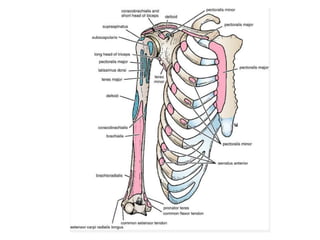
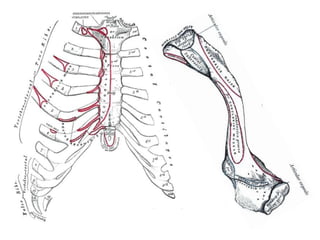
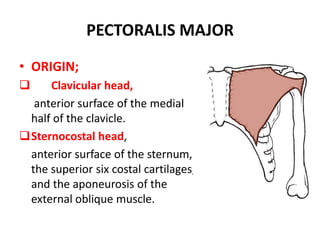
PECTORALIS MAJORORIGIN;	Clavicular head, anterior surface of the medial half of the clavicle.Sternocostal head, anterior surface of the sternum, the superior six costal cartilages, and the aponeurosis of the external oblique muscle.
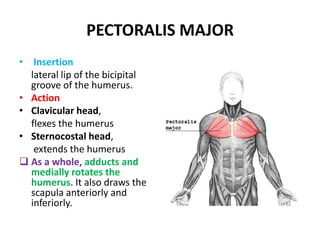
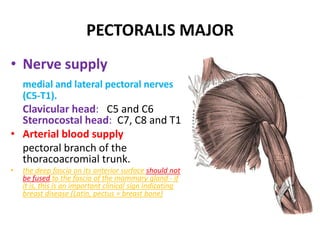
PECTORALIS MAJOR Insertionlateral lip of the bicipital groove of the humerus.ActionClavicular head,	flexes the humerusSternocostal head,	 extends the humerusAs a whole, adducts and medially rotates the humerus. It also draws the scapula anteriorly and inferiorly.PECTORALIS MAJORNerve supplymedial and lateral pectoral nerves (C5-T1).Clavicular head:   C5 and C6Sternocostal head:  C7, C8 and T1Arterial blood supply pectoral branch of the thoracoacromial trunk.the deep fascia on its anterior surface should not be fused to the fascia of the mammary gland - if it is, this is an important clinical sign indicating breast disease (Latin, pectus = breast bone)
Poland's Syndrome ///is a congenital anomaly in which there is a malformation of the chest causing the pectoralis major on one side of the body to be absent.The latissimus dorsi and teres major also aid in adduction and medial rotation of the arm.
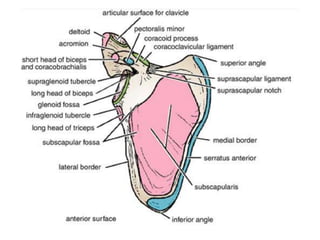
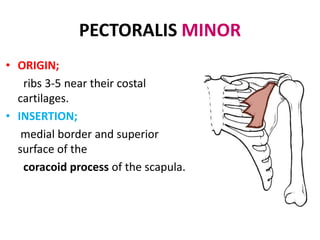
PECTORALIS MINORORIGIN; ribs 3-5 near their costal cartilages.INSERTION; medial border and superior surface of the coracoid process of the scapula.
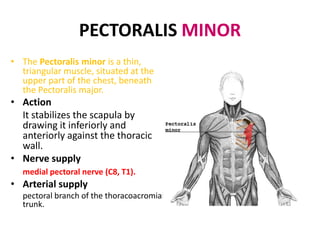
PECTORALIS MINORThe Pectoralis minor is a thin, triangular muscle, situated at the upper part of the chest, beneath the Pectoralis major.ActionIt stabilizes the scapula by drawing it inferiorly and anteriorly against the thoracic wall.Nerve supplymedial pectoral nerve (C8, T1).Arterial supply pectoral branch of the thoracoacromial trunk.
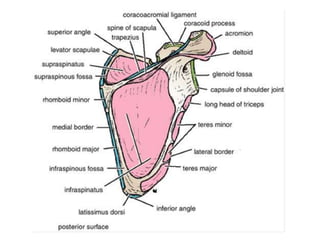
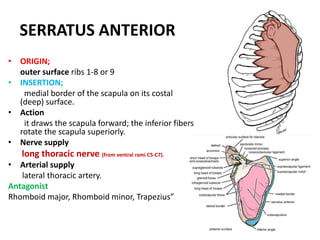
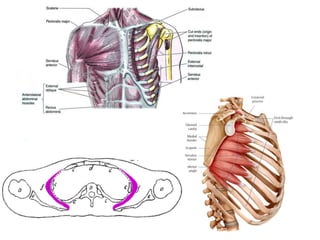
SERRATUS ANTERIORORIGIN;outer surface ribs 1-8 or 9INSERTION;  medial border of the scapula on its costal (deep) surface.Actionit draws the scapula forward; the inferior fibers rotate the scapula superiorly.Nerve supplylong thoracic nerve (from ventral rami C5-C7).Arterial supplylateral thoracic artery.AntagonistRhomboid major, Rhomboid minor, Trapezius”
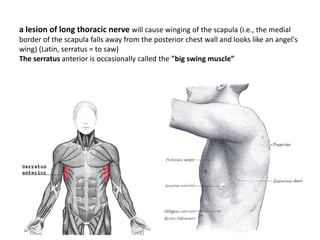
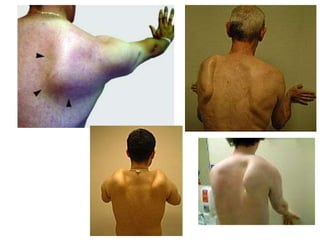
a lesion of long thoracic nerve will cause winging of the scapula (i.e., the medial border of the scapula falls away from the posterior chest wall and looks like an angel's wing) (Latin, serratus = to saw)The serratus anterior is occasionally called the "big swing muscle”
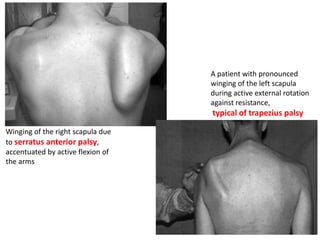
A patient with pronounced winging of the left scapula during active external rotation against resistance,typical of trapezius palsyWinging of the right scapula due to serratus anterior palsy, accentuated by active flexion of the arms
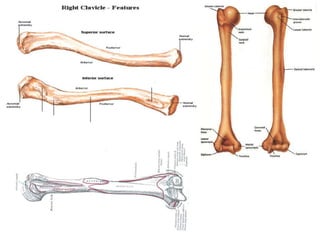
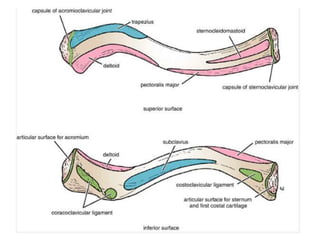
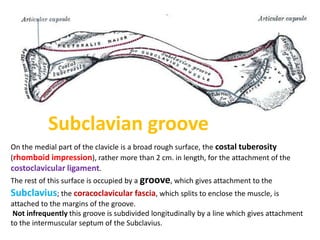
Subclavian grooveOn the medial part of the clavicle is a broad rough surface, the costal tuberosity (rhomboid impression), rather more than 2 cm. in length, for the attachment of the costoclavicular ligament. The rest of this surface is occupied by a groove, which gives attachment to the Subclavius; the coracoclavicular fascia, which splits to enclose the muscle, is attached to the margins of the groove.Not infrequently this groove is subdivided longitudinally by a line which gives attachment to the intermuscular septum of the Subclavius.
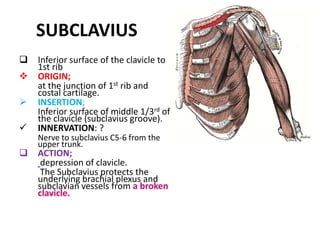
SUBCLAVIUSInferior surface of the clavicle to 1st rib
ORIGIN;	at the junction of 1st rib and costal cartilage.INSERTION; Inferior surface of middle 1/3rd of the clavicle (subclavius groove).INNERVATION: ?Nerve to subclavius C5-6 from the upper trunk.ACTION;depression of clavicle. The Subclavius protects the underlying brachial plexus and subclavian vessels from a broken clavicle.
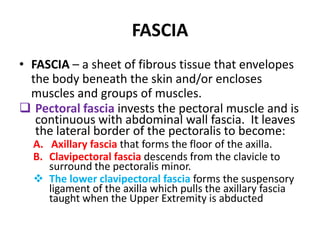
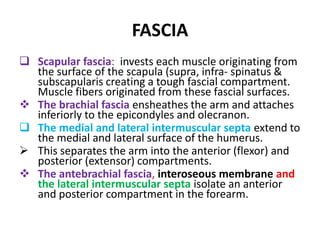
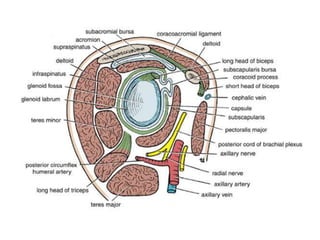
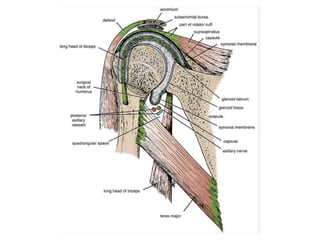
FASCIAFASCIA – a sheet of fibrous tissue that envelopes the body beneath the skin and/or encloses muscles and groups of muscles. Pectoral fasciainvests the pectoral muscle and is continuous with abdominal wall fascia.  It leaves the lateral border of the pectoralis to become:Axillary fascia that forms the floor of the axilla.Clavipectoral fascia descends from the clavicle to surround the pectoralis minor.The lower clavipectoral fascia forms the suspensory ligament of the axilla which pulls the axillary fascia taught when the Upper Extremity is abducted  FASCIAScapular fascia:  invests each muscle originating from the surface of the scapula (supra, infra- spinatus & subscapularis creating a tough fascial compartment.  Muscle fibers originated from these fascial surfaces.
The brachial fascia ensheathes the arm and attaches inferiorly to the epicondyles and olecranon.
The medial and lateral intermuscular septa extend to the medial and lateral surface of the humerus.
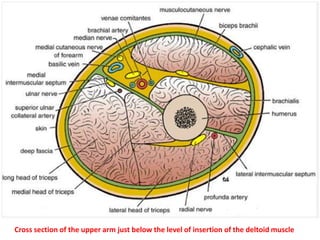
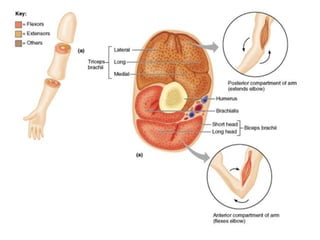
This separates the arm into the anterior (flexor) and posterior (extensor) compartments.
The antebrachial fascia,interoseous membrane andthe lateral intermuscular septa isolate an anterior and posterior compartment in the forearm.
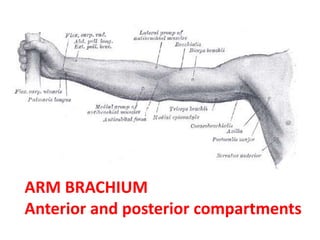
ARM BRACHIUMAnterior and posterior compartments
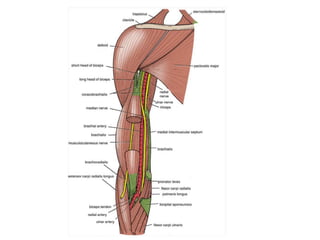
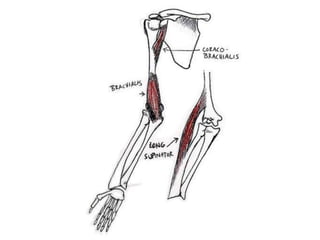
ANTERIOR COMPARTMENTBBCBICEPS BRACHII.BRACHIALIS.CORACOBRACHIALIS.
Cross section of the upper arm just below the level of insertion of the deltoid muscle
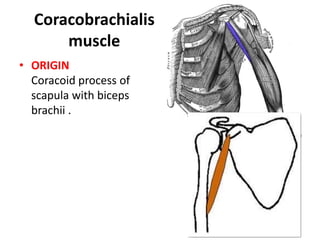
Coracobrachialis muscleORIGINCoracoid process of scapula with biceps brachii .
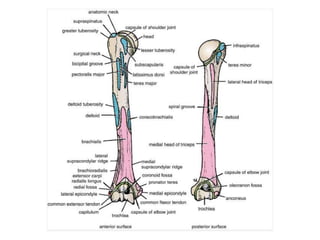
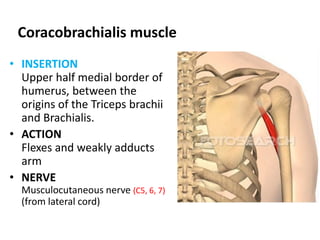
Coracobrachialis muscleINSERTIONUpper half medial border of humerus, between the origins of the Triceps brachii and Brachialis.ACTIONFlexes and weakly adducts arm NERVEMusculocutaneous nerve (C5, 6, 7) (from lateral cord)
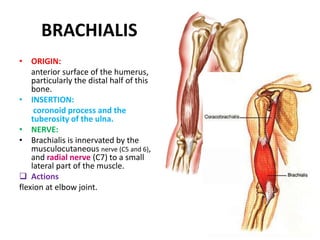
BRACHIALISORIGIN:	anterior surface of the humerus, particularly the distal half of this bone.INSERTION: coronoid process and the tuberosity of the ulna.NERVE:Brachialis is innervated by the musculocutaneous nerve (C5 and 6), and radial nerve (C7) to a small lateral part of the muscle. Actionsflexion at elbow joint.
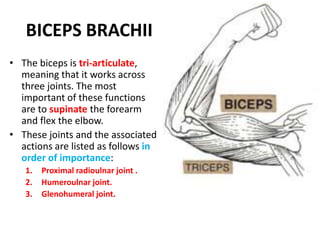
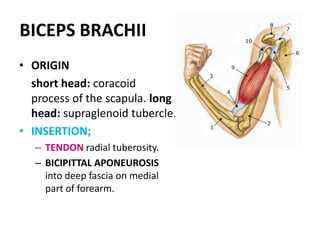
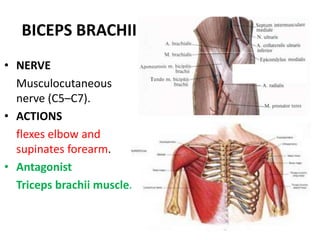
BICEPS BRACHIIThe biceps is tri-articulate, meaning that it works across three joints. The most important of these functions are to supinate the forearm and flex the elbow.These joints and the associated actions are listed as follows in order of importance:Proximal radioulnar joint .Humeroulnar joint.Glenohumeral joint.
BICEPS BRACHIIORIGINshort head: coracoid process of the scapula. long head: supraglenoid tubercle.INSERTION;TENDONradial tuberosity.BICIPITTAL APONEUROSIS into deep fascia on medial part of forearm.
BICEPS BRACHIINERVEMusculocutaneous nerve (C5–C7).ACTIONSflexes elbow and supinates forearm.Antagonist	Triceps brachii muscle.
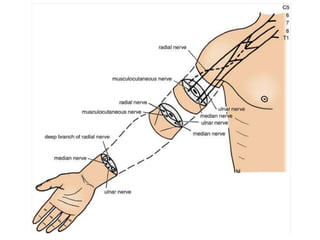
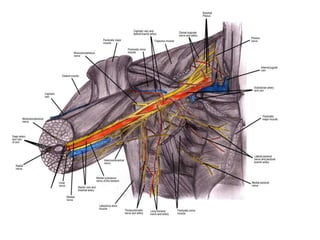
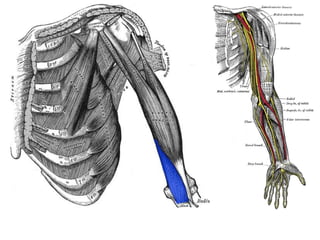
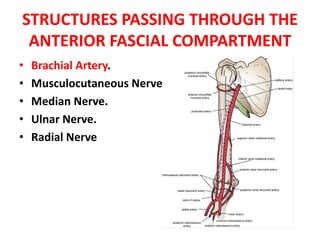
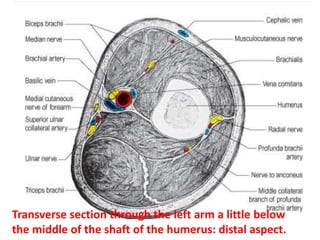
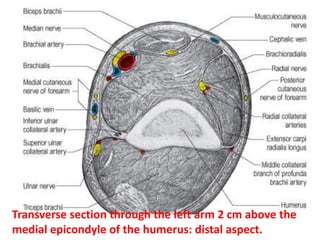
STRUCTURES PASSING THROUGH THE ANTERIOR FASCIAL COMPARTMENTBrachial Artery.Musculocutaneous Nerve.Median Nerve.Ulnar Nerve.Radial Nerve
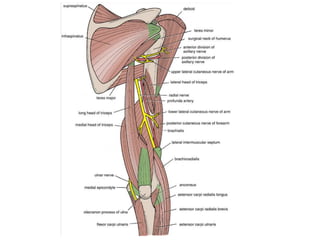
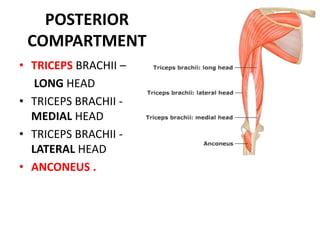
POSTERIOR COMPARTMENTTRICEPS BRACHII –LONG HEAD TRICEPS BRACHII - MEDIAL HEAD
TRICEPS BRACHII - LATERAL HEAD
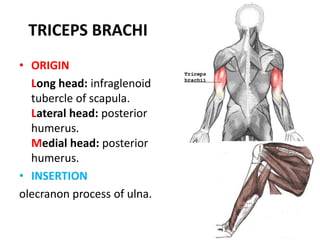
ANCONEUS .TRICEPS BRACHIORIGIN	Long head: infraglenoid tubercle of scapula.Lateral head: posterior humerus.Medial head: posterior humerus.INSERTIONolecranon process of ulna.
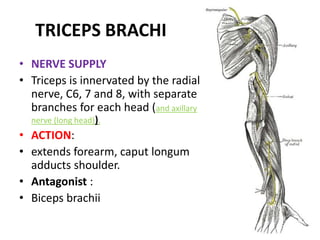
TRICEPS BRACHINERVE SUPPLYTriceps is innervated by the radial nerve, C6, 7 and 8, with separate branches for each head (and axillary nerve (long head)).ACTION:extends forearm, caput longum adducts shoulder.Antagonist :Biceps brachii
STRUCTURES PASSING THROUGH THE POSTERIOR FASCIAL COMPARTMENTRadial Nerve.Ulnar Nerve.Profunda Brachii Artery.Superior and Inferior Ulnar Collateral Arteries.
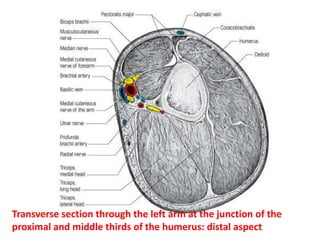
Transverse section through the left arm at the junction of the proximal and middle thirds of the humerus: distal aspect
Transverse section through the left arm a little below the middle of the shaft of the humerus: distal aspect.
Transverse section through the left arm 2 cm above the medial epicondyle of the humerus: distal aspect.
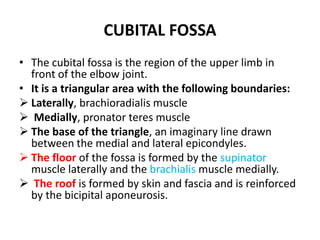
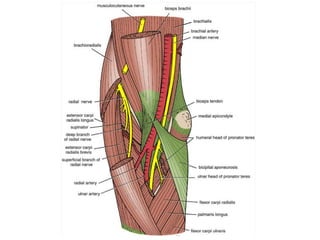
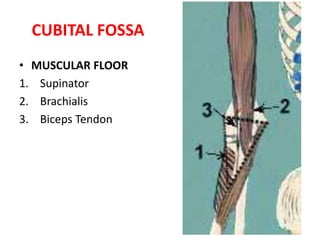
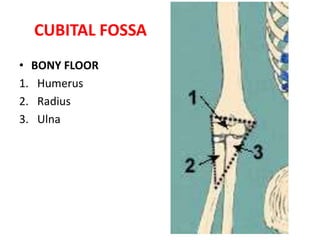
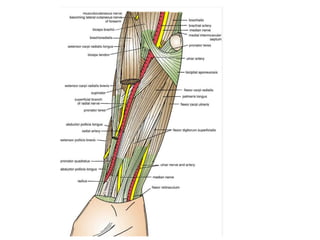
CUBITAL FOSSAThe cubital fossa is the region of the upper limb in front of the elbow joint.It is a triangular area with the following boundaries:Laterally, brachioradialis muscle
Medially, pronator teres muscle
The base of the triangle, an imaginary line drawn between the medial and lateral epicondyles.
The floor of the fossa is formed by the supinator muscle laterally and the brachialis muscle medially.
The roof is formed by skin and fascia and is reinforced by the bicipital aponeurosis.
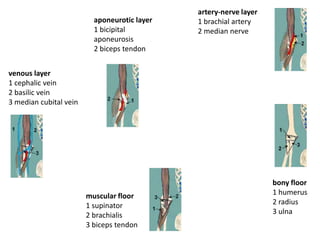
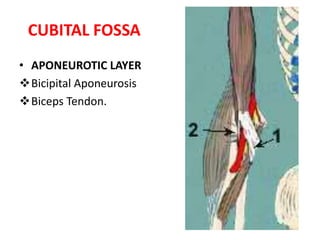
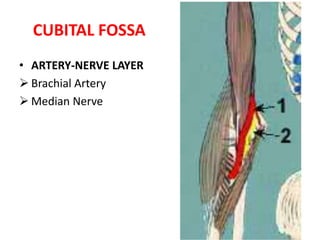
artery-nerve layer1 brachial artery 2 median nerve aponeurotic layer 1 bicipital aponeurosis 2 biceps tendon venous layer1 cephalic vein 2 basilic vein 3 median cubital vein bony floor1 humerus 2 radius 3 ulna muscular floor1 supinator 2 brachialis 3 biceps tendon
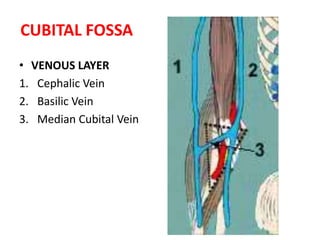
CUBITAL FOSSAVENOUS LAYERCephalic Vein Basilic Vein Median Cubital Vein

Anatomy pectoral arm02122010

  • 1.
    ANATOMYANATOMYByDr. THAAER MOHAMMEDDAHER ALSAADM.B.Ch.B.(MBBS) F.I.B.M.S.(Ph.D.)SPECIALIST IN GENERAL SURGERYSENIOR LECTURERIMS MSU
  • 2.
  • 3.
    Pectoral regionTopographical AnatomyMIDAXILLARY LINEan imaginary vertical line passing through the middle of the axilla.used as a surface landmark for descriptive purposes.MIDCLAVICULAR LINE /(milk line)an imaginary vertical line passing through the midshaft of the clavicleused as a surface landmark for descriptive purposes.
  • 4.
    DELTOPECTORAL/ clavipectoral fasciaIspierced by the following structures;Cephalic vein.Acromiothoracic artery.Lateral pectoral nerve.
  • 5.
    DELTOPECTORAL TRIANGLE/ Theclavipectoral triangle a triangle in the upper chest region that is bounded medially by the clavicle, superiorly by the deltoid muscle and inferiorly by the pectoralis major muscle this pierced by the cephalic vein on its course from the upper limb to join the axillary vein in the axilla.NIPPLElocated superficial to the 4th intercostal space in the male and prepubertal female; areola is dark ring surrounding nipple, location of the left nipple may be used to help locate the apex of heart, which is approximately 8 cm from the midline in the left 5th intercostal space; a surface landmark used to place the stethoscope for auscultation of the bicuspid valve.SUPRASTERNAL NOTCHthe notch located at the superior border of the manubrium of the sternum, between the sternal ends of the clavicles also known as: jugular notch.Topographical Anatomy
  • 12.
    LATISSIMUS DORSIOrigin;spinous processesof thoracic T7-T12, thoracolumbar fascia, iliac crest and inferior 3 or 4 ribs, inferior angle of scapula.Insertion;floor of intertubercular groove of the humerus.Nerve;thoracodorsal nerve (C6 - C8).Actions;adducts, extends and internally rotates the arm.Antagonistdeltoid, trapeziusArtery;thoracodorsal branch of the subscapular artery 
  • 14.
    PECTORALIS MAJORORIGIN; Clavicular head,anterior surface of the medial half of the clavicle.Sternocostal head, anterior surface of the sternum, the superior six costal cartilages, and the aponeurosis of the external oblique muscle.
  • 15.
    PECTORALIS MAJOR Insertionlaterallip of the bicipital groove of the humerus.ActionClavicular head, flexes the humerusSternocostal head, extends the humerusAs a whole, adducts and medially rotates the humerus. It also draws the scapula anteriorly and inferiorly.PECTORALIS MAJORNerve supplymedial and lateral pectoral nerves (C5-T1).Clavicular head: C5 and C6Sternocostal head: C7, C8 and T1Arterial blood supply pectoral branch of the thoracoacromial trunk.the deep fascia on its anterior surface should not be fused to the fascia of the mammary gland - if it is, this is an important clinical sign indicating breast disease (Latin, pectus = breast bone)
  • 16.
    Poland's Syndrome ///isa congenital anomaly in which there is a malformation of the chest causing the pectoralis major on one side of the body to be absent.The latissimus dorsi and teres major also aid in adduction and medial rotation of the arm.
  • 17.
    PECTORALIS MINORORIGIN; ribs3-5 near their costal cartilages.INSERTION; medial border and superior surface of the coracoid process of the scapula.
  • 18.
    PECTORALIS MINORThe Pectoralisminor is a thin, triangular muscle, situated at the upper part of the chest, beneath the Pectoralis major.ActionIt stabilizes the scapula by drawing it inferiorly and anteriorly against the thoracic wall.Nerve supplymedial pectoral nerve (C8, T1).Arterial supply pectoral branch of the thoracoacromial trunk.
  • 19.
    SERRATUS ANTERIORORIGIN;outer surfaceribs 1-8 or 9INSERTION; medial border of the scapula on its costal (deep) surface.Actionit draws the scapula forward; the inferior fibers rotate the scapula superiorly.Nerve supplylong thoracic nerve (from ventral rami C5-C7).Arterial supplylateral thoracic artery.AntagonistRhomboid major, Rhomboid minor, Trapezius”
  • 21.
    a lesion oflong thoracic nerve will cause winging of the scapula (i.e., the medial border of the scapula falls away from the posterior chest wall and looks like an angel's wing) (Latin, serratus = to saw)The serratus anterior is occasionally called the "big swing muscle”
  • 22.
    A patient withpronounced winging of the left scapula during active external rotation against resistance,typical of trapezius palsyWinging of the right scapula due to serratus anterior palsy, accentuated by active flexion of the arms
  • 25.
    Subclavian grooveOn themedial part of the clavicle is a broad rough surface, the costal tuberosity (rhomboid impression), rather more than 2 cm. in length, for the attachment of the costoclavicular ligament. The rest of this surface is occupied by a groove, which gives attachment to the Subclavius; the coracoclavicular fascia, which splits to enclose the muscle, is attached to the margins of the groove.Not infrequently this groove is subdivided longitudinally by a line which gives attachment to the intermuscular septum of the Subclavius.
  • 26.
    SUBCLAVIUSInferior surface ofthe clavicle to 1st rib
  • 27.
    ORIGIN; at the junctionof 1st rib and costal cartilage.INSERTION; Inferior surface of middle 1/3rd of the clavicle (subclavius groove).INNERVATION: ?Nerve to subclavius C5-6 from the upper trunk.ACTION;depression of clavicle. The Subclavius protects the underlying brachial plexus and subclavian vessels from a broken clavicle.
  • 28.
    FASCIAFASCIA – asheet of fibrous tissue that envelopes the body beneath the skin and/or encloses muscles and groups of muscles. Pectoral fasciainvests the pectoral muscle and is continuous with abdominal wall fascia. It leaves the lateral border of the pectoralis to become:Axillary fascia that forms the floor of the axilla.Clavipectoral fascia descends from the clavicle to surround the pectoralis minor.The lower clavipectoral fascia forms the suspensory ligament of the axilla which pulls the axillary fascia taught when the Upper Extremity is abducted FASCIAScapular fascia: invests each muscle originating from the surface of the scapula (supra, infra- spinatus & subscapularis creating a tough fascial compartment. Muscle fibers originated from these fascial surfaces.
  • 29.
    The brachial fasciaensheathes the arm and attaches inferiorly to the epicondyles and olecranon.
  • 30.
    The medial andlateral intermuscular septa extend to the medial and lateral surface of the humerus.
  • 31.
    This separates thearm into the anterior (flexor) and posterior (extensor) compartments.
  • 32.
    The antebrachial fascia,interoseousmembrane andthe lateral intermuscular septa isolate an anterior and posterior compartment in the forearm.
  • 39.
    ARM BRACHIUMAnterior andposterior compartments
  • 40.
  • 42.
    Cross section ofthe upper arm just below the level of insertion of the deltoid muscle
  • 43.
    Coracobrachialis muscleORIGINCoracoid processof scapula with biceps brachii .
  • 44.
    Coracobrachialis muscleINSERTIONUpper halfmedial border of humerus, between the origins of the Triceps brachii and Brachialis.ACTIONFlexes and weakly adducts arm NERVEMusculocutaneous nerve (C5, 6, 7) (from lateral cord)
  • 46.
    BRACHIALISORIGIN: anterior surface ofthe humerus, particularly the distal half of this bone.INSERTION: coronoid process and the tuberosity of the ulna.NERVE:Brachialis is innervated by the musculocutaneous nerve (C5 and 6), and radial nerve (C7) to a small lateral part of the muscle. Actionsflexion at elbow joint.
  • 48.
    BICEPS BRACHIIThe bicepsis tri-articulate, meaning that it works across three joints. The most important of these functions are to supinate the forearm and flex the elbow.These joints and the associated actions are listed as follows in order of importance:Proximal radioulnar joint .Humeroulnar joint.Glenohumeral joint.
  • 49.
    BICEPS BRACHIIORIGINshort head:coracoid process of the scapula. long head: supraglenoid tubercle.INSERTION;TENDONradial tuberosity.BICIPITTAL APONEUROSIS into deep fascia on medial part of forearm.
  • 50.
    BICEPS BRACHIINERVEMusculocutaneous nerve(C5–C7).ACTIONSflexes elbow and supinates forearm.Antagonist Triceps brachii muscle.
  • 51.
    STRUCTURES PASSING THROUGHTHE ANTERIOR FASCIAL COMPARTMENTBrachial Artery.Musculocutaneous Nerve.Median Nerve.Ulnar Nerve.Radial Nerve
  • 52.
    POSTERIOR COMPARTMENTTRICEPS BRACHII–LONG HEAD TRICEPS BRACHII - MEDIAL HEAD
  • 53.
    TRICEPS BRACHII -LATERAL HEAD
  • 54.
    ANCONEUS .TRICEPS BRACHIORIGIN Longhead: infraglenoid tubercle of scapula.Lateral head: posterior humerus.Medial head: posterior humerus.INSERTIONolecranon process of ulna.
  • 55.
    TRICEPS BRACHINERVE SUPPLYTricepsis innervated by the radial nerve, C6, 7 and 8, with separate branches for each head (and axillary nerve (long head)).ACTION:extends forearm, caput longum adducts shoulder.Antagonist :Biceps brachii
  • 56.
    STRUCTURES PASSING THROUGHTHE POSTERIOR FASCIAL COMPARTMENTRadial Nerve.Ulnar Nerve.Profunda Brachii Artery.Superior and Inferior Ulnar Collateral Arteries.
  • 57.
    Transverse section throughthe left arm at the junction of the proximal and middle thirds of the humerus: distal aspect
  • 58.
    Transverse section throughthe left arm a little below the middle of the shaft of the humerus: distal aspect.
  • 59.
    Transverse section throughthe left arm 2 cm above the medial epicondyle of the humerus: distal aspect.
  • 60.
    CUBITAL FOSSAThe cubitalfossa is the region of the upper limb in front of the elbow joint.It is a triangular area with the following boundaries:Laterally, brachioradialis muscle
  • 61.
  • 62.
    The base ofthe triangle, an imaginary line drawn between the medial and lateral epicondyles.
  • 63.
    The floor ofthe fossa is formed by the supinator muscle laterally and the brachialis muscle medially.
  • 64.
    The roof isformed by skin and fascia and is reinforced by the bicipital aponeurosis.
  • 65.
    artery-nerve layer1 brachialartery 2 median nerve aponeurotic layer 1 bicipital aponeurosis 2 biceps tendon venous layer1 cephalic vein 2 basilic vein 3 median cubital vein bony floor1 humerus 2 radius 3 ulna muscular floor1 supinator 2 brachialis 3 biceps tendon
  • 66.
    CUBITAL FOSSAVENOUS LAYERCephalicVein Basilic Vein Median Cubital Vein