1
Homeostasis
Khirendra Choudhary
Lecturer
Department of Physiology
2
Objectives
Introduction
Component of control systems
Positive feed back system
Negative feed back system
Gain and regulation of control systems
Some unusual phenomenon in homeostatic control systems
3
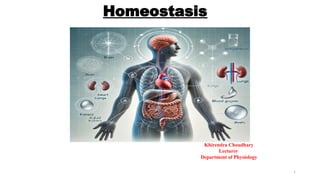
Homeostasis
Homeostasis ( homeo= same ; stasis = standing)
The term coined by Walter B cannon in 1930.
The maintenance of static or constant conditions in the internal
environment is known as homeostasis.
It is a mechanism by which a steady state condition is maintained in
the composition of ECF and ICF by a variety of regulatory process.
ECF- (internal environment) = milieu interior ( Claude Bernard
– 1857)
Factors Homeostatically Regulated
1. Concentration of nutrient molecules
2. Concentration of CO2 andO2
3. Concentration of waste products
4. pH
5. Concentration of water, salt and other electrolytes
6. Temperature
7. Volume and pressure
5
Role of various system of the body
in homeostasis
The respiratory system, blood and kidney help in the regulation of pH
The skin, respiratory system, digestive system, excretory system,skeletal muscles
and nervous system are involved in maintaining the temperature within normal
limits.
Kidneys and other excretory organs are involved in the excretion of waste
products.
Sensory system detects the state of the body or surroundings, Brain integrates and
interprets the pros and cons of these information and commands the body to act
accordingly through motor system so that, the body can avoid the damage.
6
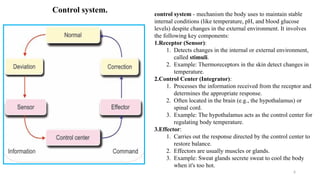
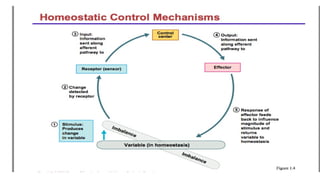
Control system. control system - mechanism the body uses to maintain stable
internal conditions (like temperature, pH, and blood glucose
levels) despite changes in the external environment. It involves
the following key components:
1.Receptor (Sensor):
1. Detects changes in the internal or external environment,
called stimuli.
2. Example: Thermoreceptors in the skin detect changes in
temperature.
2.Control Center (Integrator):
1. Processes the information received from the receptor and
determines the appropriate response.
2. Often located in the brain (e.g., the hypothalamus) or
spinal cord.
3. Example: The hypothalamus acts as the control center for
regulating body temperature.
3.Effector:
1. Carries out the response directed by the control center to
restore balance.
2. Effectors are usually muscles or glands.
3. Example: Sweat glands secrete sweat to cool the body
when it's too hot.
7
8
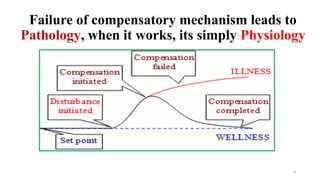
Failure of compensatory mechanism leads to
Pathology, when it works, its simply Physiology
9
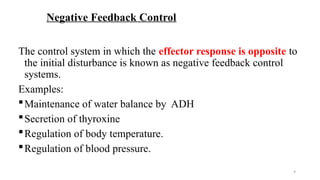
Negative Feedback Control
The control system in which the effector response is opposite to
the initial disturbance is known as negative feedback control
systems.
Examples:
Maintenance of water balance by ADH
Secretion of thyroxine
Regulation of body temperature.
Regulation of blood pressure.
10
Negative Feedback
Negative Feedback
12
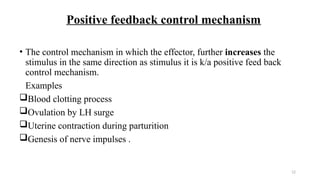
Positive feedback control mechanism
• The control mechanism in which the effector, further increases the
stimulus in the same direction as stimulus it is k/a positive feed back
control mechanism.
Examples
Blood clotting process
Ovulation by LH surge
Uterine contraction during parturition
Genesis of nerve impulses .
13
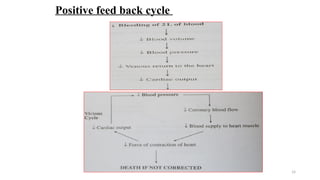
Positive Feedback Cycle
14
Positive feed back cycle
15
Gain
• Gain refers to the efficiency or effectiveness of a homeostatic control system
in correcting deviations from a set point. It is calculated using the formula:
(If BP decreases by 40 mmHg but is corrected to only 30mmHg and 10 mmHg
deviation is left back, the gain is 30/10 =3​
)
A high gain system is very effective at correcting deviations and maintaining
homeostasis.
A low gain system is less effective and may allow greater deviations
16
Regulation Factor
• The regulation factor (R) quantifies how well the regulatory system
reduces the effect of a disturbance.
• It is calculated as:
In other words, the regulation factor tells you how much of the
disturbance is left after the regulatory system has acted.
17
Steps to Understand and Calculate Regulation Factor
1.Understand the Variables:
a) Hypothetical change without regulation: The magnitude of the disturbance if the
regulatory system did not act.
b) Residual change with regulation: The remaining disturbance after the regulatory
system has acted.
c) Correction applied by the regulatory system: The amount of disturbance
corrected by the system, which is:
Correction=Hypothetical change without regulation−Residual change with regulatio
n
a) Formula for Regulation Factor:
18
Regulation Factor
• Example: Blood Pressure
• Set Point: 120 mmHg
• Disturbance: Hemorrhage
• Hypothetical change without regulation: 60 mmHg
• Residual change with regulation: 20 mmHg
The regulation factor for blood pressure is 1/3​
, meaning only one-
third of the disturbance remains after regulation.
19
Anticipatory Control Mechanisms
• These mechanisms predict and initiate responses before the disturbance occurs, based on
prior knowledge or expected changes. Unlike feedback mechanisms (which respond to a
disturbance after it occurs), anticipatory mechanisms act proactively to prevent disruptions to
homeostasis.
• Key Features:
• They involve feedforward control (act before a measurable error is detected).
• Often rely on sensory inputs or learned behavior.
• Example: Cardiovascular Regulation During Exercise
• When you start exercising, your brain anticipates the increased oxygen demand by muscles.
• The central command system in the brainstem increases heart rate and cardiac output even
before blood oxygen levels drop.
• Anticipation prevents oxygen deficiency, ensuring smooth adaptation to exercise.
• Example: Salivation Before Eating
• Just thinking about or smelling food triggers salivation (a feedforward response), preparing the
digestive system for food intake.
20
Variable Gain Systems
• In variable gain systems, the efficiency (gain) of a control mechanism changes
depending on the conditions or magnitude of the disturbance. This allows the body to
adjust its responsiveness based on the severity of the challenge.
• Key Features:
• Gain isn’t constant; it can increase or decrease.
• High gain = precise and effective correction.
• Low gain = slower or less precise correction.
• Example: Thermoregulation in Extreme Cold
• When exposed to mild cold, vasoconstriction of blood vessels conserves heat (low
gain system).
• In extreme cold, the body increases shivering and metabolic heat production (high
gain system) to counteract the larger heat loss.
• Variable Gain: The system becomes more aggressive (higher gain) as the disturbance
becomes more severe.
21
Servo Mechanisms
• A servo mechanism is a control system that uses continuous feedback to adjust a variable precisely
to match a set point. It works like a thermostat, continuously comparing the actual value of a variable
to the desired value and making corrections as needed.
• Key Features:
• Involves negative feedback.
• Operates continuously, often involving precise control.
• Found in systems requiring high accuracy.
• Example: Ocular Reflex (Gaze Stability)
• The vestibulo-ocular reflex (VOR) is a servo mechanism that stabilizes vision during head
movement.
• Sensors in the inner ear detect head motion.
• Feedback adjusts eye position to ensure the image remains stable on the retina, preventing blurring.
• Example: Blood Glucose Regulation
• The pancreas acts as a servo controller, continuously monitoring blood glucose levels.
• If glucose rises, insulin is secreted to lower it.
• If glucose drops, glucagon is secreted to raise it.
• The feedback ensures glucose levels stay near the set point (around 90 mg/dL).
22
Refrences
• Understanding medical physiology by R.L bijlani.
• Text book of medical physiology by Guyton and Hall
• Text book of physiology by GK pal
• Review of medical physiology- Ganong
• http://en.wikibooks.org/wiki/Human_Physiology/Homeostasis
• https://sites.google.com/site/physiologyforall.
23
THANK YOU
Adaptive Homeostasis: Acclimatization to high altitudes, immune system adaptation to repeated pathogen exposure.

Homeostasis - fIRST YEAR , MBBS , BASIC CONCEPT , PHYSIOLOGY

  • 1.
  • 2.
    2 Objectives Introduction Component of controlsystems Positive feed back system Negative feed back system Gain and regulation of control systems Some unusual phenomenon in homeostatic control systems
  • 3.
    3 Homeostasis Homeostasis ( homeo=same ; stasis = standing) The term coined by Walter B cannon in 1930. The maintenance of static or constant conditions in the internal environment is known as homeostasis. It is a mechanism by which a steady state condition is maintained in the composition of ECF and ICF by a variety of regulatory process. ECF- (internal environment) = milieu interior ( Claude Bernard – 1857)
  • 4.
    Factors Homeostatically Regulated 1.Concentration of nutrient molecules 2. Concentration of CO2 andO2 3. Concentration of waste products 4. pH 5. Concentration of water, salt and other electrolytes 6. Temperature 7. Volume and pressure
  • 5.
    5 Role of varioussystem of the body in homeostasis The respiratory system, blood and kidney help in the regulation of pH The skin, respiratory system, digestive system, excretory system,skeletal muscles and nervous system are involved in maintaining the temperature within normal limits. Kidneys and other excretory organs are involved in the excretion of waste products. Sensory system detects the state of the body or surroundings, Brain integrates and interprets the pros and cons of these information and commands the body to act accordingly through motor system so that, the body can avoid the damage.
  • 6.
    6 Control system. controlsystem - mechanism the body uses to maintain stable internal conditions (like temperature, pH, and blood glucose levels) despite changes in the external environment. It involves the following key components: 1.Receptor (Sensor): 1. Detects changes in the internal or external environment, called stimuli. 2. Example: Thermoreceptors in the skin detect changes in temperature. 2.Control Center (Integrator): 1. Processes the information received from the receptor and determines the appropriate response. 2. Often located in the brain (e.g., the hypothalamus) or spinal cord. 3. Example: The hypothalamus acts as the control center for regulating body temperature. 3.Effector: 1. Carries out the response directed by the control center to restore balance. 2. Effectors are usually muscles or glands. 3. Example: Sweat glands secrete sweat to cool the body when it's too hot.
  • 7.
  • 8.
    8 Failure of compensatorymechanism leads to Pathology, when it works, its simply Physiology
  • 9.
    9 Negative Feedback Control Thecontrol system in which the effector response is opposite to the initial disturbance is known as negative feedback control systems. Examples: Maintenance of water balance by ADH Secretion of thyroxine Regulation of body temperature. Regulation of blood pressure.
  • 10.
  • 11.
  • 12.
    12 Positive feedback controlmechanism • The control mechanism in which the effector, further increases the stimulus in the same direction as stimulus it is k/a positive feed back control mechanism. Examples Blood clotting process Ovulation by LH surge Uterine contraction during parturition Genesis of nerve impulses .
  • 13.
  • 14.
  • 15.
    15 Gain • Gain refersto the efficiency or effectiveness of a homeostatic control system in correcting deviations from a set point. It is calculated using the formula: (If BP decreases by 40 mmHg but is corrected to only 30mmHg and 10 mmHg deviation is left back, the gain is 30/10 =3​ ) A high gain system is very effective at correcting deviations and maintaining homeostasis. A low gain system is less effective and may allow greater deviations
  • 16.
    16 Regulation Factor • Theregulation factor (R) quantifies how well the regulatory system reduces the effect of a disturbance. • It is calculated as: In other words, the regulation factor tells you how much of the disturbance is left after the regulatory system has acted.
  • 17.
    17 Steps to Understandand Calculate Regulation Factor 1.Understand the Variables: a) Hypothetical change without regulation: The magnitude of the disturbance if the regulatory system did not act. b) Residual change with regulation: The remaining disturbance after the regulatory system has acted. c) Correction applied by the regulatory system: The amount of disturbance corrected by the system, which is: Correction=Hypothetical change without regulation−Residual change with regulatio n a) Formula for Regulation Factor:
  • 18.
    18 Regulation Factor • Example:Blood Pressure • Set Point: 120 mmHg • Disturbance: Hemorrhage • Hypothetical change without regulation: 60 mmHg • Residual change with regulation: 20 mmHg The regulation factor for blood pressure is 1/3​ , meaning only one- third of the disturbance remains after regulation.
  • 19.
    19 Anticipatory Control Mechanisms •These mechanisms predict and initiate responses before the disturbance occurs, based on prior knowledge or expected changes. Unlike feedback mechanisms (which respond to a disturbance after it occurs), anticipatory mechanisms act proactively to prevent disruptions to homeostasis. • Key Features: • They involve feedforward control (act before a measurable error is detected). • Often rely on sensory inputs or learned behavior. • Example: Cardiovascular Regulation During Exercise • When you start exercising, your brain anticipates the increased oxygen demand by muscles. • The central command system in the brainstem increases heart rate and cardiac output even before blood oxygen levels drop. • Anticipation prevents oxygen deficiency, ensuring smooth adaptation to exercise. • Example: Salivation Before Eating • Just thinking about or smelling food triggers salivation (a feedforward response), preparing the digestive system for food intake.
  • 20.
    20 Variable Gain Systems •In variable gain systems, the efficiency (gain) of a control mechanism changes depending on the conditions or magnitude of the disturbance. This allows the body to adjust its responsiveness based on the severity of the challenge. • Key Features: • Gain isn’t constant; it can increase or decrease. • High gain = precise and effective correction. • Low gain = slower or less precise correction. • Example: Thermoregulation in Extreme Cold • When exposed to mild cold, vasoconstriction of blood vessels conserves heat (low gain system). • In extreme cold, the body increases shivering and metabolic heat production (high gain system) to counteract the larger heat loss. • Variable Gain: The system becomes more aggressive (higher gain) as the disturbance becomes more severe.
  • 21.
    21 Servo Mechanisms • Aservo mechanism is a control system that uses continuous feedback to adjust a variable precisely to match a set point. It works like a thermostat, continuously comparing the actual value of a variable to the desired value and making corrections as needed. • Key Features: • Involves negative feedback. • Operates continuously, often involving precise control. • Found in systems requiring high accuracy. • Example: Ocular Reflex (Gaze Stability) • The vestibulo-ocular reflex (VOR) is a servo mechanism that stabilizes vision during head movement. • Sensors in the inner ear detect head motion. • Feedback adjusts eye position to ensure the image remains stable on the retina, preventing blurring. • Example: Blood Glucose Regulation • The pancreas acts as a servo controller, continuously monitoring blood glucose levels. • If glucose rises, insulin is secreted to lower it. • If glucose drops, glucagon is secreted to raise it. • The feedback ensures glucose levels stay near the set point (around 90 mg/dL).
  • 22.
    22 Refrences • Understanding medicalphysiology by R.L bijlani. • Text book of medical physiology by Guyton and Hall • Text book of physiology by GK pal • Review of medical physiology- Ganong • http://en.wikibooks.org/wiki/Human_Physiology/Homeostasis • https://sites.google.com/site/physiologyforall.
  • 23.
    23 THANK YOU Adaptive Homeostasis:Acclimatization to high altitudes, immune system adaptation to repeated pathogen exposure.

Editor's Notes

  • #18 Understand the Variables: Hypothetical change without regulation: The magnitude of the disturbance if the regulatory system did not act. Residual change with regulation: The remaining disturbance after the regulatory system has acted. Correction applied by the regulatory system: The amount of disturbance corrected by the system, which is: Correction=Hypothetical change without regulation−Residual change with regulation\text{Correction} = \text{Hypothetical change without regulation} - \text{Residual change with regulation}Correction=Hypothetical change without regulation−Residual change with regulation