Flaps in orthopaedics Zameer Ali
Diagrammatic representation of cross section skin
Skin grafting  and classification
Classification on basis of thickness Split thickness skin grafting Full thickness skin grafting
Diagramatic representation of skin
Species of origin Species of origin 1. Autologous (Auto) graft 2. Homologous (Homo, Allo) graft 3. Heterologous (Hetero. Xeno) graft
STSG (Thierish graft) It usually contains epidermis  and part of dermis. Thickness ranges from .01 (very thin) to  .016 intermediate thickness) to .020 (thick graft)
Split thickness skin grafting  STSG are useful for early resurfacing following burns ,immediate coverage of traumatic  defects or surgical excision defect  especially when area is too wide to  use full thickness graft  and replacement of defect caused by full thickness graft  is quite large
STSG (Thierish graft) When vascularity of recipient area is doubtful STSG is more likely to take than full thickness graft
STSG (Thierish graft) Split thickness graft may be used  as a definitive treatment in areas where durability of skin and function of underlying structures are not of prime consideration  Otherwise it must be used  temporary  to be later replaced by a more suitable type of graft
STSG STSG
When free skin grafts are to be obtained, it is well to remember that "the thinner the graft, the better the take," and yet when the graft is expected to be permanent, "the thicker the graft, the better the function
." A thick graft is better able to withstand friction and constant use than a thin one and will contract only about 10%; a thin graft may contract 50% to 75%.
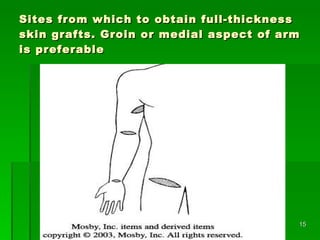
Sites from which to obtain full-thickness skin grafts. Groin or medial aspect of arm is preferable
STSG  wolfe graft 1) considerable secondary contraction 2) may develop  pigmentation later on 3)Epidermis +partial dermis  4)No need to  cover donor site 5) Quicker healing of donor site  Little contraction/shrinkage usually Little /no pigmentation Epidermis + whole of dermis Donor site to be covered by STSG  Lesser healing of donor site
Factors affecting uptake  of graft 1. Recipient site capable for producing capillary bud. 2. Approximation between the graft and recipient site (: No hematomaor infection)
3. Immobilisation during the phase of grafting 6. Subsequent behavior of free graft
No take  1. Compact bone 2. Bare cartilage 3. Bare tendon 4. Heavily irradiation of tissue
A. Take 1. Fat, fascia. 2. Muscle, tendon sheath. 3. Periosteum. Perichondrium, Cancellous bone tissue
Instruments for taking graft
Humby knife
Taking STSG
Graft taking with weck knife Technique of removing split-thickness skin graft from flexor surface above elbow with Weck knife.
Reese  dermatome  Large area of skin is removed by adhering to tape mounted on drum Thickness is measured  by  shimmer that measures distance between drum and blade
Reese deramtome
Pneumatic dermatome
mesher
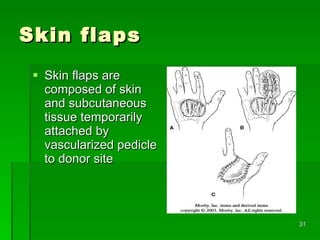
Skin flaps  Skin flaps are composed of skin and subcutaneous tissue temporarily attached by vascularized pedicle to donor site
Filletted graft from injured finger
Classification l. Due to blood supply 1. Random pattern flap 2. Axial pattern flap
Types of skin flaps Random pattern flaps  Axial flaps  Island flaps
Axial flap Limited by available vessels Based on direct cutaneous vessels Random flap at distal tip
Axial flap Axial pattern flaps allow a safe length-to-width ratio of at least 3:1, the possibility of covering either the dorsal or palmar surface, and a sufficiently long pedicle to allow arm and hand movement. Because such flaps usually do not require a delay in detachment of one end, they are useful for coverage of acute hand injuries.
Random pattern flap Most common Based on subdermal plexus Unpredictable Length:width of 3:1 or 4:1
Random pattern  flap A randomn pattern flap is one perfused by musculocutaneous arteries located in pedicle of flap and connected to dermal and subdermal plexus
Due to site of flap 1. Local flap 2. Distant flap
Flap coverage can be used in the primary closure of a hand wound or in a secondary procedure to replace scars, skin of poor quality, or necrotic skin.
flap can be obtained locally or from a distant part. If the area to be covered is small, a local flap may be indicated,
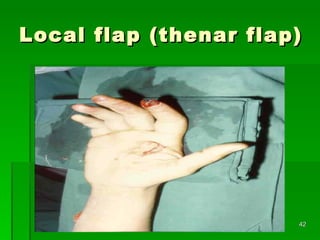
Local flap (thenar flap)
Tests for flap circulation Blanch test (Capillary circulation returns within 4 seconds after blanching if more time is consumed  suggestive of vascular insufficiency However above test gives no clue about venous drainage
Flourescein test  The flourscein  test is accurate method of evaluating skin flap circulation
Flap survival increased width of  base would increase surviving length but feeding vessels have  same perfusion pressure
Principles of skin flap  surgery 1) The recipient and donor area must be brought in position  and an over sized pattern is applied
2 ) local flaps  are preferred  because they provide similar texture  and cololr charecteristics
3) Axial pattern flaps based on specific arterio venous system  are better than  random pattern flaps
4) elderely patients  are not good candidates for large flaps  because of arteriosclerotic changes  5) the flap should not be subjected to kinking or pressure ( dressing over flap should be avoided )
6) Hematoma formation jeoparadizes flap  Complette haemostasis ,use of suction drainage and delay of flap  transfer when haemostasis is doubtful will reduce hematoma formation
7) transfer should be delayed when adequate vascularity of flap is doubtful  When transfering  a flap from distance  raw area produced by raising flap must be eleminated  this is achieved by
A) bringing donor area and recipient area close  B) immediate application of STSG C) forming hinge flap adjacent to recipient area .
Flap separation should be delayed  till  21 st   day once vascularization of  flap  at recipient area is doubtful.
Flaps should not be in tension
Delay of flaps  Instead of raising and immediately transferring flaps , flaps may be partially divided in stages before transferring  This will increase vascularity  and ensure survival of flap
Local flaps may be designated as  1 advancement,  2 rotation  3 translation 4 transposition types.
Skin to be used for a local flap should not be damaged, since necrosis may occur. Developing a local skin flap requires undermining and minimal tension on the flap.
Advancement flap Use of an advancement flap involves mobilizing a small flap of skin to cover an adjacent defect without using a skin graft for the donor defect.
These are used to cover fingertip amputations. Rotation flaps are raised on a curved radius with undermining of the flap and closed under modest tension without a skin-grafted donor defect
Translation flaps  Translation flaps usually are rectangular and are used to close an adjacent defect. The flap is moved around a pedicle base and is closed without tension. Translation flaps require a skin graft for the donor site
Translation flaps
Translation flaps  Translation flap raised from skin in continuity with area of skin loss. Donor area is covered by graft.
Transposition flaps Transposition flaps usually are moved across an adjacent area of normal skin to close an adjacent defect without tension. Skin grafting at the donor site is necessary ...
The advantages of a local flap over one from a distant part are that the involved part  is not tied to the distant donor and that in many instances finger motions may continue
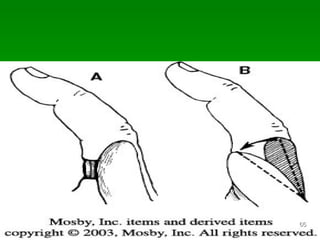
Flag flap "Flag flap."  A,  Skin can be moved over distance to palmar surface or to neighboring digit.  B,  "Flagstaff" contains the pedicle consisting of dorsal vein, dorsal branch of digital artery, and dorsal branch of digital nerve
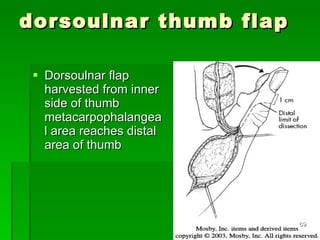
dorsoulnar thumb flap  The circulation to the dorsoulnar side of the hand and thumb has been further elucidated by Brunelli et al., leading to the development of the dorsoulnar thumb flap
dorsoulnar thumb flap  Dorsoulnar flap harvested from inner side of thumb metacarpophalangeal area reaches distal area of thumb
CROSS-FINGER FLAPS   CROSS-FINGER FLAPS  useful for covering a defect of the skin and other soft tissues on the volar surface of the finger when tendons and neurovascular structures are exposed and a small amount of subcutaneous fat is needed.
CROSS-FINGER FLAPS They also are useful for some amputations of the thumb These grafts are best avoided in patients over 50 years of age, in hands with arthritic changes or a tendency to finger stiffness for some other reason, or if local infection is present
Cross-finger flap.
Cross-finger flap. Cross-finger flap. Laterally based pedicle flap has been raised from middle finger and has been applied to distal pad of index. donor finger and  bridge between two fingers have been covered with split-thickness skin graft
Principles of three types of local flaps . In each type, defect to be covered is converted into triangular one. Flap may be rotated  or transposed  or both. Defect created by transposing flap must be covered with split-thickness graft.
Flap rotating about a pivot point - Rotation - Transposition : Rhomboid flap - Z-Plasty
Skin coverage by pedicle method provides a well vascularized cover for underlying vital structures with minimum scaring relaxing all tissues within the part and improving local blood supply and nutrition
Flaps withstand wear and tear of rough usage as soon as nerve supply returns to them A skin flap is best method of resurfacing palm of hand  and volar surface of fingers
Axial pattern flap  An  axial pattern flap (arterial flap ) contains at least one specific direct cutaneous artery within its longitudinal axis  Artery lies in subcutaneous layer just superficial to muscular  fascia  therefore flap thickness should include subcutaneous fat and deep fascia
Axial pattern flaps  Examples Deltopectoral flap  Hypo gastric flap  Superficial inferior epigastric flap  Groin flap  Superficial circumflex iliac artery flap
Abdominal flaps Traditionally, flaps from the abdomen have been used as tubed pedicle flaps or as direct flaps.
Axial pattern  abdominal flaps The tubed pedicle technique requires the formation of a bipedicle tube and 6 weeks of maturation followed by detachment of one end of the tube to be applied to the hand, followed by another 3 to 6 weeks before the flap is completely detached and "inset" into the defect.
Abdominal flaps The direct abdominal flaps typically are limited in their length-to-width ratio because of the random circulation. It rarely is safe to use such a flap with a length-to-width ratio that varies significantly from 1:1.
A random pattern abdominal flap A random pattern abdominal flap to be applied to the hand should have its base either distal, toward the superficial epigastric vessels, usually on the same side as the affected hand, or proximal, above the umbilicus toward the thoracoepigastric vessels, usually on the opposite side
A random pattern abdominal flap The flaps above the umbilicus should not be used in a patient with a "barrel chest" with chronic lung disease..
A random pattern abdominal flap
A random pattern abdominal flap Lower abdominal flap may be made narrower in relation to its length if it contains superficial circumflex iliac artery and vein (lower right) or superficial epigastric artery and vein. 
A random pattern abdominal flap Abdominal flaps obtained from areas above the umbilicus usually avoid the fat "storage areas." If the flap is obtained from the infraumbilical area, the recipient grafted area usually increases in bulk, since the infraumbilical area skin adds fat
AFTERTREATMENT The flap should be inspected almost hourly during the first 48 hours for circulatory compromise produced by tension or torsion or for the development of a hematoma.
AFTERTREATMENT Sutures that appear to be too tight should be removed because the pressure they apply on the flap may be sufficient to produce ischemia.
AFTERTREATMENT If an area becomes necrotic, it should be excised and covered with a split skin graft. Gross infection from necrosis or hematoma usually results in failure.
AFTERTREATMENT The area should be redressed frequently to avoid offensive odor and reduce the chance of infection. Usually the flap can be safely detached after 3 weeks. In children this can be reduced to 2 weeks.
Groin Pedicle Flap the iliofemoral (groin) flap, popularized by McGregor, was widely used in reparative and reconstructive surgery of the upper extremity.
Groin Pedicle Flap
Groin Pedicle Flap Advantages of the groin flap include (1) its location in an area sparse in hair, (2) minimal donor site morbidity, (3) multiple arteriovenous supply, (4) potential for incorporating bone with the overlying skin flap even when used as a pedicle flap, and (5) potentially large size.
Groin Pedicle Flap Disadvantages include (1) problems with color matching, (2) possibility of damage to vessels from previous inguinal surgery, and (3) thickness of the flap in obese patients
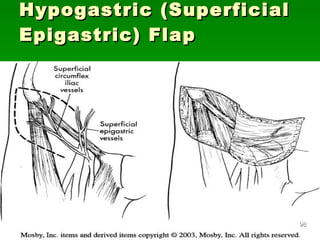
Groin Pedicle Flap The groin pedicle flap usually receives its arterial supply from the superficial circumflex iliac branch of the femoral artery. Its venous drainage is through the superficial inferior epigastric and superficial circumflex iliac veins.
Hypogastric (Superficial Epigastric) Flap it has proved extremely useful for coverage of the hand and forearm. Its arteriovenous pedicle consists of the superficial epigastric artery and vein  The axis of the flap usually is oriented in a superolateral direction, with the base near the inguinal ligament centered at about the midpoint of the ligament.
Hypogastric (Superficial Epigastric) Flap
Hypogastric (Superficial Epigastric) Flap Flaps measuring up to 18 cm long × 7 cm wide have been used. Its advantages and disadvantages are similar to those described for the  groin pedicle flap .
Hypogastric (Superficial Epigastric) Flap Usually a bone graft cannot be incorporated into the skin flap. During preoperative planning it is important to examine the abdomen on the affected side for the presence of previous surgical or traumatic scars that might have damaged the arterial supply.
Island flap  The island flap has pedicle devoid of skin and consists of nutrient artery and vein
filleted graft A filleted graft is a flap of tissue fashioned from a nearby part, usually a finger, from which the bone has been removed but in which one or more neurovascular bundles have been retained.
filleted graft In the hand such a graft is indicated only when deep tissues such as tendons, nerves, and joints are exposed and when a nearby damaged finger is to be sacrificed because it is not salvageable; it is never used at the expense of a salvageable, useful part.
Thank you……..
Flaps in orthopaedics

Flaps in orthopaedics

  • 1.
  • 2.
  • 3.
    Skin grafting and classification
  • 4.
    Classification on basisof thickness Split thickness skin grafting Full thickness skin grafting
  • 5.
  • 6.
    Species of originSpecies of origin 1. Autologous (Auto) graft 2. Homologous (Homo, Allo) graft 3. Heterologous (Hetero. Xeno) graft
  • 7.
    STSG (Thierish graft)It usually contains epidermis and part of dermis. Thickness ranges from .01 (very thin) to .016 intermediate thickness) to .020 (thick graft)
  • 8.
    Split thickness skingrafting STSG are useful for early resurfacing following burns ,immediate coverage of traumatic defects or surgical excision defect especially when area is too wide to use full thickness graft and replacement of defect caused by full thickness graft is quite large
  • 9.
    STSG (Thierish graft)When vascularity of recipient area is doubtful STSG is more likely to take than full thickness graft
  • 10.
    STSG (Thierish graft)Split thickness graft may be used as a definitive treatment in areas where durability of skin and function of underlying structures are not of prime consideration Otherwise it must be used temporary to be later replaced by a more suitable type of graft
  • 11.
  • 13.
    When free skingrafts are to be obtained, it is well to remember that "the thinner the graft, the better the take," and yet when the graft is expected to be permanent, "the thicker the graft, the better the function
  • 14.
    ." A thickgraft is better able to withstand friction and constant use than a thin one and will contract only about 10%; a thin graft may contract 50% to 75%.
  • 15.
    Sites from whichto obtain full-thickness skin grafts. Groin or medial aspect of arm is preferable
  • 16.
    STSG wolfegraft 1) considerable secondary contraction 2) may develop pigmentation later on 3)Epidermis +partial dermis 4)No need to cover donor site 5) Quicker healing of donor site Little contraction/shrinkage usually Little /no pigmentation Epidermis + whole of dermis Donor site to be covered by STSG Lesser healing of donor site
  • 17.
    Factors affecting uptake of graft 1. Recipient site capable for producing capillary bud. 2. Approximation between the graft and recipient site (: No hematomaor infection)
  • 18.
    3. Immobilisation duringthe phase of grafting 6. Subsequent behavior of free graft
  • 19.
    No take 1. Compact bone 2. Bare cartilage 3. Bare tendon 4. Heavily irradiation of tissue
  • 20.
    A. Take 1.Fat, fascia. 2. Muscle, tendon sheath. 3. Periosteum. Perichondrium, Cancellous bone tissue
  • 21.
  • 22.
  • 23.
  • 24.
    Graft taking withweck knife Technique of removing split-thickness skin graft from flexor surface above elbow with Weck knife.
  • 25.
    Reese dermatome Large area of skin is removed by adhering to tape mounted on drum Thickness is measured by shimmer that measures distance between drum and blade
  • 26.
  • 27.
  • 28.
  • 31.
    Skin flaps Skin flaps are composed of skin and subcutaneous tissue temporarily attached by vascularized pedicle to donor site
  • 32.
    Filletted graft frominjured finger
  • 33.
    Classification l. Dueto blood supply 1. Random pattern flap 2. Axial pattern flap
  • 34.
    Types of skinflaps Random pattern flaps Axial flaps Island flaps
  • 35.
    Axial flap Limitedby available vessels Based on direct cutaneous vessels Random flap at distal tip
  • 36.
    Axial flap Axialpattern flaps allow a safe length-to-width ratio of at least 3:1, the possibility of covering either the dorsal or palmar surface, and a sufficiently long pedicle to allow arm and hand movement. Because such flaps usually do not require a delay in detachment of one end, they are useful for coverage of acute hand injuries.
  • 37.
    Random pattern flapMost common Based on subdermal plexus Unpredictable Length:width of 3:1 or 4:1
  • 38.
    Random pattern flap A randomn pattern flap is one perfused by musculocutaneous arteries located in pedicle of flap and connected to dermal and subdermal plexus
  • 39.
    Due to siteof flap 1. Local flap 2. Distant flap
  • 40.
    Flap coverage canbe used in the primary closure of a hand wound or in a secondary procedure to replace scars, skin of poor quality, or necrotic skin.
  • 41.
    flap can beobtained locally or from a distant part. If the area to be covered is small, a local flap may be indicated,
  • 42.
  • 43.
    Tests for flapcirculation Blanch test (Capillary circulation returns within 4 seconds after blanching if more time is consumed suggestive of vascular insufficiency However above test gives no clue about venous drainage
  • 44.
    Flourescein test The flourscein test is accurate method of evaluating skin flap circulation
  • 45.
    Flap survival increasedwidth of base would increase surviving length but feeding vessels have same perfusion pressure
  • 46.
    Principles of skinflap surgery 1) The recipient and donor area must be brought in position and an over sized pattern is applied
  • 47.
    2 ) localflaps are preferred because they provide similar texture and cololr charecteristics
  • 48.
    3) Axial patternflaps based on specific arterio venous system are better than random pattern flaps
  • 49.
    4) elderely patients are not good candidates for large flaps because of arteriosclerotic changes 5) the flap should not be subjected to kinking or pressure ( dressing over flap should be avoided )
  • 50.
    6) Hematoma formationjeoparadizes flap Complette haemostasis ,use of suction drainage and delay of flap transfer when haemostasis is doubtful will reduce hematoma formation
  • 51.
    7) transfer shouldbe delayed when adequate vascularity of flap is doubtful When transfering a flap from distance raw area produced by raising flap must be eleminated this is achieved by
  • 52.
    A) bringing donorarea and recipient area close B) immediate application of STSG C) forming hinge flap adjacent to recipient area .
  • 53.
    Flap separation shouldbe delayed till 21 st day once vascularization of flap at recipient area is doubtful.
  • 54.
    Flaps should notbe in tension
  • 55.
    Delay of flaps Instead of raising and immediately transferring flaps , flaps may be partially divided in stages before transferring This will increase vascularity and ensure survival of flap
  • 56.
    Local flaps maybe designated as 1 advancement, 2 rotation 3 translation 4 transposition types.
  • 58.
    Skin to beused for a local flap should not be damaged, since necrosis may occur. Developing a local skin flap requires undermining and minimal tension on the flap.
  • 59.
    Advancement flap Useof an advancement flap involves mobilizing a small flap of skin to cover an adjacent defect without using a skin graft for the donor defect.
  • 60.
    These are usedto cover fingertip amputations. Rotation flaps are raised on a curved radius with undermining of the flap and closed under modest tension without a skin-grafted donor defect
  • 61.
    Translation flaps Translation flaps usually are rectangular and are used to close an adjacent defect. The flap is moved around a pedicle base and is closed without tension. Translation flaps require a skin graft for the donor site
  • 62.
  • 63.
    Translation flaps Translation flap raised from skin in continuity with area of skin loss. Donor area is covered by graft.
  • 64.
    Transposition flaps Transpositionflaps usually are moved across an adjacent area of normal skin to close an adjacent defect without tension. Skin grafting at the donor site is necessary ...
  • 65.
    The advantages ofa local flap over one from a distant part are that the involved part is not tied to the distant donor and that in many instances finger motions may continue
  • 67.
    Flag flap "Flagflap." A, Skin can be moved over distance to palmar surface or to neighboring digit. B, "Flagstaff" contains the pedicle consisting of dorsal vein, dorsal branch of digital artery, and dorsal branch of digital nerve
  • 68.
    dorsoulnar thumb flap The circulation to the dorsoulnar side of the hand and thumb has been further elucidated by Brunelli et al., leading to the development of the dorsoulnar thumb flap
  • 69.
    dorsoulnar thumb flap Dorsoulnar flap harvested from inner side of thumb metacarpophalangeal area reaches distal area of thumb
  • 70.
    CROSS-FINGER FLAPS CROSS-FINGER FLAPS useful for covering a defect of the skin and other soft tissues on the volar surface of the finger when tendons and neurovascular structures are exposed and a small amount of subcutaneous fat is needed.
  • 71.
    CROSS-FINGER FLAPS Theyalso are useful for some amputations of the thumb These grafts are best avoided in patients over 50 years of age, in hands with arthritic changes or a tendency to finger stiffness for some other reason, or if local infection is present
  • 72.
  • 73.
    Cross-finger flap. Cross-fingerflap. Laterally based pedicle flap has been raised from middle finger and has been applied to distal pad of index. donor finger and bridge between two fingers have been covered with split-thickness skin graft
  • 74.
    Principles of threetypes of local flaps . In each type, defect to be covered is converted into triangular one. Flap may be rotated or transposed or both. Defect created by transposing flap must be covered with split-thickness graft.
  • 75.
    Flap rotating abouta pivot point - Rotation - Transposition : Rhomboid flap - Z-Plasty
  • 76.
    Skin coverage bypedicle method provides a well vascularized cover for underlying vital structures with minimum scaring relaxing all tissues within the part and improving local blood supply and nutrition
  • 77.
    Flaps withstand wearand tear of rough usage as soon as nerve supply returns to them A skin flap is best method of resurfacing palm of hand and volar surface of fingers
  • 78.
    Axial pattern flap An axial pattern flap (arterial flap ) contains at least one specific direct cutaneous artery within its longitudinal axis Artery lies in subcutaneous layer just superficial to muscular fascia therefore flap thickness should include subcutaneous fat and deep fascia
  • 79.
    Axial pattern flaps Examples Deltopectoral flap Hypo gastric flap Superficial inferior epigastric flap Groin flap Superficial circumflex iliac artery flap
  • 80.
    Abdominal flaps Traditionally,flaps from the abdomen have been used as tubed pedicle flaps or as direct flaps.
  • 81.
    Axial pattern abdominal flaps The tubed pedicle technique requires the formation of a bipedicle tube and 6 weeks of maturation followed by detachment of one end of the tube to be applied to the hand, followed by another 3 to 6 weeks before the flap is completely detached and "inset" into the defect.
  • 82.
    Abdominal flaps Thedirect abdominal flaps typically are limited in their length-to-width ratio because of the random circulation. It rarely is safe to use such a flap with a length-to-width ratio that varies significantly from 1:1.
  • 83.
    A random patternabdominal flap A random pattern abdominal flap to be applied to the hand should have its base either distal, toward the superficial epigastric vessels, usually on the same side as the affected hand, or proximal, above the umbilicus toward the thoracoepigastric vessels, usually on the opposite side
  • 84.
    A random patternabdominal flap The flaps above the umbilicus should not be used in a patient with a "barrel chest" with chronic lung disease..
  • 85.
    A random patternabdominal flap
  • 86.
    A random patternabdominal flap Lower abdominal flap may be made narrower in relation to its length if it contains superficial circumflex iliac artery and vein (lower right) or superficial epigastric artery and vein. 
  • 87.
    A random patternabdominal flap Abdominal flaps obtained from areas above the umbilicus usually avoid the fat "storage areas." If the flap is obtained from the infraumbilical area, the recipient grafted area usually increases in bulk, since the infraumbilical area skin adds fat
  • 88.
    AFTERTREATMENT The flapshould be inspected almost hourly during the first 48 hours for circulatory compromise produced by tension or torsion or for the development of a hematoma.
  • 89.
    AFTERTREATMENT Sutures thatappear to be too tight should be removed because the pressure they apply on the flap may be sufficient to produce ischemia.
  • 90.
    AFTERTREATMENT If anarea becomes necrotic, it should be excised and covered with a split skin graft. Gross infection from necrosis or hematoma usually results in failure.
  • 91.
    AFTERTREATMENT The areashould be redressed frequently to avoid offensive odor and reduce the chance of infection. Usually the flap can be safely detached after 3 weeks. In children this can be reduced to 2 weeks.
  • 92.
    Groin Pedicle Flapthe iliofemoral (groin) flap, popularized by McGregor, was widely used in reparative and reconstructive surgery of the upper extremity.
  • 93.
  • 94.
    Groin Pedicle FlapAdvantages of the groin flap include (1) its location in an area sparse in hair, (2) minimal donor site morbidity, (3) multiple arteriovenous supply, (4) potential for incorporating bone with the overlying skin flap even when used as a pedicle flap, and (5) potentially large size.
  • 95.
    Groin Pedicle FlapDisadvantages include (1) problems with color matching, (2) possibility of damage to vessels from previous inguinal surgery, and (3) thickness of the flap in obese patients
  • 96.
    Groin Pedicle FlapThe groin pedicle flap usually receives its arterial supply from the superficial circumflex iliac branch of the femoral artery. Its venous drainage is through the superficial inferior epigastric and superficial circumflex iliac veins.
  • 97.
    Hypogastric (Superficial Epigastric)Flap it has proved extremely useful for coverage of the hand and forearm. Its arteriovenous pedicle consists of the superficial epigastric artery and vein The axis of the flap usually is oriented in a superolateral direction, with the base near the inguinal ligament centered at about the midpoint of the ligament.
  • 98.
  • 99.
    Hypogastric (Superficial Epigastric)Flap Flaps measuring up to 18 cm long × 7 cm wide have been used. Its advantages and disadvantages are similar to those described for the groin pedicle flap .
  • 100.
    Hypogastric (Superficial Epigastric)Flap Usually a bone graft cannot be incorporated into the skin flap. During preoperative planning it is important to examine the abdomen on the affected side for the presence of previous surgical or traumatic scars that might have damaged the arterial supply.
  • 101.
    Island flap The island flap has pedicle devoid of skin and consists of nutrient artery and vein
  • 102.
    filleted graft Afilleted graft is a flap of tissue fashioned from a nearby part, usually a finger, from which the bone has been removed but in which one or more neurovascular bundles have been retained.
  • 103.
    filleted graft Inthe hand such a graft is indicated only when deep tissues such as tendons, nerves, and joints are exposed and when a nearby damaged finger is to be sacrificed because it is not salvageable; it is never used at the expense of a salvageable, useful part.
  • 104.