Created for Tewksbury Public Schools Professional Development  by Kate Ahern, M.S.Ed.
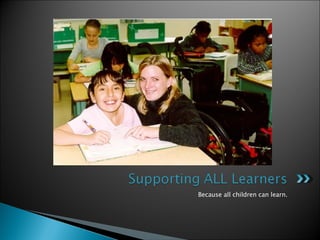
Because all children can learn.
Participants will gain knowledge of a variety of learning disorders Participants will learn instructional strategies for a variety of learning disorders Participants will be able to apply differentiated instruction in their classrooms Participants will plan for innovative ways of improving the quality of education for  all  students by using the best practice recommendations for specific disabilities
January Meeting March Meeting 12:00 Introductions 12:10  Round Robin 12:30 Overview 12:40 Specific LD 1:00 PDD/NVD 1:40 Break 1:50 Health Impairment  including  ADD/ADHD 2:10 Psychiatric  Disabilities 2:20 Questions 12:00 Review -  Pair/Share 12:15 Speech and Language  Impairment including  Processing Disorders 12:35 Developmental Delay  Intellectual Impairment 12:55 Making Differentiated  Instruction Work for  You  1:15 Break 1:25 Universal Design for  Learning 1:35 Free Technology,  Where to Find it and  What it Can Do For You  and Your Students 2:00 Action Planning 2:20  Questions
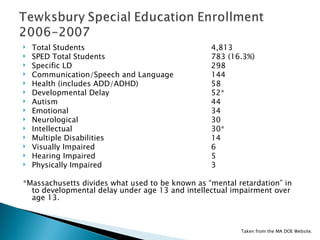
Total Students 4,813 SPED Total Students   783 (16.3%) Specific LD 298 Communication/Speech and Language 144 Health (includes ADD/ADHD) 58 Developmental Delay 52* Autism 44 Emotional 34 Neurological 30 Intellectual 30* Multiple Disabilities 14 Visually Impaired 6 Hearing Impaired 5 Physically Impaired 3 *Massachusetts divides what used to be known as “mental retardation” in to developmental delay under age 13 and intellectual impairment over age 13. Taken from the MA DOE Website.
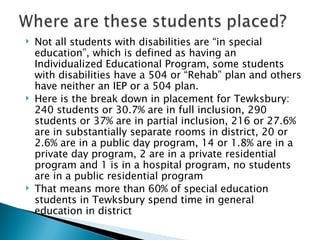
Not all students with disabilities are “in special education”, which is defined as having an Individualized Educational Program, some students with disabilities have a 504 or “Rehab” plan and others have neither an IEP or a 504 plan. Here is the break down in placement for Tewksbury: 240 students or 30.7% are in full inclusion, 290 students or 37% are in partial inclusion, 216 or 27.6% are in substantially separate rooms in district, 20 or 2.6% are in a public day program, 14 or 1.8% are in a private day program, 2 are in a private residential program and 1 is in a hospital program, no students are in a public residential program That means more than 60% of special education students in Tewksbury spend time in general education in district
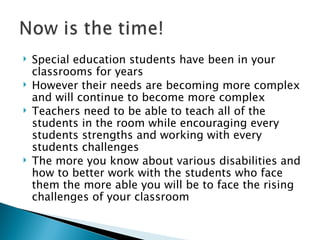
Special education students have been in your classrooms for years However their needs are becoming more complex and will continue to become more complex Teachers need to be able to teach all of the students in the room while encouraging every students strengths and working with every students challenges The more you know about various disabilities and how to better work with the students who face them the more able you will be to face the rising challenges of your classroom
Every instructional strategy you try will help  all  of your students, not just those you are targeting. (And they get easier to think of and implement over time)
Dyslexia, Dysgraphia, Dyscalcula
Our nation's special education law, the Individuals with Disabilities Education Act, defines a specific learning disability as . . . ". . . a disorder in one or more of the basic psychological processes involved in understanding or in using language, spoken or written, that may manifest itself in an imperfect ability to listen, think, speak, read, write, spell, or do mathematical calculations, including conditions such as perceptual disabilities, brain injury, minimal brain dysfunction, dyslexia, and developmental aphasia." However, learning disabilities do  not  include, "…learning problems that are primarily the result of visual, hearing, or motor disabilities, of mental retardation, of emotional disturbance, or of environmental, cultural, or economic disadvantage." 34  Code of Federal Regulations  §300.7(c)(10)
Dyslexia is a specific language based learning disability Manifested in reading, spelling, writing and pronunciation No “cure” but it can be “treated” Dyslexia is life long and compensatory strategies must increase as the student ages 6-7% of students have a specific learning disability and 85% of those have a language disability, some students with symptoms of dyslexia do not qualify for special education Students tend to have normal or above average intelligence Runs in families Two types currently identified 'dysphonetic' and 'dyseidetic‘ also called auditory dyslexia and visual (or word blindness) dyslexia Dysphonetic dyslexia may be co-morbid with auditory processing disorders
Student is likely of normal or above-normal intelligence May be fearful of reading, writing and spelling in front of others May be disorganized Trouble remembering what he or she just read or heard May not know right from left Changes letter order when spelling aloud Incorrect letter order and reversals of letters when writing (beyond developmentally normal) Cannot decode words spelled aloud Difficulty copying writing and even drawings May use social skills to mask difficulties
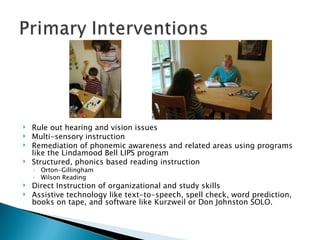
Rule out hearing and vision issues Multi-sensory instruction Remediation of phonemic awareness and related areas using programs like the Lindamood Bell LIPS program Structured, phonics based reading instruction Orton-Gillingham Wilson Reading Direct Instruction of organizational and study skills Assistive technology like text-to-speech, spell check, word prediction, books on tape, and software like Kurzweil or Don Johnston SOLO.
Change your default font Give homework assignments in writing Use  visual/graphical supports  (Kidspiration/Inspiration, other mind-maps, graphic organizers) Use multi-sensory techniques Preserve self-esteem (don’t ask to read/write/spell in front of others) Offer an alternative to reading text books Have assistive technology available
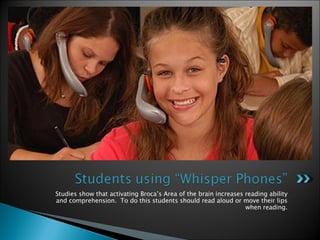
Studies show that activating Broca’s Area of the brain increases reading ability and comprehension.  To do this students should read aloud or move their lips when reading.
Additional Time Extended Breaks Segmented Test Scribe/Reader Passages of text provided on tape/MP3 Take on word processor (with word prediction and/or spell check)
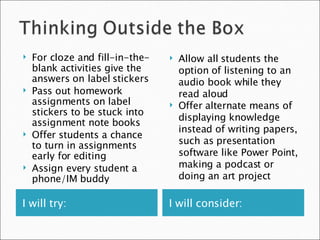
I will try: I will consider: For cloze and fill-in-the-blank activities give the answers on label stickers Pass out homework assignments on label stickers to be stuck into assignment note books Offer students a chance to turn in assignments early for editing  Assign every student a phone/IM buddy  Allow all students the option of listening to an audio book while they read aloud Offer alternate means of displaying knowledge instead of writing papers, such as presentation software like Power Point, making a podcast or doing an art project
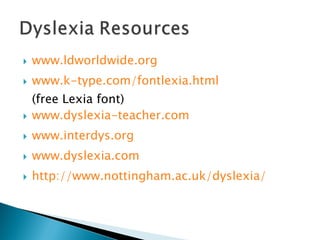
www.ldworldwide.org www.k-type.com/fontlexia.html   (free Lexia font) www.dyslexia-teacher.com www.interdys.org   www.dyslexia.com   http://www.nottingham.ac.uk/dyslexia/
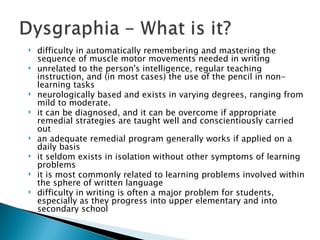
difficulty in automatically remembering and mastering the sequence of muscle motor movements needed in writing  unrelated to the person's intelligence, regular teaching instruction, and (in most cases) the use of the pencil in non-learning tasks  neurologically based and exists in varying degrees, ranging from mild to moderate.  it can be diagnosed, and it can be overcome if appropriate remedial strategies are taught well and conscientiously carried out an adequate remedial program generally works if applied on a daily basis it seldom exists in isolation without other symptoms of learning problems it is most commonly related to learning problems involved within the sphere of written language difficulty in writing is often a major problem for students, especially as they progress into upper elementary and into secondary school
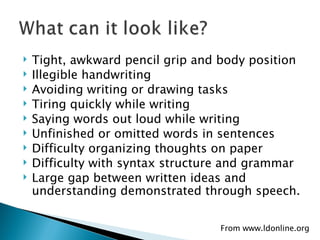
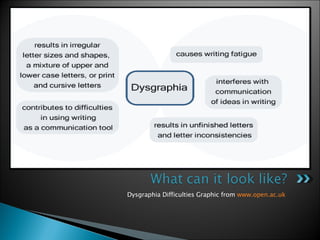
Tight, awkward pencil grip and body position Illegible handwriting Avoiding writing or drawing tasks Tiring quickly while writing Saying words out loud while writing Unfinished or omitted words in sentences Difficulty organizing thoughts on paper Difficulty with syntax structure and grammar Large gap between written ideas and understanding demonstrated through speech.  From www.ldonline.org
Dysgraphia Difficulties Graphic from  www.open.ac.uk
Occupational Therapy Programs like Handwriting without Tears in the early grades Use of low tech assistive devices like pencil grips and slant boards Use of high tech assistive technology like text-to-speech, portable word processors, and word prediction
Use of alternatives to writing to demonstrate knowledge Oral reports Art projects Multi-media presentations Use of low tech assistive technology such as adapted grips and slanted writing boards Use of high tech assistive technologies such as a computer or portable word processor  (i.e. Alphasmart)
I will try: I will consider: Allow all students to option to type written assignments  Use pre-printed peel and stick labels to fill in the blanks on worksheets/quizzes Alternative spelling test that requires circling the correct spelling from a list Allow all students to try out and use text to speech technology Publish class notes and handouts online so students can download and type in additional notes Allow all students the option of taping lectures and lessons Use partners and cooperative learning groups that call for one student to be a scribe
www.ldanatl.org/aboutld/parents/ld_basics/dysgraphia.asp   www.ninds.nih.gov/disorders/dysgraphia/dysgraphia.htm www.ldonline.org/article/12770
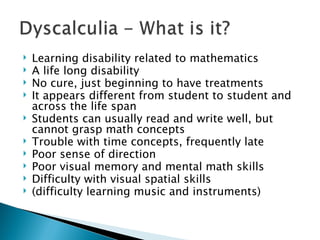
Learning disability related to mathematics A life long disability No cure, just beginning to have treatments It appears different from student to student and across the life span Students can usually read and write well, but cannot grasp math concepts Trouble with time concepts, frequently late Poor sense of direction Poor visual memory and mental math skills Difficulty with visual spatial skills (difficulty learning music and instruments)
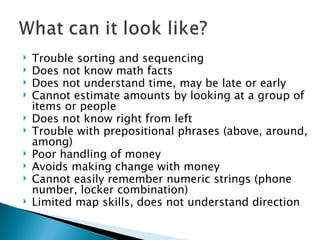
Trouble sorting and sequencing Does not know math facts Does not understand time, may be late or early Cannot estimate amounts by looking at a group of items or people Does not know right from left Trouble with prepositional phrases (above, around, among) Poor handling of money Avoids making change with money Cannot easily remember numeric strings (phone number, locker combination) Limited map skills, does not understand direction
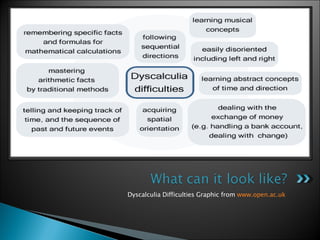
Dyscalculia Difficulties Graphic from  www.open.ac.uk
Unlike dyslexia there are no primary interventions (no Wilson Math, etc.) However in the primary grade the Touch Math program may be helpful, also Edmark Time Telling and in middle and high school technology (i.e. Math Pad Software) may help Direct instruction of compensatory techniques Multi-sensory instruction
Math done on graph paper to align numbers Use mnemonics (8x8 is 64, wipe your nose and shut the door) Use visual supports  Number line Abacus Multiplication table Visuals of story problems Time lines Written schedules Use manipulatives Teach “tricks” like multiplying on fingers Allow scrap paper and “cheat sheets” Assistive technology like calculators and the math add on for Microsoft Word
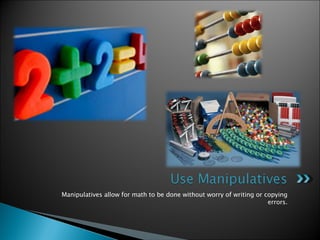
Manipulatives allow for math to be done without worry of writing or copying errors.
Allow extra time Scribe Allow scrap (graph) paper for work Allow calculator Allow use of computer with Math Pad or similar software
I will try: I will consider: Have  all  students do math on graph paper Break down scoring to allow credit for following the right steps even if there are mistakes Teach students how to self-check work Hang posters with vital information Avoid the phrases “stupid mistakes” and “careless errors” Consider spending time teaching students how to find the process to solve math problems they don’t know how to solve Use a locker lock that spells a word
www.dyscalculia.org/  www.ldonline.org/indepth/math www.ldaamerica.us/aboutld/parents/ld_basics/dyscalculia.asp www.ncld.org/content/view/463/391/
Includes ADD/ADHD, diabetes, epilepsy, Tourettes Syndrome, and other medical conditions
Health Impairment is a large category of disabilities consisting primarily of medical conditions such as asthma and diabetes and attention deficit syndrome with or without hyperactivity (ADD/ADHD) Remember student qualify for an IEP only if their disability prevents them from making progress in general education, i.e. frequent seizures prevent learning in a general education classroom without supports or ADD/ADHD calls from intervention from an OT and or Behavior Specialist
Extended test time Frequent/extended breaks Reader/scribe Take on a computer Test on tape Large print Non-scantron (bubbles) Preferential seating Change in proctoring assignment
Student carries pass that allows access to nurse, water fountain and rest room at any time Teachers and staff trained on emergency protocol for that student or for particular conditions Student may be allowed extra travel time in the halls if needed Student may be allowed flexible deadlines on assignments if caregivers/medical staff confirm medical need  These will be highly variable based on student needs and condition
A person with ADHD has a chronic level of inattention, impulsive hyperactivity, or both such that daily functioning is compromised.  The symptoms of the disorder must be present at levels that are higher than expected for a person's developmental stage and must interfere with the person's ability to function in different settings (e.g., in school and at home).  A person with ADHD may struggle in important areas of life, such as peer and family relationships, and school or work performance.  There are three types Predominantly inattentive Predominantly hyperactive-impulsive Combined
Inattentive Distractible Disorganized Out-of-it or day dreaming in class Impulsive Poor judgment Cannot sit still (restless, fidgets, in and out of seat) Hyperfocus May also exhibit: Anxiety Depression Defiance/Anger Issues Mood Instability Confusion  Poor retention
Behavioral therapy Psycho-educational treatment Medical therapy
Extended test time Frequent/extended breaks Extra cues Option to sit at a desk or stand at a podium and move between the two Assistance with organization and time management Non-scantron (bubbles) Preferential seating Change in proctoring assignment
As much as possible limit distractions Use well-organized texts Offer materials in advance Show a sample (of an organized notebook, an “A” paper, etc.) Use the "tell them what you are going to tell them, tell them, tell them what you told them" approach Indicate main points before viewing videos or films, have students fill in an outline as they watch, stop video often Clearly indicate the main points of every material Emphasize the relationships between ideas, using visual as well as verbal methods (e.g. concept maps, diagrams) Use multi-sensory teaching techniques Visual supports Non-verbal cues to get student back on task Mind maps Written and oral assignments, lectures etc Get students up and moving, acting out dialogues, etc Encourage group work when feasible (e.g. brainstorming, assignments) Allow movement in the classroom, create movement breaks as needed Use advantageous seating Study carrels or other quiet work spaces An extra set of books at home Adapted from  http://library.queensu.ca/websrs/faculty_guide-Strategies-ADD.html and  http://www.healthyplace.com/communities/add/judy/teaching_tools_1.htm
Opportunities to move may increase attention.
I will try: I will consider: Use aquarium tubing (sterilized in boiling water) stuck onto the tops of pencils to reduce pencil chewing Have a buddy system with a teacher on the other side of the building when a student needs to talk a walk Use “on task” cards in two colors (green when on task, red when not) and drop them onto students desks during silent work, red cards are returned with out consequence, green cards are collected and turned in for a free home pass or similar prize Have a custodian raise an adjustable height table as high as it will go and allow students to work standing up Tie rubber tubing between chair legs for students to use to get energy out Have students use self monitoring to keep them selves on task Allow all students the option of using a seat cushion, stress ball or other item during mostly listening activities Photograph your notes from the board and post on Flickr or similar site or use  www.qipit.com  which is designed for that purpose
Medical Conditions ADD/ADHD www.lehman.cuny.edu/faculty/jfleitas/bandaides www.jdrf.org www.noattacks.org www.epilepsyfoundation.org www.rarechromo.org www.tsa-usa.org   www.cdc.gov/ncbddd/adhd   www.school.familyeducation.com/learning-disabilities/treatments/37770.html   www.additudemag.com   www.helpguide.org/mental/adhd_add_teaching_strategies.htm   www.childdevelopmentinfo.com/learning/teacher.shtml
Autism, Asperger’s Syndrome, PDD-NOS and (not technically PDD but related) Non-Verbal Learning Disability
Under the umbrella of Pervasive Developmental Delay (PDD) come Autism, Asperger’s Syndrome, Rett Syndrome and PDD-NOS (Not Otherwise Specified), also called Autism Spectrum Disorder (or being “on the spectrum”) Non-verbal Learning Disability (NVD) is similar in some ways to Autism/Asperger’s These are life long neurological disabilities affecting communicative ability and language understanding, play and social skills  PDD is frequently associated with sensory integration dysfunction and psychiatric issues like anxiety and obsessive compulsive disorder
Difficulty with language Limited verbal ability Extremely literal Hyperlexic (may read very well possibly with little comprehension) Does not understand social rules Does not learn by inference or understand inference in readings Difficulties with transition and change Perseverates on certain ideas, topic and objects May make stereotypical movements May repeat certain words and sounds (echolalia) Over or under reacts to sensory stimulation Does not like being touched Cannot stand certain sounds or smells Cannot tolerate some kinds of lighting  Few friends and limited play or leisure skills
Application of Behavior Analysis (ABA) TEACCH (Treatment and Education of Autistic and Related Communication Handicapped Children) Pivotal Response Treatment Floortime Occupational Therapy and Sensory Integration Speech and Language Therapy which may include Picture Exchange Communication Systems (PECS) or other augmentative and alternative communication systems Medical and Psychiatric Intervention  Complementary therapies such as art, music, drama, animal and hippotherapy Social skills training and use of social stories
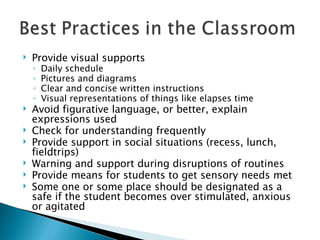
Provide visual supports Daily schedule  Pictures and diagrams Clear and concise written instructions Visual representations of things like elapses time Avoid figurative language, or better, explain expressions used Check for understanding frequently Provide support in social situations (recess, lunch, fieldtrips) Warning and support during disruptions of routines Provide means for students to get sensory needs met Some one or some place should be designated as a safe if the student becomes over stimulated, anxious or agitated
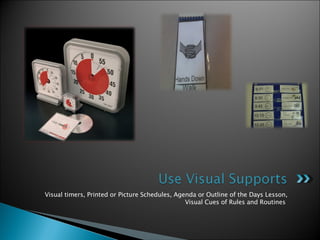
Visual timers, Printed or Picture Schedules, Agenda or Outline of the Days Lesson, Visual Cues of Rules and Routines
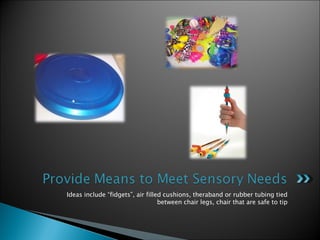
Ideas include “fidgets”, air filled cushions, theraband or rubber tubing tied between chair legs, chair that are safe to tip
Allow extra time Frequent/Extended breaks Segmented test Check for understanding Scribe/reader Assistive technology
I will try: I will consider: Give out written copies of assignments and instructions Allow students to e-mail you and peers for assistance Provide direct instruction of social skills and rules Offer sensory solutions to all students Chair cushions Pencil fidgets Independent work done on bean bag chairs, sitting in a rocking chair or standing up, etc.  Weighted hall pass Weighted lap blanket Rubber tubing tied to chair legs Eliminate negative sensory input Tennis balls on chair legs Offer head phones to block sound Portable study carrels Use mind mapping and other visual means for hand outs Put lesson notes online Find ways to combine all verbal cues with visual cues Hang up written descriptions of expected routines Give explicit directions if things are to going to be different (i.e. field trips)
www.autism-pdd.net www.autism-society.org www.polyxo.com www.nldontheweb.org www.usevisualstrategies.com
Depression, Bi-polar, Post Traumatic Stress Disorder and other psychiatric disabilities
Depression is a common mental disorder that presents with depressed mood, loss of interest or pleasure, feelings of guilt and/or low self-worth, disturbed sleep and/or appetite, low energy, and poor concentration.  Bipolar disorder, also known as manic-depressive illness, is a brain disorder that causes unusual shifts in a person’s mood, energy, and ability to function. People with anxiety disorders feel extremely fearful and unsure.  Panic attacks, sleep problems and other symptoms maybe present. Post-Traumatic Stress Disorder, PTSD, is an anxiety disorder that can develop after exposure to a terrifying event or ordeal in which grave physical harm occurred or was threatened. People with PTSD have persistent frightening thoughts and memories of their ordeal and feel emotionally numb, especially with people they were once close to. They may experience sleep problems, feel detached or numb, or be easily startled. Adapted from the World Health Organization and  The National Institute of Mental Health
Students with depression may be withdrawn, shy, agitated, have difficulty concentrating or be apathetic.  They may not participate or do assignments.  Students with bi-polar may exhibit the depression symptoms above or may have symptoms of mania such as excessive movement and talking, racing thoughts, or trouble concentrating. Students with anxiety disorders may be shy, fearful or withdrawn.  They may act out to avoid situations.  Depending on the nature of the anxiety disorder the student may avoid social interactions, crowds, heights, or may have panic attacks. Students with PTSD may be hyper vigilant and over react to sudden stimuli, be fearful, have flashbacks, be tired from lack of sleep due to nightmares, avoid certain people or situations because of what they represent.  A severe symptom may be disassociating under stress. Any of these students may exhibit side effects of psychiatric medication such as tiredness and fatigue, difficulty concentrating, dry mouth, head ache, stomach upset and other symptoms.
Professional help from a psychiatrist, psychologist, social workers or other qualified counselor in a 1:1, family or group setting Medication Support groups and social skill groups Application of Behavior Analysis (ABA) and other behavioral interventions
Check in with the student on a regular basis and give other indications that you care about the student’s well being Observe student for signs of change in his or her condition and report to case worker, guidance counselor or parent Note students mood at various times of the day and work to pro-actively avoid exacerbating the issue (i.e. more mania after lunch may mean independent work at that time, anxiety before gym class may mean allowing student to leave class early and change in an empty locker room or working with PE teacher to eliminate the gym clothes requirement) Avoid giving “triggering” assignments like, “A time I was disappointed…” Avoid reinforcing negative acting out as a means of gaining attention, especially in front of other students Know the protocol for both psychiatric and physical emergencies in your building
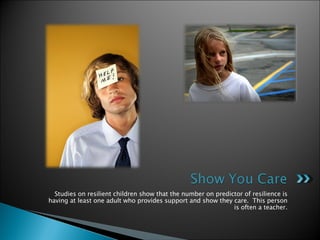
Studies on resilient children show that the number on predictor of resilience is having at least one adult who provides support and show they care.  This person is often a teacher.
Allow extra time Frequent breaks Other accommodations on an individual basis
I will try: I will consider: When assigning writing topics provide several if one might be upsetting to some students Be especially sensitive around various holidays – Christmas, Mother’s Day, Father’s Day - if there are family issues Avoid things that cause sudden loud noises Be sensitive to the difficulties some students face before and after holidays, long weekends and vacations Many medications have the side effect of dry mouth, let all students have water bottles with spill limiting lids at their desks Plan for variations on lessons in terms of interaction and energy level needed and take the cues from your students on which version to teach Work with guidance and adjustment counselors to assure all students have some semblance of friendship with peers at school Have a quiet area in the room where students can seek some refuge if they need it Be sure to have plenty of support for yourself
National Institute of Mental Health www.nimh.nih.gov What accommodations work in school?  www.bu.edu/cpr/reasaccom/educa-accom.html
We will finish looking at the six high incidence disabilities in Tewksbury We will learn about differentiating instruction for ALL learners We will take a look at technology for learners with disabilities and their teachers (Universal Design for Learning UDL) We will see free and cheap interventions and funding ideas We will make action plans based on your needs as educators and your students needs as learners

High Incidence Learning Disabilities And Accomodations 97

  • 1.
    Created for TewksburyPublic Schools Professional Development by Kate Ahern, M.S.Ed.
  • 2.
  • 3.
    Participants will gainknowledge of a variety of learning disorders Participants will learn instructional strategies for a variety of learning disorders Participants will be able to apply differentiated instruction in their classrooms Participants will plan for innovative ways of improving the quality of education for all students by using the best practice recommendations for specific disabilities
  • 4.
    January Meeting MarchMeeting 12:00 Introductions 12:10 Round Robin 12:30 Overview 12:40 Specific LD 1:00 PDD/NVD 1:40 Break 1:50 Health Impairment including ADD/ADHD 2:10 Psychiatric Disabilities 2:20 Questions 12:00 Review - Pair/Share 12:15 Speech and Language Impairment including Processing Disorders 12:35 Developmental Delay Intellectual Impairment 12:55 Making Differentiated Instruction Work for You 1:15 Break 1:25 Universal Design for Learning 1:35 Free Technology, Where to Find it and What it Can Do For You and Your Students 2:00 Action Planning 2:20 Questions
  • 5.
    Total Students 4,813SPED Total Students 783 (16.3%) Specific LD 298 Communication/Speech and Language 144 Health (includes ADD/ADHD) 58 Developmental Delay 52* Autism 44 Emotional 34 Neurological 30 Intellectual 30* Multiple Disabilities 14 Visually Impaired 6 Hearing Impaired 5 Physically Impaired 3 *Massachusetts divides what used to be known as “mental retardation” in to developmental delay under age 13 and intellectual impairment over age 13. Taken from the MA DOE Website.
  • 6.
    Not all studentswith disabilities are “in special education”, which is defined as having an Individualized Educational Program, some students with disabilities have a 504 or “Rehab” plan and others have neither an IEP or a 504 plan. Here is the break down in placement for Tewksbury: 240 students or 30.7% are in full inclusion, 290 students or 37% are in partial inclusion, 216 or 27.6% are in substantially separate rooms in district, 20 or 2.6% are in a public day program, 14 or 1.8% are in a private day program, 2 are in a private residential program and 1 is in a hospital program, no students are in a public residential program That means more than 60% of special education students in Tewksbury spend time in general education in district
  • 7.
    Special education studentshave been in your classrooms for years However their needs are becoming more complex and will continue to become more complex Teachers need to be able to teach all of the students in the room while encouraging every students strengths and working with every students challenges The more you know about various disabilities and how to better work with the students who face them the more able you will be to face the rising challenges of your classroom
  • 8.
    Every instructional strategyyou try will help all of your students, not just those you are targeting. (And they get easier to think of and implement over time)
  • 9.
  • 10.
    Our nation's specialeducation law, the Individuals with Disabilities Education Act, defines a specific learning disability as . . . ". . . a disorder in one or more of the basic psychological processes involved in understanding or in using language, spoken or written, that may manifest itself in an imperfect ability to listen, think, speak, read, write, spell, or do mathematical calculations, including conditions such as perceptual disabilities, brain injury, minimal brain dysfunction, dyslexia, and developmental aphasia." However, learning disabilities do not include, "…learning problems that are primarily the result of visual, hearing, or motor disabilities, of mental retardation, of emotional disturbance, or of environmental, cultural, or economic disadvantage." 34 Code of Federal Regulations §300.7(c)(10)
  • 11.
    Dyslexia is aspecific language based learning disability Manifested in reading, spelling, writing and pronunciation No “cure” but it can be “treated” Dyslexia is life long and compensatory strategies must increase as the student ages 6-7% of students have a specific learning disability and 85% of those have a language disability, some students with symptoms of dyslexia do not qualify for special education Students tend to have normal or above average intelligence Runs in families Two types currently identified 'dysphonetic' and 'dyseidetic‘ also called auditory dyslexia and visual (or word blindness) dyslexia Dysphonetic dyslexia may be co-morbid with auditory processing disorders
  • 12.
    Student is likelyof normal or above-normal intelligence May be fearful of reading, writing and spelling in front of others May be disorganized Trouble remembering what he or she just read or heard May not know right from left Changes letter order when spelling aloud Incorrect letter order and reversals of letters when writing (beyond developmentally normal) Cannot decode words spelled aloud Difficulty copying writing and even drawings May use social skills to mask difficulties
  • 13.
    Rule out hearingand vision issues Multi-sensory instruction Remediation of phonemic awareness and related areas using programs like the Lindamood Bell LIPS program Structured, phonics based reading instruction Orton-Gillingham Wilson Reading Direct Instruction of organizational and study skills Assistive technology like text-to-speech, spell check, word prediction, books on tape, and software like Kurzweil or Don Johnston SOLO.
  • 14.
    Change your defaultfont Give homework assignments in writing Use visual/graphical supports (Kidspiration/Inspiration, other mind-maps, graphic organizers) Use multi-sensory techniques Preserve self-esteem (don’t ask to read/write/spell in front of others) Offer an alternative to reading text books Have assistive technology available
  • 15.
    Studies show thatactivating Broca’s Area of the brain increases reading ability and comprehension. To do this students should read aloud or move their lips when reading.
  • 16.
    Additional Time ExtendedBreaks Segmented Test Scribe/Reader Passages of text provided on tape/MP3 Take on word processor (with word prediction and/or spell check)
  • 17.
    I will try:I will consider: For cloze and fill-in-the-blank activities give the answers on label stickers Pass out homework assignments on label stickers to be stuck into assignment note books Offer students a chance to turn in assignments early for editing Assign every student a phone/IM buddy Allow all students the option of listening to an audio book while they read aloud Offer alternate means of displaying knowledge instead of writing papers, such as presentation software like Power Point, making a podcast or doing an art project
  • 18.
    www.ldworldwide.org www.k-type.com/fontlexia.html (free Lexia font) www.dyslexia-teacher.com www.interdys.org www.dyslexia.com http://www.nottingham.ac.uk/dyslexia/
  • 19.
    difficulty in automaticallyremembering and mastering the sequence of muscle motor movements needed in writing unrelated to the person's intelligence, regular teaching instruction, and (in most cases) the use of the pencil in non-learning tasks neurologically based and exists in varying degrees, ranging from mild to moderate. it can be diagnosed, and it can be overcome if appropriate remedial strategies are taught well and conscientiously carried out an adequate remedial program generally works if applied on a daily basis it seldom exists in isolation without other symptoms of learning problems it is most commonly related to learning problems involved within the sphere of written language difficulty in writing is often a major problem for students, especially as they progress into upper elementary and into secondary school
  • 20.
    Tight, awkward pencilgrip and body position Illegible handwriting Avoiding writing or drawing tasks Tiring quickly while writing Saying words out loud while writing Unfinished or omitted words in sentences Difficulty organizing thoughts on paper Difficulty with syntax structure and grammar Large gap between written ideas and understanding demonstrated through speech. From www.ldonline.org
  • 21.
  • 22.
    Occupational Therapy Programslike Handwriting without Tears in the early grades Use of low tech assistive devices like pencil grips and slant boards Use of high tech assistive technology like text-to-speech, portable word processors, and word prediction
  • 23.
    Use of alternativesto writing to demonstrate knowledge Oral reports Art projects Multi-media presentations Use of low tech assistive technology such as adapted grips and slanted writing boards Use of high tech assistive technologies such as a computer or portable word processor (i.e. Alphasmart)
  • 24.
    I will try:I will consider: Allow all students to option to type written assignments Use pre-printed peel and stick labels to fill in the blanks on worksheets/quizzes Alternative spelling test that requires circling the correct spelling from a list Allow all students to try out and use text to speech technology Publish class notes and handouts online so students can download and type in additional notes Allow all students the option of taping lectures and lessons Use partners and cooperative learning groups that call for one student to be a scribe
  • 25.
    www.ldanatl.org/aboutld/parents/ld_basics/dysgraphia.asp www.ninds.nih.gov/disorders/dysgraphia/dysgraphia.htm www.ldonline.org/article/12770
  • 26.
    Learning disability relatedto mathematics A life long disability No cure, just beginning to have treatments It appears different from student to student and across the life span Students can usually read and write well, but cannot grasp math concepts Trouble with time concepts, frequently late Poor sense of direction Poor visual memory and mental math skills Difficulty with visual spatial skills (difficulty learning music and instruments)
  • 27.
    Trouble sorting andsequencing Does not know math facts Does not understand time, may be late or early Cannot estimate amounts by looking at a group of items or people Does not know right from left Trouble with prepositional phrases (above, around, among) Poor handling of money Avoids making change with money Cannot easily remember numeric strings (phone number, locker combination) Limited map skills, does not understand direction
  • 28.
  • 29.
    Unlike dyslexia thereare no primary interventions (no Wilson Math, etc.) However in the primary grade the Touch Math program may be helpful, also Edmark Time Telling and in middle and high school technology (i.e. Math Pad Software) may help Direct instruction of compensatory techniques Multi-sensory instruction
  • 30.
    Math done ongraph paper to align numbers Use mnemonics (8x8 is 64, wipe your nose and shut the door) Use visual supports Number line Abacus Multiplication table Visuals of story problems Time lines Written schedules Use manipulatives Teach “tricks” like multiplying on fingers Allow scrap paper and “cheat sheets” Assistive technology like calculators and the math add on for Microsoft Word
  • 31.
    Manipulatives allow formath to be done without worry of writing or copying errors.
  • 32.
    Allow extra timeScribe Allow scrap (graph) paper for work Allow calculator Allow use of computer with Math Pad or similar software
  • 33.
    I will try:I will consider: Have all students do math on graph paper Break down scoring to allow credit for following the right steps even if there are mistakes Teach students how to self-check work Hang posters with vital information Avoid the phrases “stupid mistakes” and “careless errors” Consider spending time teaching students how to find the process to solve math problems they don’t know how to solve Use a locker lock that spells a word
  • 34.
    www.dyscalculia.org/ www.ldonline.org/indepth/mathwww.ldaamerica.us/aboutld/parents/ld_basics/dyscalculia.asp www.ncld.org/content/view/463/391/
  • 35.
    Includes ADD/ADHD, diabetes,epilepsy, Tourettes Syndrome, and other medical conditions
  • 36.
    Health Impairment isa large category of disabilities consisting primarily of medical conditions such as asthma and diabetes and attention deficit syndrome with or without hyperactivity (ADD/ADHD) Remember student qualify for an IEP only if their disability prevents them from making progress in general education, i.e. frequent seizures prevent learning in a general education classroom without supports or ADD/ADHD calls from intervention from an OT and or Behavior Specialist
  • 37.
    Extended test timeFrequent/extended breaks Reader/scribe Take on a computer Test on tape Large print Non-scantron (bubbles) Preferential seating Change in proctoring assignment
  • 38.
    Student carries passthat allows access to nurse, water fountain and rest room at any time Teachers and staff trained on emergency protocol for that student or for particular conditions Student may be allowed extra travel time in the halls if needed Student may be allowed flexible deadlines on assignments if caregivers/medical staff confirm medical need These will be highly variable based on student needs and condition
  • 39.
    A person withADHD has a chronic level of inattention, impulsive hyperactivity, or both such that daily functioning is compromised. The symptoms of the disorder must be present at levels that are higher than expected for a person's developmental stage and must interfere with the person's ability to function in different settings (e.g., in school and at home). A person with ADHD may struggle in important areas of life, such as peer and family relationships, and school or work performance.  There are three types Predominantly inattentive Predominantly hyperactive-impulsive Combined
  • 40.
    Inattentive Distractible DisorganizedOut-of-it or day dreaming in class Impulsive Poor judgment Cannot sit still (restless, fidgets, in and out of seat) Hyperfocus May also exhibit: Anxiety Depression Defiance/Anger Issues Mood Instability Confusion Poor retention
  • 41.
    Behavioral therapy Psycho-educationaltreatment Medical therapy
  • 42.
    Extended test timeFrequent/extended breaks Extra cues Option to sit at a desk or stand at a podium and move between the two Assistance with organization and time management Non-scantron (bubbles) Preferential seating Change in proctoring assignment
  • 43.
    As much aspossible limit distractions Use well-organized texts Offer materials in advance Show a sample (of an organized notebook, an “A” paper, etc.) Use the "tell them what you are going to tell them, tell them, tell them what you told them" approach Indicate main points before viewing videos or films, have students fill in an outline as they watch, stop video often Clearly indicate the main points of every material Emphasize the relationships between ideas, using visual as well as verbal methods (e.g. concept maps, diagrams) Use multi-sensory teaching techniques Visual supports Non-verbal cues to get student back on task Mind maps Written and oral assignments, lectures etc Get students up and moving, acting out dialogues, etc Encourage group work when feasible (e.g. brainstorming, assignments) Allow movement in the classroom, create movement breaks as needed Use advantageous seating Study carrels or other quiet work spaces An extra set of books at home Adapted from http://library.queensu.ca/websrs/faculty_guide-Strategies-ADD.html and http://www.healthyplace.com/communities/add/judy/teaching_tools_1.htm
  • 44.
    Opportunities to movemay increase attention.
  • 45.
    I will try:I will consider: Use aquarium tubing (sterilized in boiling water) stuck onto the tops of pencils to reduce pencil chewing Have a buddy system with a teacher on the other side of the building when a student needs to talk a walk Use “on task” cards in two colors (green when on task, red when not) and drop them onto students desks during silent work, red cards are returned with out consequence, green cards are collected and turned in for a free home pass or similar prize Have a custodian raise an adjustable height table as high as it will go and allow students to work standing up Tie rubber tubing between chair legs for students to use to get energy out Have students use self monitoring to keep them selves on task Allow all students the option of using a seat cushion, stress ball or other item during mostly listening activities Photograph your notes from the board and post on Flickr or similar site or use www.qipit.com which is designed for that purpose
  • 46.
    Medical Conditions ADD/ADHDwww.lehman.cuny.edu/faculty/jfleitas/bandaides www.jdrf.org www.noattacks.org www.epilepsyfoundation.org www.rarechromo.org www.tsa-usa.org www.cdc.gov/ncbddd/adhd www.school.familyeducation.com/learning-disabilities/treatments/37770.html www.additudemag.com www.helpguide.org/mental/adhd_add_teaching_strategies.htm www.childdevelopmentinfo.com/learning/teacher.shtml
  • 47.
    Autism, Asperger’s Syndrome,PDD-NOS and (not technically PDD but related) Non-Verbal Learning Disability
  • 48.
    Under the umbrellaof Pervasive Developmental Delay (PDD) come Autism, Asperger’s Syndrome, Rett Syndrome and PDD-NOS (Not Otherwise Specified), also called Autism Spectrum Disorder (or being “on the spectrum”) Non-verbal Learning Disability (NVD) is similar in some ways to Autism/Asperger’s These are life long neurological disabilities affecting communicative ability and language understanding, play and social skills PDD is frequently associated with sensory integration dysfunction and psychiatric issues like anxiety and obsessive compulsive disorder
  • 49.
    Difficulty with languageLimited verbal ability Extremely literal Hyperlexic (may read very well possibly with little comprehension) Does not understand social rules Does not learn by inference or understand inference in readings Difficulties with transition and change Perseverates on certain ideas, topic and objects May make stereotypical movements May repeat certain words and sounds (echolalia) Over or under reacts to sensory stimulation Does not like being touched Cannot stand certain sounds or smells Cannot tolerate some kinds of lighting Few friends and limited play or leisure skills
  • 50.
    Application of BehaviorAnalysis (ABA) TEACCH (Treatment and Education of Autistic and Related Communication Handicapped Children) Pivotal Response Treatment Floortime Occupational Therapy and Sensory Integration Speech and Language Therapy which may include Picture Exchange Communication Systems (PECS) or other augmentative and alternative communication systems Medical and Psychiatric Intervention Complementary therapies such as art, music, drama, animal and hippotherapy Social skills training and use of social stories
  • 51.
    Provide visual supportsDaily schedule Pictures and diagrams Clear and concise written instructions Visual representations of things like elapses time Avoid figurative language, or better, explain expressions used Check for understanding frequently Provide support in social situations (recess, lunch, fieldtrips) Warning and support during disruptions of routines Provide means for students to get sensory needs met Some one or some place should be designated as a safe if the student becomes over stimulated, anxious or agitated
  • 52.
    Visual timers, Printedor Picture Schedules, Agenda or Outline of the Days Lesson, Visual Cues of Rules and Routines
  • 53.
    Ideas include “fidgets”,air filled cushions, theraband or rubber tubing tied between chair legs, chair that are safe to tip
  • 54.
    Allow extra timeFrequent/Extended breaks Segmented test Check for understanding Scribe/reader Assistive technology
  • 55.
    I will try:I will consider: Give out written copies of assignments and instructions Allow students to e-mail you and peers for assistance Provide direct instruction of social skills and rules Offer sensory solutions to all students Chair cushions Pencil fidgets Independent work done on bean bag chairs, sitting in a rocking chair or standing up, etc. Weighted hall pass Weighted lap blanket Rubber tubing tied to chair legs Eliminate negative sensory input Tennis balls on chair legs Offer head phones to block sound Portable study carrels Use mind mapping and other visual means for hand outs Put lesson notes online Find ways to combine all verbal cues with visual cues Hang up written descriptions of expected routines Give explicit directions if things are to going to be different (i.e. field trips)
  • 56.
    www.autism-pdd.net www.autism-society.org www.polyxo.comwww.nldontheweb.org www.usevisualstrategies.com
  • 57.
    Depression, Bi-polar, PostTraumatic Stress Disorder and other psychiatric disabilities
  • 58.
    Depression is acommon mental disorder that presents with depressed mood, loss of interest or pleasure, feelings of guilt and/or low self-worth, disturbed sleep and/or appetite, low energy, and poor concentration. Bipolar disorder, also known as manic-depressive illness, is a brain disorder that causes unusual shifts in a person’s mood, energy, and ability to function. People with anxiety disorders feel extremely fearful and unsure. Panic attacks, sleep problems and other symptoms maybe present. Post-Traumatic Stress Disorder, PTSD, is an anxiety disorder that can develop after exposure to a terrifying event or ordeal in which grave physical harm occurred or was threatened. People with PTSD have persistent frightening thoughts and memories of their ordeal and feel emotionally numb, especially with people they were once close to. They may experience sleep problems, feel detached or numb, or be easily startled. Adapted from the World Health Organization and The National Institute of Mental Health
  • 59.
    Students with depressionmay be withdrawn, shy, agitated, have difficulty concentrating or be apathetic. They may not participate or do assignments. Students with bi-polar may exhibit the depression symptoms above or may have symptoms of mania such as excessive movement and talking, racing thoughts, or trouble concentrating. Students with anxiety disorders may be shy, fearful or withdrawn. They may act out to avoid situations. Depending on the nature of the anxiety disorder the student may avoid social interactions, crowds, heights, or may have panic attacks. Students with PTSD may be hyper vigilant and over react to sudden stimuli, be fearful, have flashbacks, be tired from lack of sleep due to nightmares, avoid certain people or situations because of what they represent. A severe symptom may be disassociating under stress. Any of these students may exhibit side effects of psychiatric medication such as tiredness and fatigue, difficulty concentrating, dry mouth, head ache, stomach upset and other symptoms.
  • 60.
    Professional help froma psychiatrist, psychologist, social workers or other qualified counselor in a 1:1, family or group setting Medication Support groups and social skill groups Application of Behavior Analysis (ABA) and other behavioral interventions
  • 61.
    Check in withthe student on a regular basis and give other indications that you care about the student’s well being Observe student for signs of change in his or her condition and report to case worker, guidance counselor or parent Note students mood at various times of the day and work to pro-actively avoid exacerbating the issue (i.e. more mania after lunch may mean independent work at that time, anxiety before gym class may mean allowing student to leave class early and change in an empty locker room or working with PE teacher to eliminate the gym clothes requirement) Avoid giving “triggering” assignments like, “A time I was disappointed…” Avoid reinforcing negative acting out as a means of gaining attention, especially in front of other students Know the protocol for both psychiatric and physical emergencies in your building
  • 62.
    Studies on resilientchildren show that the number on predictor of resilience is having at least one adult who provides support and show they care. This person is often a teacher.
  • 63.
    Allow extra timeFrequent breaks Other accommodations on an individual basis
  • 64.
    I will try:I will consider: When assigning writing topics provide several if one might be upsetting to some students Be especially sensitive around various holidays – Christmas, Mother’s Day, Father’s Day - if there are family issues Avoid things that cause sudden loud noises Be sensitive to the difficulties some students face before and after holidays, long weekends and vacations Many medications have the side effect of dry mouth, let all students have water bottles with spill limiting lids at their desks Plan for variations on lessons in terms of interaction and energy level needed and take the cues from your students on which version to teach Work with guidance and adjustment counselors to assure all students have some semblance of friendship with peers at school Have a quiet area in the room where students can seek some refuge if they need it Be sure to have plenty of support for yourself
  • 65.
    National Institute ofMental Health www.nimh.nih.gov What accommodations work in school? www.bu.edu/cpr/reasaccom/educa-accom.html
  • 66.
    We will finishlooking at the six high incidence disabilities in Tewksbury We will learn about differentiating instruction for ALL learners We will take a look at technology for learners with disabilities and their teachers (Universal Design for Learning UDL) We will see free and cheap interventions and funding ideas We will make action plans based on your needs as educators and your students needs as learners

Editor's Notes

  • #2 What are some of the disabilities you have had in your classroom? What are some of the ways you accommodate learners with disabilities? What is the most difficult part of including learners with disabilities in your classroom? What is the best part of including learners with disabilities in your classroom? How do you participate in the IEP process?