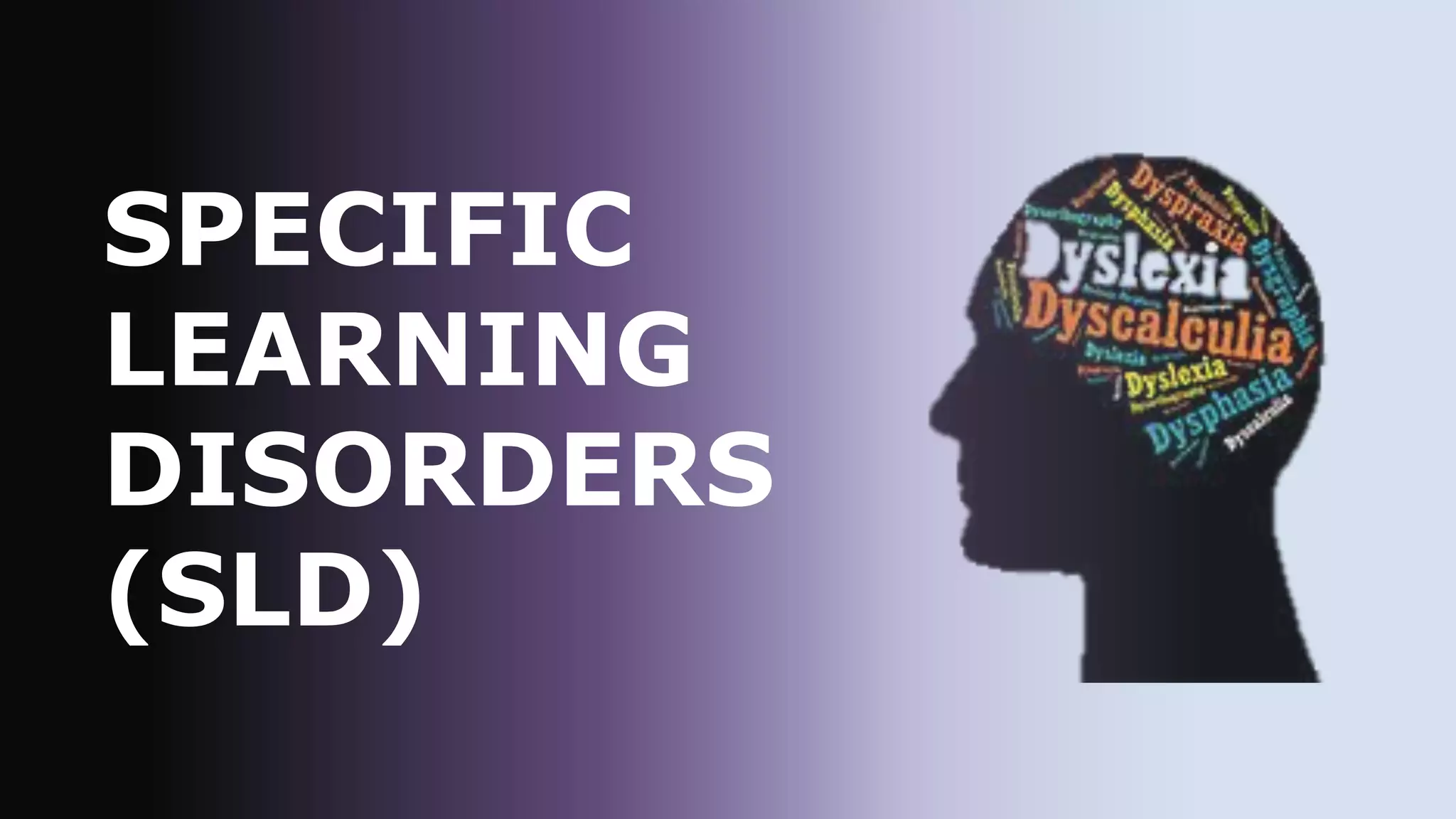
SPECIFIC
LEARNING
DISORDERS
(SLD)
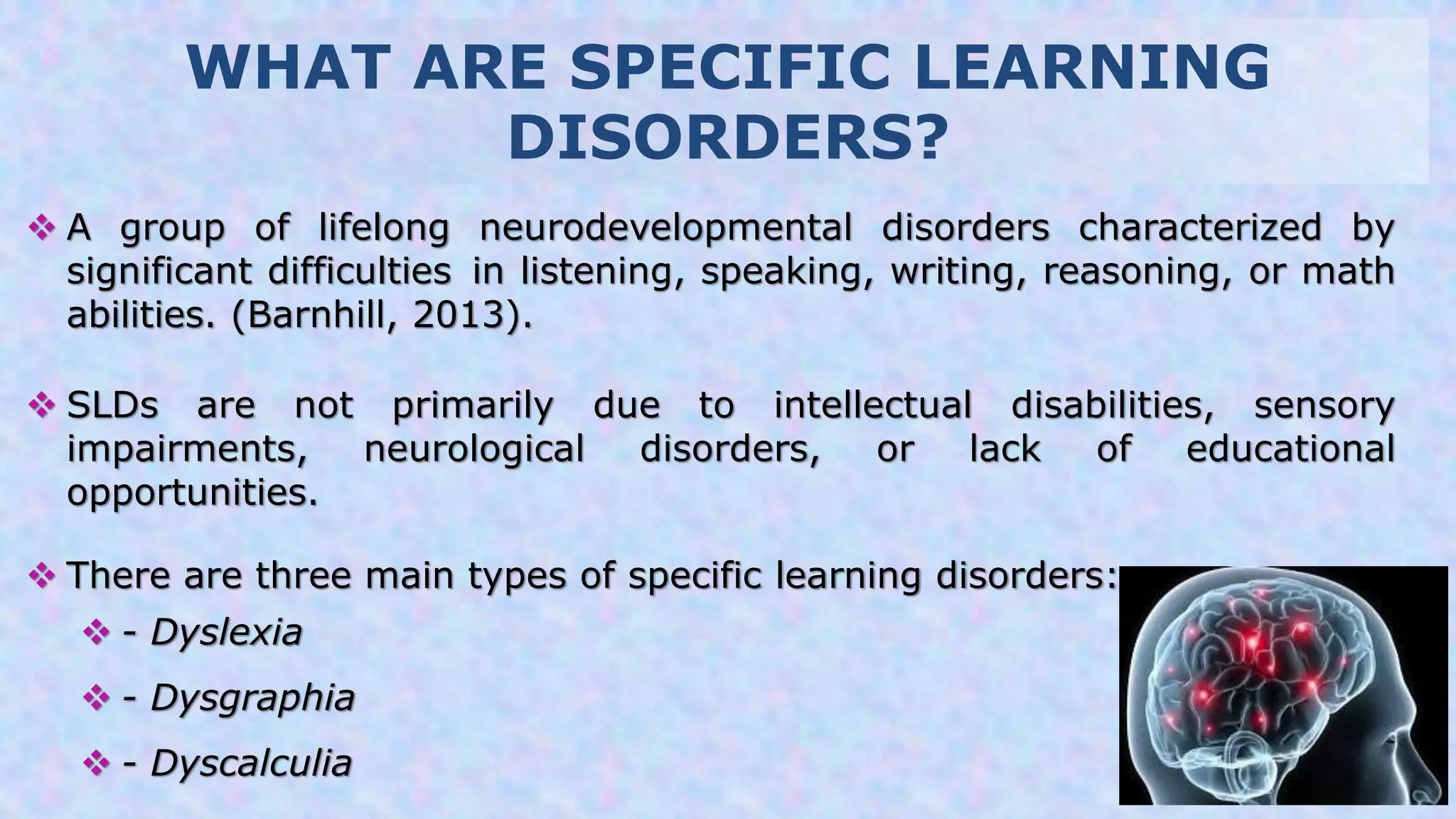
WHAT ARE SPECIFIC LEARNING
DISORDERS?
 A group of lifelong neurodevelopmental disorders characterized by
significant difficulties in listening, speaking, writing, reasoning, or math
abilities. (Barnhill, 2013).
 SLDs are not primarily due to intellectual disabilities, sensory
impairments, neurological disorders, or lack of educational
opportunities.
 There are three main types of specific learning disorders:
 - Dyslexia
 - Dysgraphia
 - Dyscalculia
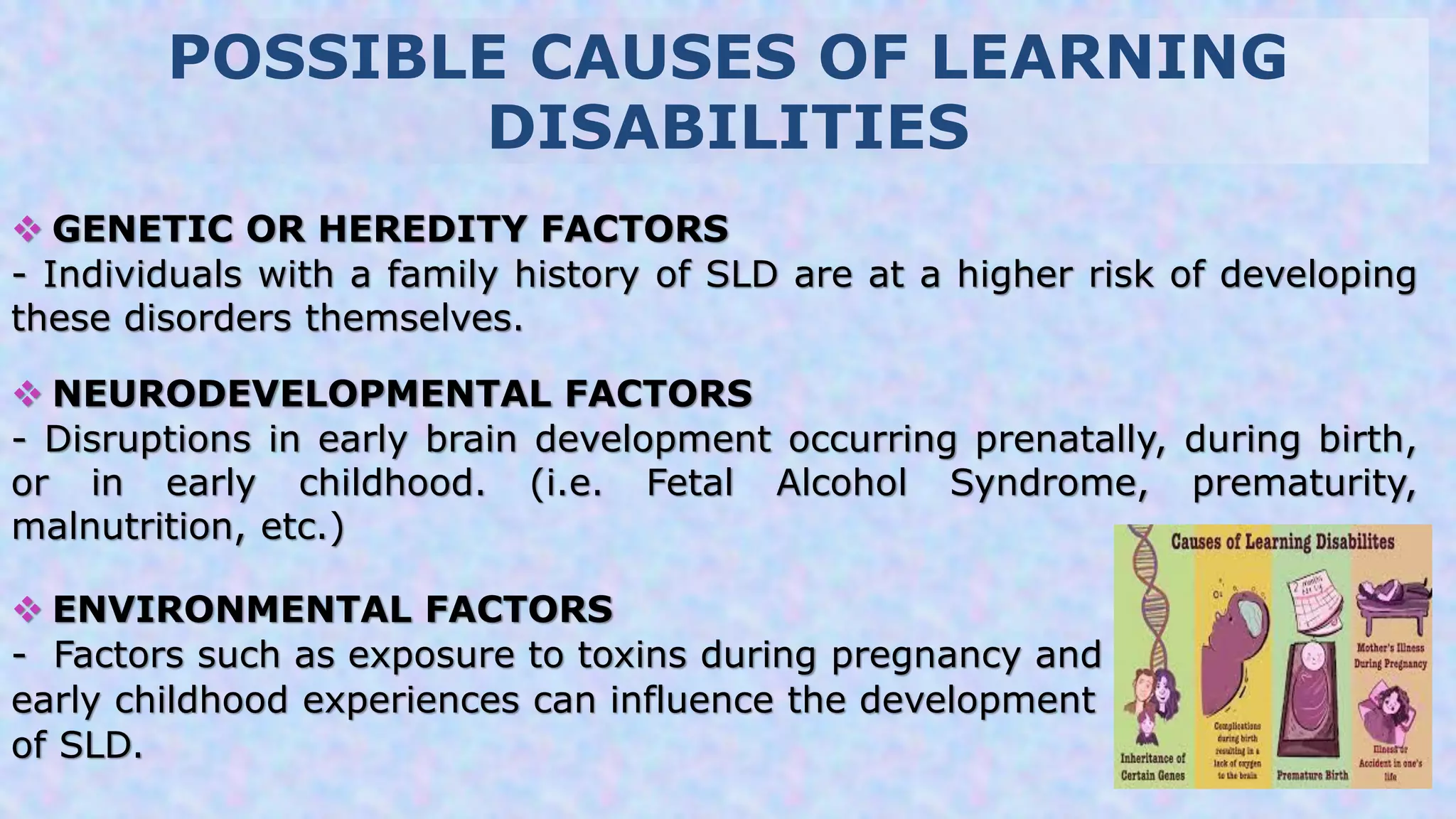
POSSIBLE CAUSES OF LEARNING
DISABILITIES
 GENETIC OR HEREDITY FACTORS
- Individuals with a family history of SLD are at a higher risk of developing
these disorders themselves.
 NEURODEVELOPMENTAL FACTORS
- Disruptions in early brain development occurring prenatally, during birth,
or in early childhood. (i.e. Fetal Alcohol Syndrome, prematurity,
malnutrition, etc.)
 ENVIRONMENTAL FACTORS
- Factors such as exposure to toxins during pregnancy and
early childhood experiences can influence the development
of SLD.
MORE ON SPECIFIC LEARNING
DISABILITIES
 The severity of the disorders often vary from mild, to moderate, and
severe.
1. MILD: Where the learner can function well with appropriate
accommodations or support services.
2. MODERATE: Where the learner faces significant difficulties with
learning and requires intensive and specialized teaching,
accommodations or support services.
3. SEVERE: Where the learner has severe difficulties with learning and
this affects the learner’s academics requiring ongoing intensive
specialized teaching.
(Khoza, 2020:6)
DYSLEXIA
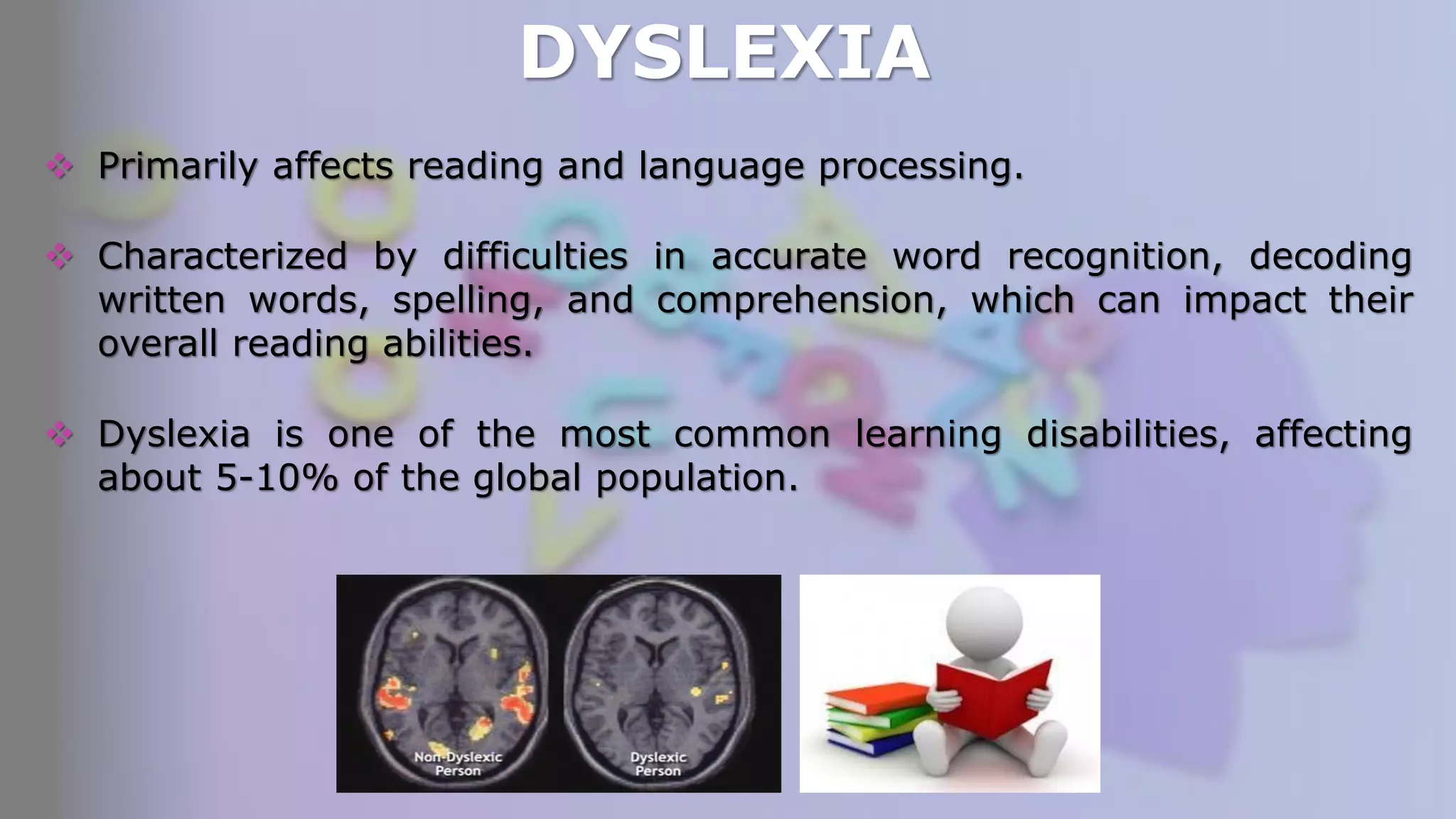
 Primarily affects reading and language processing.
 Characterized by difficulties in accurate word recognition, decoding
written words, spelling, and comprehension, which can impact their
overall reading abilities.
 Dyslexia is one of the most common learning disabilities, affecting
about 5-10% of the global population.
DYSLEXIA
SIGNS OF READING DISORDER:
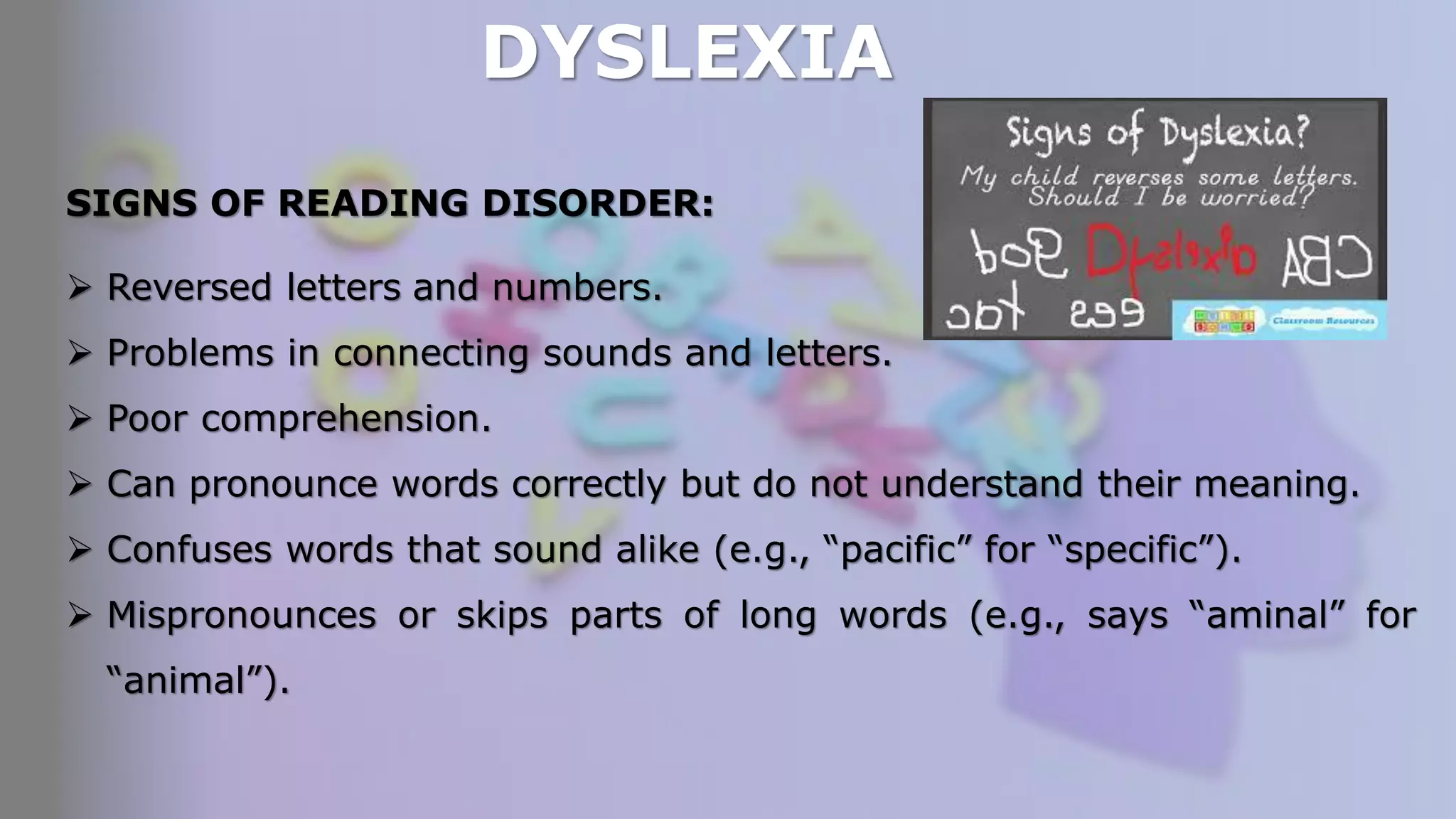
 Reversed letters and numbers.
 Problems in connecting sounds and letters.
 Poor comprehension.
 Can pronounce words correctly but do not understand their meaning.
 Confuses words that sound alike (e.g., “pacific” for “specific”).
 Mispronounces or skips parts of long words (e.g., says “aminal” for
“animal”).
DYSGRAPHIA
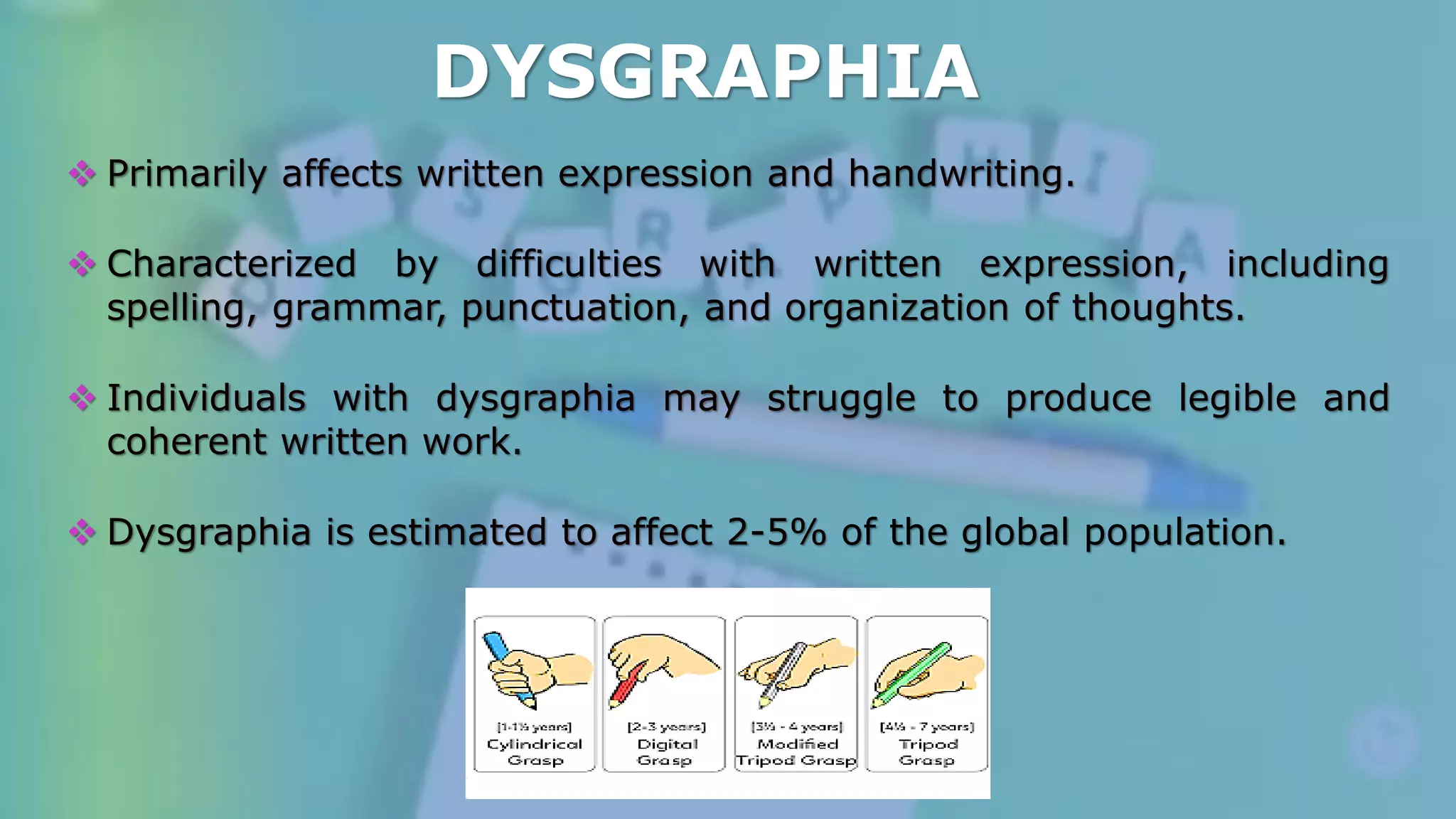
 Primarily affects written expression and handwriting.
 Characterized by difficulties with written expression, including
spelling, grammar, punctuation, and organization of thoughts.
 Individuals with dysgraphia may struggle to produce legible and
coherent written work.
 Dysgraphia is estimated to affect 2-5% of the global population.
DYSGRAPHIA
SIGNS OF READING DISORDER:
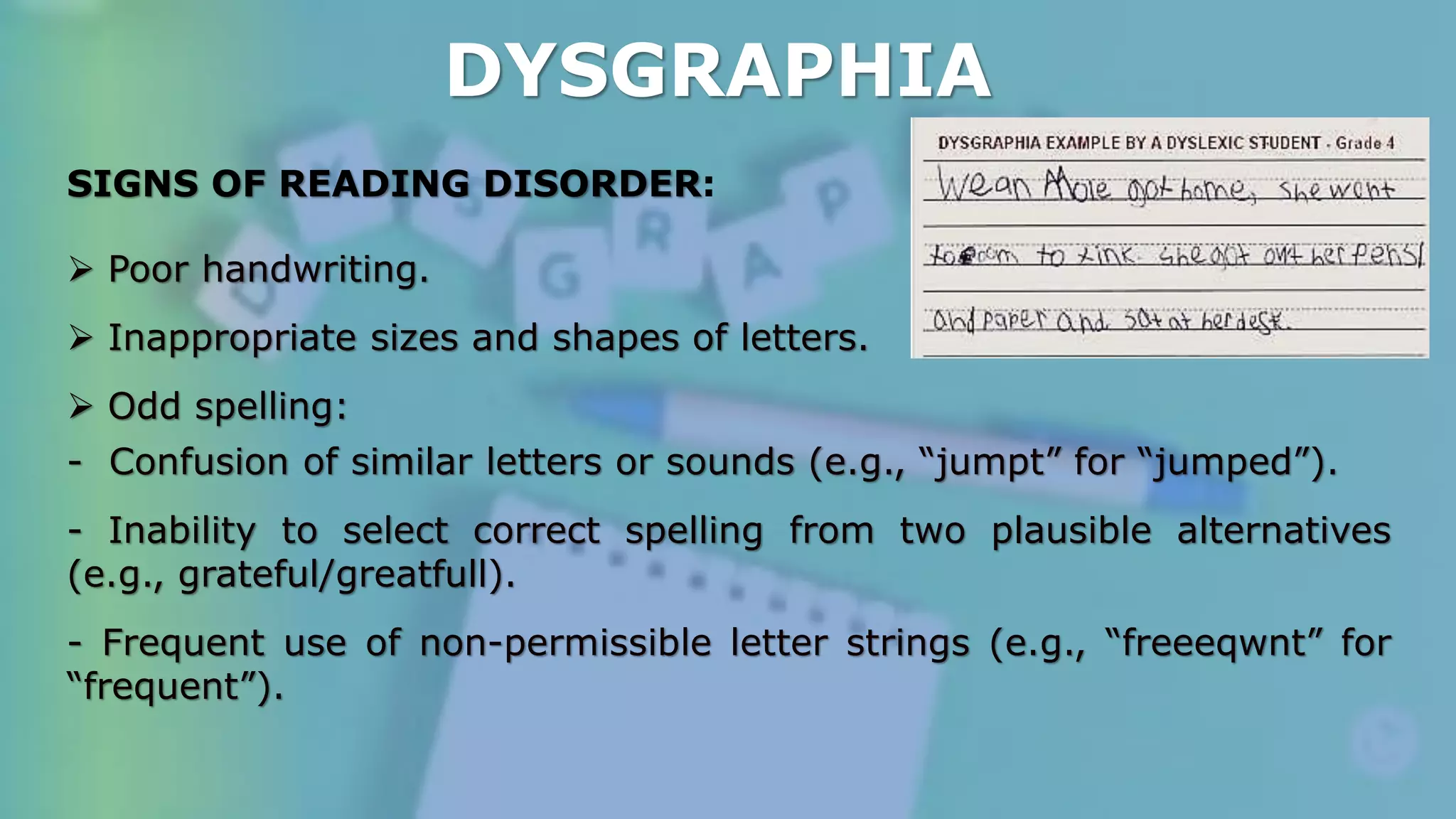
 Poor handwriting.
 Inappropriate sizes and shapes of letters.
 Odd spelling:
- Confusion of similar letters or sounds (e.g., “jumpt” for “jumped”).
- Inability to select correct spelling from two plausible alternatives
(e.g., grateful/greatfull).
- Frequent use of non-permissible letter strings (e.g., “freeeqwnt” for
“frequent”).
DYSCALCULIA
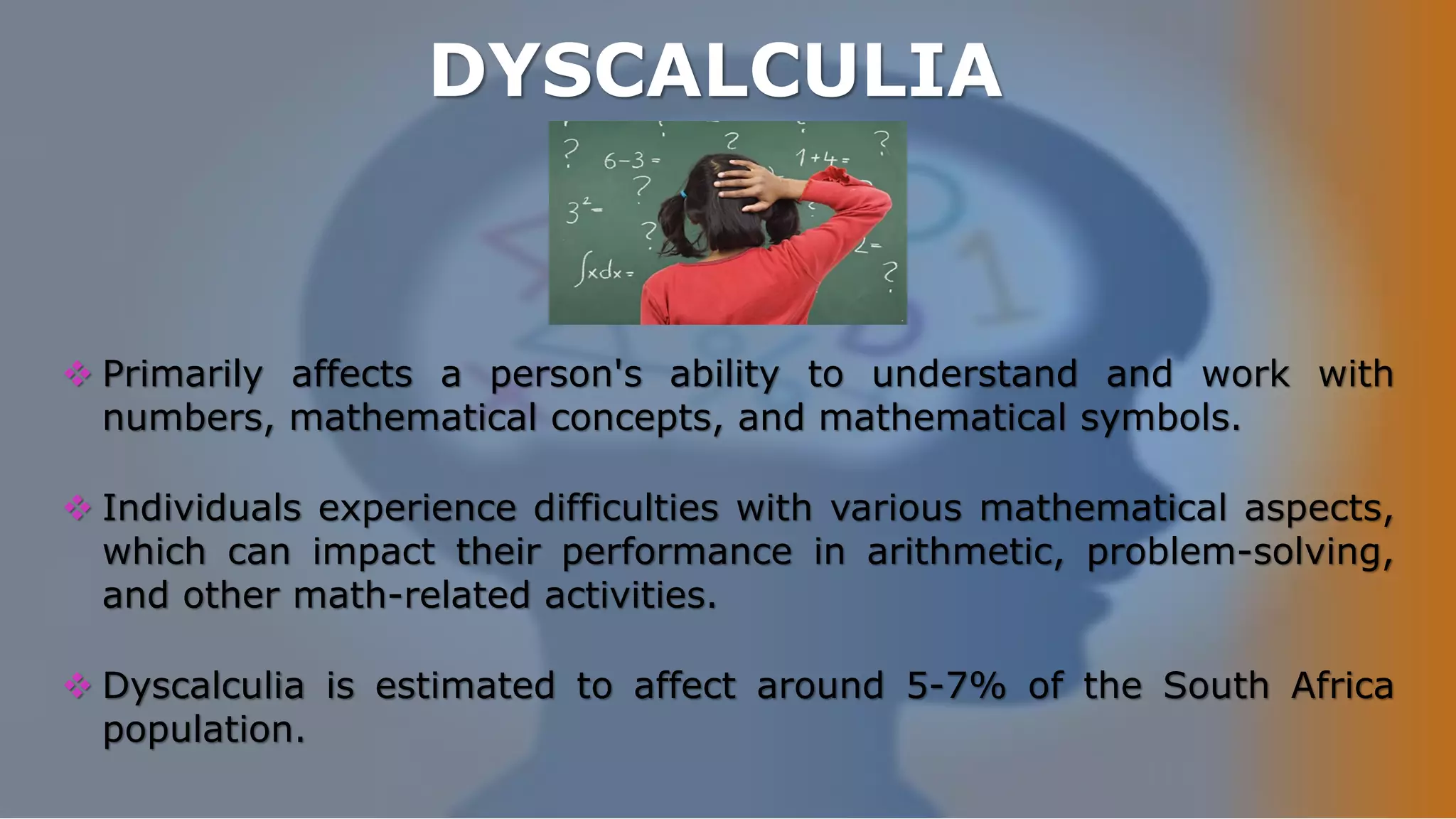
 Primarily affects a person's ability to understand and work with
numbers, mathematical concepts, and mathematical symbols.
 Individuals experience difficulties with various mathematical aspects,
which can impact their performance in arithmetic, problem-solving,
and other math-related activities.
 Dyscalculia is estimated to affect around 5-7% of the South Africa
population.
DYSCALCULIA
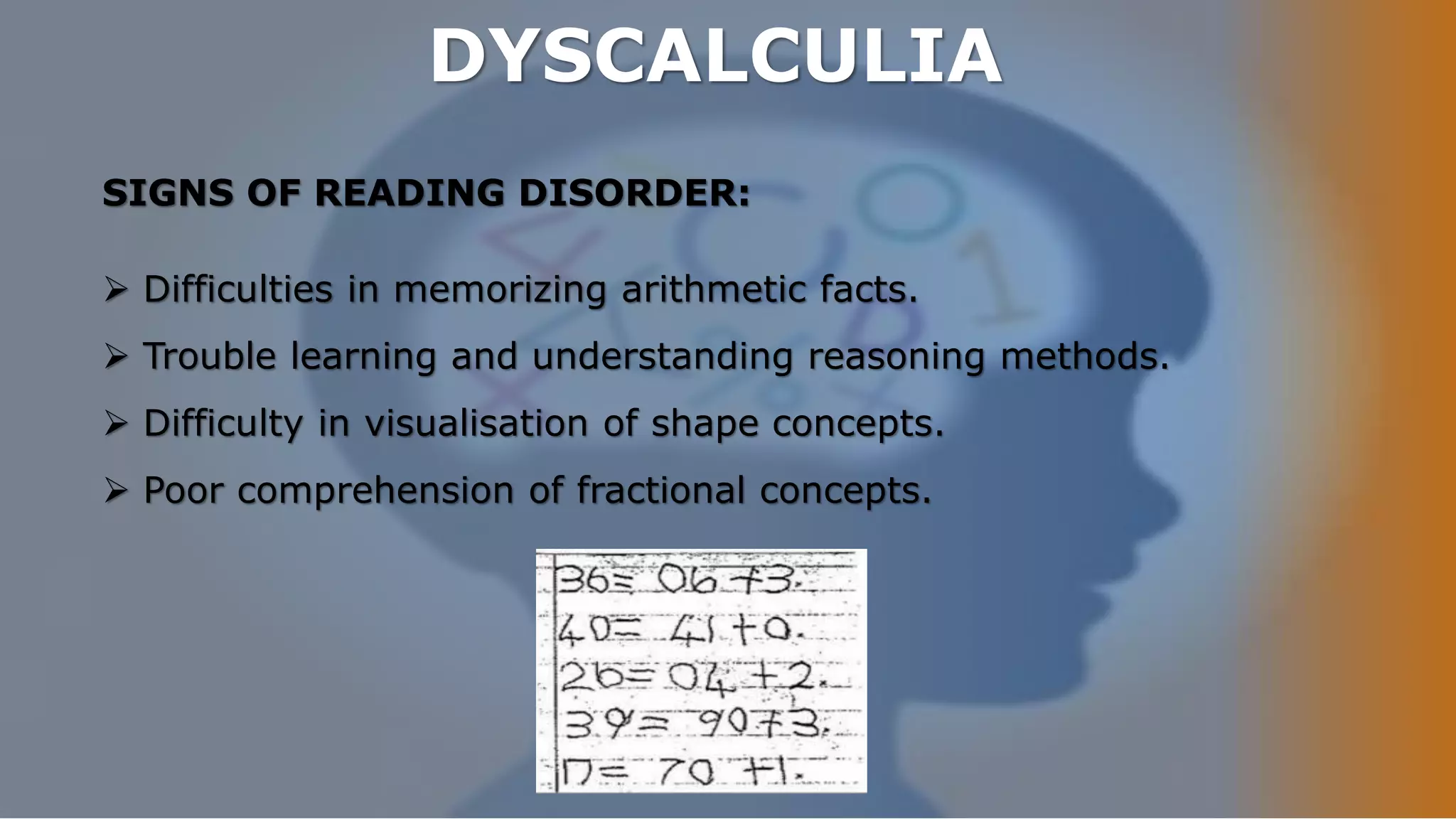
SIGNS OF READING DISORDER:
 Difficulties in memorizing arithmetic facts.
 Trouble learning and understanding reasoning methods.
 Difficulty in visualisation of shape concepts.
 Poor comprehension of fractional concepts.
SIDE-EFFECTS OF LEARNING DISABILITY
Learning disabilities can have a range of emotional, psychological, and
social side effects in addition to their academic challenges. Some of the
side effects include:
 Difficulty in accessing information for different subjects.
 Reduced reading inhibits growth of vocabulary and comprehension.
 Frustration and Despair- Difficulties cause student to give up.
 Loss of confidence.
 Negative self-image.
 Stigmas can be put on the student.
ASSESSMENT/DIAGNOSIS
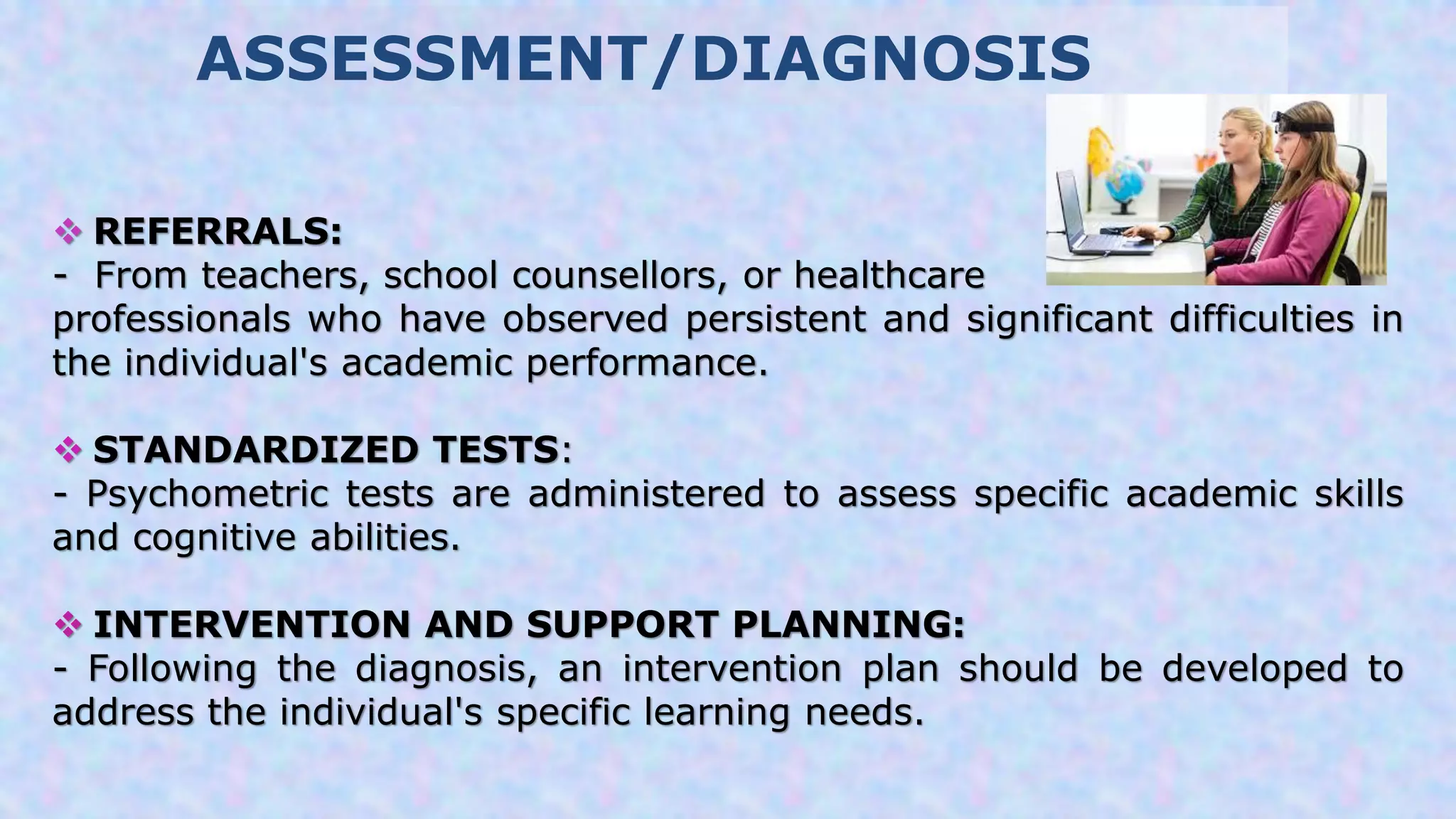
 REFERRALS:
- From teachers, school counsellors, or healthcare
professionals who have observed persistent and significant difficulties in
the individual's academic performance.
 STANDARDIZED TESTS:
- Psychometric tests are administered to assess specific academic skills
and cognitive abilities.
 INTERVENTION AND SUPPORT PLANNING:
- Following the diagnosis, an intervention plan should be developed to
address the individual's specific learning needs.
INTERVENTIONS
 Early intervention and appropriate support can significantly
improve outcomes for individuals with specific learning
disorders.
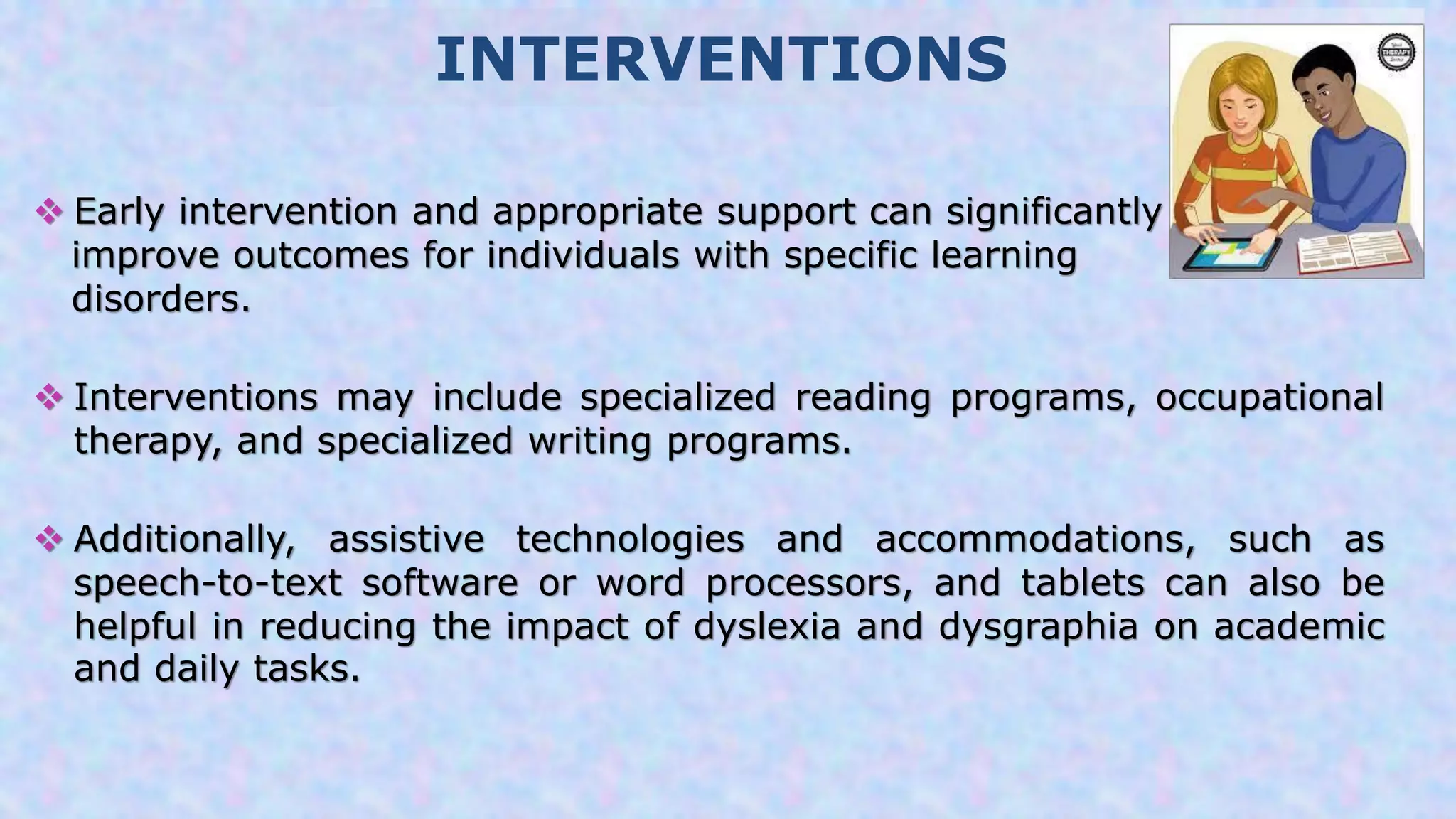
 Interventions may include specialized reading programs, occupational
therapy, and specialized writing programs.
 Additionally, assistive technologies and accommodations, such as
speech-to-text software or word processors, and tablets can also be
helpful in reducing the impact of dyslexia and dysgraphia on academic
and daily tasks.
INSTRUCTIONAL STRATEGIES
TEACHING WRITING
1. Guided Writing
2. Modelling the Writing Process
3. Write in Response to Reading
DIFFICULTIES IN MATH
1. Use Manipulatives
2. Strategies for mental math
3. Reading comprehension tasks for
problem solving.
GENERAL TEACHING PRACTICE
1. Personal Spelling Dictionary
2. Explicit Reading
Comprehension Strategies
3. Basic Listening Strategies
4. Use of computers in classroom
READING INSTRUCTION
1. Whole Language Method
(Learning of structure comes as the reader
improves)
2. Phonemic Awareness
(explicit instruction on phonics.)
3. Direct teaching of Comprehension
LISTEN STRATEGY
[A copy on the students’ desks or on a poster at the
front of the class.]
L - Look at the teacher.
I - Ignore the student beside you.
S - Stay in your place.
T - Try to focus on the teacher.
E - Enjoy the story.
N - Nice Job!
REFERENCES
• Aylin, A. (2019). Understanding Learning Disabilities and Attention Disorder. Available from SlideShare:
https://www.slideshare.net/aylin22/adhd-188927557 (Accessed 15 August 2023).
• Barnhill, J. W. (2013). Neurodevelopmental Disorders In DSM-5® clinical cases. American Psychiatric Publishing.
• Ford, G. (2011). Learning Disabilities. Available from SlideShare: https://www.slideshare.net/fordge10/learning-
disabilities-6862182 (Accessed 15 August 2023).
• Khoza, GG. (2020). Learning barriers & Specific learning disorders. Available from SlideShare:
https://www.slideshare.net/gugugracious/learning-barriers-specific-learning-disorders (Accessed 15 August 2023).
• Gupta, L. (2021). Specific learning disability. Available from SlideShare:
https://www.slideshare.net/LaxmiGupta12/sld-250049148 (Accessed 16 August 2023).
• Bhardwaj, P.R. (2015), Learning Disabled: A Field in Transition. Available from SlideShare:
https://www.slideshare.net/PriyankaRalhan/learning-disabled-priyanka-bhardwaj (Accessed 16 August 2023)
• Sharma, R. (2023). Introduction Unit VIII (Psychology). Available from SlideShare:
https://www.slideshare.net/RahulSharma4576/introduction-unit-viii-psychologypptx (Accessed 14 August 2023)

Specific learning disorders.pdf

  • 1.
  • 2.
    WHAT ARE SPECIFICLEARNING DISORDERS?  A group of lifelong neurodevelopmental disorders characterized by significant difficulties in listening, speaking, writing, reasoning, or math abilities. (Barnhill, 2013).  SLDs are not primarily due to intellectual disabilities, sensory impairments, neurological disorders, or lack of educational opportunities.  There are three main types of specific learning disorders:  - Dyslexia  - Dysgraphia  - Dyscalculia
  • 3.
    POSSIBLE CAUSES OFLEARNING DISABILITIES  GENETIC OR HEREDITY FACTORS - Individuals with a family history of SLD are at a higher risk of developing these disorders themselves.  NEURODEVELOPMENTAL FACTORS - Disruptions in early brain development occurring prenatally, during birth, or in early childhood. (i.e. Fetal Alcohol Syndrome, prematurity, malnutrition, etc.)  ENVIRONMENTAL FACTORS - Factors such as exposure to toxins during pregnancy and early childhood experiences can influence the development of SLD.
  • 4.
    MORE ON SPECIFICLEARNING DISABILITIES  The severity of the disorders often vary from mild, to moderate, and severe. 1. MILD: Where the learner can function well with appropriate accommodations or support services. 2. MODERATE: Where the learner faces significant difficulties with learning and requires intensive and specialized teaching, accommodations or support services. 3. SEVERE: Where the learner has severe difficulties with learning and this affects the learner’s academics requiring ongoing intensive specialized teaching. (Khoza, 2020:6)
  • 5.
    DYSLEXIA  Primarily affectsreading and language processing.  Characterized by difficulties in accurate word recognition, decoding written words, spelling, and comprehension, which can impact their overall reading abilities.  Dyslexia is one of the most common learning disabilities, affecting about 5-10% of the global population.
  • 6.
    DYSLEXIA SIGNS OF READINGDISORDER:  Reversed letters and numbers.  Problems in connecting sounds and letters.  Poor comprehension.  Can pronounce words correctly but do not understand their meaning.  Confuses words that sound alike (e.g., “pacific” for “specific”).  Mispronounces or skips parts of long words (e.g., says “aminal” for “animal”).
  • 7.
    DYSGRAPHIA  Primarily affectswritten expression and handwriting.  Characterized by difficulties with written expression, including spelling, grammar, punctuation, and organization of thoughts.  Individuals with dysgraphia may struggle to produce legible and coherent written work.  Dysgraphia is estimated to affect 2-5% of the global population.
  • 8.
    DYSGRAPHIA SIGNS OF READINGDISORDER:  Poor handwriting.  Inappropriate sizes and shapes of letters.  Odd spelling: - Confusion of similar letters or sounds (e.g., “jumpt” for “jumped”). - Inability to select correct spelling from two plausible alternatives (e.g., grateful/greatfull). - Frequent use of non-permissible letter strings (e.g., “freeeqwnt” for “frequent”).
  • 9.
    DYSCALCULIA  Primarily affectsa person's ability to understand and work with numbers, mathematical concepts, and mathematical symbols.  Individuals experience difficulties with various mathematical aspects, which can impact their performance in arithmetic, problem-solving, and other math-related activities.  Dyscalculia is estimated to affect around 5-7% of the South Africa population.
  • 10.
    DYSCALCULIA SIGNS OF READINGDISORDER:  Difficulties in memorizing arithmetic facts.  Trouble learning and understanding reasoning methods.  Difficulty in visualisation of shape concepts.  Poor comprehension of fractional concepts.
  • 11.
    SIDE-EFFECTS OF LEARNINGDISABILITY Learning disabilities can have a range of emotional, psychological, and social side effects in addition to their academic challenges. Some of the side effects include:  Difficulty in accessing information for different subjects.  Reduced reading inhibits growth of vocabulary and comprehension.  Frustration and Despair- Difficulties cause student to give up.  Loss of confidence.  Negative self-image.  Stigmas can be put on the student.
  • 12.
    ASSESSMENT/DIAGNOSIS  REFERRALS: - Fromteachers, school counsellors, or healthcare professionals who have observed persistent and significant difficulties in the individual's academic performance.  STANDARDIZED TESTS: - Psychometric tests are administered to assess specific academic skills and cognitive abilities.  INTERVENTION AND SUPPORT PLANNING: - Following the diagnosis, an intervention plan should be developed to address the individual's specific learning needs.
  • 13.
    INTERVENTIONS  Early interventionand appropriate support can significantly improve outcomes for individuals with specific learning disorders.  Interventions may include specialized reading programs, occupational therapy, and specialized writing programs.  Additionally, assistive technologies and accommodations, such as speech-to-text software or word processors, and tablets can also be helpful in reducing the impact of dyslexia and dysgraphia on academic and daily tasks.
  • 14.
    INSTRUCTIONAL STRATEGIES TEACHING WRITING 1.Guided Writing 2. Modelling the Writing Process 3. Write in Response to Reading DIFFICULTIES IN MATH 1. Use Manipulatives 2. Strategies for mental math 3. Reading comprehension tasks for problem solving. GENERAL TEACHING PRACTICE 1. Personal Spelling Dictionary 2. Explicit Reading Comprehension Strategies 3. Basic Listening Strategies 4. Use of computers in classroom READING INSTRUCTION 1. Whole Language Method (Learning of structure comes as the reader improves) 2. Phonemic Awareness (explicit instruction on phonics.) 3. Direct teaching of Comprehension LISTEN STRATEGY [A copy on the students’ desks or on a poster at the front of the class.] L - Look at the teacher. I - Ignore the student beside you. S - Stay in your place. T - Try to focus on the teacher. E - Enjoy the story. N - Nice Job!
  • 15.
    REFERENCES • Aylin, A.(2019). Understanding Learning Disabilities and Attention Disorder. Available from SlideShare: https://www.slideshare.net/aylin22/adhd-188927557 (Accessed 15 August 2023). • Barnhill, J. W. (2013). Neurodevelopmental Disorders In DSM-5® clinical cases. American Psychiatric Publishing. • Ford, G. (2011). Learning Disabilities. Available from SlideShare: https://www.slideshare.net/fordge10/learning- disabilities-6862182 (Accessed 15 August 2023). • Khoza, GG. (2020). Learning barriers & Specific learning disorders. Available from SlideShare: https://www.slideshare.net/gugugracious/learning-barriers-specific-learning-disorders (Accessed 15 August 2023). • Gupta, L. (2021). Specific learning disability. Available from SlideShare: https://www.slideshare.net/LaxmiGupta12/sld-250049148 (Accessed 16 August 2023). • Bhardwaj, P.R. (2015), Learning Disabled: A Field in Transition. Available from SlideShare: https://www.slideshare.net/PriyankaRalhan/learning-disabled-priyanka-bhardwaj (Accessed 16 August 2023) • Sharma, R. (2023). Introduction Unit VIII (Psychology). Available from SlideShare: https://www.slideshare.net/RahulSharma4576/introduction-unit-viii-psychologypptx (Accessed 14 August 2023)