EDM 703
INSTRUCTIONAL
LEADERSHIP
Prepared by
NOR ZAKIAH BT ISMAIL
2013741249
STUDENT DIVERSITY
WHAT IS STUDENT
DIVERSITY?
Students differences in
-Gender
-Ethnicity
-Students ability
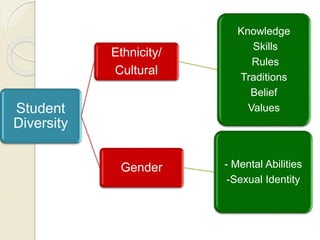
Student
Diversity
Ethnicity/
Cultural
Knowledge
Skills
Rules
Traditions
Belief
Values
Gender - Mental Abilities
-Sexual Identity
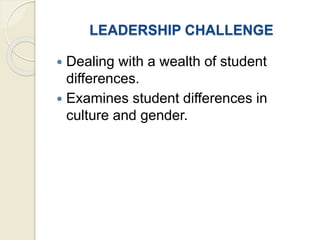
LEADERSHIP CHALLENGE
 Dealing with a wealth of student
differences.
 Examines student differences in
culture and gender.
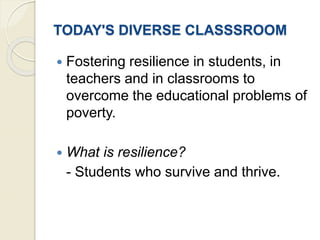
TODAY'S DIVERSE CLASSSROOM
 Fostering resilience in students, in
teachers and in classrooms to
overcome the educational problems of
poverty.
 What is resilience?
- Students who survive and thrive.
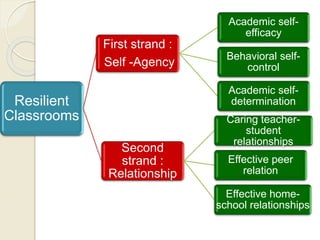
Resilient
Classrooms
First strand :
Self -Agency
Academic self-
efficacy
Behavioral self-
control
Academic self-
determination
Second
strand :
Relationship
Caring teacher-
student
relationships
Effective peer
relation
Effective home-
school relationships
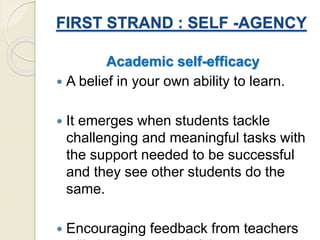
FIRST STRAND : SELF -AGENCY
Academic self-efficacy
 A belief in your own ability to learn.
 It emerges when students tackle
challenging and meaningful tasks with
the support needed to be successful
and they see other students do the
same.
 Encouraging feedback from teachers
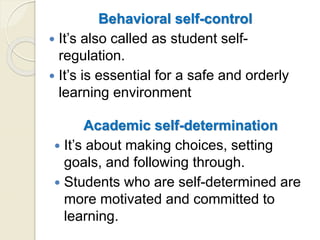
Academic self-determination
 It’s about making choices, setting
goals, and following through.
 Students who are self-determined are
more motivated and committed to
learning.
Behavioral self-control
 It’s also called as student self-
regulation.
 It’s is essential for a safe and orderly
learning environment
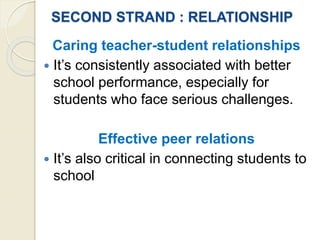
SECOND STRAND : RELATIONSHIP
Caring teacher-student relationships
 It’s consistently associated with better
school performance, especially for
students who face serious challenges.
Effective peer relations
 It’s also critical in connecting students to
school
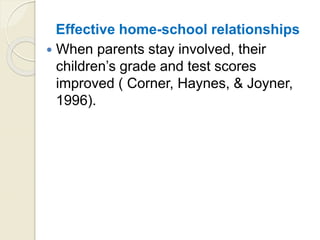
Effective home-school relationships
 When parents stay involved, their
children’s grade and test scores
improved ( Corner, Haynes, & Joyner,
1996).
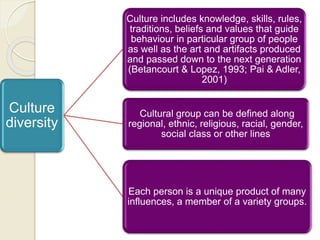
Culture
diversity
Culture includes knowledge, skills, rules,
traditions, beliefs and values that guide
behaviour in particular group of people
as well as the art and artifacts produced
and passed down to the next generation
(Betancourt & Lopez, 1993; Pai & Adler,
2001)
Cultural group can be defined along
regional, ethnic, religious, racial, gender,
social class or other lines
Each person is a unique product of many
influences, a member of a variety groups.
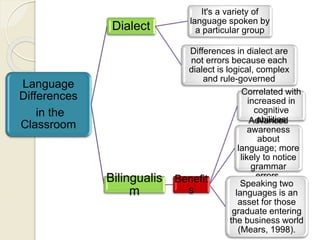
Language
Differences
in the
Classroom
Dialect
It's a variety of
language spoken by
a particular group
Differences in dialect are
not errors because each
dialect is logical, complex
and rule-governed
Bilingualis
m
Benefit
s
Correlated with
increased in
cognitive
abilitiesAdvanced
awareness
about
language; more
likely to notice
grammar
errors.
Speaking two
languages is an
asset for those
graduate entering
the business world
(Mears, 1998).
CREATING CULTURALLY
INCLUSIVE CLASSROOM
 Goal
-"to eliminate racism, classism and
prejudice while adapting the content
and methods and instructions in order
to meet students need".
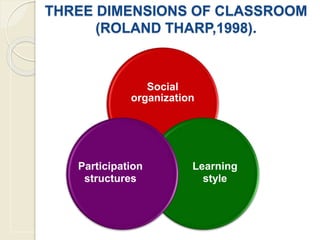
THREE DIMENSIONS OF CLASSROOM
(ROLAND THARP,1998).
Social
organization
Learning
style
Participation
structures
THREE DIMENSIONS OF CLASSROOM
(ROLAND THARP,1998).
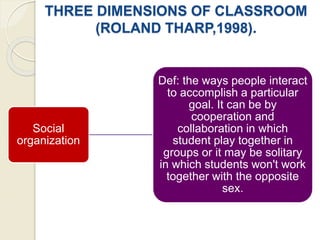
Social
organization
Def: the ways people interact
to accomplish a particular
goal. It can be by
cooperation and
collaboration in which
student play together in
groups or it may be solitary
in which students won't work
together with the opposite
sex.
THREE DIMENSIONS OF CLASSROOM
(ROLAND THARP,1998).
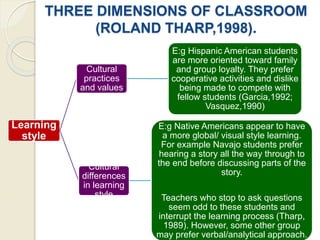
Learning
style
Cultural
practices
and values
E:g Hispanic American students
are more oriented toward family
and group loyalty. They prefer
cooperative activities and dislike
being made to compete with
fellow students (Garcia,1992;
Vasquez,1990)
Cultural
differences
in learning
style
E:g Native Americans appear to have
a more global/ visual style learning.
For example Navajo students prefer
hearing a story all the way through to
the end before discussing parts of the
story.
Teachers who stop to ask questions
seem odd to these students and
interrupt the learning process (Tharp,
1989). However, some other group
may prefer verbal/analytical approach.
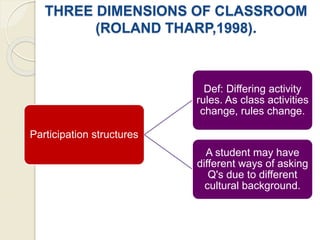
THREE DIMENSIONS OF CLASSROOM
(ROLAND THARP,1998).
Participation structures
Def: Differing activity
rules. As class activities
change, rules change.
A student may have
different ways of asking
Q's due to different
cultural background.
Should teachers focus on
Students' learning style?
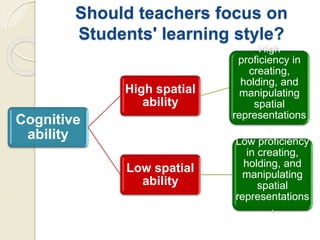
Should teachers focus on
Students' learning style?
Cognitive
ability
High spatial
ability
High
proficiency in
creating,
holding, and
manipulating
spatial
representations
.
Low spatial
ability
Low proficiency
in creating,
holding, and
manipulating
spatial
representations
.
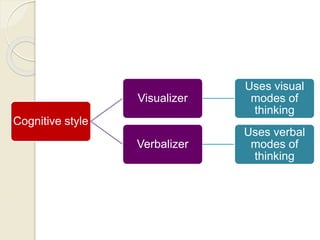
Cognitive style
Visualizer
Uses visual
modes of
thinking
Verbalizer
Uses verbal
modes of
thinking
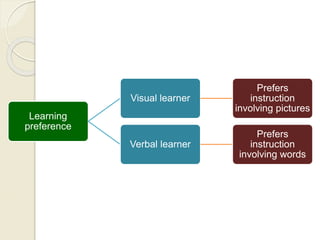
Learning
preference
Visual learner
Prefers
instruction
involving pictures
Verbal learner
Prefers
instruction
involving words
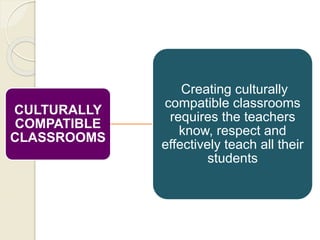
CULTURALLY
COMPATIBLE
CLASSROOMS
Creating culturally
compatible classrooms
requires the teachers
know, respect and
effectively teach all their
students
CULTURALLY
RELEVANT
PEDAGOGY
Student
Experience
academic success
Develop/maintain
their cultural
competence
Develop a critical
consciousness to challenge
the status quo.
Teacher
must believe in children's
inherent intellectual ability,
humanity, spiritual character
must fight foolishness
test scores or scripted
lesson make for good
learning
must learn who their
children are and the
legacies they bring.
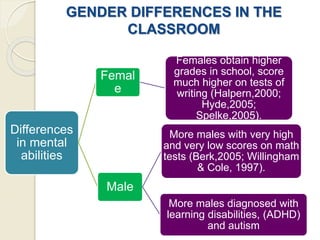
GENDER DIFFERENCES IN THE
CLASSROOM
Differences
in mental
abilities
Femal
e
Females obtain higher
grades in school, score
much higher on tests of
writing (Halpern,2000;
Hyde,2005;
Spelke,2005).
Male
More males with very high
and very low scores on math
tests (Berk,2005; Willingham
& Cole, 1997).
More males diagnosed with
learning disabilities, (ADHD)
and autism
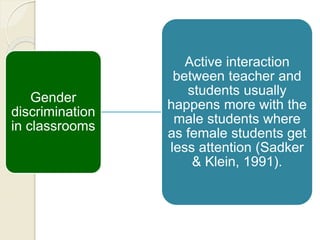
Gender
discrimination
in classrooms
Active interaction
between teacher and
students usually
happens more with the
male students where
as female students get
less attention (Sadker
& Klein, 1991).
Eliminating
Gender Bias
It makes sense to
balance both cooperative
and competitive
approaches so that the
students who learn better
each way have equal
opportunities.
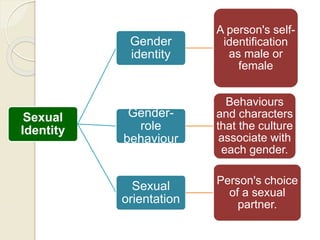
Sexual
Identity
Gender
identity
A person's self-
identification
as male or
female
Gender-
role
behaviour
Behaviours
and characters
that the culture
associate with
each gender.
Sexual
orientation
Person's choice
of a sexual
partner.
KEY POINTS
1. A key to overcome the educational problems
of poverty is by fostering resilience in
students, in teachers, and in classrooms.
2. Academic self-efficacy is a belief in your own
ability to learn, and it is one of the consistent
predictors of academic achievement.
3. A dialect is a variety of language spoken by a
particular groups; it’s important that teachers
remember that differences in dialect are not
errors.
4. Bilingualism is an asset, not a liability,
provided that there is balance-equal
fluency in both languages.
5. Learning styles are preferred ways of
learning and processing information;
teachers need to be aware of cultural
differences in learning style so that
teaching approaches are consistent with
the learning style.
6. Creating culturally compatible classrooms
requires that teachers know, respect, and
effectively teach their students.
7. There appear to be some gender
differences in spatial and mathematical
abilities, but these do not hold in all
cultures and situation.
8. Teachers are in positions to reinforce or
challenge gender stereotypes through
their choice of materials and interactions
with students.
THANK YOU

Instructional leadership (chapter 2 student diversity)

  • 1.
    EDM 703 INSTRUCTIONAL LEADERSHIP Prepared by NORZAKIAH BT ISMAIL 2013741249 STUDENT DIVERSITY
  • 2.
    WHAT IS STUDENT DIVERSITY? Studentsdifferences in -Gender -Ethnicity -Students ability
  • 3.
  • 4.
    LEADERSHIP CHALLENGE  Dealingwith a wealth of student differences.  Examines student differences in culture and gender.
  • 5.
    TODAY'S DIVERSE CLASSSROOM Fostering resilience in students, in teachers and in classrooms to overcome the educational problems of poverty.  What is resilience? - Students who survive and thrive.
  • 6.
    Resilient Classrooms First strand : Self-Agency Academic self- efficacy Behavioral self- control Academic self- determination Second strand : Relationship Caring teacher- student relationships Effective peer relation Effective home- school relationships
  • 7.
    FIRST STRAND :SELF -AGENCY Academic self-efficacy  A belief in your own ability to learn.  It emerges when students tackle challenging and meaningful tasks with the support needed to be successful and they see other students do the same.  Encouraging feedback from teachers
  • 8.
    Academic self-determination  It’sabout making choices, setting goals, and following through.  Students who are self-determined are more motivated and committed to learning. Behavioral self-control  It’s also called as student self- regulation.  It’s is essential for a safe and orderly learning environment
  • 9.
    SECOND STRAND :RELATIONSHIP Caring teacher-student relationships  It’s consistently associated with better school performance, especially for students who face serious challenges. Effective peer relations  It’s also critical in connecting students to school
  • 10.
    Effective home-school relationships When parents stay involved, their children’s grade and test scores improved ( Corner, Haynes, & Joyner, 1996).
  • 11.
    Culture diversity Culture includes knowledge,skills, rules, traditions, beliefs and values that guide behaviour in particular group of people as well as the art and artifacts produced and passed down to the next generation (Betancourt & Lopez, 1993; Pai & Adler, 2001) Cultural group can be defined along regional, ethnic, religious, racial, gender, social class or other lines Each person is a unique product of many influences, a member of a variety groups.
  • 12.
    Language Differences in the Classroom Dialect It's avariety of language spoken by a particular group Differences in dialect are not errors because each dialect is logical, complex and rule-governed Bilingualis m Benefit s Correlated with increased in cognitive abilitiesAdvanced awareness about language; more likely to notice grammar errors. Speaking two languages is an asset for those graduate entering the business world (Mears, 1998).
  • 13.
    CREATING CULTURALLY INCLUSIVE CLASSROOM Goal -"to eliminate racism, classism and prejudice while adapting the content and methods and instructions in order to meet students need".
  • 14.
    THREE DIMENSIONS OFCLASSROOM (ROLAND THARP,1998). Social organization Learning style Participation structures
  • 15.
    THREE DIMENSIONS OFCLASSROOM (ROLAND THARP,1998). Social organization Def: the ways people interact to accomplish a particular goal. It can be by cooperation and collaboration in which student play together in groups or it may be solitary in which students won't work together with the opposite sex.
  • 16.
    THREE DIMENSIONS OFCLASSROOM (ROLAND THARP,1998). Learning style Cultural practices and values E:g Hispanic American students are more oriented toward family and group loyalty. They prefer cooperative activities and dislike being made to compete with fellow students (Garcia,1992; Vasquez,1990) Cultural differences in learning style E:g Native Americans appear to have a more global/ visual style learning. For example Navajo students prefer hearing a story all the way through to the end before discussing parts of the story. Teachers who stop to ask questions seem odd to these students and interrupt the learning process (Tharp, 1989). However, some other group may prefer verbal/analytical approach.
  • 17.
    THREE DIMENSIONS OFCLASSROOM (ROLAND THARP,1998). Participation structures Def: Differing activity rules. As class activities change, rules change. A student may have different ways of asking Q's due to different cultural background.
  • 18.
    Should teachers focuson Students' learning style?
  • 19.
    Should teachers focuson Students' learning style? Cognitive ability High spatial ability High proficiency in creating, holding, and manipulating spatial representations . Low spatial ability Low proficiency in creating, holding, and manipulating spatial representations .
  • 20.
    Cognitive style Visualizer Uses visual modesof thinking Verbalizer Uses verbal modes of thinking
  • 21.
  • 22.
    CULTURALLY COMPATIBLE CLASSROOMS Creating culturally compatible classrooms requiresthe teachers know, respect and effectively teach all their students
  • 23.
    CULTURALLY RELEVANT PEDAGOGY Student Experience academic success Develop/maintain their cultural competence Developa critical consciousness to challenge the status quo. Teacher must believe in children's inherent intellectual ability, humanity, spiritual character must fight foolishness test scores or scripted lesson make for good learning must learn who their children are and the legacies they bring.
  • 24.
    GENDER DIFFERENCES INTHE CLASSROOM Differences in mental abilities Femal e Females obtain higher grades in school, score much higher on tests of writing (Halpern,2000; Hyde,2005; Spelke,2005). Male More males with very high and very low scores on math tests (Berk,2005; Willingham & Cole, 1997). More males diagnosed with learning disabilities, (ADHD) and autism
  • 25.
    Gender discrimination in classrooms Active interaction betweenteacher and students usually happens more with the male students where as female students get less attention (Sadker & Klein, 1991).
  • 26.
    Eliminating Gender Bias It makessense to balance both cooperative and competitive approaches so that the students who learn better each way have equal opportunities.
  • 27.
    Sexual Identity Gender identity A person's self- identification asmale or female Gender- role behaviour Behaviours and characters that the culture associate with each gender. Sexual orientation Person's choice of a sexual partner.
  • 28.
    KEY POINTS 1. Akey to overcome the educational problems of poverty is by fostering resilience in students, in teachers, and in classrooms. 2. Academic self-efficacy is a belief in your own ability to learn, and it is one of the consistent predictors of academic achievement. 3. A dialect is a variety of language spoken by a particular groups; it’s important that teachers remember that differences in dialect are not errors.
  • 29.
    4. Bilingualism isan asset, not a liability, provided that there is balance-equal fluency in both languages. 5. Learning styles are preferred ways of learning and processing information; teachers need to be aware of cultural differences in learning style so that teaching approaches are consistent with the learning style. 6. Creating culturally compatible classrooms requires that teachers know, respect, and effectively teach their students.
  • 30.
    7. There appearto be some gender differences in spatial and mathematical abilities, but these do not hold in all cultures and situation. 8. Teachers are in positions to reinforce or challenge gender stereotypes through their choice of materials and interactions with students.
  • 31.