THE ROLE OF
PRINCIPAL IN
SCHOOL
ADMINISTRATION
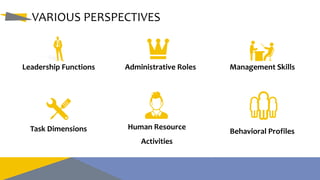
VARIOUS PERSPECTIVES
Behavioral Profiles
Leadership Functions Administrative Roles Management Skills
Task Dimensions Human Resource
Activities
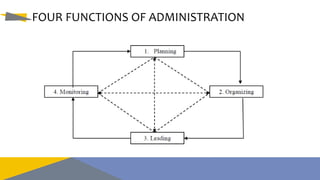
FOUR FUNCTIONS OF ADMINISTRATION
PLANNING
 Plans and the goals on which they are based give purpose and direction to the
school, its subunits, and contributing staff.
Example: increase the number of students reading at grade level by 20
percent by the year 2018
 School counselors, social workers, school psychologists, library media specialists,
department heads, and teachers would set and synchronize individual objectives
with those of the building principal
 Planning is important because it provides staff with a sense of purpose and
direction, outlines the kinds of tasks they will be performing, and explains how
their activities are related to the overall goals of the school
 becomes the basis for monitoring and evaluating actual performance
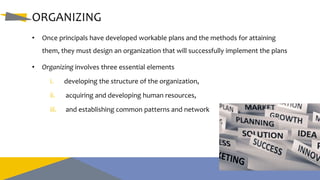
ORGANIZING
• Once principals have developed workable plans and the methods for attaining
them, they must design an organization that will successfully implement the plans
• Organizing involves three essential elements
i. developing the structure of the organization,
ii. acquiring and developing human resources,
iii. and establishing common patterns and network
LEADING
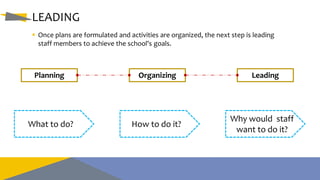
 Once plans are formulated and activities are organized, the next step is leading
staff members to achieve the school's goals.
Planning Organizing Leading
What to do? How to do it?
Why would staff
want to do it?
 leading function is also called facilitating, collaborating, or actuating
 No matter what it is called, leading entails guiding and influencing people
 Principals cannot do all of the work in schools alone. They must, therefore,
influence the behavior of other people in a certain direction
 To influence others, the principal needs to understand something about leadership,
motivation, communication, and group dynamics.
MONITORING
 When principals compare expected results with actual results, and take the necessary
corrective action, they are performing the monitoring function
 Monitoring is the responsibility of every principal. It may simply consist of walking
around the building to see how things are going, talking to students, visiting classrooms,
talking to faculty, or it may involve designing sophisticated information systems to check
on the quality of performance, but it must be done if the principal is to be successful
 The success with which principals carry out these functions determines how effectively
the school operates
ADMINISTRATIVE
ROLES
PRINCIPAL ACTIVITIES
 What do principals actually do to plan, organize, lead, and monitor on an hour-to-
hour, day-to-day basis?
 Heavy Workload at a Fast Pace.
 Variety, Fragmentation, and Brevity.
 Oral Communication.
MANAGEMENT
SKILLS
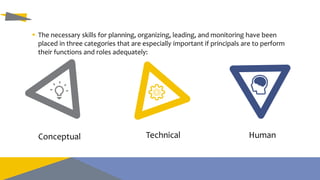
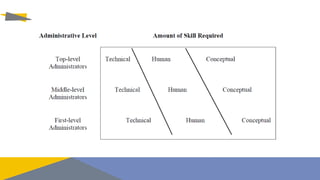
 The necessary skills for planning, organizing, leading, and monitoring have been
placed in three categories that are especially important if principals are to perform
their functions and roles adequately:
Conceptual HumanTechnical
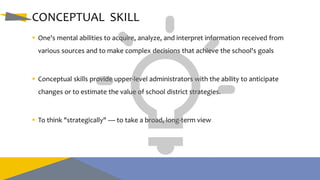
CONCEPTUAL SKILL
 One's mental abilities to acquire, analyze, and interpret information received from
various sources and to make complex decisions that achieve the school's goals
 Conceptual skills provide upper-level administrators with the ability to anticipate
changes or to estimate the value of school district strategies.
 To think "strategically" — to take a broad, long-term view
HUMAN SKILLS
 Principals spend considerable time interacting with people in scheduled and
unscheduled meetings, telephone calls, hallway/classroom tours, and other face-to-
face contacts
 human skills: the ability to motivate, facilitate, coordinate, lead, communicate,
manage conflict, and get along with others
 effective principals are cheerleaders, facilitators, coaches, and nurturers of
champions
 Effective human skills enable principals to unleash the energy within staff members
and help them grow, ultimately resulting in maximum performance and goal
attainment.
TECHNICAL SKILLS
 The ability to use the knowledge, methods, and techniques of a specific discipline
or field is referred to as a technical skill
 Department heads and team leaders in schools are examples of people with
technical skills — they are recognized as experts in their disciplines and are
presumed to have the ability to supervise others
 A successful principal must:
(a) understand the work that is to be performed (leadership functions)
(b) understand the behavior needed to perform the job (administrative roles)
(c) master the skills involved in performing their role (management skills).
TASK
DIMENSIONS
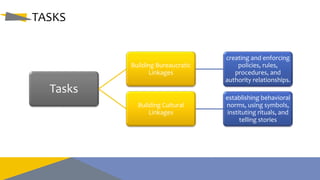
TASKS
Tasks
Building Bureaucratic
Linkages
creating and enforcing
policies, rules,
procedures, and
authority relationships.
Building Cultural
Linkages
establishing behavioral
norms, using symbols,
instituting rituals, and
telling stories
HUMAN
RESOURCE
ACTIVITIES
 A study of twenty effective administrators and twenty-one ineffective ones
emphasizes the importance of being able to work effectively with others. The
shortcomings of the ineffective administrators that were found are as follows
 1. Insensitive to others; abrasive, intimidating, bullying style
 2. Cold, aloof, arrogant
 3. Betrayal of trust (failure to accomplish stated intentions)
 4. Overly ambitious; thinking of the next job, playing politics
 5. Over-managing: unable to delegate or build a team
 6. Unable to staff effectively
 7. Unable to plan and organize work
 8. Unable to adapt to a superior with a different style
 9. Unable to adjust to new and changing conditions
 10. Overdependence on an advocate or mentor
CONCLUSION
 Every principal’s goal is to ensure high performance of students and faculty in
achieving the school’s mission. High performance requires the effective use of
organizational resources through the leadership functions of planning, organizing,
leading, and monitoring.
 In order to perform these functions and roles, principals need three skills –
conceptual, human, and technical.
 Effective principals engage in two categories of tasks dimensions
 managerial tasks – creating and enforcing policies, rules, and procedures, and
authority relationships
 building cultural linkages – establishing behavioral norms, using symbols,
instituting rituals, and telling stories designed to build the cultural foundations of
school excellence .
THANK YOU