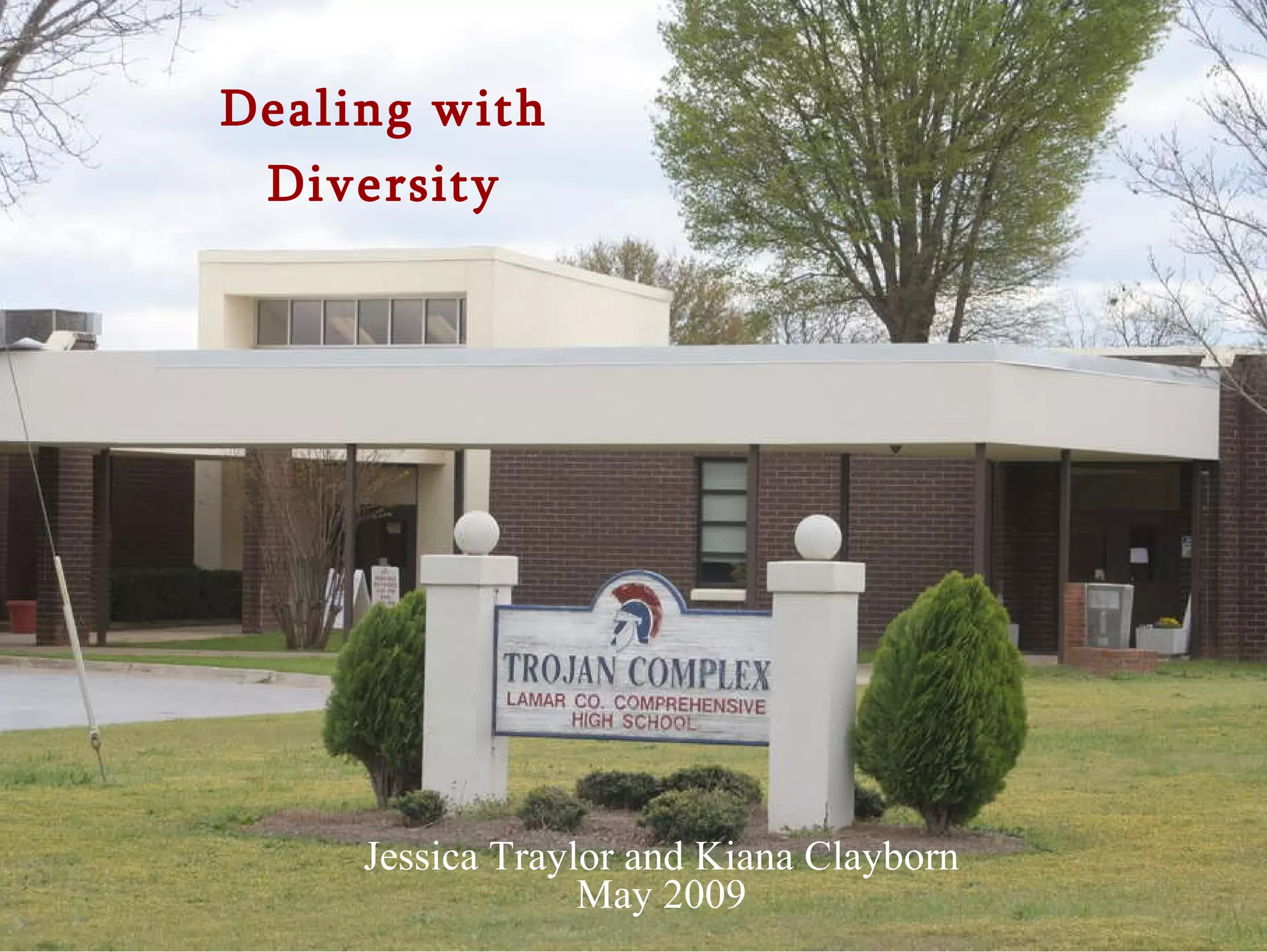
Dealing with Diversity Jessica Traylor and Kiana Clayborn May 2009
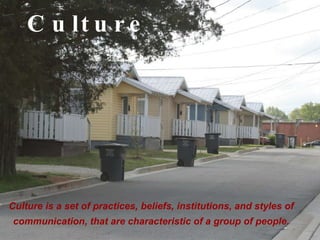
Culture Culture is a set of practices, beliefs, institutions, and styles of communication, that are characteristic of a group of people.
Our Cultural and Educational Experiences Find a partner you do not know well. Describe the cultural situation you grew up in. What were your educational experiences as a youth? Did your family culture ever clash with school culture? Describe your cultural situation today. How do these aspects of your life influence your work? Think about the students at school. What do you know about their culture? What do you need to know to create a meaningful learning environment for them? If you were a student at your school, what type of staff interactions and program experiences would you need to be successful? Share an interesting fact about yourself or your partner.
Think-Pair-Share What is culture? What are some cultures  in Lamar County?
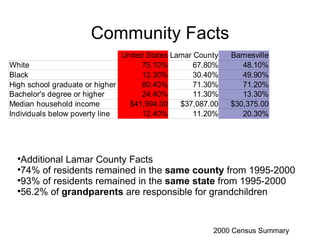
Community Facts Additional Lamar County Facts 74% of residents remained in the  same county  from 1995-2000 93% of residents remained in the  same state  from 1995-2000 56.2% of  grandparents  are responsible for grandchildren 2000 Census Summary
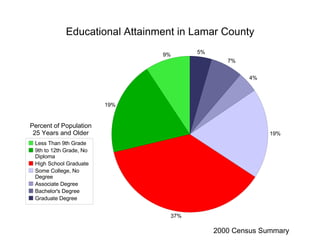
Educational Attainment in Lamar County 2000 Census Summary Percent of Population 25 Years and Older
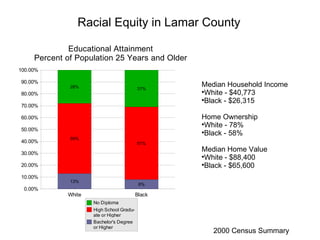
Racial Equity in Lamar County 2000 Census Summary Median Household Income White - $40,773 Black - $26,315 Home Ownership White - 78% Black - 58% Median Home Value White - $88,400 Black - $65,600
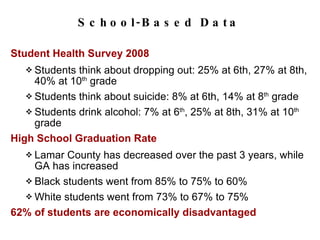
School-Based Data Student Health Survey 2008 Students think about dropping out: 25% at 6th, 27% at 8th, 40% at 10 th  grade Students think about suicide: 8% at 6th, 14% at 8 th  grade Students drink alcohol: 7% at 6 th , 25% at 8th, 31% at 10 th  grade High School Graduation Rate Lamar County has decreased over the past 3 years, while GA has increased Black students went from 85% to 75% to 60% White students went from 73% to 67% to 75% 62% of students are economically disadvantaged
Data Analysis Discuss the community and school data with the people at your table. Organize your thoughts into categories. ex. strengths, weaknesses, interesting facts, protective factors, risk factors, etc. Record your thoughts on the chart paper. Report your findings to the group.
What is an “at-risk youth”? Think-Pair-Share
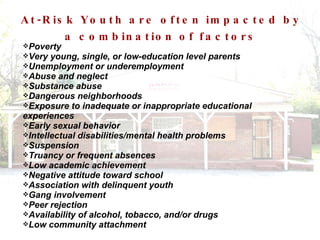
At-Risk Youth are often impacted by a combination of factors Poverty Very young, single, or low-education level parents Unemployment or underemployment Abuse and neglect Substance abuse Dangerous neighborhoods Exposure to inadequate or inappropriate educational experiences Early sexual behavior Intellectual disabilities/mental health problems Suspension Truancy or frequent absences Low academic achievement Negative attitude toward school Association with delinquent youth Gang involvement Peer rejection Availability of alcohol, tobacco, and/or drugs Low community attachment
Take a 5 minute break. F:\Culturally Relevant Pedagogy\Music\09 Track 09 2.m4a
You might be a culturally relevant teacher if... … you have tried to defend your Wii as a business expense … you have a MySpace page … you borrow students’ iPods to hear the newest songs…and try to incorporate them into your lessons … you have been relied on to do all the tech stuff on your hall … you would rather text than call … you have to interpret text messages for your co-workers … your lesson plans include music, video, and technology … you watch MTV or BET and call it research … your lesson planning includes new music, video games, sporting events, movies, and fast food restaurants … you find yourself regularly explaining youth to adults and adults to youth … you repeat the line over and over… “I can’t believe I get paid to do this!”
Culturally Relevant Pedagogy Why?   Culturally relevant practices shape thinking processes of groups and individuals. How?   Maintain positive perspectives on parents & families Communicate high expectations Learning within the context of culture Student-centered instruction Culturally mediated instruction Reshape the curriculum Teacher as facilitator
Culturally Relevant Pedagogy What?   1.) Three characteristics: academic success, cultural competence, and critical consciousness (Ladson-Billings) ‏ 2.) A critical pedagogy that recognizes the importance of including students' cultural references in all aspects of learning (Ladson-Billings) ‏ 3.) Link between culture and classroom practices (Hollins) ‏ 4.) Recognizes, respects, and uses students' identities and backgrounds as meaningful sources for creating optimal learning environments (Nieto) ‏
Culturally Responsive  Teaching Teaching style consistent with learning styles Music as a teaching tool, multimedia and technology integration, visual learning, role-playing, cooperative learning Issues and topics related to students' background and culture Respect for culture, allow topic choice, be knowledgeable about their life outside of school Meaningful connection between school and real-life situations Service learning, project-based learning, school-community collaboration
Reshaping Media If we embrace it, we can direct its influence.
Youth and Media Don't Believe the Hype: How much do you know about media consumption? The People
The average American adolescent: Spends 3-4 hours a day listening to music and watching music videos Listens to three hours of music per day Surfs the internet and communicates via e-mail three hours per day Plays video games three hours per day A
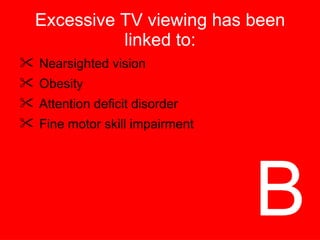
Excessive TV viewing has been linked to: Nearsighted vision Obesity Attention deficit disorder Fine motor skill impairment B
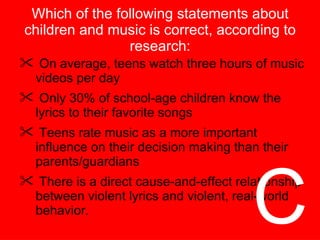
Which of the following statements about children and music is correct, according to research: On average, teens watch three hours of music videos per day Only 30% of school-age children know the lyrics to their favorite songs Teens rate music as a more important influence on their decision making than their parents/guardians There is a direct cause-and-effect relationship between violent lyrics and violent, real-world behavior. C
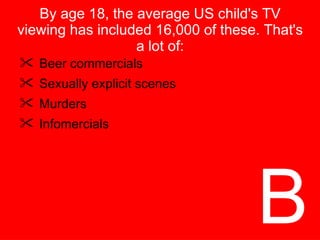
By age 18, the average US child's TV viewing has included 16,000 of these. That's a lot of: Beer commercials Sexually explicit scenes Murders Infomercials B
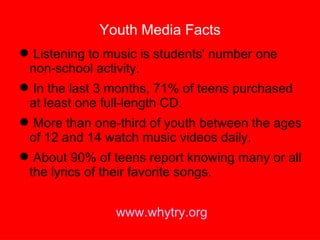
Youth Media Facts Listening to music is students' number one non-school activity. In the last 3 months, 71% of teens purchased at least one full-length CD. More than one-third of youth between the ages of 12 and 14 watch music videos daily. About 90% of teens report knowing many or all the lyrics of their favorite songs. www.whytry.org
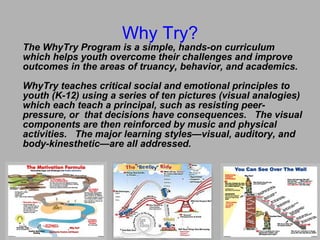
Why Try? The WhyTry Program is a simple, hands-on curriculum which helps youth overcome their challenges and improve outcomes in the areas of truancy, behavior, and academics.   WhyTry teaches critical social and emotional principles to youth (K-12) using a series of ten pictures (visual analogies) which each teach a principal, such as resisting peer-pressure, or  that decisions have consequences.   The visual components are then reinforced by music and physical activities.   The major learning styles—visual, auditory, and body-kinesthetic—are all addressed.
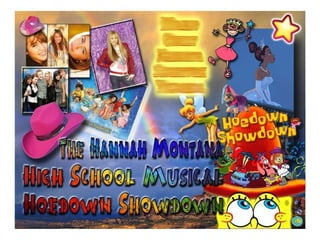
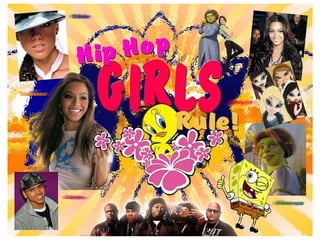
Group Counseling Example The following slides are posters created for athematic small-group counseling. The groups were done at the Primary School this school year. Thanks to Daniel Sergent for sharing his creativity and passion for use in this presentation. F:\Culturally Relevant Pedagogy\Music\02 Track 02 1.m4a


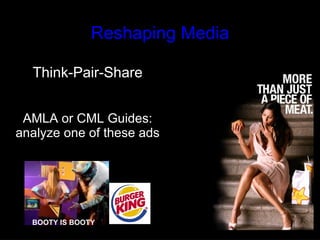
Reshaping Media Think-Pair-Share AMLA or CML Guides: analyze one of these ads BOOTY IS BOOTY
Reshaping Media Think-Pair-Share What can you do to reshape media and use it as a teaching tool? Status Quo
Reshaping Media Several “programs” are available to assist us in using the media to teach valuable life and academic lessons. Rhyme & Reason Flocabulary Hip-Hop Curriculum
Cultural Competence What can we do? Talk to students about different cultures. Have a “cultural day” at school. Show respect for their culture. Use their language and style of communicating to build bridges between their culture and the dominant culture.
References GA Department of Education. (2009).  Georgia's Education Scoreboard: Lamar County High School.  Retrieved from  http://www.doe.k12.ga.us   Ladson-Billings, G. (1995). But That’s Just Good Teaching! The Case for Culturally Relevant Pedagogy.  Theory Into Practice, 34 (1), 159-165. McNulty, R. J. and Quaglia, R. J. (2007). Rigor, Relevance, and Relationships.  The School Administrator.  Retrieved from  http://www.aasa.org   McPhail, I. P. and Coleman, L. G. (2007).  Culturally Mediated Instruction: A Critical Tool in Achieving the Dream  [PowerPoint]. Retrieved from  http://www.achievingthedream.org   Norton, N. E. L. (2008). Aligning Hip-Hop, Curriculum, Standards, and Potential.  Journal of Literacy and Technology 9 (1), 62-100. Saifer, S., Edwards, K., Ellis, D., Ko, L., and Stuczynski, A. (2005).  Classroom to Community and Back.  Portland, OR: Northwest Regional Educational Laboratory.  The Governor's Office of Student Achievement. (2009).  2007 GSHS School Results: Lamar County . Retrieved from  http://www.gaosa.org   Tumbleson, H. (2001, August 21). Maybe we're the ones who put youth 'at risk.'  The Seattle Times.  Retrieved from  http://seattletimes.nwsource.com U. S. Census Bureau. (2000).  State and county Quickfacts: Lamar County, GA.  Retrieved from  http://factfinder.census.gov
Helpful Websites www.whytry.org www.urbanyouth.org www.tolerance.org http://usa.usembassy.de/classroom/hiphop.htm www.studycircles.org www.aecf.org http://www.artsanctuary.org/site/artsanctuary/content.php?type=1&id=13548 http://factfinder.census.gov/
Thanks! Comments? Questions?

Culturally Relevant Teaching

  • 1.
    Dealing with DiversityJessica Traylor and Kiana Clayborn May 2009
  • 2.
    Culture Culture isa set of practices, beliefs, institutions, and styles of communication, that are characteristic of a group of people.
  • 3.
    Our Cultural andEducational Experiences Find a partner you do not know well. Describe the cultural situation you grew up in. What were your educational experiences as a youth? Did your family culture ever clash with school culture? Describe your cultural situation today. How do these aspects of your life influence your work? Think about the students at school. What do you know about their culture? What do you need to know to create a meaningful learning environment for them? If you were a student at your school, what type of staff interactions and program experiences would you need to be successful? Share an interesting fact about yourself or your partner.
  • 4.
    Think-Pair-Share What isculture? What are some cultures in Lamar County?
  • 5.
    Community Facts AdditionalLamar County Facts 74% of residents remained in the same county from 1995-2000 93% of residents remained in the same state from 1995-2000 56.2% of grandparents are responsible for grandchildren 2000 Census Summary
  • 6.
    Educational Attainment inLamar County 2000 Census Summary Percent of Population 25 Years and Older
  • 7.
    Racial Equity inLamar County 2000 Census Summary Median Household Income White - $40,773 Black - $26,315 Home Ownership White - 78% Black - 58% Median Home Value White - $88,400 Black - $65,600
  • 8.
    School-Based Data StudentHealth Survey 2008 Students think about dropping out: 25% at 6th, 27% at 8th, 40% at 10 th grade Students think about suicide: 8% at 6th, 14% at 8 th grade Students drink alcohol: 7% at 6 th , 25% at 8th, 31% at 10 th grade High School Graduation Rate Lamar County has decreased over the past 3 years, while GA has increased Black students went from 85% to 75% to 60% White students went from 73% to 67% to 75% 62% of students are economically disadvantaged
  • 9.
    Data Analysis Discussthe community and school data with the people at your table. Organize your thoughts into categories. ex. strengths, weaknesses, interesting facts, protective factors, risk factors, etc. Record your thoughts on the chart paper. Report your findings to the group.
  • 10.
    What is an“at-risk youth”? Think-Pair-Share
  • 11.
    At-Risk Youth areoften impacted by a combination of factors Poverty Very young, single, or low-education level parents Unemployment or underemployment Abuse and neglect Substance abuse Dangerous neighborhoods Exposure to inadequate or inappropriate educational experiences Early sexual behavior Intellectual disabilities/mental health problems Suspension Truancy or frequent absences Low academic achievement Negative attitude toward school Association with delinquent youth Gang involvement Peer rejection Availability of alcohol, tobacco, and/or drugs Low community attachment
  • 12.
    Take a 5minute break. F:\Culturally Relevant Pedagogy\Music\09 Track 09 2.m4a
  • 13.
    You might bea culturally relevant teacher if... … you have tried to defend your Wii as a business expense … you have a MySpace page … you borrow students’ iPods to hear the newest songs…and try to incorporate them into your lessons … you have been relied on to do all the tech stuff on your hall … you would rather text than call … you have to interpret text messages for your co-workers … your lesson plans include music, video, and technology … you watch MTV or BET and call it research … your lesson planning includes new music, video games, sporting events, movies, and fast food restaurants … you find yourself regularly explaining youth to adults and adults to youth … you repeat the line over and over… “I can’t believe I get paid to do this!”
  • 14.
    Culturally Relevant PedagogyWhy? Culturally relevant practices shape thinking processes of groups and individuals. How? Maintain positive perspectives on parents & families Communicate high expectations Learning within the context of culture Student-centered instruction Culturally mediated instruction Reshape the curriculum Teacher as facilitator
  • 15.
    Culturally Relevant PedagogyWhat? 1.) Three characteristics: academic success, cultural competence, and critical consciousness (Ladson-Billings) ‏ 2.) A critical pedagogy that recognizes the importance of including students' cultural references in all aspects of learning (Ladson-Billings) ‏ 3.) Link between culture and classroom practices (Hollins) ‏ 4.) Recognizes, respects, and uses students' identities and backgrounds as meaningful sources for creating optimal learning environments (Nieto) ‏
  • 16.
    Culturally Responsive Teaching Teaching style consistent with learning styles Music as a teaching tool, multimedia and technology integration, visual learning, role-playing, cooperative learning Issues and topics related to students' background and culture Respect for culture, allow topic choice, be knowledgeable about their life outside of school Meaningful connection between school and real-life situations Service learning, project-based learning, school-community collaboration
  • 17.
    Reshaping Media Ifwe embrace it, we can direct its influence.
  • 18.
    Youth and MediaDon't Believe the Hype: How much do you know about media consumption? The People
  • 19.
    The average Americanadolescent: Spends 3-4 hours a day listening to music and watching music videos Listens to three hours of music per day Surfs the internet and communicates via e-mail three hours per day Plays video games three hours per day A
  • 20.
    Excessive TV viewinghas been linked to: Nearsighted vision Obesity Attention deficit disorder Fine motor skill impairment B
  • 21.
    Which of thefollowing statements about children and music is correct, according to research: On average, teens watch three hours of music videos per day Only 30% of school-age children know the lyrics to their favorite songs Teens rate music as a more important influence on their decision making than their parents/guardians There is a direct cause-and-effect relationship between violent lyrics and violent, real-world behavior. C
  • 22.
    By age 18,the average US child's TV viewing has included 16,000 of these. That's a lot of: Beer commercials Sexually explicit scenes Murders Infomercials B
  • 23.
    Youth Media FactsListening to music is students' number one non-school activity. In the last 3 months, 71% of teens purchased at least one full-length CD. More than one-third of youth between the ages of 12 and 14 watch music videos daily. About 90% of teens report knowing many or all the lyrics of their favorite songs. www.whytry.org
  • 24.
    Why Try? TheWhyTry Program is a simple, hands-on curriculum which helps youth overcome their challenges and improve outcomes in the areas of truancy, behavior, and academics.  WhyTry teaches critical social and emotional principles to youth (K-12) using a series of ten pictures (visual analogies) which each teach a principal, such as resisting peer-pressure, or  that decisions have consequences.   The visual components are then reinforced by music and physical activities.   The major learning styles—visual, auditory, and body-kinesthetic—are all addressed.
  • 25.
    Group Counseling ExampleThe following slides are posters created for athematic small-group counseling. The groups were done at the Primary School this school year. Thanks to Daniel Sergent for sharing his creativity and passion for use in this presentation. F:\Culturally Relevant Pedagogy\Music\02 Track 02 1.m4a
  • 26.
  • 27.
  • 28.
  • 29.
  • 30.
  • 31.
  • 32.
    Reshaping Media Think-Pair-ShareAMLA or CML Guides: analyze one of these ads BOOTY IS BOOTY
  • 33.
    Reshaping Media Think-Pair-ShareWhat can you do to reshape media and use it as a teaching tool? Status Quo
  • 34.
    Reshaping Media Several“programs” are available to assist us in using the media to teach valuable life and academic lessons. Rhyme & Reason Flocabulary Hip-Hop Curriculum
  • 35.
    Cultural Competence Whatcan we do? Talk to students about different cultures. Have a “cultural day” at school. Show respect for their culture. Use their language and style of communicating to build bridges between their culture and the dominant culture.
  • 36.
    References GA Departmentof Education. (2009). Georgia's Education Scoreboard: Lamar County High School. Retrieved from http://www.doe.k12.ga.us Ladson-Billings, G. (1995). But That’s Just Good Teaching! The Case for Culturally Relevant Pedagogy. Theory Into Practice, 34 (1), 159-165. McNulty, R. J. and Quaglia, R. J. (2007). Rigor, Relevance, and Relationships. The School Administrator. Retrieved from http://www.aasa.org McPhail, I. P. and Coleman, L. G. (2007). Culturally Mediated Instruction: A Critical Tool in Achieving the Dream [PowerPoint]. Retrieved from http://www.achievingthedream.org Norton, N. E. L. (2008). Aligning Hip-Hop, Curriculum, Standards, and Potential. Journal of Literacy and Technology 9 (1), 62-100. Saifer, S., Edwards, K., Ellis, D., Ko, L., and Stuczynski, A. (2005). Classroom to Community and Back. Portland, OR: Northwest Regional Educational Laboratory. The Governor's Office of Student Achievement. (2009). 2007 GSHS School Results: Lamar County . Retrieved from http://www.gaosa.org Tumbleson, H. (2001, August 21). Maybe we're the ones who put youth 'at risk.' The Seattle Times. Retrieved from http://seattletimes.nwsource.com U. S. Census Bureau. (2000). State and county Quickfacts: Lamar County, GA. Retrieved from http://factfinder.census.gov
  • 37.
    Helpful Websites www.whytry.orgwww.urbanyouth.org www.tolerance.org http://usa.usembassy.de/classroom/hiphop.htm www.studycircles.org www.aecf.org http://www.artsanctuary.org/site/artsanctuary/content.php?type=1&id=13548 http://factfinder.census.gov/
  • 38.