
Introduction to
AAC
Kate Ahern, M.S.Ed.
AAC Bootcamp
Easter Seals MA
August 2014
Underlying Principles
Everybody Communicates
AAC Definitions
AAC
Augmentative and Alternative
Communication
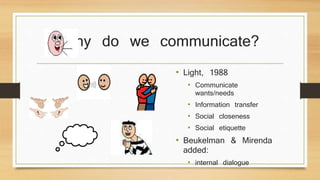
Why do we communicate?
• Light, 1988
• Communicate
wants/needs
• Information transfer
• Social closeness
• Social etiquette
• Beukelman & Mirenda
added:
• internal dialogue
Can your users communicate for
all five?
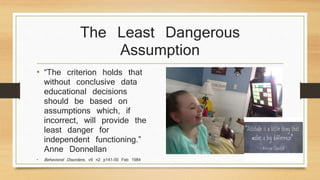
The Least Dangerous
Assumption
• “The criterion holds that
without conclusive data
educational decisions
should be based on
assumptions which, if
incorrect, will provide the
least danger for
independent functioning.”
Anne Donnellan
• Behavioral Disorders, v9 n2 p141-50 Feb 1984
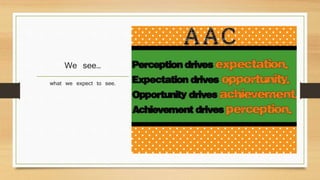
We see…
what we expect to see.
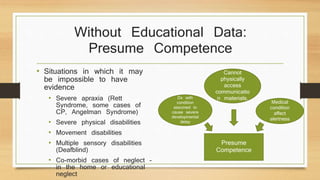
Without Educational Data:
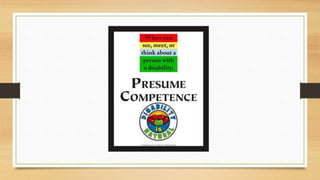
Presume Competence
• Situations in which it may
be impossible to have
evidence
• Severe apraxia (Rett
Syndrome, some cases of
CP, Angelman Syndrome)
• Severe physical disabilities
• Movement disabilities
• Multiple sensory disabilities
(Deafblind)
• Co-morbid cases of neglect –
in the home or educational
neglect
Cannot
physically
access
communicatio
n materials.
Presume
Competence
Dx with
condition
assumed to
cause severe
developmental
delay
Medical
condition
affect
alertness
Check Your Assumptions
• Historical Belief of Severe
Developmental Disability is
NOT Educational Data
• Research into many
disabilities is proving that
many individuals have been
underestimated leading to
improper interventions,
educational and residential
placements (Down Syndrome,
Fragile X Syndrome, Rett
Syndrome, Angelman
Syndrome, Deafblind)
• Learners with presumed
moderate to severe
disabilities are more likely to
suffer from educational
neglect
• Data from children who have
not been taught to
communicate only indicates a
lack of teaching/appropriate
intervention not a lack of
potential to communicate
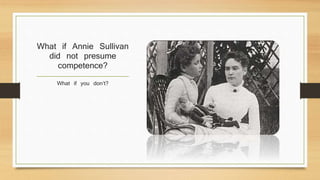
What if Annie Sullivan
did not presume
competence?
What if you don’t?
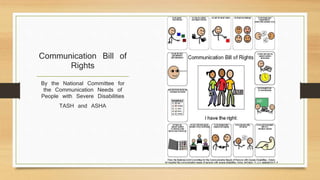
Communication Bill of
Rights
By the National Committee for
the Communication Needs of
People with Severe Disabilities
TASH and ASHA
Bill of Rights
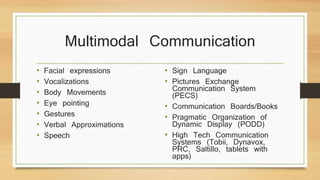
Multimodal Communication
• Facial expressions
• Vocalizations
• Body Movements
• Eye pointing
• Gestures
• Verbal Approximations
• Speech
• Sign Language
• Pictures Exchange
Communication System
(PECS)
• Communication Boards/Books
• Pragmatic Organization of
Dynamic Display (PODD)
• High Tech Communication
Systems (Tobii, Dynavox,
PRC, Saltillo, tablets with
apps)
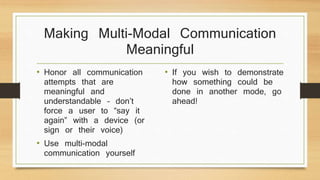
Making Multi-Modal Communication
Meaningful
• Honor all communication
attempts that are
meaningful and
understandable – don’t
force a user to “say it
again” with a device (or
sign or their voice)
• Use multi-modal
communication yourself
• If you wish to demonstrate
how something could be
done in another mode, go
ahead!
Types of AAC
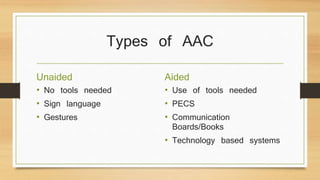
Types of AAC
Unaided
• No tools needed
• Sign language
• Gestures
Aided
• Use of tools needed
• PECS
• Communication
Boards/Books
• Technology based systems
Types of AAC
Low/Light Tech High Tech
A few words about
symbols:
1. Myth of symbol hierarchy is
pervasive (object, photo,
drawing, words)
2. Use of objects and photos
can lead to lack of
generalization and overuse of
nouns
3. Studies have shown that both
iconicity (transparency) and
the meaning assigned to a
symbol by adults and peers
affect learning symbols for
communication
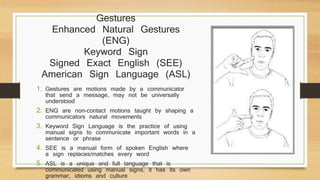
Gestures
Enhanced Natural Gestures
(ENG)
Keyword Sign
Signed Exact English (SEE)
American Sign Language (ASL)
1. Gestures are motions made by a communicator
that send a message, may not be universally
understood
2. ENG are non-contact motions taught by shaping a
communicators natural movements
3. Keyword Sign Language is the practice of using
manual signs to communicate important words in a
sentence or phrase
4. SEE is a manual form of spoken English where
a sign replaces/matches every word
5. ASL is a unique and full language that is
communicated using manual signs, it has its own
grammar, idioms and culture
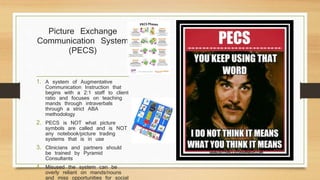
Picture Exchange
Communication System
(PECS)
1. A system of Augmentative
Communication Instruction that
begins with a 2:1 staff to client
ratio and focuses on teaching
mands through intraverbals
through a strict ABA
methodology
2. PECS is NOT what picture
symbols are called and is NOT
any notebook/picture trading
systems that is in use
3. Clinicians and partners should
be trained by Pyramid
Consultants
4. Misused the system can be
overly reliant on mands/nouns
and miss opportunities for social
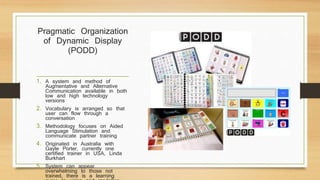
Pragmatic Organization
of Dynamic Display
(PODD)
1. A system and method of
Augmentative and Alternative
Communication available in both
low and high technology
versions
2. Vocabulary is arranged so that
user can flow through a
conversation
3. Methodology focuses on Aided
Language Stimulation and
communicate partner training
4. Originated in Australia with
Gayle Porter, currently one
certified trainer in USA, Linda
Burkhart
5. System can appear
overwhelming to those not
trained, there is a learning
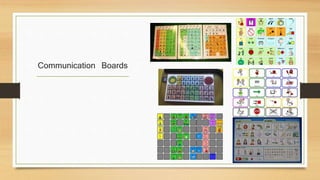
Communication Boards
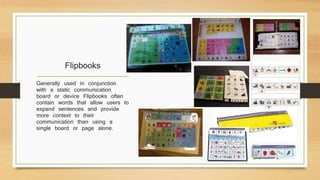
Flipbooks
Generally used in conjunction
with a static communication
board or device Flipbooks often
contain words that allow users to
expand sentences and provide
more context to their
communication than using a
single board or page alone.
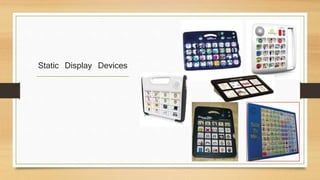
Static Display Devices
Dynamic Display
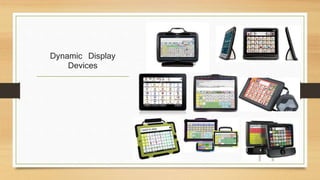
Devices
Other Tools in the AAC
Toolbox
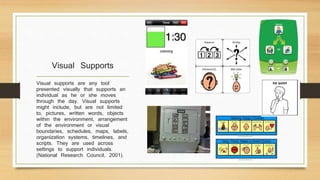
Visual Supports
Visual supports are any tool
presented visually that supports an
individual as he or she moves
through the day. Visual supports
might include, but are not limited
to, pictures, written words, objects
within the environment, arrangement
of the environment or visual
boundaries, schedules, maps, labels,
organization systems, timelines, and
scripts. They are used across
settings to support individuals.
(National Research Council, 2001).
Classroom
Natural Aided
Language
Communication
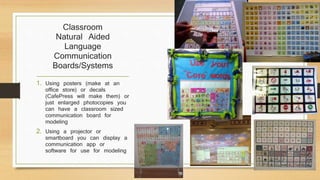
Boards/Systems
1. Using posters (make at an
office store) or decals
(CafePress will make them) or
just enlarged photocopies you
can have a classroom sized
communication board for
modeling
2. Using a projector or
smartboard you can display a
communication app or
software for use for modeling
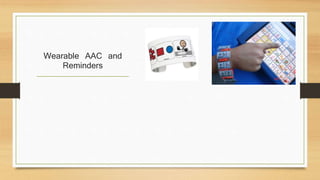
Wearable AAC and
Reminders
The Latest Research
Multiple Modes
• Key to successful
communication
• Light,-Collier,-&-Parnes, 1985
• Blackstone-&-Hunt Berg, 2003
• Light-&-Drager, 2005
• Binger-&-Light, 2006
AAC Does not Impede
Speech
• AAC has no impact or
sometimes (over 80% of
the time) increases natural
speech
• Romski-&-Sevcik,-2005
• Millar,-Light,-and-Schlosser-
2006
The Latest Research
The Best System
• Research supports using a
system with evidence
based implementation, no
one system is “best”
• Mirenda-(2003,-2005)
Not Enough Language
• Most young children using
systems that do not have
enough language for
communication or to even
learn to communicate
• Binger-&-Light,-2006
• Hustad-et-al.,-2005
Directions in Research
Visual Scenes May Be
Helpful
• With younger children (1-3)
using visual scenes that
depict and entire concept
with outlined hotspots can
be helpful, more research
needed
• Fallon,-Light,-&-Achenbach,-
2003
• Light-and-Drager-(2005)-
Finding a symbol is
easier than finding a
page
• Individuals may need help
navigating to the correct
page of their book or
device, using screen shots of
pages may help find the
correct page
• Drager-et-al.,-2003
• Light,- Drager,-McCarthy,-et-al.-
(2004)

Introduction toAAC for AAC Bootcamp ESMA 2014

  • 1.
    Introduction to AAC Kate Ahern,M.S.Ed. AAC Bootcamp Easter Seals MA August 2014
  • 2.
  • 3.
  • 4.
  • 5.
  • 6.
    Why do wecommunicate? • Light, 1988 • Communicate wants/needs • Information transfer • Social closeness • Social etiquette • Beukelman & Mirenda added: • internal dialogue
  • 7.
    Can your userscommunicate for all five?
  • 9.
    The Least Dangerous Assumption •“The criterion holds that without conclusive data educational decisions should be based on assumptions which, if incorrect, will provide the least danger for independent functioning.” Anne Donnellan • Behavioral Disorders, v9 n2 p141-50 Feb 1984
  • 10.
    We see… what weexpect to see.
  • 11.
    Without Educational Data: PresumeCompetence • Situations in which it may be impossible to have evidence • Severe apraxia (Rett Syndrome, some cases of CP, Angelman Syndrome) • Severe physical disabilities • Movement disabilities • Multiple sensory disabilities (Deafblind) • Co-morbid cases of neglect – in the home or educational neglect Cannot physically access communicatio n materials. Presume Competence Dx with condition assumed to cause severe developmental delay Medical condition affect alertness
  • 12.
    Check Your Assumptions •Historical Belief of Severe Developmental Disability is NOT Educational Data • Research into many disabilities is proving that many individuals have been underestimated leading to improper interventions, educational and residential placements (Down Syndrome, Fragile X Syndrome, Rett Syndrome, Angelman Syndrome, Deafblind) • Learners with presumed moderate to severe disabilities are more likely to suffer from educational neglect • Data from children who have not been taught to communicate only indicates a lack of teaching/appropriate intervention not a lack of potential to communicate
  • 13.
    What if AnnieSullivan did not presume competence? What if you don’t?
  • 14.
    Communication Bill of Rights Bythe National Committee for the Communication Needs of People with Severe Disabilities TASH and ASHA
  • 15.
  • 17.
    Multimodal Communication • Facialexpressions • Vocalizations • Body Movements • Eye pointing • Gestures • Verbal Approximations • Speech • Sign Language • Pictures Exchange Communication System (PECS) • Communication Boards/Books • Pragmatic Organization of Dynamic Display (PODD) • High Tech Communication Systems (Tobii, Dynavox, PRC, Saltillo, tablets with apps)
  • 18.
    Making Multi-Modal Communication Meaningful •Honor all communication attempts that are meaningful and understandable – don’t force a user to “say it again” with a device (or sign or their voice) • Use multi-modal communication yourself • If you wish to demonstrate how something could be done in another mode, go ahead!
  • 19.
  • 20.
    Types of AAC Unaided •No tools needed • Sign language • Gestures Aided • Use of tools needed • PECS • Communication Boards/Books • Technology based systems
  • 21.
    Types of AAC Low/LightTech High Tech
  • 22.
    A few wordsabout symbols: 1. Myth of symbol hierarchy is pervasive (object, photo, drawing, words) 2. Use of objects and photos can lead to lack of generalization and overuse of nouns 3. Studies have shown that both iconicity (transparency) and the meaning assigned to a symbol by adults and peers affect learning symbols for communication
  • 23.
    Gestures Enhanced Natural Gestures (ENG) KeywordSign Signed Exact English (SEE) American Sign Language (ASL) 1. Gestures are motions made by a communicator that send a message, may not be universally understood 2. ENG are non-contact motions taught by shaping a communicators natural movements 3. Keyword Sign Language is the practice of using manual signs to communicate important words in a sentence or phrase 4. SEE is a manual form of spoken English where a sign replaces/matches every word 5. ASL is a unique and full language that is communicated using manual signs, it has its own grammar, idioms and culture
  • 24.
    Picture Exchange Communication System (PECS) 1.A system of Augmentative Communication Instruction that begins with a 2:1 staff to client ratio and focuses on teaching mands through intraverbals through a strict ABA methodology 2. PECS is NOT what picture symbols are called and is NOT any notebook/picture trading systems that is in use 3. Clinicians and partners should be trained by Pyramid Consultants 4. Misused the system can be overly reliant on mands/nouns and miss opportunities for social
  • 25.
    Pragmatic Organization of DynamicDisplay (PODD) 1. A system and method of Augmentative and Alternative Communication available in both low and high technology versions 2. Vocabulary is arranged so that user can flow through a conversation 3. Methodology focuses on Aided Language Stimulation and communicate partner training 4. Originated in Australia with Gayle Porter, currently one certified trainer in USA, Linda Burkhart 5. System can appear overwhelming to those not trained, there is a learning
  • 26.
  • 27.
    Flipbooks Generally used inconjunction with a static communication board or device Flipbooks often contain words that allow users to expand sentences and provide more context to their communication than using a single board or page alone.
  • 28.
  • 29.
  • 30.
    Other Tools inthe AAC Toolbox
  • 31.
    Visual Supports Visual supportsare any tool presented visually that supports an individual as he or she moves through the day. Visual supports might include, but are not limited to, pictures, written words, objects within the environment, arrangement of the environment or visual boundaries, schedules, maps, labels, organization systems, timelines, and scripts. They are used across settings to support individuals. (National Research Council, 2001).
  • 32.
    Classroom Natural Aided Language Communication Boards/Systems 1. Usingposters (make at an office store) or decals (CafePress will make them) or just enlarged photocopies you can have a classroom sized communication board for modeling 2. Using a projector or smartboard you can display a communication app or software for use for modeling
  • 33.
  • 34.
    The Latest Research MultipleModes • Key to successful communication • Light,-Collier,-&-Parnes, 1985 • Blackstone-&-Hunt Berg, 2003 • Light-&-Drager, 2005 • Binger-&-Light, 2006 AAC Does not Impede Speech • AAC has no impact or sometimes (over 80% of the time) increases natural speech • Romski-&-Sevcik,-2005 • Millar,-Light,-and-Schlosser- 2006
  • 35.
    The Latest Research TheBest System • Research supports using a system with evidence based implementation, no one system is “best” • Mirenda-(2003,-2005) Not Enough Language • Most young children using systems that do not have enough language for communication or to even learn to communicate • Binger-&-Light,-2006 • Hustad-et-al.,-2005
  • 36.
    Directions in Research VisualScenes May Be Helpful • With younger children (1-3) using visual scenes that depict and entire concept with outlined hotspots can be helpful, more research needed • Fallon,-Light,-&-Achenbach,- 2003 • Light-and-Drager-(2005)- Finding a symbol is easier than finding a page • Individuals may need help navigating to the correct page of their book or device, using screen shots of pages may help find the correct page • Drager-et-al.,-2003 • Light,- Drager,-McCarthy,-et-al.- (2004)